There is a generalization here that is worth considering:
While public markets can be fickle, they can also be exuberant. Being public allows the smart capital allocator to generate a warchest balance sheet during heady times and deploy it during contractions. It’s possible to employ the same tactic as a private company but it is much harder.
The value of being public is access to capital. Simply put. And it turns out capital, when you have a lot of it, solves many problems:
1) employee comp - pay more
2) product - buy defensively
3) R&D - buy proactively
4) competition - subsidize to grow
5) growth - consolidate markets
At the limit, as a tech company, you are always one turn of innovation away from irrelevance. Your cash flows. As a result, are fragile. So being private underprices those cash flows in periods of exuberance and overprices them in periods of meandering or decline.
It’s a hard trade to make work over a long time horizon.
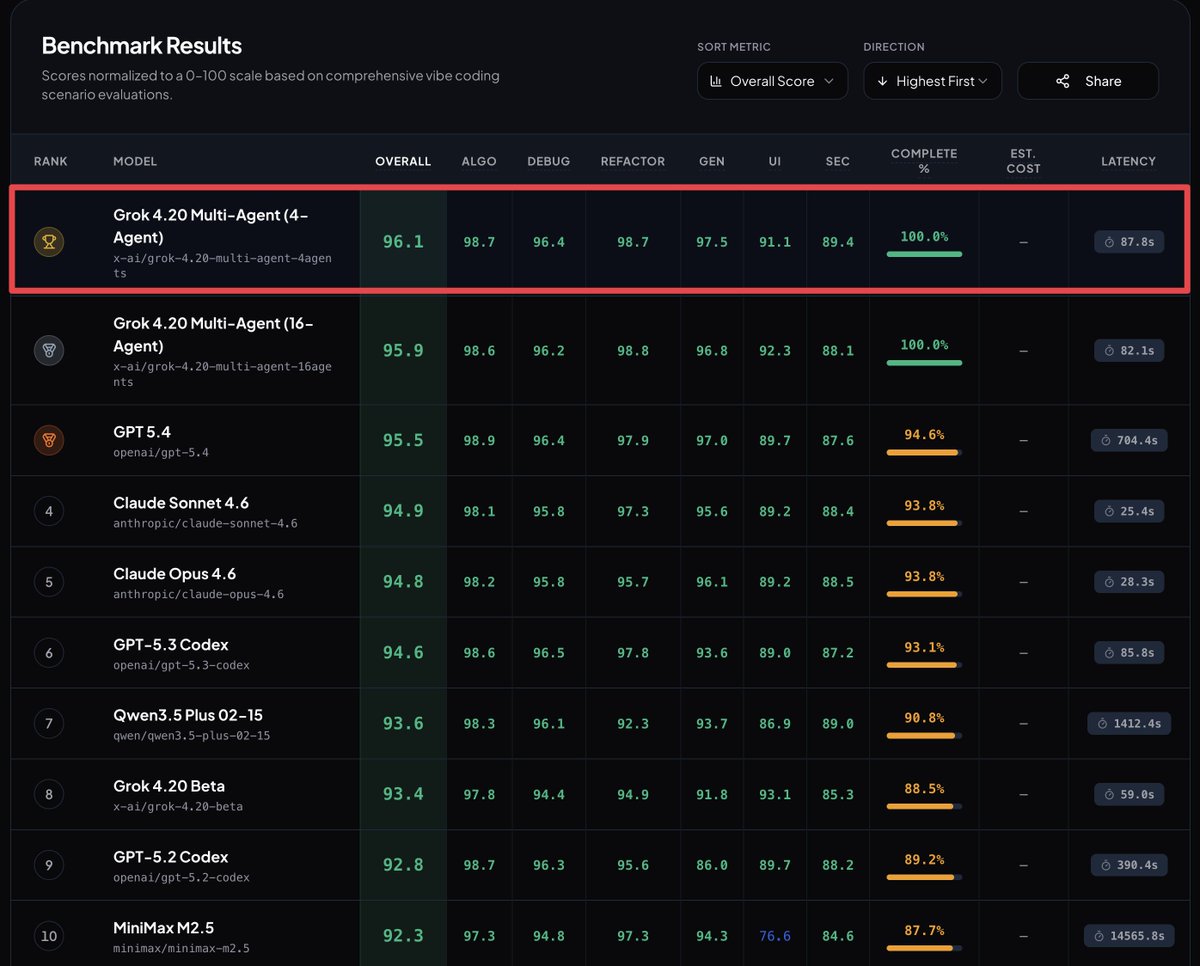
Grok 4.20 Multi-Agent just took #1 on BridgeBench.
96.1 overall. 100% completion rate. 87.8s latency.
Beat GPT 5.4, Claude Sonnet 4.6, and Claude Opus 4.6.
xAI came out of nowhere.
The multi-agent future is here. And Grok is leading it.
@elonmusk We also need to start mining helium 3 from the moon before China cracks nuclear fusion. Just sayin Dude . Also good refeuling base for Starship orbital transfer.
@elonmusk Hey Elon, imagine Robotaxis using real-world cameras linked to satellite dishes using a secure cloud service like CoreWeave on street corners, feeding secure cloud space via Starlink’s bandwidth. Add CoreWeave tech at Tesla chargers nationwide for a safer, scalable hive mind.