Statistics / social science folks:
When authors of an observational study claim they "controlled for" various confounding factors, how much should I trust that they actually successfully did?
Never? Only sometimes? (If so, when? Do you have heuristics you use?)
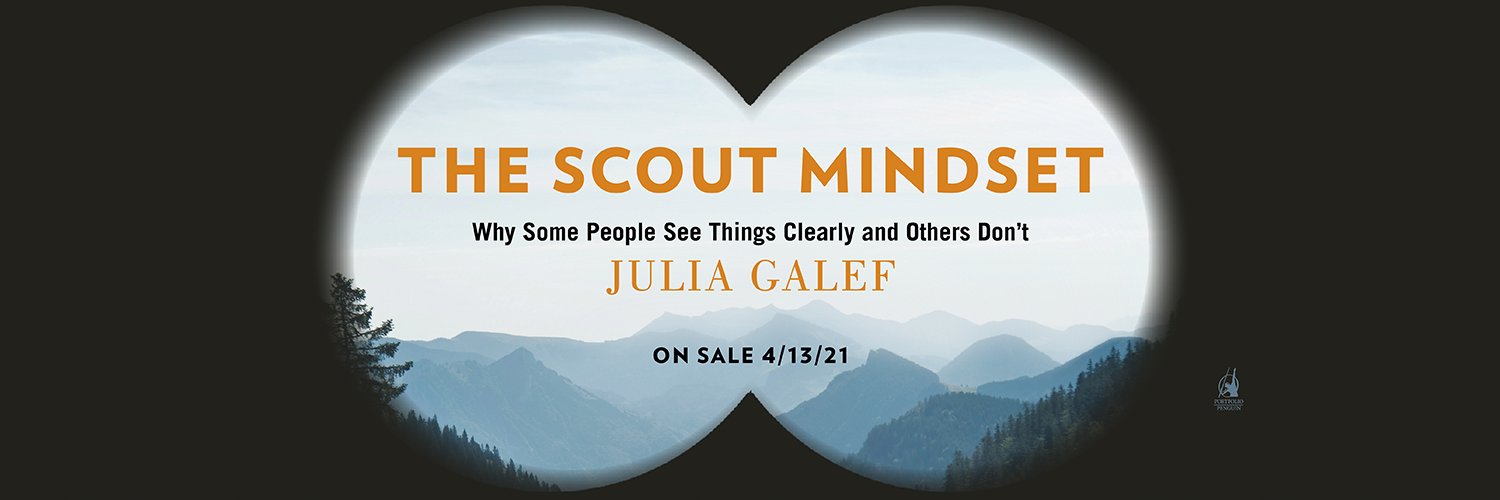
Five Lessons from @juliagalef 's ‘The Scout Mindset." (Julia was a guest on the most recent episode of my BBC podcast series "Think with Pinker" https://t.co/hzLh55KbAR) https://t.co/RZTMKKkR7a
Yes, the media & scientific establishment often misrepresent things
But "...therefore we can't trust ANYTHING they say" is the wrong conclusion
So what's the right conclusion?
It's tricky, but @slatestarcodex has a characteristically great take: https://t.co/8LCkKiPTET
@gmiller@coldxman I'm definitely more sympathetic to his view than that. But regardless, what I wanted to praise was the *policy* of thinking about the specifics of individual cases, not the outcome of that policy here
People tend to have a simple rule (e.g. "cancel culture = bad," or "race in hiring = bad") and get reflexively angry at anything that pattern-matches to that
So I really appreciate the rare people who reflect on the specifics of each case to decide if it's actually bad 👇
@alexandrosM@AdamCatalyst@stuartbuck1@slatestarcodex I haven't watched that video, but I know that she was recently saying ivermectin "prevents deaths by 80%"
I assumed that stat must include the (now known to be) fraudulent studies. But are you saying she still thinks the effectiveness is 80% even without those studies?
@alexandrosM@slatestarcodex I don't understand that comment (maybe I'm missing some context)?
I was just asking if her estimate of ivermectin's effectiveness (and how confident she is in that estimate) has changed after excluding the studies we now know are fraudulent
I'm not talking about publishing
@alexandrosM@slatestarcodex I haven't listened to that podcast, but it seems weird that someone's analysis would not change much when you remove the fraudulent studies, since those were the ones showing a huge effect
@alexandrosM@slatestarcodex I'm surprised, I thought you would agree with #3
That the experts who ought to be good at evaluating evidence don't think ivermectin works -- don't you agree with that?
(you just think those "experts" are mistaken / misleading us)
@curiouswavefn What are the differences of degree in, though? Is it about the predictive power of genes on educational attainment? @kph3k estimated that to be about 17%... you're suggesting critics disagree because they think it's significantly lower than 17%?
I had an interesting disagreement yesterday that seemed to come down to what counts as "genetic determinism" (click through for thread)
I'm still confused though... (cont.)
@ras_nielsen@Graham_Coop @molly_przew @kph3k i.e., are you saying that only *neurological* explanations (for the relationship between genes and EA ) constitute genetic determinism?
Maybe that's the piece of your model I was missing