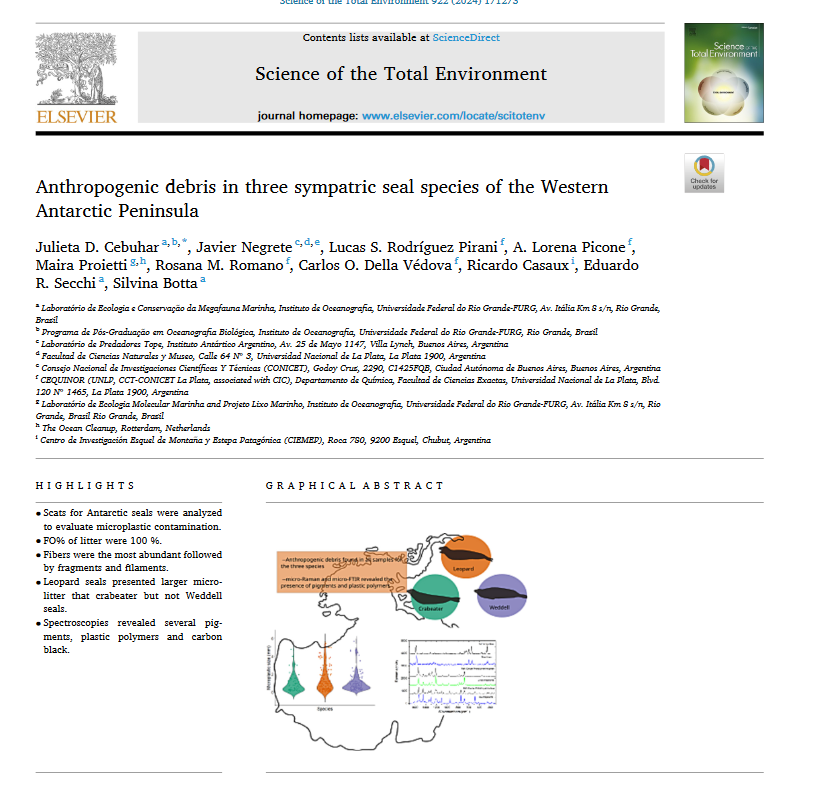
The first paper of my PhD is finally published at SOTEN!! Here we assess the anthropogenic debris contamination in three Antarctic seal species 🦭
@ResearchGate: https://t.co/rIdf6MrTnM
Un mapeo de las bases antárticas para detectar y biorremediar hidrocarburos en el suelo
✍ Ornella Rapallini, corresponsalía itinerante Sector Antártico Argentino
https://t.co/O4jTcHBaWV
Happy 4th #PolarPrideDay! We're thrilled to see fun reports from around the world about how you're showing your #PolarPride! PiPR is shifting to offer more public vs behind-the-scenes advocacy. Stay tuned for details when our US-based social media team wakes up! #PolarPride2023
Here’s a recipe for a cheap but effective DNA and RNA preservative solution for preserving animal tissues, their associated microbiomes, and possibly other tissue and DNA sources as well.
The solution is known as “Nucleic Acid Preservation” or NAP buffer, and is more fully described in the article below:
Camacho‐Sanchez, M., Burraco, P., Gomez‐Mestre, I., & Leonard, J. A. (2013). Preservation of RNA and DNA from mammal samples under field conditions. Molecular ecology resources, 13(4), 663-673.
Link: https://t.co/CrlP8W0mzC
NAP buffer contains 7.44 g of EDTA, 7.35 g of sodium citrate tri-sodium salt dihydrate, and 700 g of ammonium sulphate in 1 L of water, adjusted to pH 5.2 using sulphuric acid.
The authors reported that samples stored in NAP at ambient temperatures contained high-quality DNA for up to 10 months, and tissue DNA concentrations were significantly higher in NAP than in tissues stored in 95% ethanol or cryopreserved.
RNA losses were higher but there was no significant difference between NAP and a commercial RNA preservation solution (RNALater), which possibly has a very similar chemical composition.
The solution appears to be relatively rarely cited compared to commercial alternatives, but it has been used for quite a few diverse applications:
Menke et al. (2017) used it for sheep dung microbiome studies and found NAP gave better preservation results than commercially available alternatives: https://t.co/mMHRbgfcPY
Huaman et al. (2021) used it for preserving lung, trachea, and spleen samples of deer for testing of Picobirnavirus during sampling at field sites before the return home:
https://t.co/p5PgIJM7Ez
Segura-Wang et al. (2021) used it for metagenomic studies of chicken gut microbiomes:
https://t.co/s6V7VqXarg
Hofmann et al. (2023) used it for swabs of biofilms from tree bark surfaces:
https://t.co/4qvM0isNDk
Ward et al. (2023) compared FTA cards, chlorhexidine digluconate solution, cold packs, and NAP for preserving equine faecal microbiota over time, and they found that only “NAP buffer inhibited the significant changes in microbial abundance that occurred by 72 h of room temperature storage.”
https://t.co/AXRTY6wgZm
The chemicals needed to make NAP buffer are inexpensive, safe, and widely available, except for the sulphuric acid for pH adjustment. And it seems quite simple to make if you have the chemicals, a pH meter, and some sulphuric acid to adjust the pH.
So, if you need a cheap DNA and RNA preservative solution, then maybe this is one to try out!
A new PhD started today. She asked for general advice for the first few months. This was my advice:
1. Don’t work evenings or weekends
2. Don’t aim to prove yourself (to me), I’m already convinced of your capacities
3. Go for a walk when things dazzle you (1/3)
Did you miss out on our summer #bioinformatics workshops? Good news - lectures are now available on our Youtube channel, with all our course materials on https://t.co/yhHzCuyqmz . Keep reading for a listing of everything we've recently published (for free!)... 🧵#OpenScience