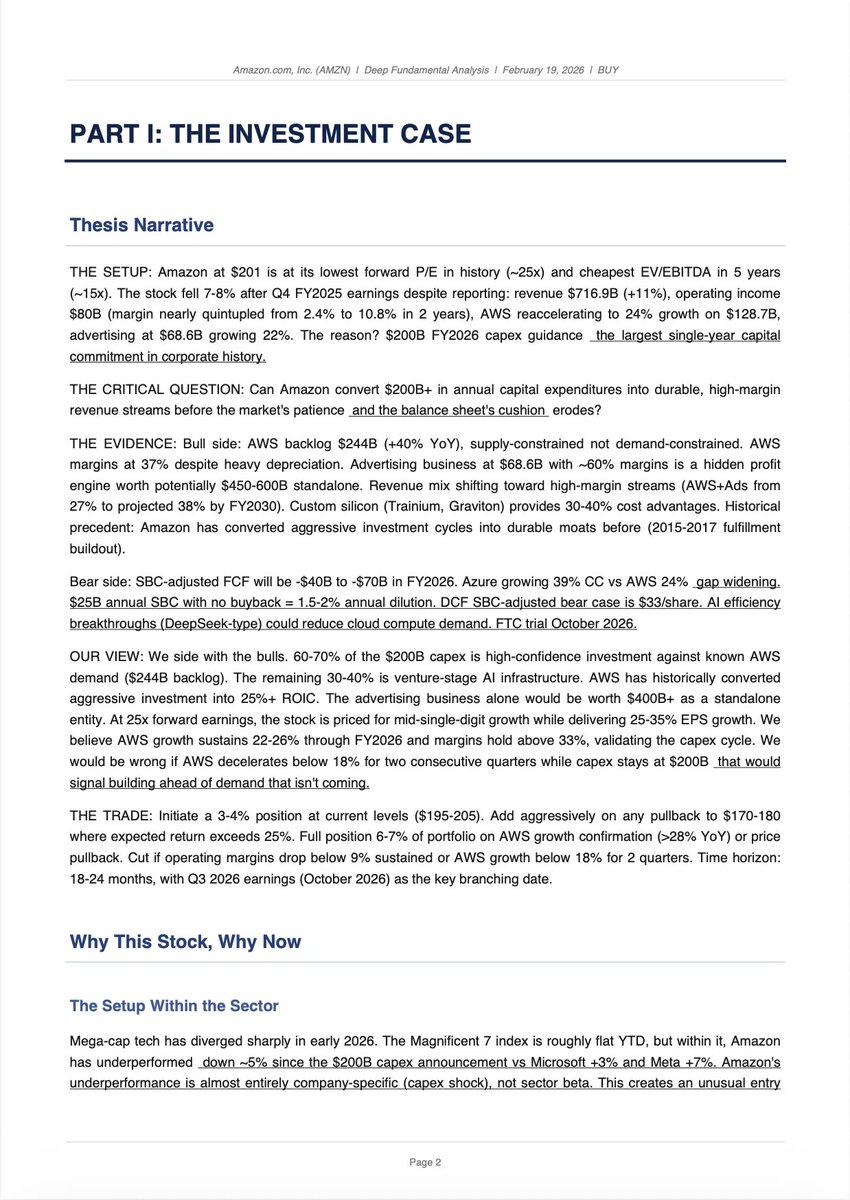
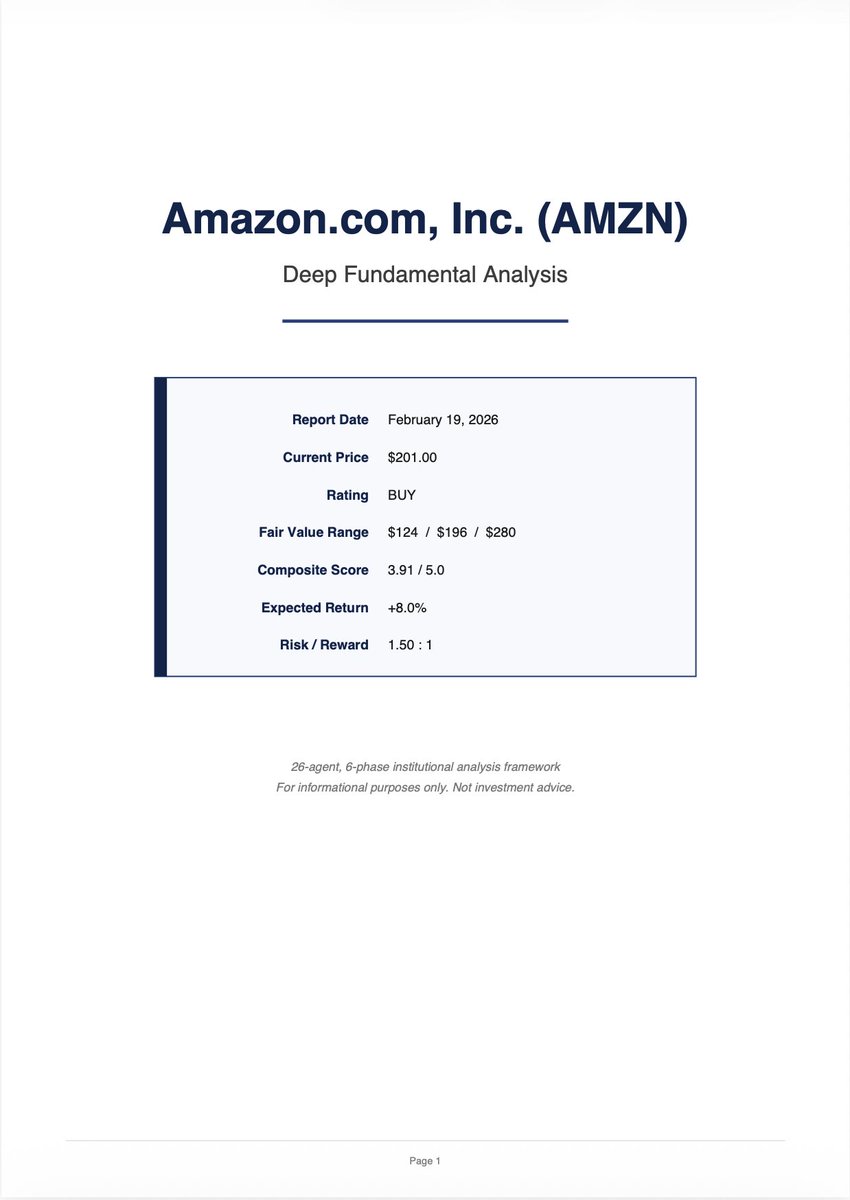
This is one of my most ambitious investment projects, and honestly, it's still very early.
I built a system where 26 AI agents work together across 6 phases to produce deep equity research. The kind of analysis that takes a team of analysts weeks, condensed into an hour. And with models getting better every few months, this is only going to scale from here.
Here's how it works.
Phase 1: Four agents go out in parallel to collect data.
> SEC filings, earnings call transcripts, market data, insider transactions, and competitive intelligence.
> They cross-reference across sources; nothing gets taken at face value.
> Each agent produces a full, detailed output and a compressed briefing that gets passed forward.
Phase 2: Six agents break down the financials.
> Revenue quality and growth trajectory with deceleration tracking.
> GAAP vs non-GAAP margin reconciliation.
> Balance sheet liquidity with dilution trajectory mapped against revenue growth.
> Operating and free cash flow with SBC-adjusted FCF.
> Historical beat/miss patterns on guidance.
> Each dimension scored 1-5 with a weighted composite, and the key financial tension was identified.
Phase 3: Four agents handle the strategic layer.
> Competitive moats scored 0-3 across five dimensions: network effects, switching costs, cost advantages, intangible assets, and efficient scale.
> Each one gets an AI-disruption overlay. Does AI strengthen or weaken this specific moat source?
> Management is evaluated on the founder-led vs. professional track record, capital-allocation track record, insider alignment based on actual transaction data, and governance structure.
> Industry analysis includes TAM sizing, adoption curve positioning, and an AI disruption taxonomy (additive vs. substitutive vs. deflationary, with specific evidence).
> Sector vulnerability decomposes the stock's movement into sector-wide and company-specific components.
Phase 4: Five agents build the forward-looking picture.
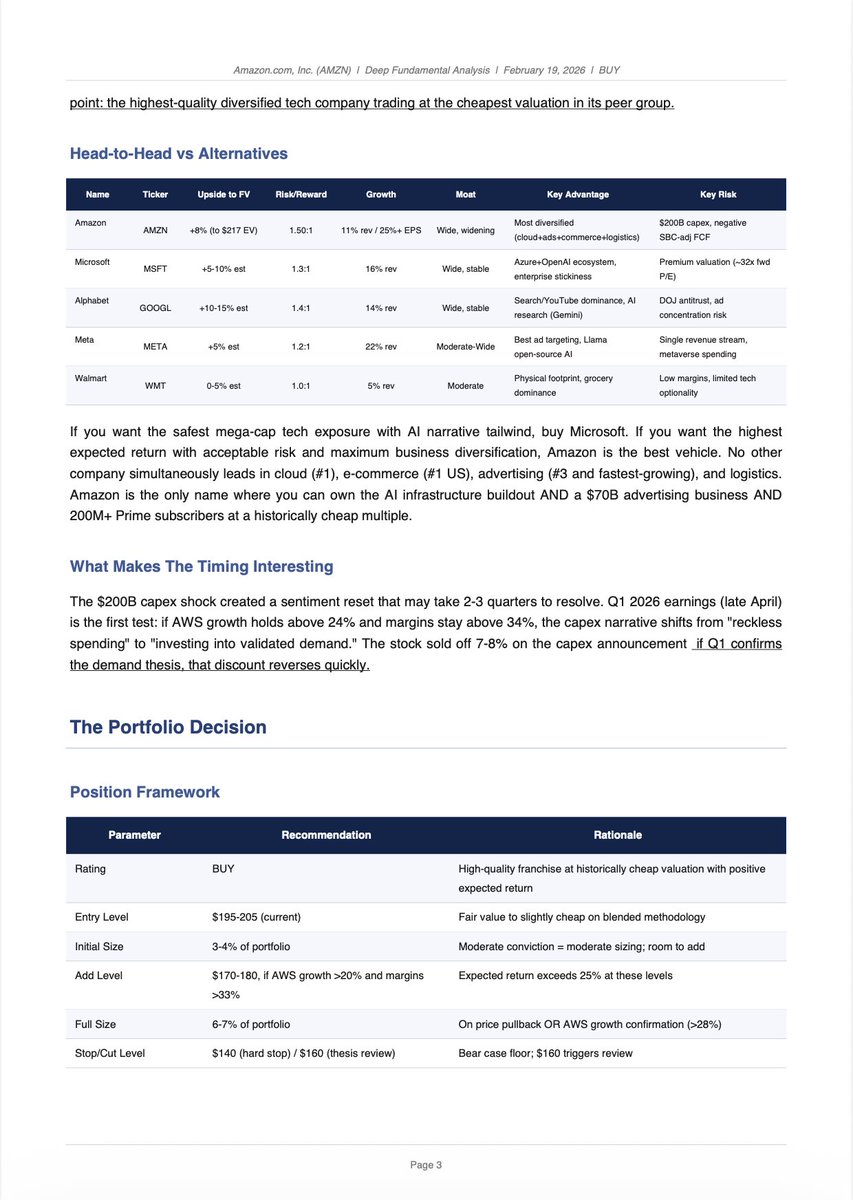
> Head-to-head peer ranking across 4-6 alternatives on upside potential, risk/reward, growth durability, and moat strength.
> Revenue evolution modeled by a stream, with per-stream gross margins and blended valuation-multiple implications.
> Competitive threat scorecards with actual data cards per competitor: users, revenue, funding, growth signal, enterprise presence, classified as share taker vs TAM expander vs disruptive substitute.
> Quarterly scenario progressions through 2027 for bull, base, and bear, with branching metrics identified.
> And a thesis narrative that opens with the critical question the market is debating and takes a side.
Phase 5: Four agents on risk and valuation.
> Top 7 risks ranked by probability times impact with timeframes.
> Three-scenario DCF with Year 5 revenue, FCF margin, WACC, terminal growth, and sensitivity matrix.
> 5-8 peer comparable company analysis with growth-adjusted multiples.
> Valuation convergence blending DCF at 40%, comps at 30%, historical at 10%, and revenue evolution at 20% into a probability-weighted expected value.
Phase 6: Three agents synthesize everything the other 23 produced into a final report structured in five parts.
> Investment case with thesis narrative. Investment debate with bull/bear arguments, each carrying confirmation and invalidation triggers.
> The numbers with every section ending in "what this means for the thesis." Supporting evidence with competitive data cards and a catalyst calendar.
> And a verdict with entry levels, sizing framework, add/cut triggers at specific metric thresholds, and a time horizon.
The architecture handles context window limits by having each phase produce compressed briefings (600-800 words) that get passed to the next phase. Full outputs stay available if an agent needs to dig deeper. Parallel execution within each phase, sequential across phases. File-based handoffs between every stage.
One important caveat: ignore the specific buy/sell recommendations and price targets in this version. The valuation models need more work. But what this system already does really well is give you a deep, structured understanding of the business. All the qualitative and quantitative aspects you need to actually make your own informed decision. The moat understanding, competitive dynamics, revenue quality breakdown, risk matrix, scenario mapping. That's the real value right now.
Built it for US stocks first. India is next (to be added soon with data pipelines API help).
Ran the first full test on Amazon. Still a lot to improve, but even at this stage, the depth of understanding it produces is genuinely useful.
Link to the full report and all 6 phase outputs in the next tweet 🧵
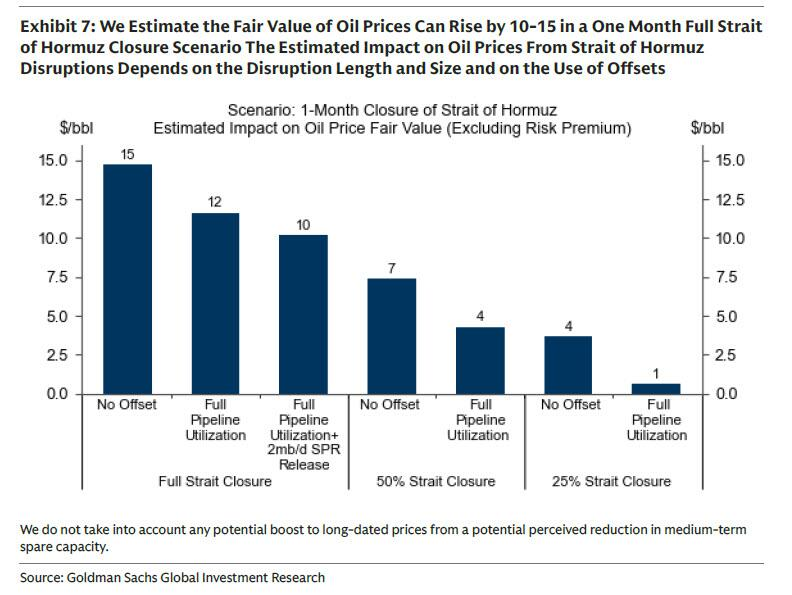
Goldman estimates the following effects on the fair value of oil prices in scenarios for one-month disruptions to oil flows through the Strait:
+$15 for a full one-month closure if there are no offsets (e.g. utilization of spare pipeline capacity, SPR release)
+$12 for a full one-month closure if all estimated 4mb/d spare pipeline capacity is used
+$10 for a full one-month closure if all estimated spare pipeline capacity is used and global SPRs are released for one month at a 2mb/d pace
+$4 for a partial 50% one-month closure if all estimated spare pipeline capacity is used
+$1 for a partial 25% one-month closure if all estimated spare pipeline capacity is used
I spent 100 hours over the past week researching, writing and editing the piece we just put out.
It’s a scenario, not a prediction like most of our work. But it was rigorously constructed, dismissing it outright requires the kind of intellectual laziness that tends to get expensive.
And we’ve released it for free. Hopefully you enjoy it.
https://t.co/YK8E11GcDU
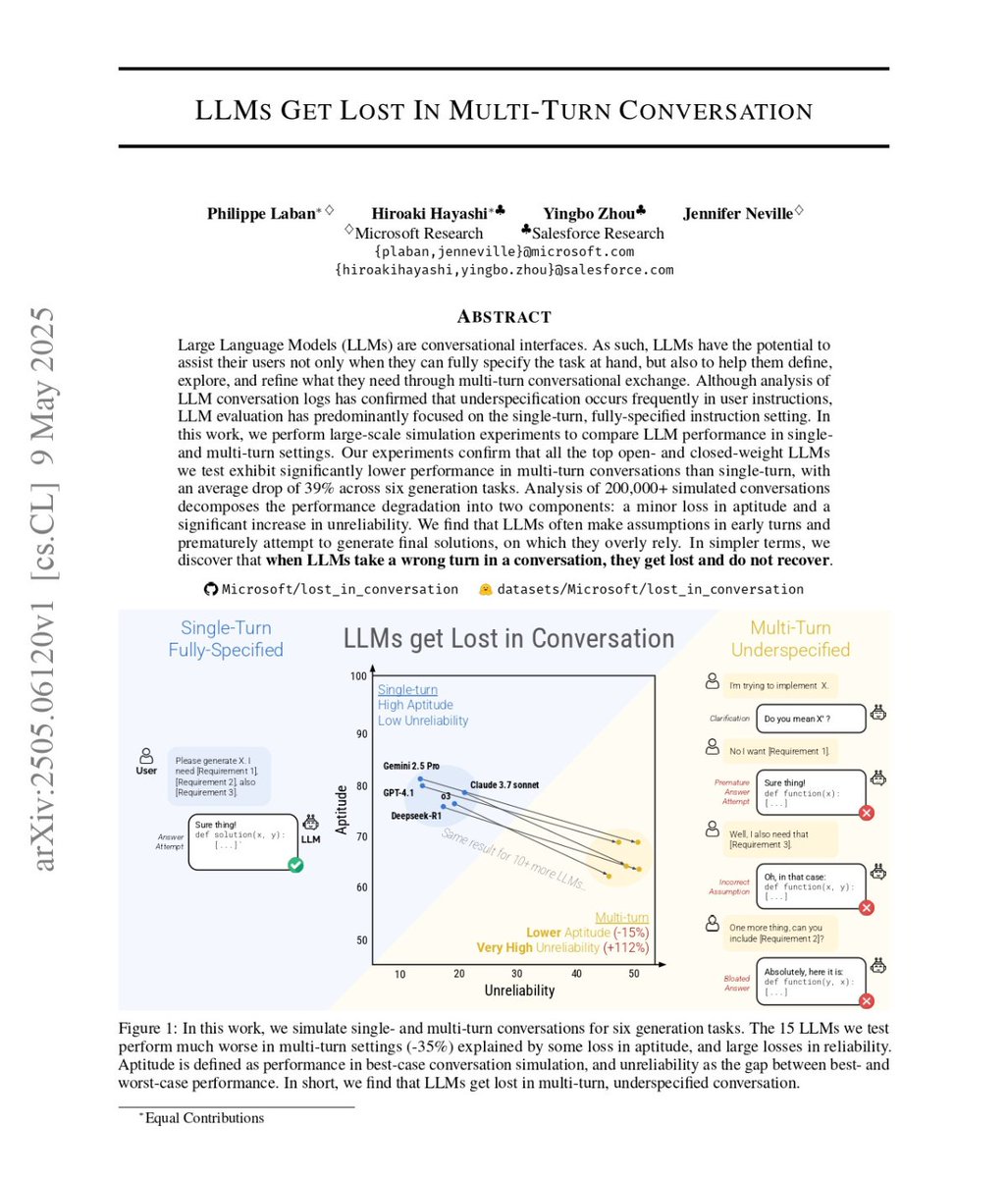
🚨BREAKING: Microsoft Research + Salesforce just dropped a paper that should scare every AI builder.
They tested 15 top LLMs GPT-4.1, Gemini 2.5 Pro, Claude 3.7 Sonnet, o3, DeepSeek R1, Llama 4 across 200,000+ simulated conversations.
Single-turn prompt: 90% performance.
Multi-turn conversation: 65% performance.
Same model. Same task. Just... talking normally.
The culprit isn't intelligence. Aptitude only dropped 15%.
Unreliability EXPLODED by 112%.
→ LLMs answer before you finish explaining (wrong assumptions get baked in permanently)
→ They fall in love with their first wrong answer and build on it
→ They forget the middle of your conversation entirely
→ Longer responses introduce more assumptions = more errors
Even reasoning models failed. o3 and DeepSeek R1 performed just as badly.
Extra thinking tokens did nothing.
Setting temperature to 0? Still broken.
The fix right now: give your AI everything upfront in one message instead of back-and-forth.
Every benchmark you've seen was tested on single-turn prompts in perfect lab conditions.
Real conversations break every model on the market and nobody's talking about it.
BREAKING 🚨 TESLA HAS PATENTED A "MATHEMATICAL CHEAT CODE" THAT FORCES CHEAP 8-BIT CHIPS TO RUN ELITE 32-BIT AI MODELS AND REWRITES THE RULES OF SILICON 🐳
How does a Tesla remember a stop sign it hasn’t seen for 30 seconds, or a humanoid robot maintain perfect balance while carrying a heavy, shifting box?
It comes down to Rotary Positional Encoding (RoPE)—the "GPS of the mind" that allows AI to understand its place in space and time by assigning a unique rotational angle to every piece of data.
Usually, this math is a hardware killer. To keep these angles from "drifting" into chaos, you need power-hungry, high-heat 32-bit processors (chips that calculate with extreme decimal-point precision).
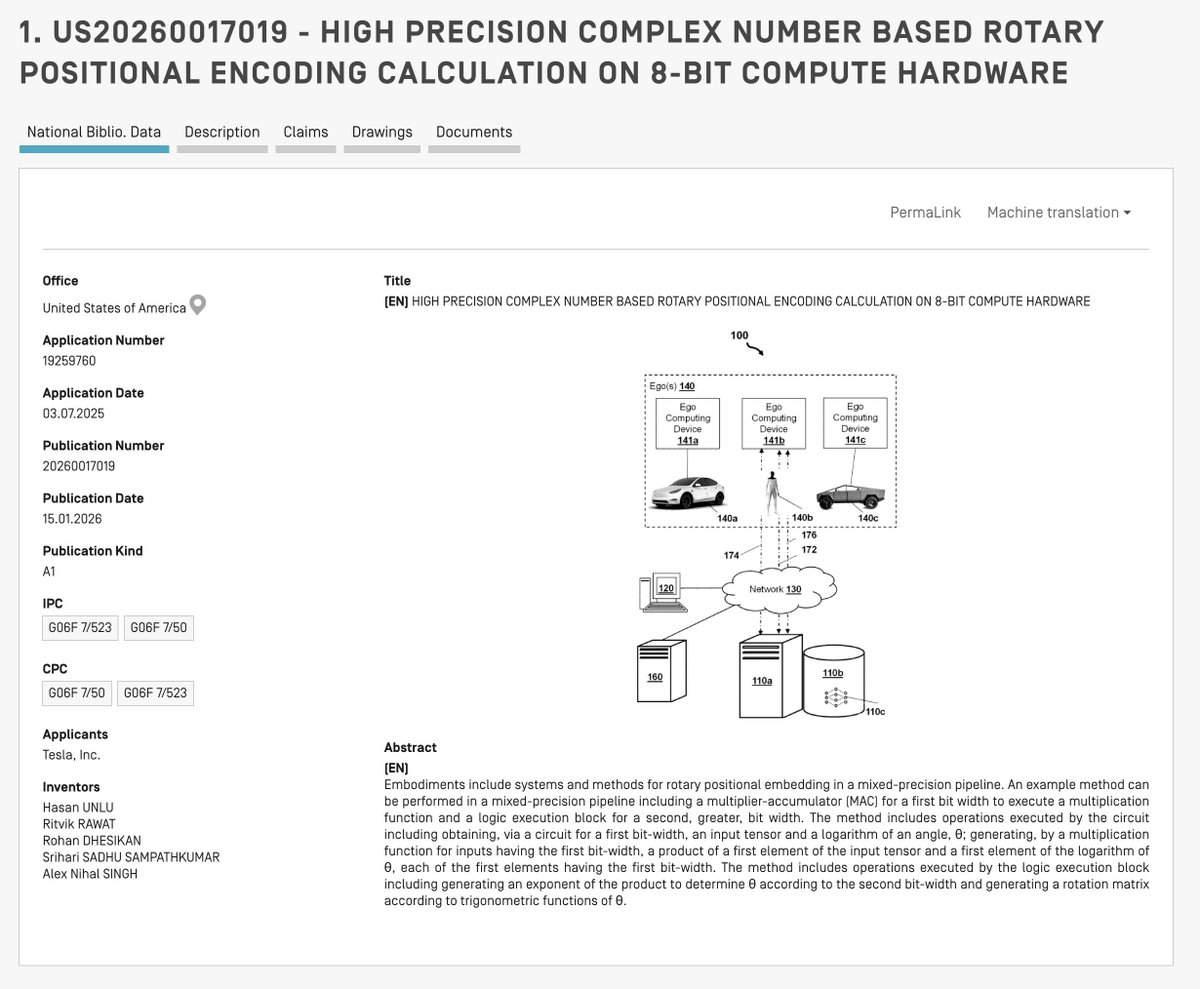
But Tesla has engineered a way to cheat the laws of physics. Freshly revealed in patent US20260017019A1, Tesla’s "MIXED-PRECISION BRIDGE" is a mathematical translator that allows inexpensive, power-sipping 8-bit hardware (which usually handles only simple, rounded numbers) to perform elite 32-bit rotations without dropping a single coordinate.
This breakthrough is the secret "Silicon Bridge" that gives Optimus and FSD high-end intelligence without sacrificing a mile of range or melting their internal circuits. It effectively turns Tesla’s efficient "budget" hardware into a high-fidelity supercomputer on wheels.
📉 The problem: the high cost of precision
In the world of self-driving cars and humanoid robots, we are constantly fighting a war between precision and power. Modern AI models like Transformers rely on RoPE to help the AI understand where objects are in a sequence or a 3D space.
The catch is that these trigonometric functions (sines and cosines) usually require 32-bit floating-point math—imagine trying to calculate a flight path using 10 decimal places of accuracy.
If you try to cram that into the standard 8-bit multipliers (INT8) used for speed (which is like rounding everything to the nearest whole number), the errors pile up fast. The car effectively goes blind to fine details.
For a robot like Optimus, a tiny math error means losing its balance or miscalculating the distance to a fragile object. To bridge this gap without simply adding more expensive chips, Tesla had to fundamentally rethink how data travels through the silicon.
🛠️ Tesla's solution: the logarithmic shortcut & pre-computation
Tesla’s engineers realized they didn't need to force the whole pipeline to be high-precision. Instead, they designed the Mixed-Precision Bridge.
They take the crucial angles used for positioning and convert them into logarithms. Because the "dynamic range" of a logarithm is much smaller than the original number, it’s much easier to move that data through narrow 8-bit hardware without losing the "soul" of the information.
It’s a bit like dehydrating food for transport; it takes up less space and is easier to handle, but you can perfectly reconstitute it later.
Crucially, the patent reveals that the system doesn't calculate these logarithms on the fly every time. Instead, it retrieves pre-computed logarithmic values from a specialized "cheat sheet" (look-up storage) to save cycles.
By keeping the data in this "dehydrated" log-state, Tesla ensures that the precision doesn't "leak out" during the journey from the memory chips to the actual compute cores. However, keeping data in a log-state is only half the battle; the chip eventually needs to understand the real numbers again.
🏗️ The recovery architecture: rotation matrices & Horner’s method
When the 8-bit multiplier (the Multiplier-Accumulator or MAC) finishes its job, the data is still in a "dehydrated" logarithmic state. To bring it back to a real angle theta without a massive computational cost, Tesla’s high-precision ALU uses a Taylor-series expansion optimized via Horner’s Method.
This is a classic computer science trick where a complex equation (like an exponent) is broken down into a simple chain of multiplications and additions.
By running this in three specific stages—multiplying by constants like 1/3 and 1/2 at each step—Tesla can approximate the exact value of an angle with 32-bit accuracy while using a fraction of the clock cycles.
Once the angle is recovered, the high-precision logic generates a Rotation Matrix (a grid of sine and cosine values) that locks the data points into their correct 3D coordinates.
This computational efficiency is impressive, but Tesla didn't stop at just calculating faster; they also found a way to double the "highway speed" of the data itself.
🧩 The data concatenation: 8-bit inputs to 16-bit outputs
One of the most clever hardware "hacks" detailed in the patent is how Tesla manages to move 16-bit precision through an 8-bit bus. They use the MAC as a high-speed interleaver—effectively a "traffic cop" that merges two lanes of data.
It takes two 8-bit values (say, an X-coordinate and the first half of a logarithm) and multiplies one of them by a power of two to "left-shift" it.
This effectively glues them together into a single 16-bit word in the output register, allowing the low-precision domain to act as a high-speed packer for the high-precision ALU to "unpack".
This trick effectively doubles the bandwidth of the existing wiring on the chip without requiring a physical hardware redesign. With this high-speed data highway in place, the system can finally tackle one of the biggest challenges in autonomous AI: object permanence.
🧠 Long-context memory: remembering the stop sign
The ultimate goal of this high-precision math is to solve the "forgetting" problem. In previous versions of FSD, a car might see a stop sign, but if a truck blocked its view for 5 seconds, it might "forget" the sign existed.
Tesla uses a "long-context" window, allowing the AI to look back at data from 30 seconds ago or more.
However, as the "distance" in time increases, standard positional math usually drifts. Tesla's mixed-precision pipeline fixes this by maintaining high positional resolution, ensuring the AI knows exactly where that occluded stop sign is even after a long period of movement.
The RoPE rotations are so precise that the sign stays "pinned" to its 3D coordinate in the car's mental map. But remembering 30 seconds of high-fidelity video creates a massive storage bottleneck.
⚡ KV-cache optimization & paged attention: scaling memory
To make these 30-second memories usable in real-time without running out of RAM, Tesla optimizes the KV-cache (Key-Value Cache)—the AI's "working memory" scratchpad.
Tesla’s hardware handles this by storing the logarithm of the positions directly in the cache. This reduces the memory footprint by 50% or more, allowing Tesla to store twice as much "history" (up to 128k tokens) in the same amount of RAM.
Furthermore, Tesla utilizes Paged Attention—a trick borrowed from operating systems. Instead of reserving one massive, continuous block of memory (which is inefficient), it breaks memory into small "pages".
This allows the AI5 chip to dynamically allocate space only where it's needed, drastically increasing the number of objects (pedestrians, cars, signs) the car can track simultaneously without the system lagging.
Yet, even with infinite storage efficiency, the AI's attention mechanism has a flaw: it tends to crash when pushed beyond its training limits.
🔒 Pipeline integrity: the "read-only" safety lock
A subtle but critical detail in the patent is how Tesla protects this data. Once the transformed coordinates are generated, they are stored in a specific location that is read-accessible to downstream components but not write-accessible by them.
Furthermore, the high-precision ALU itself cannot read back from this location.
This one-way "airlock" prevents the system from accidentally overwriting its own past memories or creating feedback loops that could cause the AI to hallucinate. It ensures that the "truth" of the car's position flows in only one direction: forward, toward the decision-making engine.
🌀 Attention sinks: preventing memory overflow
Even with a lean KV-cache, a robot operating for hours can't remember everything forever. Tesla manages this using Attention Sink tokens.
Transformers tend to dump "excess" attention math onto the very first tokens of a sequence, so if Tesla simply used a "sliding window" that deleted old memories, the AI would lose these "sink" tokens and its brain would effectively crash.
Tesla's hardware is designed to "pin" these attention sinks permanently in the KV-cache. By keeping these mathematical anchors stable while the rest of the memory window slides forward, Tesla prevents the robot’s neural network from destabilizing during long, multi-hour work shifts.
While attention sinks stabilize the "memory", the "compute" side has its own inefficiencies—specifically, wasting power on empty space.
🌫️ Sparse tensors: cutting the compute fat
Tesla’s custom silicon doesn't just cheat with precision; it cheats with volume. In the real world, most of what a car or robot sees is "empty" space (like clear sky).
In AI math, these are represented as "zeros" in a Sparse Tensor (a data structure that ignores empty space). Standard chips waste power multiplying all those zeros, but Tesla’s newest architecture incorporates Native Sparse Acceleration.
The hardware uses a "coordinate-based" system where it only stores the non-zero values and their specific locations. The chip can then skip the "dead space" entirely and focus only on the data that matters—the actual cars and obstacles.
This hardware-level sparsity support effectively doubles the throughput of the AI5 chip while significantly lowering the energy consumed per operation.
🔊 The audio edge: Log-Sum-Exp for sirens
Tesla’s "Silicon Bridge" isn't just for vision—it's also why your Tesla is becoming a world-class listener. To navigate safely, an autonomous vehicle needs to identify emergency sirens and the sound of nearby collisions using a Log-Mel Spectrogram approach (a visual "heat map" of sound frequencies).
The patent details a specific Log-Sum-Exp (LSE) approximation technique to handle this. By staying in the logarithm domain, the system can handle the massive "dynamic range" of sound—from a faint hum to a piercing fire truck—using only 8-bit hardware without "clipping" the loud sounds or losing the quiet ones.
This allows the car to "hear" and categorize environmental sounds with 32-bit clarity. Of course, all this high-tech hardware is only as good as the brain that runs on it, which is why Tesla's training process is just as specialized.
🎓 Quantization-aware training: pre-adapting the brain
Finally, to make sure this "Mixed-Precision Bridge" works flawlessly, Tesla uses Quantization-Aware Training (QAT).
Instead of training the AI in a perfect 32-bit world and then "shrinking" it later—which typically causes the AI to become "drunk" and inaccurate—Tesla trains the model from day one to expect 8-bit limitations.
They simulate the rounding errors and "noise" of the hardware during the training phase, creating a neural network that is "pre-hardened". It’s like a pilot training in a flight simulator that perfectly mimics a storm; when they actually hit the real weather in the real world, the AI doesn’t "drift" or become inaccurate because it was born in that environment.
This extreme optimization opens the door to running Tesla's AI on devices far smaller than a car.
🚀 The strategic roadmap: from AI5 to ubiquitous edge AI
This patent is not just a "nice-to-have" optimization; it is the mathematical prerequisite for Tesla’s entire hardware roadmap. Without this "Mixed-Precision Bridge", the thermal and power equations for next-generation autonomy simply do not work.
It starts by unlocking the AI5 chip, which is projected to be 40x more powerful than current hardware. Raw power is useless if memory bandwidth acts as a bottleneck.
By compressing 32-bit rotational data into dense, log-space 8-bit packets, this patent effectively quadruples the effective bandwidth, allowing the chip to utilize its massive matrix-compute arrays without stalling.
This efficiency is critical for the chip's "half-reticle" design, which reduces silicon size to maximize manufacturing yield while maintaining supercomputer-level throughput.
This efficiency is even more critical for Tesla Optimus, where it is a matter of operational survival. The robot runs on a 2.3 kWh battery (roughly 1/30th of a Model 3 pack).
Standard 32-bit GPU compute would drain this capacity in under 4 hours, consuming 500W+ just for "thinking".
By offloading complex RoPE math to this hybrid logic, Tesla slashes the compute power budget to under 100W. This solves the "thermal wall", ensuring the robot can maintain balance and awareness for a full 8-hour work shift without overheating.
This stability directly enables the shift to End-to-End Neural Networks. The "Rotation Matrix" correction described in the patent prevents the mathematical "drift" that usually plagues long-context tracking.
This ensures that a stop sign seen 30 seconds ago remains "pinned" to its correct 3D coordinate in the World Model, rather than floating away due to rounding errors.
Finally, baking this math into the silicon secures Tesla's strategic independence. It decouples the company from NVIDIA’s CUDA ecosystem and enables a Dual-Foundry Strategy with both Samsung and TSMC to mitigate supply chain risks.
This creates a deliberate "oversupply" of compute, potentially turning its idle fleet and unsold chips into a distributed inference cloud that rivals AWS in efficiency.
But the roadmap goes further. Because this mixed-precision architecture slashes power consumption by orders of magnitude, it creates a blueprint for "Tesla AI on everything".
It opens the door to porting world-class vision models to hardware as small as a smart home hub or smartphone. This would allow tiny, cool-running chips to calculate 3D spatial positioning with zero latency—bringing supercomputer-level intelligence to the edge without ever sending private data to a massive cloud server.