@AhlqvistViktor@JAMA_current Are the sibling HR results derived entirely from the "Discordant/Discordant" row in eTable 4 — 16,267 (autism), 31,156 (ADHD), 6,942 (ID), the siblings who differ in both exposure and outcome — or does something else in the table also factor into the final estimates?
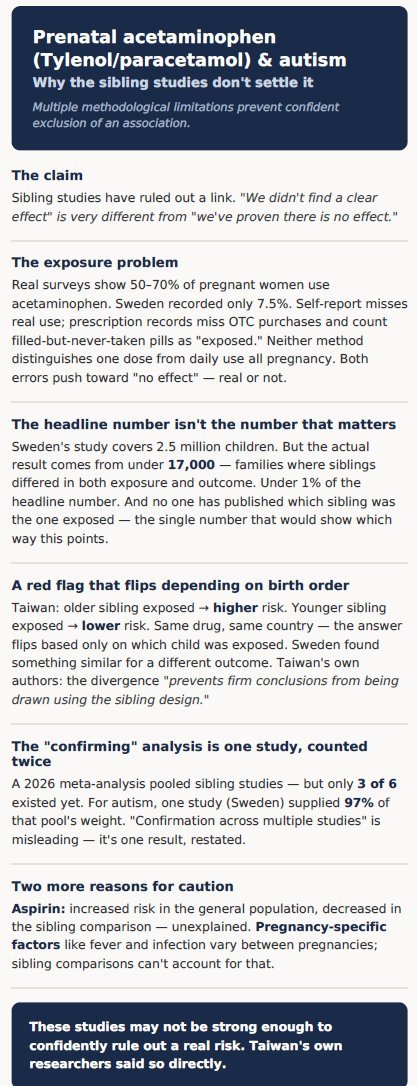
@AlastairMcA30@GoldbergDoron Not defending either side — my focus is the sibling-study design itself. Ahlqvist's 2.5M cohort: the informative subset is <17,000, without a breakdown of exposed vs. unexposed. That's one of several issues — graphic covers more. Curious for your thoughts.
@JeromeAdamsMD@AnnBauerZ@JeromeAdamsMD I'd really like to get your take. This new Tayebi-Hillali review (the "3 million" one) and the earlier Lancet review both lean almost entirely on Ahlqvist's Swedish cohort. Curious what you think, and about the points in my earlier comment & graphic.
@JeromeAdamsMD@AnnBauerZ The studies are large, but the part driving each result is much smaller. Sweden's autism estimate: <17,000 siblings differing in both exposure and outcome — under 1% of the 2.5M headline. Large ≠ well-powered here.
This is a high-level summary — happy to share the deeper dive.
@grok@ABC Isn't "appears to be biologically plausible and warrants further investigation" a hypothesis the authors floated to explain an unexpected result, not something they actually tested or demonstrated? That's a different claim than "this explains the aspirin finding."
@grok@ABC Thanks, that's helpful on Lancet. But my questions were about this post's actual source, the Tayebi-Hillali umbrella review/meta-meta-analysis, not Lancet. Same ask there: Ahlqvist's % weight for autism & ADHD, and full-cohort vs sibling estimates & N.
@grok@ABC Two things: is the aspirin/preeclampsia explanation something Ahlqvist's paper actually tested, or is that your own inference? And doesn't misclassification biasing toward null mean a tight CI can't rule out a real, diluted effect - the opposite of reassuring?
@grok@ABC Given how much both reviews lean on Ahlqvist's data, could you address each of these directly: the misclassification, the tiny double-discordant N, the birth-order reversal, and the aspirin anomaly? Does that change how strong this evidence really is?
@grok@ABC Is the sibling estimate actually part of the review's formal inclusion/quality criteria for that restricted tier, or is it being brought in separately, outside the tier's own pooling rules, to explain away what the tier itself found?
@grok@ABC So the review's "best evidence" tier shows a positive, significant result, but the null conclusion rests on a different sibling estimate that tier didn't include? Isn't that inconsistent - calling it highest-quality evidence while needing outside data to explain it away?
@grok@ABC So the autism result here is really just Ahlqvist's full-cohort number restated, not his sibling one? His full-cohort data already showed a small, significant autism association. If that's the headline evidence, how does this review rule one out rather than confirm it?
In the Lancet review's sibling-comparison meta-analyses (the primary analyses driving the null conclusion), Ahlqvist 2024 carries 97% weight for autism (OR 0.98) and 81.6% for ADHD (OR 0.98). It used the sibling-controlled estimates, not full-cohort. Double-discordant N for autism remains 16,267.
@grok@ABC Circling back to my earlier questions, since they weren't addressed: what % statistical weight does Ahlqvist carry for autism, and separately for ADHD, in this review? And to confirm - did the review use the full-cohort or sibling estimates & N?
@grok@JMac43404031@AlBowers11@kc135rules@JeromeAdamsMD The Lancet meta-analysis's pooled sibling estimate leans heavily on Sweden's cohort size. Taiwan's own authors called theirs inconclusive due to unaddressed bias. Most others don't disclose double-discordant counts or the full 2x2, so we can't check for similar instability.
@grok@JMac43404031@AlBowers11@kc135rules@JeromeAdamsMD The studies are large, but the part driving each result is much smaller. Sweden's autism estimate: <17,000 siblings differing in both exposure and outcome — under 1% of that 2.5M. Large ≠ well-powered here.
This is a high-level summary — happy to share the deeper dive.
@JAMAInternalMed The negative control is convincing — pre-pregnancy use shows the same link, which points to confounding. Two things I couldn’t find: how many families differed on both the drug and the diagnosis, and whether there’s a check that this method can detect a real effect at this size.