I learn a huge amount from papers that are adjacent to, or completely outside, my research areas that I will probably never have a reason to cite. A friendly reminder that paper impact will be (immeasurably) larger than just # of citations! #AcademicTwitter#AcademicChatter
The 4th International Physical Employment Standards Conference (IPES) 2023 being held Bond University with the Tactical Research Unit is here: See below for registrations, abstract submissions, and sponsorship opportunities.
https://t.co/mbEIMseTnh
The 4th International Physical Employment Standards Conference (IPES) 2023 being held Bond University with the Tactical Research Unit is here: See below for registrations, abstract submissions, and sponsorship opportunities. https://t.co/fM9Ner8cU6
#AddAStatisticalWordorPhraseRuinAMovie
In the spirit of Jimmy Fallon, add a statistical word or phrase to a movie title and change its meaning. I'm putting together a top ten list of these for the @TheASAPodcast and would love to add yours to the list. Here are some examples:
@tessamaroni Presenting our research on Entry Fitness And Subsequent Physical Performance Change In Recruits Across British Army Basic Training Courses. [Board No. 178] this morning at #ACSM2022 in San Diego. @chiuni@OPRG_UniChi
With COVID, and all infections:
Symptoms occur for at least 2 VERY different reasons
1) Immunity Fighting the infection (fever, congestion)
2) The infection winning & causing harm (lose smell, breathing issues)
Symptoms do NOT define if you are infectious, the virus does!
1/
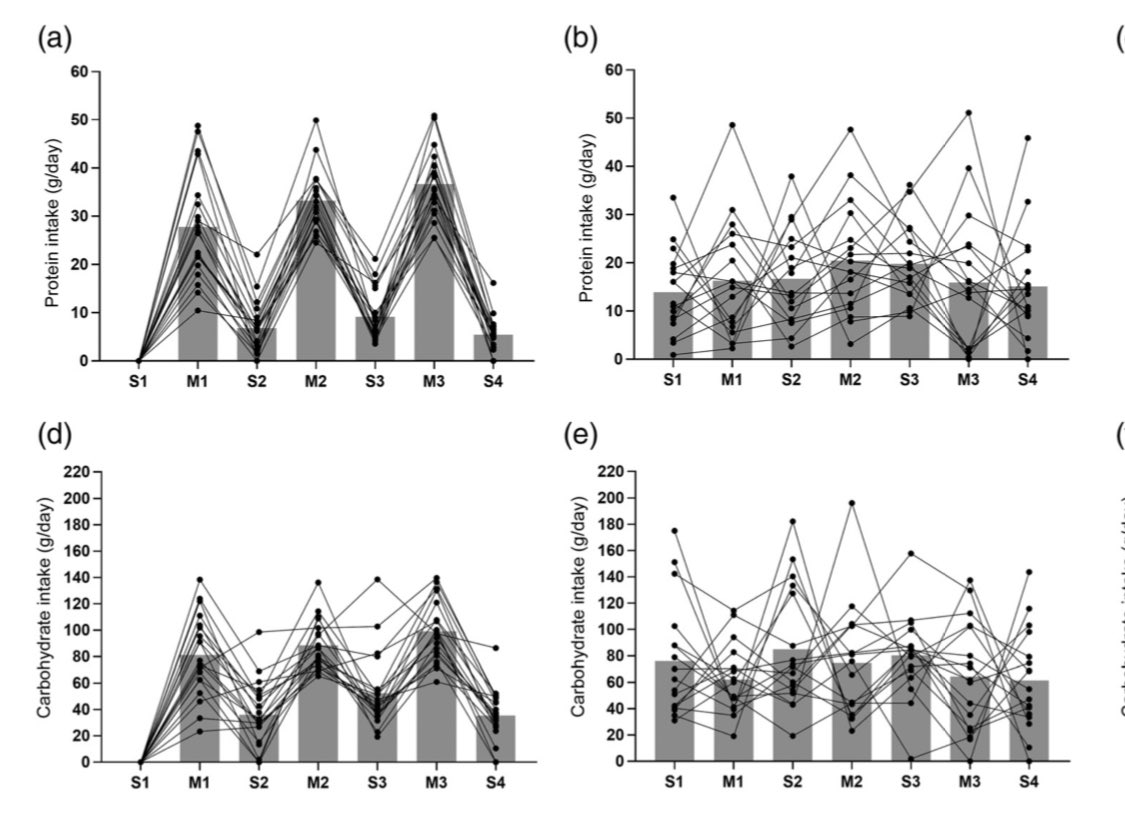
Fantastic work and congratulations to @vickyedwards14 for pulling together this tough dual submission from @OPRG_UniChi monitoring officer training! Fun figure: disparity in CHO/PRO intake timing between when training could allow core meals (a, d) vs. field exercise (b, e)
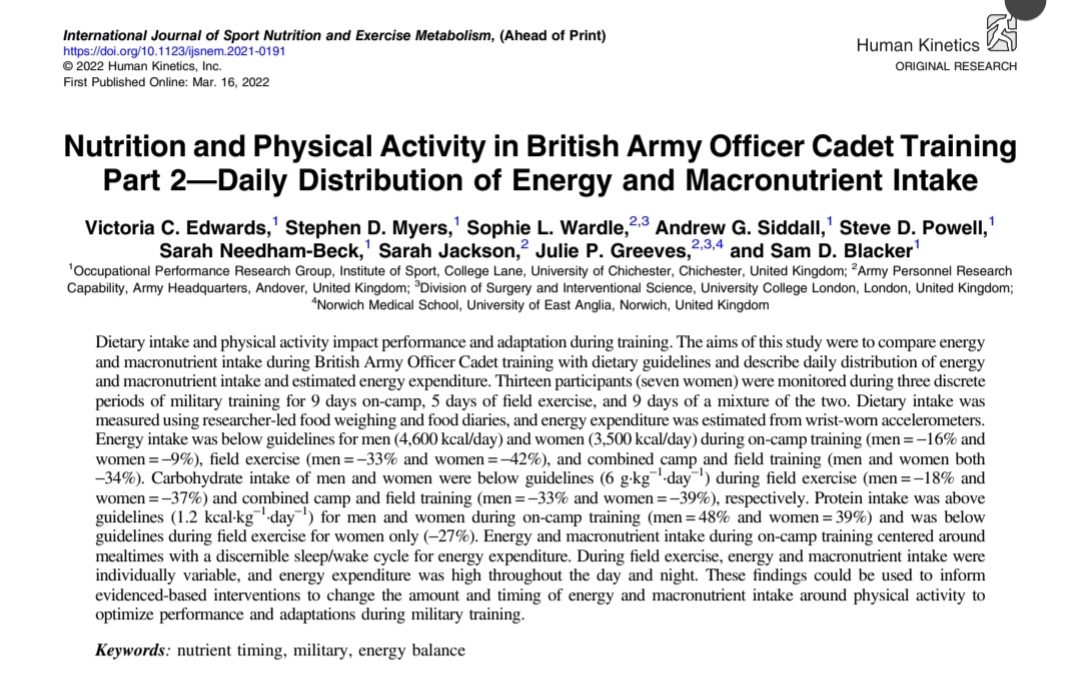
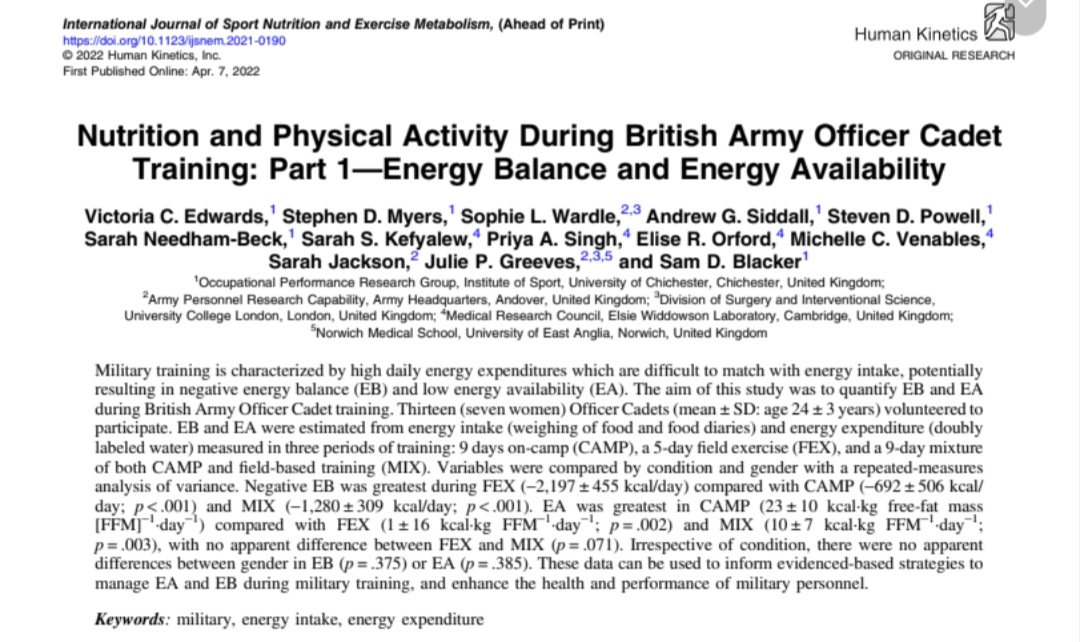
Pleased to have these two published in @IJSNEMJournal 🥳 describing energy balance & availability, and the energy & macro distribution in Officer Cadets at @RMASandhurst over their 44 week commissioning course.
https://t.co/H3V8rK0IhI
https://t.co/3MWeKatRDr
@OPRG_UniChi
Pleased to have these two published in @IJSNEMJournal 🥳 describing energy balance & availability, and the energy & macro distribution in Officer Cadets at @RMASandhurst over their 44 week commissioning course.
https://t.co/H3V8rK0IhI
https://t.co/3MWeKatRDr
@OPRG_UniChi
@TenanATC@ExPhysStudent Thanks- This is precisely the sort of thing that prompted my question. Seeing one-to-one time-aligned data from an individual, and wanting to know if/what approaches exist to statistically do the “visual checking”. Like “pattern/shape” agreement - if that makes sense!
Will be completely out of my depth- but what approaches exist for equivalence/agreement across high frequency time-series data? (E.g time-aligned HRV in 2 devices). Many claim “correlation” by superimposing one longitudinal pattern on top of another. Ideas? (Perhaps @TenanATC?)
@ExPhysStudent@TenanATC Aaron, thanks for saying this - I would be interested whether there are some who would not define this as agreement - or it’s close enough (not wordplay intended). I suppose it may also depend on what each epochs of time you repeatedly apply this over.
@TenanATC@ExPhysStudent I think this was one of my concerns - was whether average differences over time could be used for “sameness” - the methods above are helpful. I will look forward to trying these all out on day!
@ExPhysStudent@TenanATC Glad you’ve joined the party too Aaron! Aware that agreement and equivalence are different, as LoA and equiv testing are sometimes used in tandem to show different concepts, so this was an either/or type question to see what methods existed!
@TenanATC Thanks Matt - I figured you might have! I am not (currently) looking to run an analysis, but I will have use in the near future. But have just been seeing a lot of claims without an analysis of this type- so it made me wonder what existed and/or is actually appropriate.
It remains surprising to me that a limited analysis, that told us little we didn't already know, not only made the front page of the NYT, but seems to have been taken as "case-closed" on non-lab origins of sars-2.
There is no scientific merit to the use of a simplified heatmap (kernel density estimate) to represent residential addresses of early COVID cases in Worobey et al (2022)
https://t.co/YB1MvTH7Y1.
@MichaelWorobey @acritschristoph @K_G_Andersen @stuartjdneil
@edwardcholmes @arambaut









![Sam_Blacker's tweet photo. @tessamaroni Presenting our research on Entry Fitness And Subsequent Physical Performance Change In Recruits Across British Army Basic Training Courses. [Board No. 178] this morning at #ACSM2022 in San Diego. @chiuni @OPRG_UniChi https://t.co/KwJouCrmOW](https://pbs.twimg.com/media/FUa5G1BUEAAFqId.jpg)