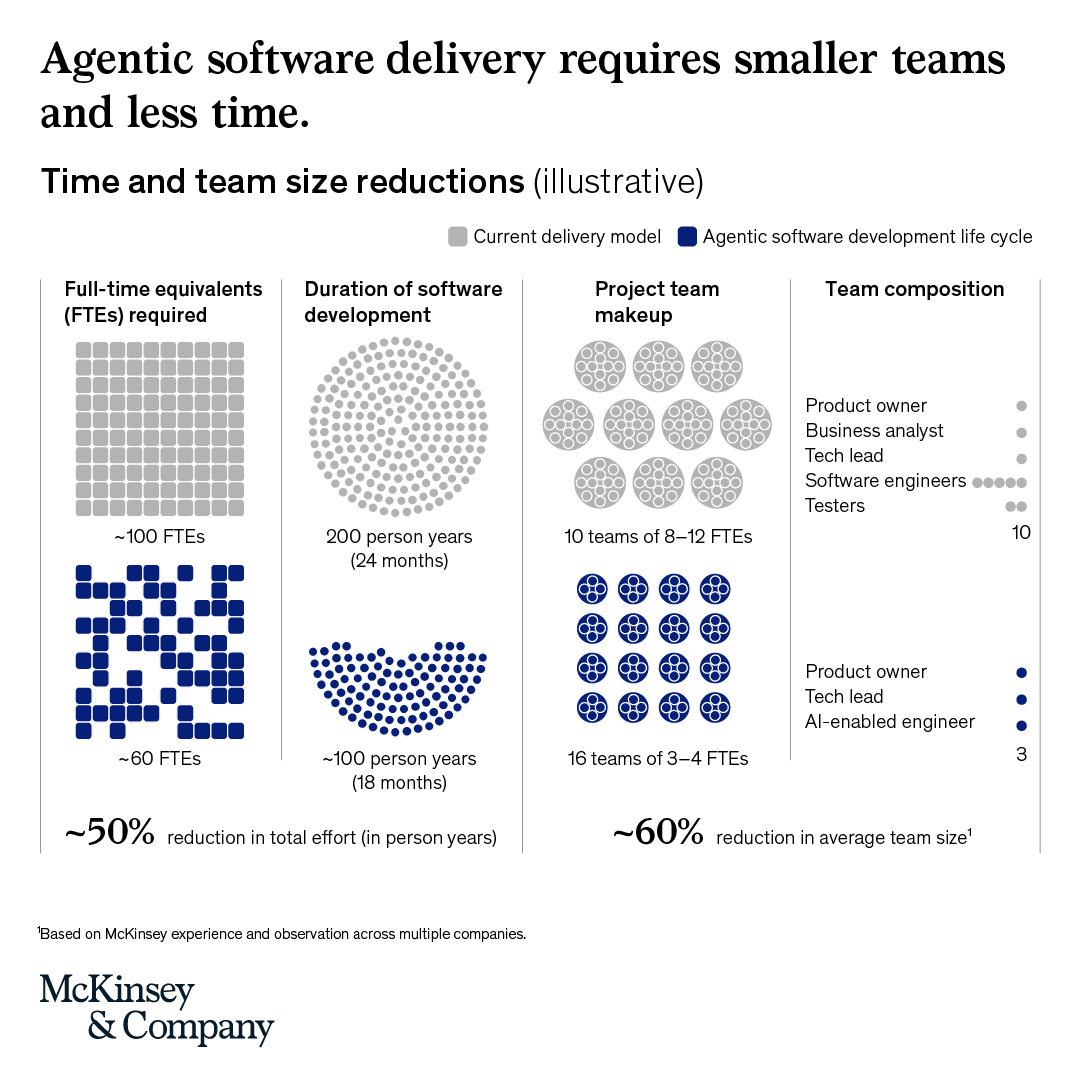
Leading companies are moving from two-week sprint cycles to a daily rhythm that combines human judgment with overnight agent execution.
The opportunity now is how organizations use the capacity those agent-enabled workflows create. https://t.co/heERvijLRD
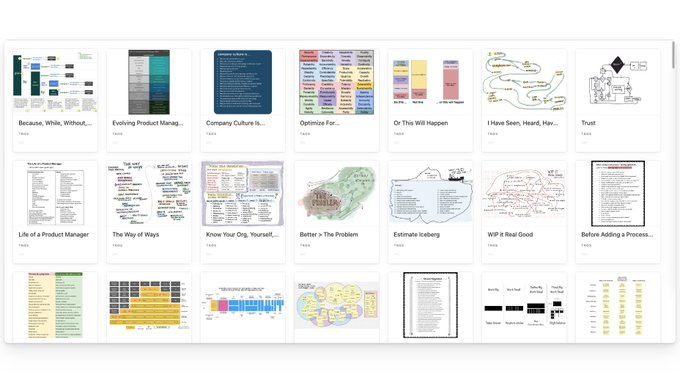
John Cutler is an icon in product management circles.
He pushed the concept of the North Star Metric framework further and continues to give sage, thoughtful advice.
He's super generous & put all his diagrams out there for everyone. Check out his amazing stuff here 👇
BREAKING: Claude can now research like a PhD.
These 9 prompts turn 40+ research papers into literature reviews, knowledge maps, and research gaps in minutes.
Academics won’t like this. Save this👇
I'm obsessed with cognitive biases.
A "cognitive bias" is a systematic error in thinking that destroys decision-making.
11 most powerful (and dangerous) cognitive biases I've found: 🧵
1. Survivorship Bias:
I'm obsessed with cognitive biases.
A "cognitive bias" is a systematic error in thinking that destroys decision-making.
11 most powerful (and dangerous) cognitive biases I've found: 🧵
1. Survivorship Bias:
10 best resources on UI/UX every serious designer & product founder must read at least once in 2026:
1. First Rule of Usability? Don't Listen to Users
by NNG
Users will tell you they want everything.
Watch what they DO instead.
https://t.co/wBqdhJfDLi
2. Never Ask What They Want - 3 Better Questions
by Chuck Liu
Stop asking "What features do you want?"
Start asking questions that reveal actual problems.
https://t.co/JyvdOGQSqD
3. The Jobs-to-be-Done Mattress Interview
by Jason Fried (48-min video)
Watch a master uncover what people REALLY need.
Not what they think they want.
https://t.co/UXYRrZxZL2
4. Just Enough Research
by Erika Hall
Short book. Big impact.
Plus her free 9 Rules of Design Research:
https://t.co/JeQvfsEd9B
5. Thinking Aloud: The #1 Usability Tool
by NNG
These guys have done more usability tests than anyone alive.
When they talk, I listen.
https://t.co/cGqZPF4GfN
6. Steve Krug's Usability Downloads
Free word-for-word usability study script.
Live video of him testing Zipcar.
https://t.co/LC5yJymHgg
(His book "Don't Make Me Think" is mandatory)
7. The End of Web Design
by Jakob Nielsen (2000)
Where "Jakob's Law" was born:
"Users spend most time on OTHER sites"
https://t.co/WCPCYfMz8J
8. Obvious Always Wins
by Luke Wroblewski
The title says everything.
Make shit obvious or watch users leave.
https://t.co/iFJi7B0RoX
9. Web Forms
by Luke Wroblewski
THE Bible on form design.
This man is the world's expert on forms for a reason.
https://t.co/2OTTOFBFyH
10. UX and the Civilizing Process
by Kevin Simler
Philosophical take: Good UX = good manners.
Treat your users like guests, not prisoners.
https://t.co/CGEXNo3O54
Look, you can read all the trendy design content on Medium.
Or you can study the fundamentals that haven't changed in 20 years.
Your choice.
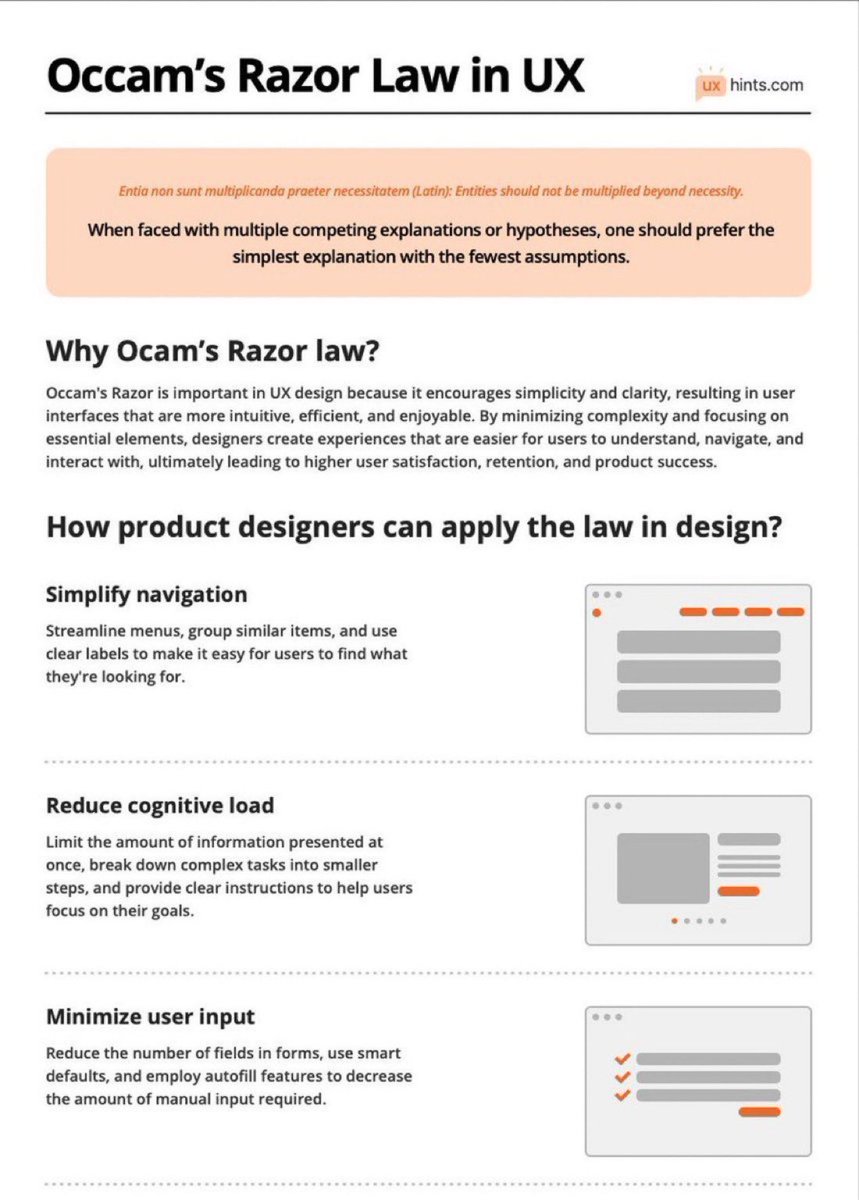
Learn How To Use Occam’s Razor Law to Boost Your Next Design Project! 🙌
FREE PDF Download 🔖
Occam’s Razor is a problem-solving principle stating that the simplest explanation or solution, with the fewest assumptions, is often the most likely to be correct.
Summary:
Why Ocam’s Razor law?
Occam's Razor is crucial in UX design for promoting simplicity and clarity. By focusing on essential elements and minimizing complexity, designers create intuitive and efficient user interfaces. This leads to higher user satisfaction, retention, and product success.
How product designers can apply the law in design?
Simplify navigation
Streamline menus, group similar items, and use clear labels to make it easy for users to find what they're looking for.
Reduce cognitive load
Limit the amount of information presented at once, break down complex tasks into smaller steps, and provide clear instructions to help users focus on their goals.
Minimize user input
Reduce the number of fields in forms, use smart defaults, and employ autofill features to decrease the amount of manual input required.
Emphasize clarity and consistency
Use consistent visual elements, typography, and color schemes throughout the design to help users build a mental model of the interface.
Remove unnecessary elements
Eliminate any extraneous features, buttons, or content that don't directly contribute to the user's goals or improve their experience.
Optimize for mobile
Design with mobile devices in mind, ensuring that interfaces are responsive, touch-friendly, and easily navigable on smaller screens.
Prioritize usability over aesthetics
While an attractive interface is important, prioritize functionality and ease of use over purely visual design elements.
Test and iterate
Conduct user testing to identify potential issues or areas for improvement, and continually refine the design based on user feedback.
#UX # UI #ProductDesign #UXDesign #UIDesign
I love this concept of a "KPI tree"
Thinking about it this way helps you:
• Define clear KPIs
• Identify the levers you can pull to influence that KPI
• Identify the levers you can pull to influence *those* KPIs
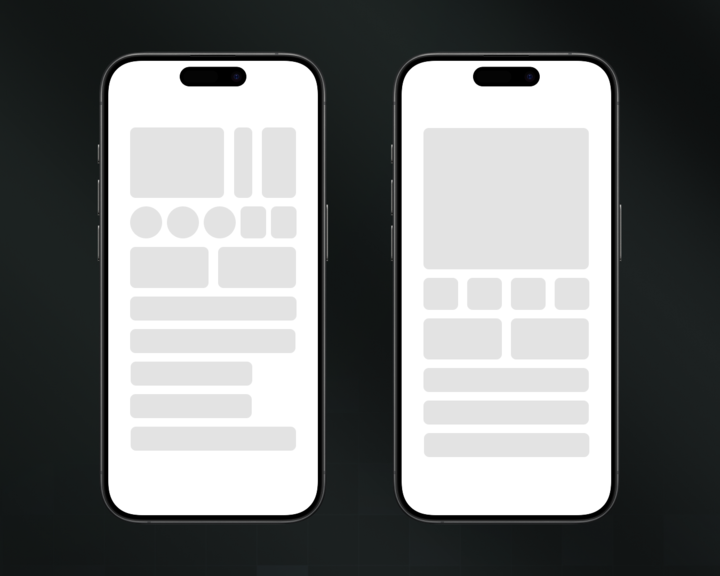
Look at these 2 UIs.
One of them will 100% outperform the other for one reason:
Law of Prägnanz.
Here's how this psychological principle works & how to use it in your products:
Eric Schmidt says traditional user interfaces are going to go away.
The WIMP model (windows, icons, menus, pull-downs) was built 50 years ago.
In the age of agents, UI becomes ephemeral. Generated on demand, shaped by intent, not layout.
Worthy Read: TBM 275: "Bad" Strategy. Why? by John Cutler
"A company does not have a strategy. The individuals in a company have strategies." 🎯
Ever wonder why your company's strategy doesn't match the "good strategy" examples you read about? Here's what's really happening behind the scenes:
🤝 Strategy is actually a negotiation between different stakeholders
🧠 Real strategy often lives in people's heads, not documents
⚖️ What's right for a new designer might not be right for the CFO
🎲 Sometimes a "safe" 6/10 strategy is good enough
🔄 Many successful strategies emerged from trial and error, not perfect planning
⭐ When things are working well, there's little motivation to change
You might not see the full picture, but that doesn't mean there isn't strategic thinking happening. What you see is often just the tip of the iceberg - a negotiated narrative that works for multiple stakeholders.
Read the article: https://t.co/0RQ57SlP0y
❓ What's the most surprising thing you've learned about how strategy actually works in companies? Share your thoughts in the comments below.
💡 UX Research Cheatsheet
Common types of user research
✅ Qualitative vs. quantitative
✅ Attitudinal vs. behavioral
✅ Generative vs. evaluative
With a brief description and key research methods. Nicely put together by the Maze team.
👇
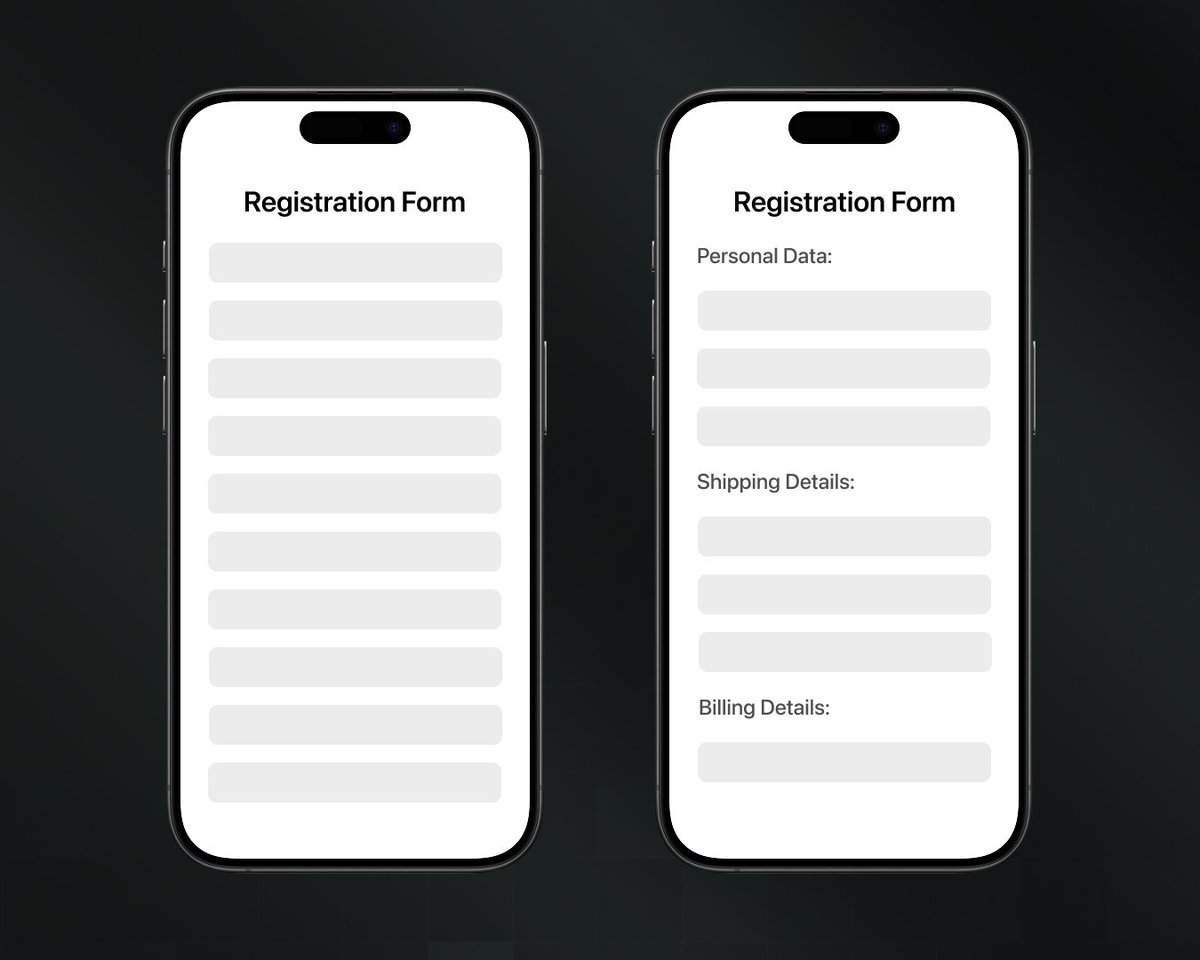
Look at these 2 UIs.
One of them will 100% outperform the other for one reason.
Miller's Law.
Here's how this psychological principle works & how to use it in your products:
Excellent Cheatsheet to Help You Understand Your Customers in Your Next Design Project 🙌
FREE Cheatsheet attached 🔖
Four levels of customer understanding
Level 1
What they say
Don't rely too much on CRM data, surveys, or polls. It may look like data, but it's often just opinions.
Level 2
What they think or feel
Good surveys and buyer interviews can help you understand this by looking at customer expectations and experiences.
Level 3
What they do
To influence what customers buy, you need to understand their actions. Use open ended questioning, task analysis, and behavioural analytics.
Level 4
Why they
To get deep understanding, find out why customers act the way they do. This can be done through detailed interviews, psychological analysis, and behavioural observation.
#ux #uxdesign #ui #uidesign #productdesign #uxprocess #userexperience #design #usertesting #usabilitytesting #startup #digital #business #startup
Look at these 2 UIs.
One of them will 100% outperform the other for one reason:
The Doherty Threshold.
Here's how this psychological principle works & how to use it in your products: