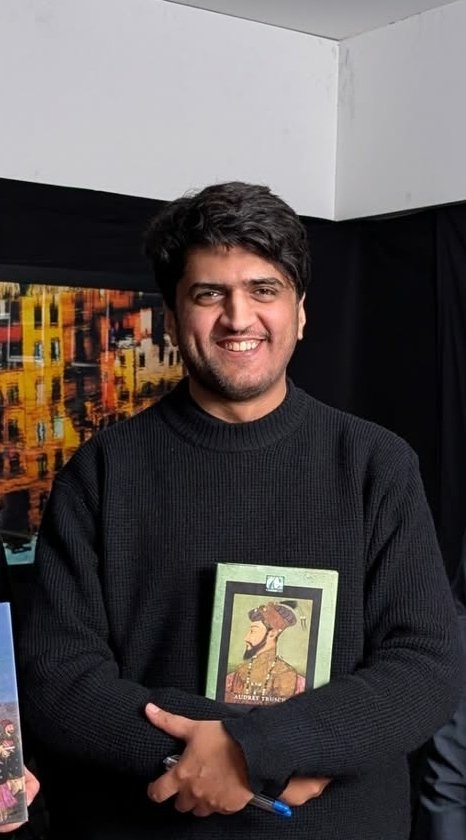
The image of journalist Mujahid Bani Muflih encapsulates the reality of the Israeli prison system, which has become a tool of slow and direct killing of Palestinian prisoners.
Bani Muflih, a journalist with Ultra Palestine,
For those of you who don't know:
Bernie Sanders does not believe in equal rights for Palestinians and Jews in the Levant.
"If that happens, then that would be the end of the State of Israel. And I support Israel's right to exist".
Bernie Sanders is a Jewish supremacist.
@theRealYLH I am not a JI follower. However, ppl evolve and so did jinnah, modudi and mirza ghulam ahmed. Jinnah was once in congress, later joined Muslim league. Mirza ghulam ahmed, initially wrote against second coming of Christ and then retracted from his earlier opinion.
🚨 Watch this retired Pakistan Army Captain… now SSP @HamzahHumayun - speaking to civilians.
Listen to his tone, his threats, his raw arrogance. Does this sound like a Police Officer… or a man who brought military entitlement into law enforcement?
This is superiority complex in uniform: pure disdain for civilians, zero accountability, and absolute power trip.
When power goes unchecked, “officers” start acting like masters and civilians are reduced to peasants.
To civil society, journalists, and state officials:
I am writing as a grieving wife, seeking the immediate and lawful release of my husband, Muhammad Saad.
At approximately 3:30 AM this Monday, 12–13 masked men with guns forcibly entered our home and took him away without presenting any warrant or lawful authority. This was an unlawful deprivation of liberty and a direct violation of due process.
Only after legal pressure did personnel within CTD register an FIR on laughable grounds. This post facto action raises serious concerns of mala fide intent and abuse of process, where the law is invoked after the fact to justify an illegal act.
Saad is a journalist, researcher, and Political Science scholar. His work engages with complex subjects, including Balochistan, Kashmir, and international affairs. He has interviewed recognised public figures such as Former Prime Minister Anwar ul Haq Kakar, as well as senior journalists Sohail Warraich and Hamid Mir, and has introduced major international voices to Pakistan’s media space.
More importantly, Saad has worked with state institutions when called upon, contributing to areas aligned with the national interest. He was vetted, cleared, and entrusted by the State. Today, that same individual is being subjected to coercive action by its functionaries.
This contradiction is not incidental but structural.
If individuals who have been vetted and trusted by the state can be subjected to arbitrary detention and retrospective criminalisation, then the question is unavoidable: on what basis does the state expect trust from its citizens?
The actions of certain personnel within CTD constitute a clear overreach of authority. Powers granted for public safety cannot be exercised in violation of constitutional safeguards, including the inviolability of the home and the right to due process. The law does not permit enforced taking into custody followed by procedural reconstruction.
Saad has never engaged with any proscribed material nor been involved in any unlawful activity. His life and work have remained within the bounds of law and intellectual inquiry.
I call upon civil society, the media, and responsible state authorities to take immediate cognisance of this case. Ensure due process. Examine the legality of the initial detention. Hold those responsible accountable. And ensure his safe and immediate release.
This is not just about one individual. It is about law and dignity. It is about giving hope to others who have worked for the state and Pakistan whenever called upon, who have trusted the state against all odds. This youth must be protected and safeguarded within a shrinking demographic that believe in state and that is increasingly disillusioned and disenfranchised.
#ReleaseSaad #RuleofLaw
It’s always a good day to talk about how Israel is inventing ancient history - but this week (with the news from Arizona…) is an especially good week for it.
نجم سیٹھی جیسے افراد کو شرم آنی چاہیے کہ وہ ایک مقید لیڈر پر تبصرہ کرتے ہیں، جب کہ وہ خود بول نہیں سکتا۔
نواز شریف اور زرداری کرپشن کے الزامات پر جیل گئے اور عوامی حمایت نہ ہونے کے باعث ڈیل کر لی۔
عمران خان واحد لیڈر ہے جس پر 200 مقدمات کے باوجود عوام اس کے ساتھ کھڑی ہے۔
اس کی جدوجہد اسے تاریخ میں بزدلوں کے ساتھ نہیں بلکہ بہادروں کے ساتھ یاد رکھے گی! مطیع اللہ جان۔
میں نے عمران خان کا ایک کمرشل شوٹ کیا شوٹ کے بعد وہاں کھانے کیلئے تین الگ الگ ٹیبلز لگے۔سلیبریٹیز کیلئے الگ، فلم شوٹنگ والوں کیلئے الگ اور لیبر کیلئے الگ۔۔عمران خان آئے اُنہوں نے اِدھر اُدھر دیکھا اور کھانے کیلئے لیبر کے ساتھ زمین پر بیٹھ گئے اور کہا میرا کھانا بھی اِدھر لاؤ
A Persian scholar finished a single math book in 9th century Baghdad that quietly became the foundation for every line of code running on Earth today.
I started reading about him at midnight and could not believe how many things in my daily life trace back to one man.
His name was Muhammad ibn Musa al-Khwarizmi. The book is called The Compendious Book on Calculation by Completion and Balancing.
Every time you say the word algebra, you are saying his book title. Every time someone says the word algorithm, they are saying his name. Both English words come from him. Both are Latin transliterations of Arabic and of his own identity. The man did not just contribute to mathematics. He named it.
Here is the part almost nobody tells you.
Al-Khwarizmi was born around 780 CE in Khwarazm, in what is now Uzbekistan. He moved to Baghdad and worked at a research institution called the House of Wisdom, which during the Islamic Golden Age was the single most important center of learning on the planet. The caliph al-Mamun hired the best mathematicians, astronomers, and philosophers from across three continents and put them in one building with one job. Translate, study, and produce new knowledge.
Al-Khwarizmi finished his book on algebra around 820 CE. The Arabic title contained the word al-jabr, which referred to one of the two operations he used to solve equations. When the book was translated into Latin in the 12th century, the Latin world did not have a word for what he had built. So they kept his Arabic word. Al-jabr became algebra. The discipline was named after a single Arabic word in the title of a single book by a single man.
The deeper insight is what he actually changed about how humans think.
Before al-Khwarizmi, mathematical problems were solved geometrically. You drew shapes. You measured them. You compared areas. The Greeks had built an entire mathematical tradition on visual proofs and physical constructions. It was beautiful and limited. You could not solve a problem you could not draw.
Al-Khwarizmi did something nobody had done before him at this scale. He said you could solve any problem using abstract symbols and rules. You did not need a shape. You needed a procedure. You moved terms across the equation. You cancelled like terms on both sides. You isolated the unknown. He invented the idea that mathematics is a manipulation of symbols according to rules, not a study of physical figures.
That single shift made everything that came afterward possible. Calculus. Differential equations. Linear algebra. Quantum mechanics. None of it works if math is locked inside geometry. He pulled it out.
The second thing he did is the one that changed how the world counted forever. He took the Hindu numeral system from Indian mathematics, refined it, and wrote a book introducing it to the Arab world. That system included the concept of zero as a placeholder, and a positional notation where the value of a digit depends on its location. Roman numerals could not do complex calculation. Hindu-Arabic numerals could.
When his book on numerals was translated into Latin as Algoritmi de numero Indorum, the word Algoritmi was just the Latin spelling of his own name. Europeans started calling the new method "doing algorism," then "running an algorithm." The word for the most important concept in computer science is literally his name in Latin.
The third thing he did is the part that should haunt anyone who works in tech.
His method of solving problems was systematic. Step one, do this. Step two, check that. Step three, if condition A, then do X, otherwise do Y. He wrote down procedures that could be followed by anyone, anywhere, who knew how to read. The procedure did not depend on intuition or genius. It worked because the steps worked.
That is exactly what an algorithm is. A finite, deterministic procedure for solving a problem. He did not just give us the word. He gave us the entire concept of programming a thousand years before there was anything to program.
When Alan Turing built the first abstract model of computation in 1936, when John von Neumann designed the first stored-program computer in 1945, when every engineer at Google, OpenAI, Anthropic, and DeepMind writes code in 2026, they are working in a paradigm that started with one man in Baghdad twelve centuries ago.
The strangest part is what happens when you walk into any tech office in San Francisco or Bangalore or Lahore today. Engineers say the words algebra and algorithm hundreds of times a day. They do not know whose name they are saying. Almost nobody can spell al-Khwarizmi correctly on the first try.
His original Arabic manuscript is preserved at Oxford. His book on Hindu numerals survives only in Latin translation. The Latin version was the textbook that taught medieval Europe how to count.
The man who built the foundation of the AI revolution did not live to see a calculator. He died around 850 CE, a thousand years before the first electric current was sent through a wire. The civilization he built mathematics for collapsed. The library he wrote in burned. His own grave is unmarked.
But every algorithm running on every machine on Earth right now still answers to his name.
یہ معصوم پنجاب کے ان 1 کروڑ بدنصیب بچوں میں سے ایک ہے کہ اگر اس کی زبردستی کی مسلط کردہ ماں کو گیارہ ارب کے جہاز میں جھولے لینے کا شوق نہ ہوتا تو وہ سکول میں ہوتا۔