206 days ago, #XRP's total supply was 99,985,726,061👉🏻 today the total supply is 99,985,630,555 (95,506 XRP burned and gone forever in 206 days) about 463 XRP a day - When the price of XRP increases, as the billions flow in - this number will DECREASE.
Remember, higher value for $XRP means larger amounts of value can be moved on chain. At the current price, XRP can't handle $100 Billion. Higher price isn’t speculation... it will be required for scale.
$100 per XRP is inevitable.
I've been tracking this, click below to follow the quotes 💥
@mrnguyen007 Your government and banks are literally screwing the whole world over. The rest of the world is livid with the circus the US government and banks are running. It's seriously pathetic
🚨 $QNT holders, seven major UK banks are testing programmable bank money on infrastructure provided by Quant.
Read those names again:
Barclays. HSBC. Lloyds Banking Group. NatWest. Santander. Monzo. Nationwide.
Led by UK Finance, the Great British Tokenised Deposit initiative is delivering live pilot transactions involving digital versions of normal sterling bank deposits.
The easiest way to understand it is this:
Your money remains bank money.
But instead of sending it blindly and trusting every person in the process, rules can be attached before it moves.
Payment releases when the buyer receives the product.
Mortgage funds transfer when every document and condition is ready.
Money and a tokenised asset settle together, so neither participant is left waiting and exposed.
Quant’s Overledger provides the orchestration and interoperability connecting participating banks with RTGS, Faster Payments, Open Banking and tokenised-deposit platforms.
That is why this matters more than another blockchain demonstration.
The institutions are testing real financial activity across multiple banks, with fraud protection, settlement efficiency and programmability at the centre.
GBTD also follows Quant’s involvement in the UK Regulated Liability Network, while its acceptance into the Bank of England Synchronisation Lab places the project beside the UK’s work on atomic central-bank-money settlement.
Does this guarantee every bank will buy QNT? No.
But it gives Quant institutional validation that most interoperability projects spend years trying to earn.
If GBTD succeeds, the opportunity will extend far beyond one UK pilot.
Other countries are also exploring tokenised deposits, digital securities and connected payment systems.
QNT is sitting behind infrastructure the largest banks will need to make those separate systems work together.
Many people will study QNT after adoption becomes obvious.
I would rather understand why seven banks selected Quant before everyone else notices.
My conviction in $QNT came before the headlines.
Now the adoption is becoming impossible to ignore.
One of the most important integrations enabling digital asset interoperability. 🔑
Ripple’s Interledger Protocol interoperability with the SWIFT network via ISO 20022.✅
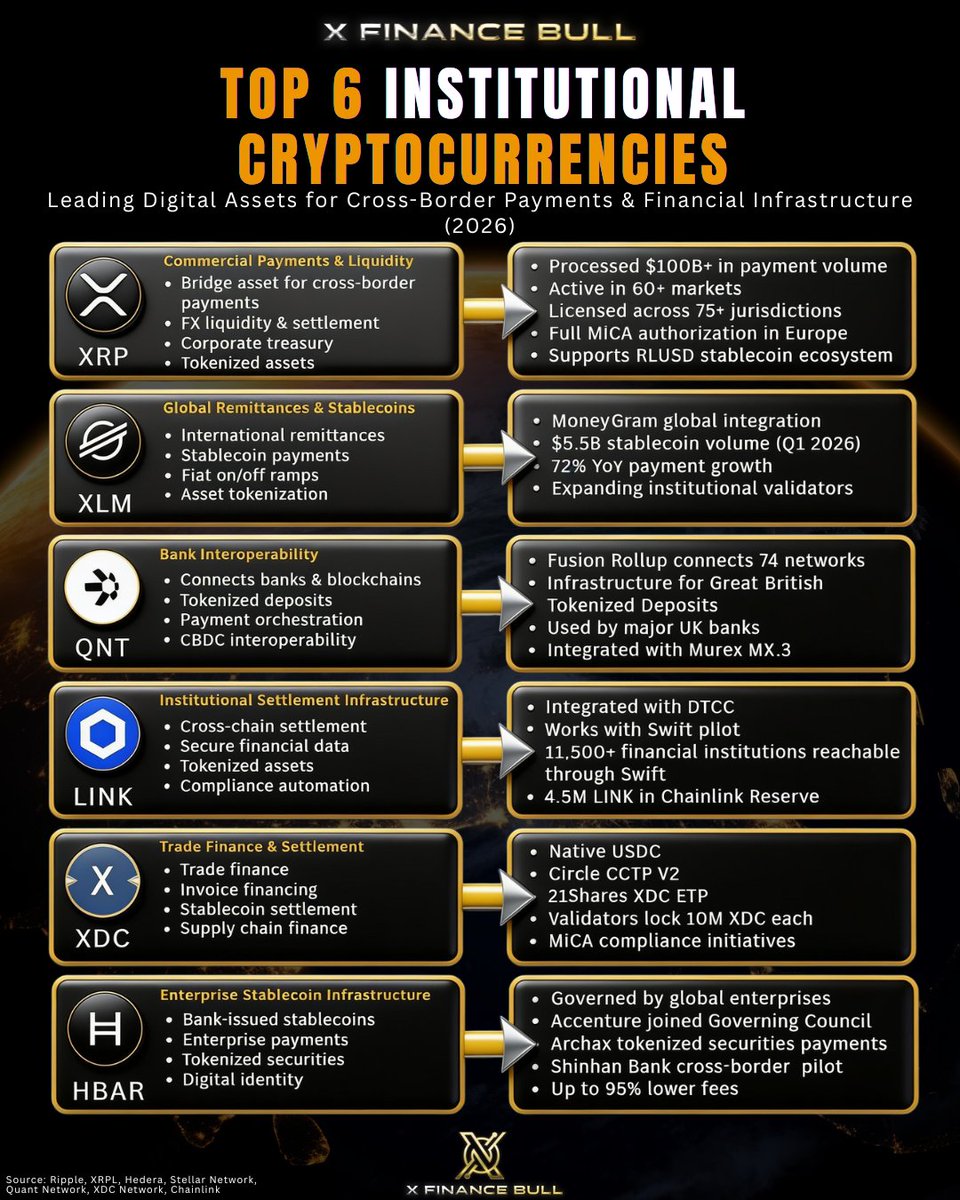
🚨 THE INSTITUTIONAL PAYMENT RACE HAS SIX CLEAR FRONT-RUNNERS. 🚨
$XRP $XLM $QNT $LINK $XDC $HBAR
I ranked them by something more important than attention:
Who is already connected to banks, payment companies, market infrastructure and real settlement activity?
1. $XRP
The strongest direct bridge-asset design.
XRP can provide temporary liquidity between currencies, helping payment companies avoid keeping money trapped in accounts around the world. Ripple’s full MiCA authorisation now gives its regulated crypto services access across the European Economic Area.
2. $XLM
The strongest remittance and stablecoin network.
Stellar recorded $5.5 billion in stablecoin payment volume during Q1 2026. MoneyGram also continues connecting Stellar-based digital dollars with cash access, and DTC expects tokenised assets to become available on Stellar in 2027.
3. $QNT
The interoperability layer.
Quant’s Fusion Rollup connects 74 networks, while UK Finance is testing tokenised bank deposits with Barclays, HSBC, Lloyds, NatWest, Nationwide and Santander.
4. $LINK
The institutional connection and data layer.
DTCC is integrating Chainlink into its Collateral AppChain for pricing, valuation and near-real-time collateral movement, with production expected in Q4 2026.
5. $XDC
The trade-finance specialist.
Native USDC and CCTP V2 are live on XDC, strengthening its position for cross-border settlement, receivables and tokenised trade assets.
6. $HBAR
The enterprise settlement network.
Archax is already using Hedera for tokenised securities whose USDC cash flows automatically follow ownership in near real time.
One moves liquidity.
One connects money with people.
One links banking systems.
One delivers trusted data and instructions.
One modernises global trade.
One supports regulated enterprise assets.
Institutions will not choose only one rail.
They will need an entire financial stack.
These six are already positioning themselves inside it.
While tokenised issuance and trading have moved fast, post-trade remains fragmented across ledgers and settlement systems.
QuantNet connects tokenised assets and money across ledgers, without replacing what's already there. Real-time visibility, coordinated settlement, built to scale with adoption.
Learn more: https://t.co/k2kqqYHYBO
#CapitalMarkets #PostTrade #Tokenisation