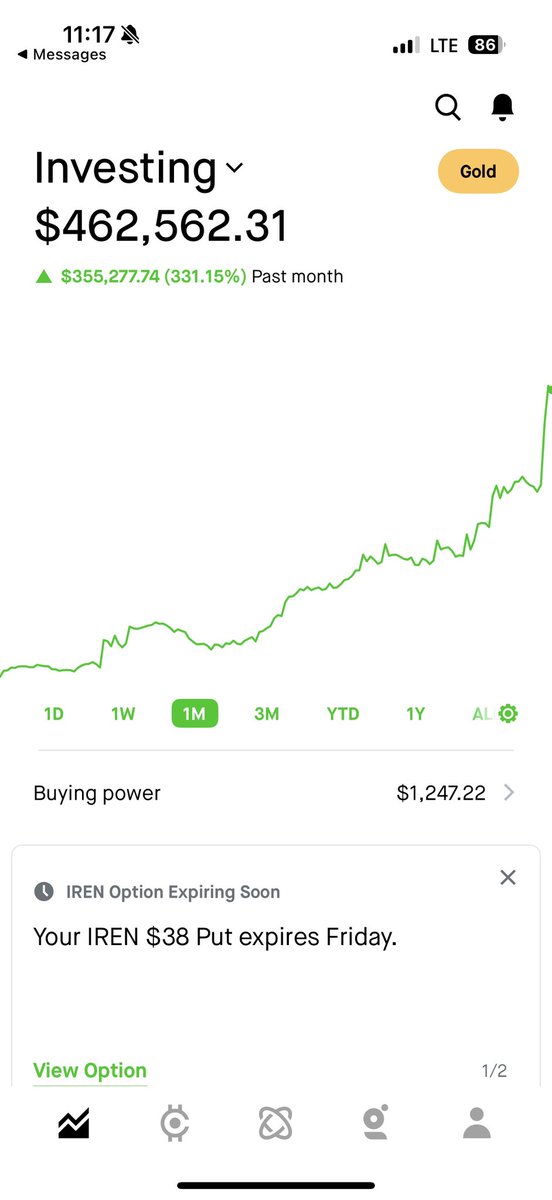
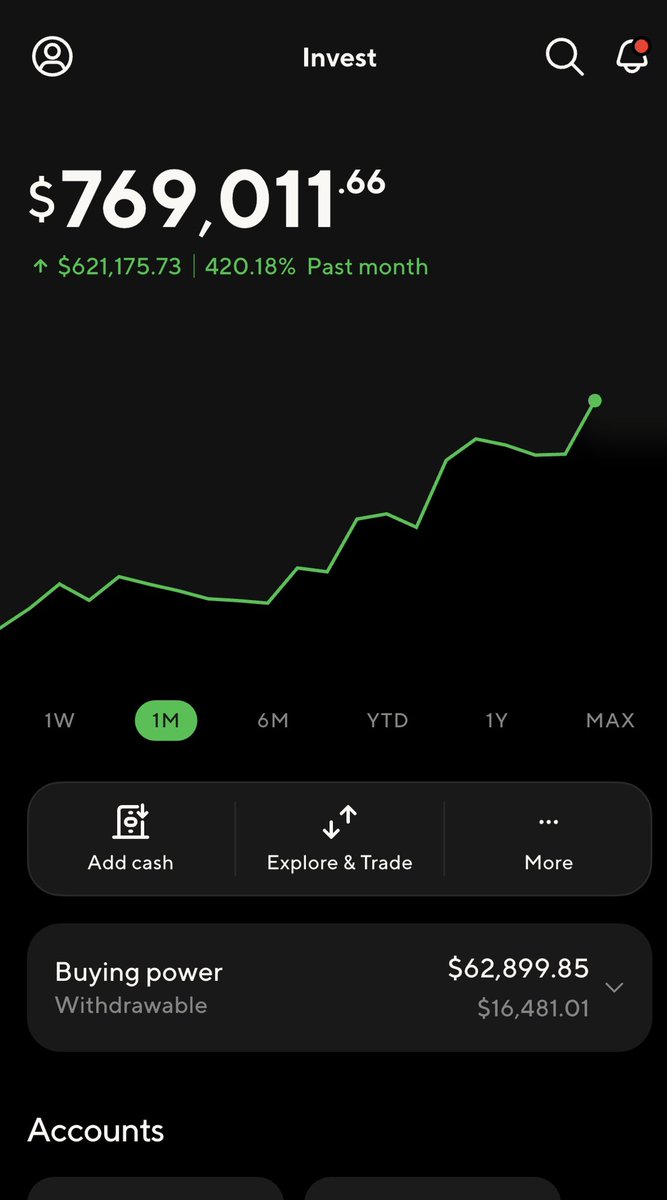
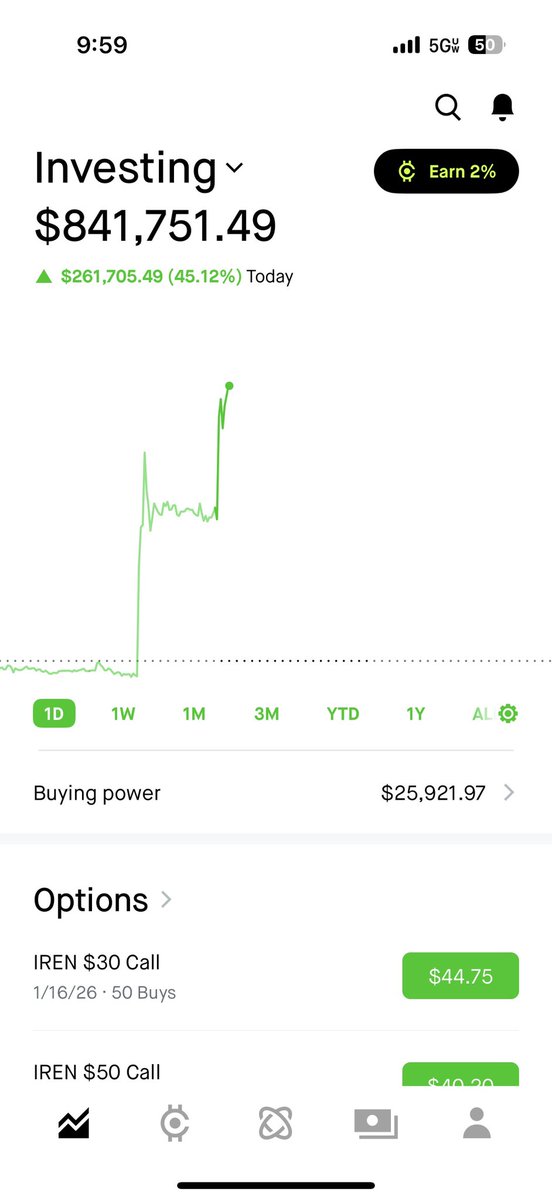
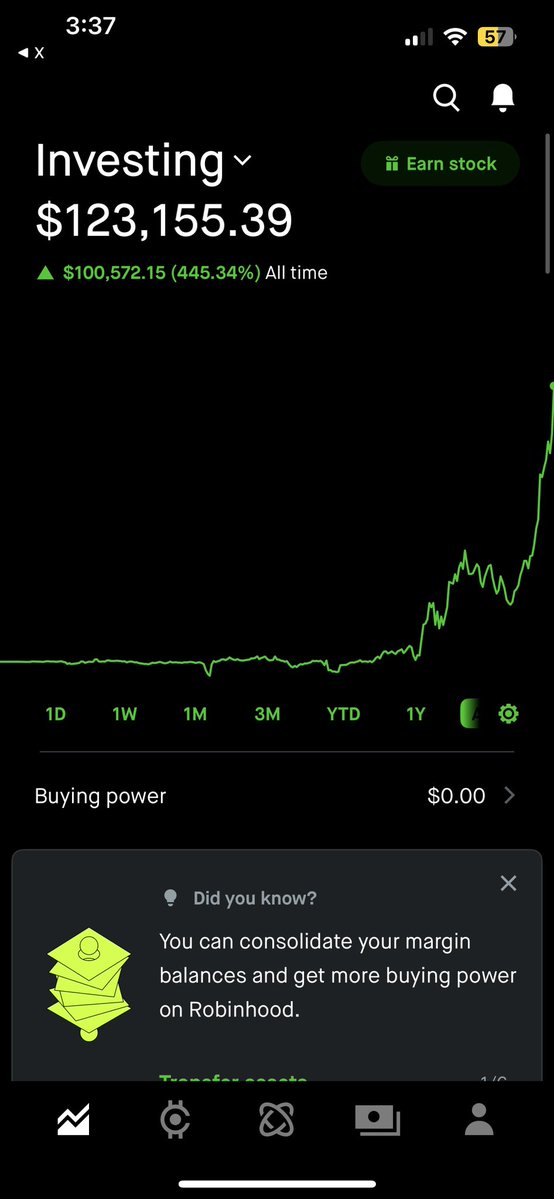
This is my trading journey from 2024 -> now
Every thing I’ve did in the past has been a learning experience which got me to where I am now. There has been days where I felt like giving up, hopeless, & defeated, but I stayed true to myself because I knew there was much to learn. Every opportunity whether it’s a fail or win, is a learning experience.
I first started with around $10,000 and fast forward to now I sit around $1.5m. I didn’t get this overnight, I got to where I am by staying dedicated to learning and never gave up over my four years in the market.
I do not sell a course and I do not look forward to selling a course. When I started posting on X, I enjoyed posting about my knowledge and helping people learn things about the market. I give my honest opinions, I share my holdings (with receipts) and I do like sharing my technical analysis completely free.
My first big play was $pltr which I got in around $16 with 500 shares. It ran all the way up to around $80 before I started taking my first big profits. It now sits around $130 & I still hold shares for the long term. My second big hit was $hims which ran all the way up to $70. I first got in before they first added compounded glp1 which is what started the run. My first buy was in the single digits around $8. As it got to around $15 I had around 1500 shares. I took my first profits around $40-$50, kind of missed a lot on the run to $70 but it ended up falling all the way down to $15.
I have 2 main brokerages, which are Robinhood & SoFi. Robinhood is more of my trading brokerage where I trade my options and also wheel options. I do use leverage, but mainly for selling options which net me great premiums. My biggest gain in a day was close to $300k which was from $iren. I had over 5k shares around $10 and a shit ton of calls at the time because I was starting to understand that data centers would be the bottleneck of Ai because ai needs energy. I still hold more than 4k shares of iren today. SoFi is more of my investing account but I do use leverage here and there which the most I made in a single month was $620k from mainly $Te, $oss, & $ampg shares + calls & $nbis, $mu, & $amd calls.
I did not start seeing these numbers overnight. It took countless days & nights learning about the companies I hold now, learning the basics of support & resistance levels, and overall knowing my entries & exits.
Disclaimer: I can only show up to 4 pictures on x so here is 4 of my biggest gains
Solar generated more electricity than coal in the U.S. for the first time ever in May.
Solar supplied 12.8% of U.S. electricity, or 45.5 TWh, up 17% YoY.
Coal supplied 12.2%, its fourth-lowest monthly share ever.
Solar also became the third-largest U.S. electricity source in May, behind natural gas and nuclear.
Solar + storage made up 91% of all new U.S. power capacity added in Q1.
I actually bought $NXT in a Gamestock tournament a couple weeks ago.
Gamestock is a stock competition app where users build portfolios and compete in tournaments:
https://t.co/DfgoZJ3FSb
$Iren H1 handoff is coming, and it’s a massively bullish catalyst.
Horizon 1 (H1) at their Childress site is the first newly built, liquid-cooled AI data center purpose built for microsoft. The expected handoff around mid-July marks the start of revenue recognition from their $9.7B AI cloud contract, which targets $1.94B in annual recurring revenue once H1-H4 are fully online (at ~$9.7M per MW).
This will show Iren’s dedicated execution once they pivot their high quality, Bitcoin infrastructure into premium AI compute with 85%+ EBITDA margins, using only a fraction of their 5GW+ secured power.
Successful handoff de-risks execution, kicks off real AI revenue (reducing ATM dilution needs), validates their tech and build speed, and sets up H2-H4 deliveries through 2026 for a potential re-rating toward their multi billion ARR targets.
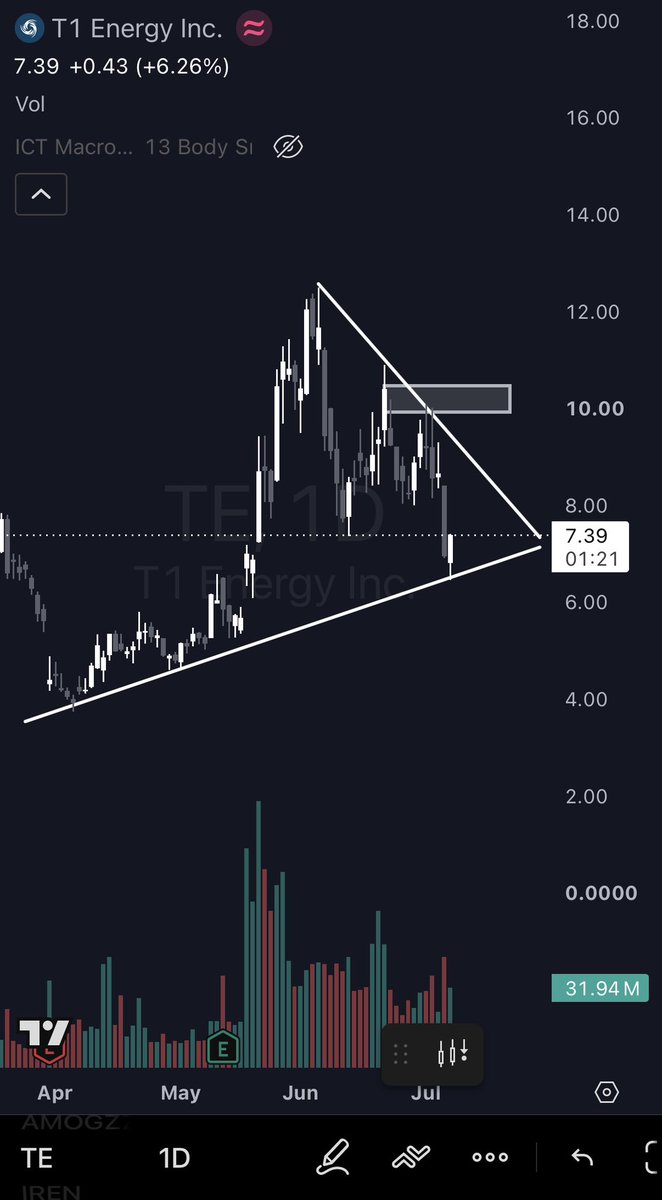
$Te It’s honestly insane how cheap we are right now.
We are currently trading under a $2b market cap in the middle of a huge energy crisis that is just starting to unfold.
People are vastly underestimating solar. Solar is the cheapest & fastest way to access power right now. Costs keep crashing, domestic production ramps up, and free sunlight is about to power the future while the market sleeps on it. Solar keeps making new records every single year. The U.S. added a record 43 GW of new solar capacity, marking its fifth straight year as the top source of new power.
T1’s G1 Dallas facility is already churning out hundreds of MW of high-efficiency solar modules with a clear path to multi-GW production this year, scaling insanely fast. Then you have G2 Austin which is under active construction and targeting first cell output in late Q4 with strategic financing in the works, which could be announced any day now. This vertically integrated solar powerhouse in the making is set to be an absolute game changer. That’s before we even start talking about the $1b+ forecasted revenue for 2026 and an expected shift towards positive EBITDA & Adj. EBITDA.
T1 recently acquired Kore Power which provides a strategic entry point into the Battery Energy Storage System (BESS) and AI data center infrastructure markets. This alone is just added potential, and not to mention they’ve acquired Kore for a very cheap price of $32m. Why so cheap? T1 is getting immediate EBITDA accretion ($15-$20m in 2027) and a proven U.S. based engineering/software platform for utility-scale storage, all while paying mostly in equity and tying sellers to results. In a market exploding with data center demand, this gives T1 massive potential at a fraction of what similar assets would cost.
Now here is where it starts to get interesting. A LOT of people have no idea about T1’s data center assets which could be MASSIVE catalysts, and it’s flying right under the radar. In Finland, they hold building permits and 300MW of power rights for an AI industrial site where Microsoft has already broken ground, prime real estate for hyperscalers who need ready-to-go capacity. Then In Norway, they’ve got a 50MW AI datacenter hull fully permitted with 396mw in queue. The power they have could generate high margin, long-term contracted revenue and cash flow with minimal capex, MASSIVELY derisking the business, and even the G2 Austin project itself.
I will continue to add at these levels with no hesitation🫠
$TE quick reminder while it sits at a $2bn market cap at $7.
You get:
- 5 GW solar module giga fab
- 2 GW solar cell fab under construction and 50% already financed through equity
- Kore Power Deal which adds about $20m in annual ebitda
- An AI industrial site in Finland with building permits and 300MW power rights where Microsoft has just started construction
- An AI datacenter hull with 50MW power in Norway
- about $1bn in forecasted revenue for 2026
Have a great weekend!
This is my trading journey from 2024 -> now
Every thing I’ve did in the past has been a learning experience which got me to where I am now. There has been days where I felt like giving up, hopeless, & defeated, but I stayed true to myself because I knew there was much to learn. Every opportunity whether it’s a fail or win, is a learning experience.
I first started with around $10,000 and fast forward to now I sit around $1.5m. I didn’t get this overnight, I got to where I am by staying dedicated to learning and never gave up over my four years in the market.
I do not sell a course and I do not look forward to selling a course. When I started posting on X, I enjoyed posting about my knowledge and helping people learn things about the market. I give my honest opinions, I share my holdings (with receipts) and I do like sharing my technical analysis completely free.
My first big play was $pltr which I got in around $16 with 500 shares. It ran all the way up to around $80 before I started taking my first big profits. It now sits around $130 & I still hold shares for the long term. My second big hit was $hims which ran all the way up to $70. I first got in before they first added compounded glp1 which is what started the run. My first buy was in the single digits around $8. As it got to around $15 I had around 1500 shares. I took my first profits around $40-$50, kind of missed a lot on the run to $70 but it ended up falling all the way down to $15.
I have 2 main brokerages, which are Robinhood & SoFi. Robinhood is more of my trading brokerage where I trade my options and also wheel options. I do use leverage, but mainly for selling options which net me great premiums. My biggest gain in a day was close to $300k which was from $iren. I had over 5k shares around $10 and a shit ton of calls at the time because I was starting to understand that data centers would be the bottleneck of Ai because ai needs energy. I still hold more than 4k shares of iren today. SoFi is more of my investing account but I do use leverage here and there which the most I made in a single month was $620k from mainly $Te, $oss, & $ampg shares + calls & $nbis, $mu, & $amd calls.
I did not start seeing these numbers overnight. It took countless days & nights learning about the companies I hold now, learning the basics of support & resistance levels, and overall knowing my entries & exits.
Disclaimer: I can only show up to 4 pictures on x so here is 4 of my biggest gains
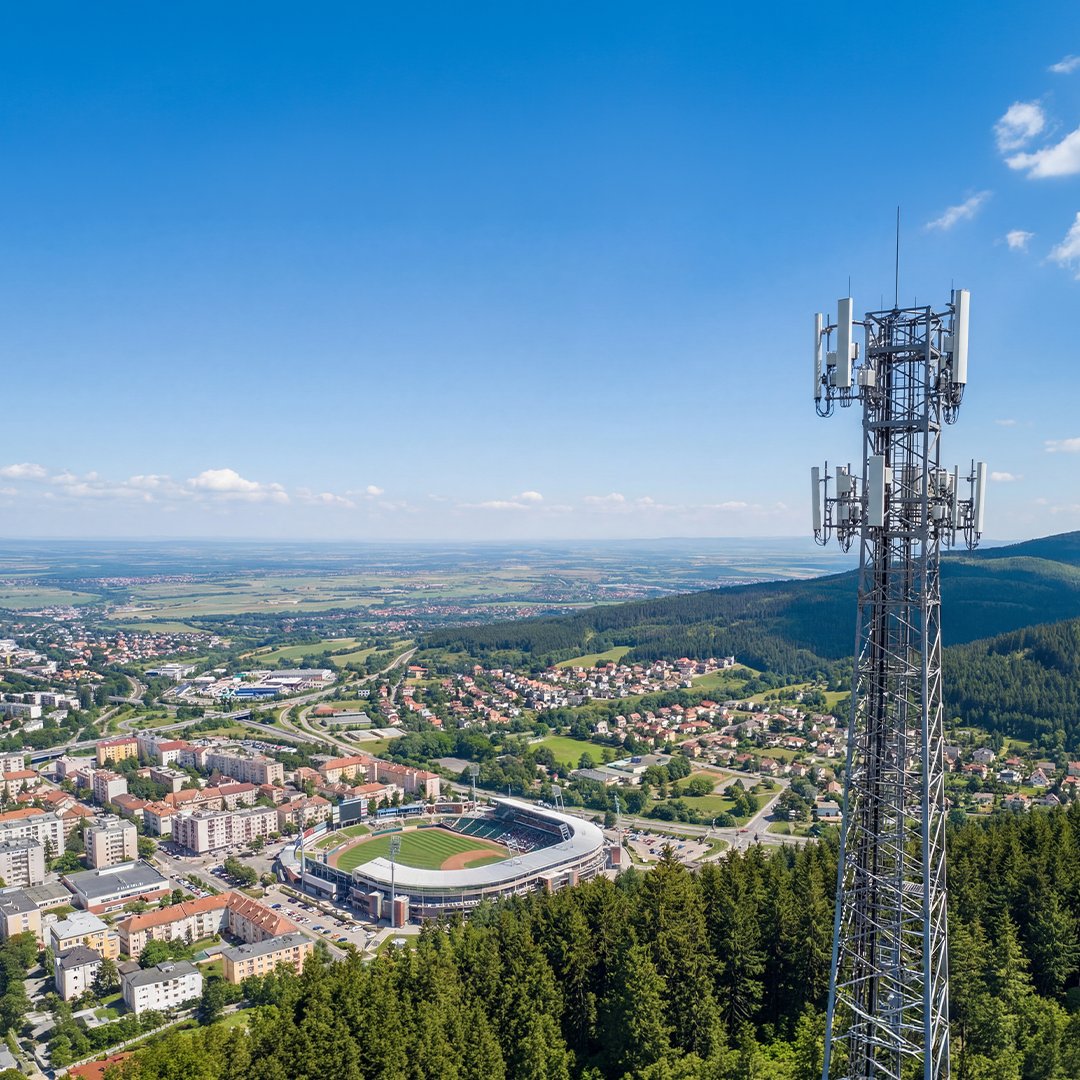
As AI-native models grow to handle real-world network complexity, legacy hardware constraints can limit what networks can achieve.
NVIDIA AI Aerial's GPU-accelerated, AI-native architecture enables a new class of Layer 1 and Layer 2 algorithms that help close the massive MIMO performance gap in real deployments, with up to 1.62x throughput gains in AI-based beamforming.
The shift to AI-native RAN is the path to enhancing performance, efficiency, and programmability for radio networks. Learn more ➡️ https://t.co/5ScM1LoWo4
Solar generated 15% of Texas's electricity in the past year.
Solar grew more in 5 years than gas did in 20 — *in absolute terms*, and more in the past 2 than gas did in 10.
$IREN at @RaiseSummit
Kent Draper: 3 layers of AI compute
1. Physical Infrastructure
2. Compute
3. Software & Services
Layers 1 and 2 are the key foundation, without those, your ceiling is capped.
I have been pounding the table on the superior model of a bottom-up approach.
@kentpdraper confirms that @IREN_Ltd sees it the same.
Having a strong foundation of land, power, grid connections, substations, owned GPUs, network core buildings, and storage, will unlock the amount of GPU hours that can be monetized up the stack.
It's very simple: with an abundance of physical infrastructure and chips — software is the layer that can be added when needed.
The foundation of the thesis rests on physical assets and power being scarce, and those are the limiting factors in your ability to grow faster than peers.