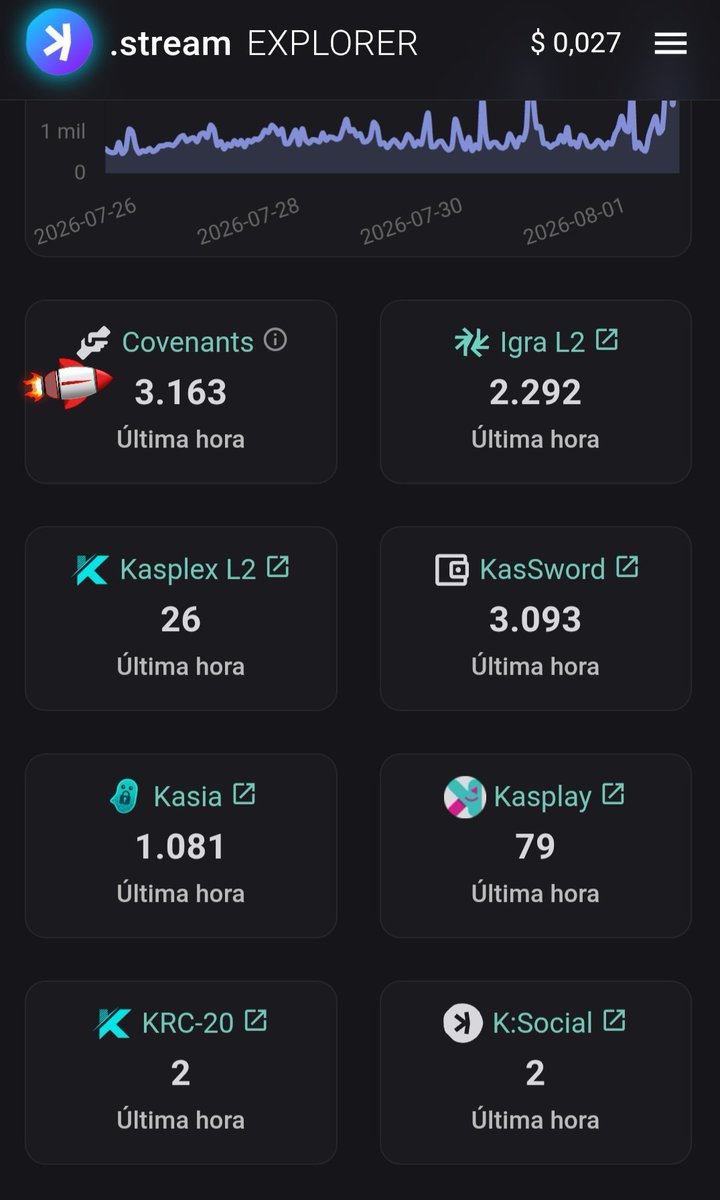
Kaspa can be understood as a digital dissipative structure: an open system maintained far from equilibrium by a continuous influx of electrical energy, computational work, transactions, and network information. Mining converts electricity into irreversible proof-of-work, but the network receiving that work is turbulent, blocks propagate unevenly, miners discover them concurrently, and every participant holds a slightly different view of the recent past. Traditional linear blockchains suppress this turbulence by slowing block production and discarding competing blocks. Kaspa instead operates at ten blocks per second and uses its blockDAG with GHOSTDAG to retain and order parallel block production, converting network disorder into a coherent, rapidly updating settlement history.
Toccata, extends this ordering engine into a programmable economic substrate through KIPs 16, 17, 20 and 21. Covenants now allow a UTXO to reveal its previous state, evaluate a permitted transition and require the transaction to recreate an authorized successor state. Covenant IDs preserve application lineage even as the underlying state and P2SH commitment change. More complex applications can publish ordered operations through dedicated lanes, execute computation off-chain and return compressed ZK proofs for verification by an L1 covenant; KIP-21 lets those proofs scale with the application’s own lane activity rather than the entire DAG. Kaspa therefore does more than convert energy into monetary finality: it can convert decentralized computation into verifiable, rule-bound economic state while preserving proof-of-work as the system’s underlying ordering force. @Themooseisloos5 :)
$KAS is internet-speed Bitcoin, which is exactly crypto's mission. Invest before adoption kicks in is a bet Kaspians are gladly taking. The risk-reward is highly in our favor at these lows.
Worst case: ride the altcoin tide.
Best case: discover the moon.
#Kaspa to the Top 5 🏆
KForge, a fair-launch token platform on Kaspa L1.
Anyone can launch a token, anyone can buy it, nobody can rug it. No presale, no insider allocation, no mint key. The chain enforces the rules.
Progress so far: launch, mint, and buy are all live on internaltestnet. Working through wallet signing, the sell side, and the full site next. Stay tuned for updates
Institutional advocacy is not conducted on X.
It is conducted directly with principals, CTOs, risk committees, legal counsel and compliance officers.
Kaspa’s native programmable layer is only a few weeks old. Security auditors are still studying covenants and the blockDAG architecture. That learning curve alone takes time.
Beyond the technology itself sit far heavier requirements that social-media commentary routinely ignores:
• Institutional custody frameworks demand proven controls, independent audits, insurance wrappers, and operational maturity before any serious capital is placed on a new layer.
• Procurement and public/private tendering processes follow multi-stage RFPs, due-diligence cycles, vendor risk assessments and board-level approvals that routinely run 12–24 months.
• Each industry carries its own mandatory standards - financial messaging (ISO 20022), energy settlement, supply-chain provenance, sanctions screening, data-residency rules and sector-specific regulatory sandboxes. Meeting those standards is not optional and cannot be accelerated by tweets.
Sandbox testing, formal verification, regulatory engagement and independent security review all operate on institutional timelines, not crypto-Twitter timelines. Asking major institutions to move valuable assets onto a newly programmable layer without that groundwork is not “ambition” - it is ignorance of how these organisations actually work.
Those of us doing the substantive work understand the sequence and the constraints. Those who do not should stop confusing volume of posts with progress. Patience is part of getting it right.
$KAS as we approach official release of KaChat 3.0 work is well underway for 4.0. Here is what to expect.
4.0 The Everywhere update
KaChat is coming to desktop so it can be used as a website or as a web app on your computer. Completion of this would mean KaChat is available on every device!
For KaChat to work it requires your phone to connect to a Kaspa node and Indexer to be able to load all of your messages and transaction history.
By default you connect to nodes and indexers that are ran by someone else. 4.0 intends to bring proper documentation and possibly software so that everyone can easily run their own infrastructure and no longer be reliant on third parties if you don't want to.
Tangem support. This will allow users to simply import their already created Tangem wallet and manage their Kaspa with all the features KaChat offers such as multiple addresses support and coin control.
KaPosts. KaPosts will allow you to like, dislike, repost, follow, and comment on posts made to the Kaspa network.
Google Cloud and native notification support for Android.
Potential integration of nextcloud to store your messages across devices so that you can run your own cloud and data.
Hope you enjoy KaChat!
Happy KaChatting!
UPDATE: 🚨 Galaxy Research says nearly 1,200 addresses were drained of over 1,000 BTC, worth about $70M, in transactions linked to the COLDCARD hardware wallet vulnerability.
Things you might find interesting this morning:
- Weak entropy is the quietest failure in self-custody.
- Key generation should provide at least 128 bits of entropy.
- Tangem cards generate keys inside the secure element, using its hardware TRNG.
Stay safe out there.
Kaspa is sitting 86.9% just 0.1% below its all-time low drawdown level.
Price peaked at $0.2075 and has spent the last year grinding into the -75% to -87% zone, now near the deepest drawdown of the whole period, max was 87.0%.
Brutal on the chart, but this is also where the on-chain picture has been quietly tightening: supply going dormant, coins leaving exchanges, holders sitting through the pain rather than selling it.
Ledger is not affected by the recently published Coldcard Mk3 advisory.
Ledger devices use a certified True Random Number Generator (TRNG) built directly into our Secure Element chip, generating full 256 bits of entropy for every 24-word Secret Recovery Phrase. Please refer to this article for more information: https://t.co/wYlVHAeiVX
Coinkite has published a security advisory regarding certain Coldcard Mk3 firmware versions - you can read their notice here: https://t.co/uHkzcCWoBW
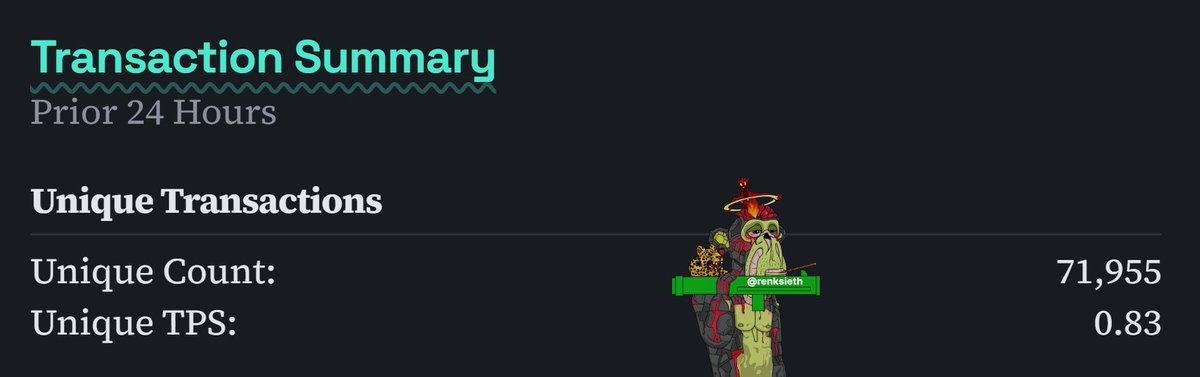
71,955 unique $KAS transactions in the last 24h
nearly 72k people moving value around while CT keeps staring at the price
kaspa usage is still there
just waiting for attention to catch up
BREAKING: 🚨 Massive attack drains nearly 600 $BTC from ~500 Bitcoin wallets.
An attacker exploited a Coldcard Mk3 seed generation flaw to steal 594 $BTC (~$38M) in a 25-minute attack.
The bug made some Mk3 recovery phrases predictable due to weak entropy.
HUGEEE 💥
OVER 1 MILLION CALLS AND EMAILS HAVE NOW BEEN SENT TO U.S. SENATORS IN SUPPORT OF THE CLARITY ACT, SAYS COINBASE’S FARYAR SHIRZAD.
THE PRESSURE IS ON 🚀
Argent is shaping up to be one of the most important developer layers in Kaspa’s new programmability stack because it lets builders think in terms of entire applications instead of isolated covenant scripts. The basic model is simple: each actor is a stateful covenant UTXO, each actor owns typed state, and each entrypoint defines how that actor can be consumed and recreated. When an action happens, Argent describes the whole transaction-wide state transition using "consumes", "emits", and "become", then compiles that logic into ordinary Silverscript and ultimately native Kaspa Script.
This matters because multi-contract covenant systems get complicated fast. Developers otherwise have to manually manage state serialization, output ordering, covenant IDs, template hashes, route commitments, cross-contract state reads, hidden witnesses, and successor validation. Argent moves most of that mechanical work into the compiler while keeping the generated ".sil" contracts visible and auditable.
Argent also introduces Inter-Covenant Communication, or ICC. This allows independently deployed covenant applications to coordinate inside the same atomic transaction. One covenant can observe another covenant’s inputs and outputs, verify its state transition, or require that another covenant ID is co-spent. Closed ICC links directly to a known application, while open ICC uses "actor_type<State>" handles so different implementations can interact through a shared state interface.
The runtime side is equally important. "argent-runtime" loads compiled artifacts, builds the correct covenant UTXOs, fills hidden route and template witnesses, assembles multi-actor transactions, measures actual script-unit usage, and calculates the required compute budget for Toccata transactions.
Argent is still experimental and not production-ready, but the direction is clear: Silverscript handles individual covenant logic, while Argent provides the application-level language, linker, artifact system, and transaction planner needed to turn many stateful UTXOs into one coherent Kaspa application.
Kaspa Native is live!
A new X account and YouTube channel for native Kaspa development.
Starting with an Argent live coding session, building a simple multi-actor ticketing app from start to finish
>
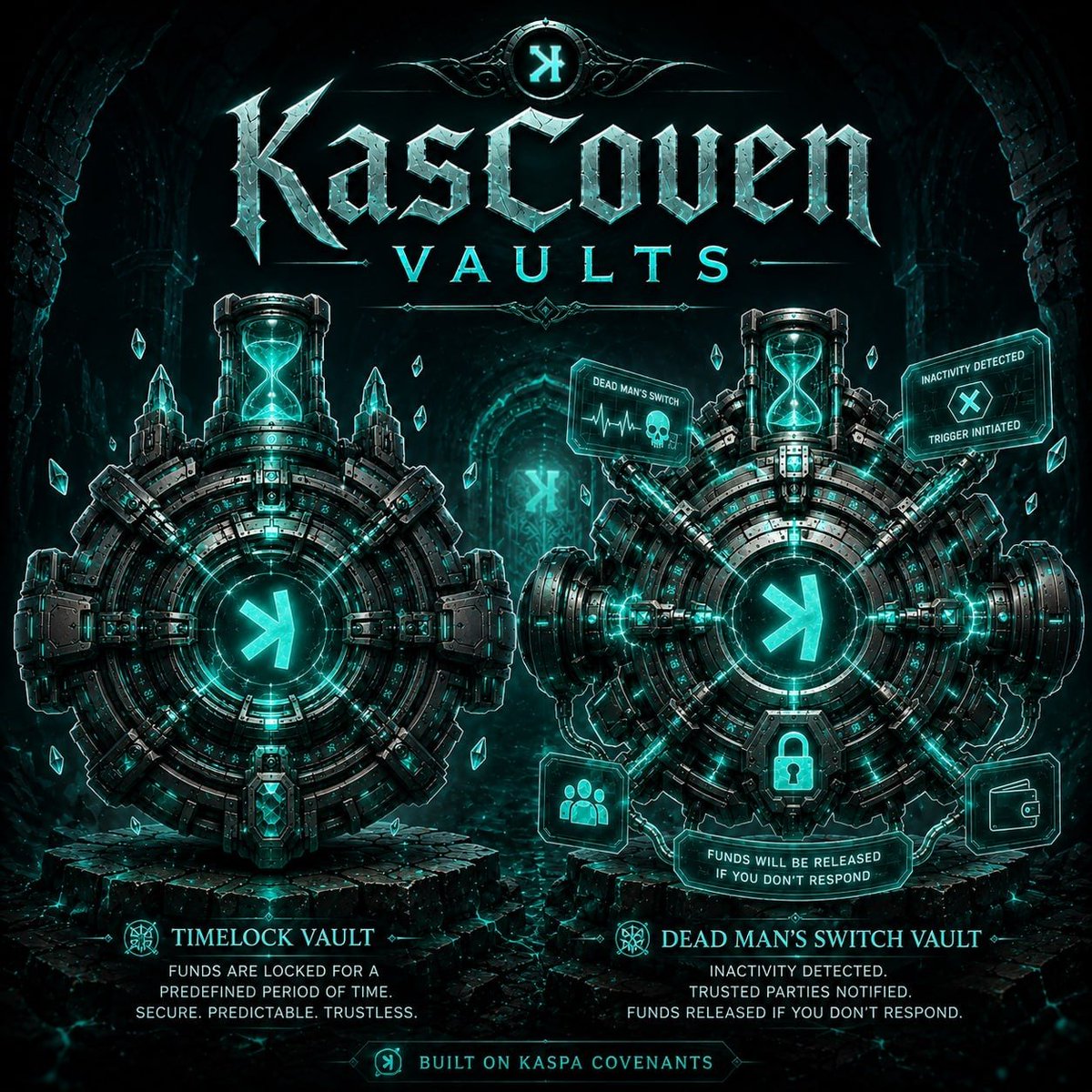
🔐 Introducing KasCoven Vaults: KasCoven Vaults brings programmable self-custody to Kaspa.
Create native $KAS vaults whose rules are enforced directly by covenant logic and Kaspa consensus, not by a company, custodian or centralized backend.
⏳ Time-Locked Vaults
Lock Kaspa until a chosen Kaspa DAA score. Once the deadline has passed, the funds can be returned to the owner wallet.
💓 Dead Man’s Switch Vaults
Secure KAS for a beneficiary. The owner can reset the inactivity period with an on-chain pulse. If no pulse is sent before expiry, the beneficiary can claim the vault.
Key features:
— Non-custodial by design
— Covenant-enforced release conditions
— DAA-based timing with human-readable duration controls
— Automatic on-chain vault discovery
— Portable recovery files and a self-hostable recovery tool
— Support for your own Kaspa node
— Open-source and independently deployable
Your keys remain in your wallet.
Your vault rules live on Kaspa.
Your money. Your rules.
🌐 https://t.co/NOVj40IWpy
Open source code on GitHub: https://t.co/0tmfUkYvBO
Notice: covenant logic is still fairly new on Kaspa and considered experimental. Checkout creating vaults with small balances first. We performed over 700 mainnet vaults in the last 3 weeks during the development stage, with zero vaults that couldn't be opened.
PS: tomorrow we will create a special 1000 $KAS vault that can be opened by anyone. We will share the link to the prize vault to everyone who creates minimum 3 vaults, no matter the amount 👀
BREAKING: 🇺🇸 Republicans and Democrats reportedly reached a bipartisan deal on an ethics package in the CLARITY Act.
Details have not yet emerged, and White House approval is still needed.