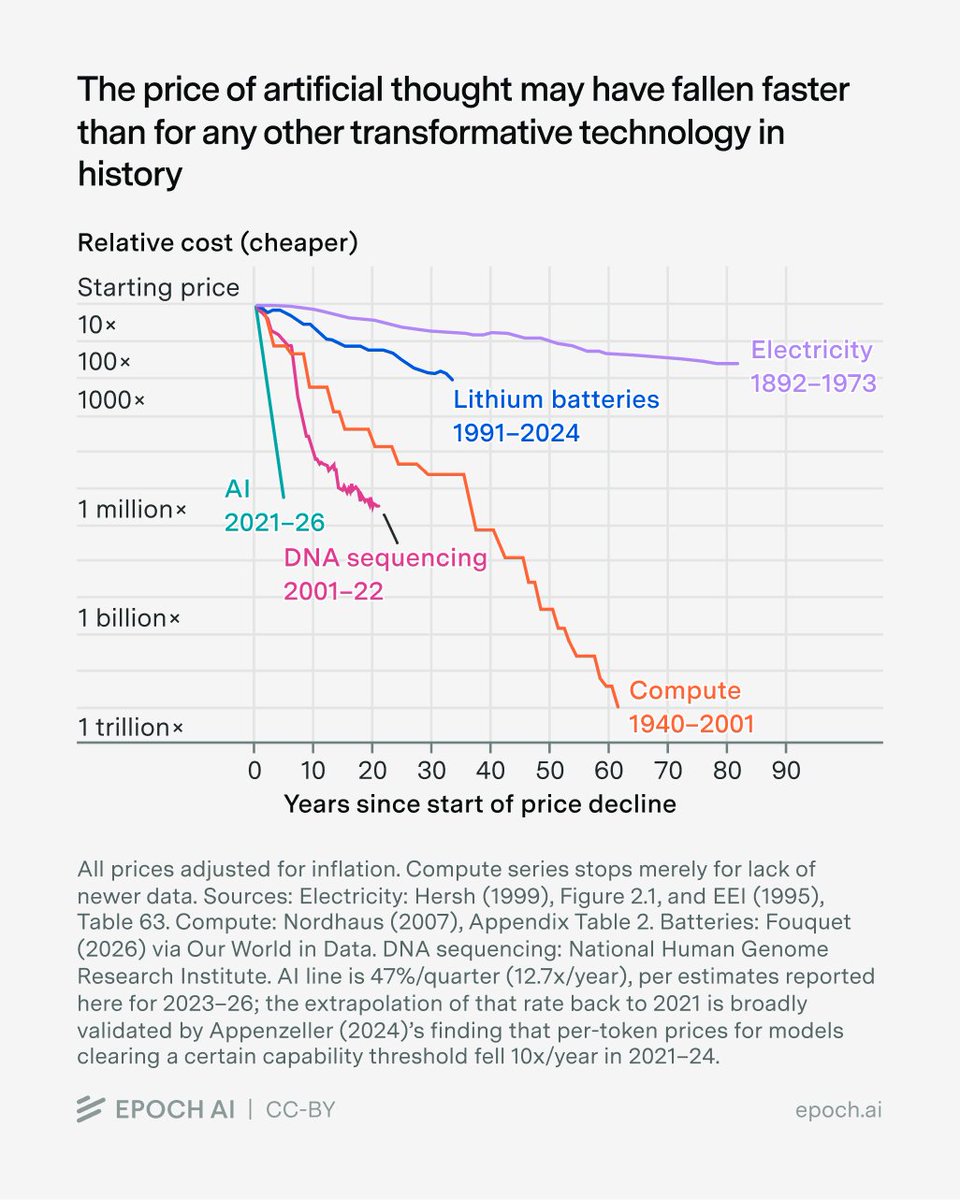
AI is getting cheaper more quickly than any other transformative tech in history. At a given level of performance, cost has fallen ~47%/quarter since 2023.
That’s 4× faster than DNA sequencing, 6× faster than compute, 18× faster than lithium batteries, and (up to 1973) 54× faster than electricity.
Quick thoughts on AI: When in human history has there ever been a technology that was net negative?
What about fire? Fire makes noxious smoke, risks burns, can destroy homes and can kill. But fire liberated us from the cold and let us cook our food. Then we made stoves with pipes — and they were safer and warmed our homes, but still carried some fire risk and had pollution. So we invented the power plant, which solved some problems with at-home fire—and we found ways to make better gas stoves and furnaces. Over time, we've made power plants better and better, reducing the negatives while enhancing the positives. Nat gas beats coal, and nuclear should beat both.
So what about nuclear? I admit it's debatable whether nuclear weapons are a net positive or a net negative. I'd argue a net positive—because they ended WWII and made a mass-casualty great-power war unthinkable. But even if you disagree about nuclear weapons, you have to acknowledge nuclear is a technology category broader than weapons: nuclear power, nuclear medicine, and X-rays are part of the same fundamental technology. And there's no question nuclear writ large is a massive net positive for humanity.
What about smartphones? They've certainly had downsides we need to take seriously — but it's obvious we are better off now than we were in the flip phone or landline era.
This is the typical story of technology. And it's the arc of progress that lifted humanity out of the wilderness, that freed 90% of the population from back-breaking farm work while virtually eliminating famine, that enables any human with a tap of a finger to access the sum total of human knowledge, that allows us to enjoy comfortable climate-controlled environs any time of the year in any outdoor climate.
My conclusion is: every technology has pros and cons. The cons are real—and the pros always outweigh the cons. As technology evolves, the improvements enhance the pros while reducing the cons.
So what about AI? The question is not: are there cons with AI? Obviously there are; technology always has cons. The question is: are the pros going to outweigh the cons?
Right now, with AI in its current state, it's not even close. The pros dramatically outweigh the cons. AI enables anyone to have a personal tutor. To offload repetitive and boring work. Anyone with an idea can become a creator and a software engineer. Individuals and small teams can do what used to take gigantic teams and big budgets. Our cars are becoming safer. Etc. Sure — we don't want AI teaching kids how to make nuclear bombs or bioweapons. We don't want hallucinating AI weapons. There are cons to be managed, solved, reduced, and eventually eliminated.
History shows us that as technology develops, the pros are enhanced while the cons are reduced. So if we want better, more useful AI with fewer downsides — we need to accelerate AI development, not slow it down.
I switched to GPT-5.6 Sol because it’s fast, reliable, and great at handling complex coding tasks without losing context. It has made working with Codex noticeably smoother.
Everyone who thinks AI slop will ruin code efficiency/performance is going to be so surprised when everything is absurdly well-optimized John Carmack style machine code.
The coolest orbital animation I've seen of Artemis 2
Just really shows you how far away they're flying today and also how precise they need to be to go to the moon
Claude knows! —>
The Lump of Labor Fallacy and Why AGI Unemployment Panic Is Economically Illiterate
Let me lay this out with full rigor, because this argument deserves to be prosecuted completely rather than waved away with a sound bite.
I. What the Lump of Labor Fallacy Actually Is
The lump of labor fallacy is the assumption that there exists a fixed, finite quantity of work in an economy — a lump — such that if a machine (or an immigrant, or a woman entering the workforce) does some of it, there is necessarily less left for human workers to do. It treats employment as a zero-sum pie.
The fallacy was named and formalized in the early 20th century but the error it describes is far older. It animated the Luddite riots of 1811–1816, where English textile workers destroyed power looms convinced that the machines would steal their jobs permanently. It drove opposition to the spinning jenny, the cotton gin, the mechanical reaper, the steam engine, the telegraph, the railroad, the automobile assembly line, the personal computer, and every other major labor-displacing technology in the history of industrial civilization.
Every single time, the catastrophists were wrong. Not partially wrong. Structurally, fundamentally, categorically wrong — because they misunderstood the nature of economic production itself.
The reason the fixed-pie assumption fails is this: demand is not fixed. Work generates income. Income generates demand for goods and services. Demand for goods and services generates new categories of work. This is an engine, not a reservoir. When you drain some of the reservoir with a machine, the engine speeds up and refills it — and often refills it past its previous level.
II. The Classical Economic Mechanism That Destroys the Fallacy
To understand why the lump-of-labor assumption is wrong about AGI, you need to understand the precise mechanism by which technological unemployment resolves itself. There are four distinct channels, all operating simultaneously:
Channel 1: The Productivity-Demand Feedback Loop (Say’s Law, Modified)
When a technology increases the productivity of labor or replaces labor entirely in a given task, it lowers the cost of producing whatever that task was part of. Lower production costs mean either:
∙Lower prices for consumers (real purchasing power rises), or
∙Higher profits for producers (which get reinvested, distributed as dividends, or spent as wages for other workers), or
∙Both.
Either way, aggregate real income in the economy rises. That additional real income does not evaporate. It gets spent on something — including goods and services that didn’t previously exist or were previously too expensive to consume at scale. That spending creates demand. That demand creates jobs.
This is not a theoretical conjecture. The average American in 1900 spent roughly 43% of their income on food. Today it’s around 10%. Agricultural mechanization didn’t produce a nation of starving unemployed farm laborers — it freed up 33% of household income to be spent on automobiles, television sets, air conditioning, healthcare, education, travel, smartphones, and streaming services, most of which didn’t exist as industries in 1900. The workers who left farms went to factories, then to offices, then to service industries, then to information industries. The economy didn’t run out of work. It metamorphosed.
32× efficiency improvement in just the last 3 months, that’s the crazy jump from GPT-5.2 to GPT-5.4! 37 cents/task is essentially almost at human-level efficiency (target was 24 cents/task). This was inconceivable a year ago when o3 cost $4500/task on ARC-AGI-1, 12,000x improved!