The Mandy Files — 7
Perhaps a succinct précis of what ails this government, with Keir Starmer the heart of the problem:
Mandelson: ‘They [10 Downing Street] don’t work as a team, they are not led and none of them really know what Keir [Starmer] thinks or wants.
‘In fact most of them don’t think Keir knows what he wants.’
In these 33 words Mandelson sums up why this government , despite its landslide majority, has gone off the rails so quickly and so completely.
It's incredibly febrile tonight:
* Three Cabinet ministers including Shabana Mahmood, the home secretary, told the PM today he needs to consider his position. Ed Miliband, the energy secretary, did so a fortnight ago.
* Tomorrow's Cabinet meeting is going to be absolutely extraordinary. The PM appears adamant that he is going nowhere. Ministers say his position is unsustainable. Rock meet hard place
* Cabinet is divided. David Lammy, the deputy PM, is supporting Starmer and making calls on his behalf to try to rally support as per @BethRigby . But Cabinet ministers privately say it is unsustainable.
* Wes Streeting, the health secretary, is preparing to mount his bid for Number 10. He has been working on it for months. His PPS and some of his closest allies went over the top ahead of him today
* Starmer's loyal Cabinet ministers believe that Streeting has orchestrated the entire coup. One accused Starmer of pushing the party into 'internescine warfare'
* A total of ***75*** Labour MPs have gone over the top. This includes five ministerial aides. It represents more than a quarter of the parliamentary party
* By tomorrow morning we will have the symbolic 81 MPs publicly calling on PM to go. Separately Catherine West already has 81 signatories to her letter. The intent here is to try to force the PM out. But what if he refuses to go? This could get very, very messy indeed
* Lastly the markets tomorrow morning are likely to be carnage. Expect the cost of government borrowing to soar. The political instability plus further turmoil over Iran bodes very badly for the economy
With all results in, the correlation between 2016 Leave vote and 2026 Reform vote is even more striking.
The link? Urgent underlying problems in Labour's former heartlands that look no closer to being addressed.
This ought to be Starmer's focus:-
https://t.co/Bbxf4cT26G
Today’s elections could be the most consequential of my lifetime, outside of a general election.
Here’s why.
First, if they are as catastrophic for Labour as some polls indicate, they may send Labour MPs into paroxysms of despair, and set in train a challenge to Starmer’s leadership of the party and country.
That would lead to governmental paralysis and turmoil in bond markets - even if in the end Starmer survives.
Buckle up.
Second, if Reform does as well as expected in English local elections and in Scottish and Welsh parliamentary elections, at that point many would see them as the real representatives of right-wing Britain.
That would be a challenge to the status and authority of the Conservative Party, for all that Kemi Badenoch is widely seen to be performing effectively as their leader and they remain the official opposition in parliament.
Talk of Reform eventually absorbing the Tory Party, before the next general election, would only intensify.
Third nationalist parties are like to be in charge in the parliaments of Scotland, Wales and Northern Ireland: the SNP and Plaid are almost certain to form new respective governments in Scotland and Wales, and Sinn Fein is already the senior partner in Northern Ireland’s assembly.
This doesn’t mean that formal break up of the UK is imminent. But if you believe as I do that Newton’s first law applies to politics, it means the integrity of the UK would be much less secure than it was.
Fourth all the polls indicate the LibDems are treading water in terms of national vote share, and that disillusionment with the government and Tories is disproportionately benefiting Reform and the Greens.
Given that the LibDems, or Liberals as they once were, would in the past have benefited from the ailing popularity of the two big parties, questions will be asked about whether Ed Davey is the most appropriate leader for these chaotic times - for all that his party hoovered up more seats in the last election than for decades.
By contrast and fifth, the Greens have surged thanks in large part to the positive charismatic force of one person, its leader Zack Polanski. Which implies the party has a lot of policy work to do to consolidate its position and be taken seriously as a potential party of government.
Sixth, the big story will be that there are now at least seven parties on the British mainland - Reform, the Greens, the LibDems, the SNP, Plaid Cymru, Labour and the Conservatives - with legitimate claims to have meaningful national, regional or local vote shares.
So today could be the definitive end of Britain’s 250 years of two party politics. And because this degree of fragmentation is so new, it brings enormous uncertainties and dangers.
It means, for example, that - under our first-past-the-post electoral system - a party could win the votes of just one-in-six of us and yet have an absolute majority of MPs.
For the majority to be subject to rule by the representatives of such a small minority would be a duck that does not quack democracy.
It would be a crisis infecting our most important institution, parliament itself. As I say, today’s polls matter.
My monologue from today’s The Times at One with
ANDREW NEIL @TimesRadio
SAY FAREWELL TO ENGLAND’S TWO PARTY SYSTEM
Tomorrow’s various elections in England, Scotland and Wales will ignite yet more fires under Keir Starmer’s leadership as Labour goes down in flames in all three nations. But they will also mark something more significant: the demise of the century-old two-party system in England.
In a sense this is just England catching up with the rest of the country: Scotland, Wales and Northern Ireland have long been multi-party systems. But England joining the multiple-party flock is more significant — and more far-reaching for the direction of British politics.
There was a time — within recent memory — when Labour or the Conservatives could win clear overall majorities in the House of Commons with just over 40% of the vote. Tomorrow Labour and Conservative will be lucky to get 35% of the vote combined.
The latest YouGov poll puts reform on 25%, Labour, Tories, Greens and LibDems clustered behind at 18%, 17%, 15% and 14% respectively. On other words instead of Labour and the Tories winning the lion’s share — way back in the Labour landslide of 1945 they took 97% — votes are spread if not evenly then more generously over five parties.
That alone marks the demise of the two parties. But there’s an added factor. We’re moving to a multi-party system but we still have a first-past-the-post voting system designed for two-party contests.
This is not an argument for proportional representation, which has a myriad of its own problems. But it cannot be denied that a multi-party system with first-past-the-post can result in something of what the Americans would call a ‘crap shoot’.
Consider this. There was a time last year when Reform topped 30% in the polls. Every point above 30% makes it more likely Reform would be the largest party in the Commons, with perhaps even an overall majority.
But Reform, though still in the lead, has fallen back since then, as the latest polls confirm. Imagine at a general election Reform won 25% of the vote and, say, Labour 20%. It is perfectly possible that Labour, given the vagaries of our voting system in a multi-party setting, would end up with more seats than Reform — perhaps a lot more.
For elections to have democratic legitimacy there has to be a broad if not exact correlation between vote share and seats won. But in this case there would not be, raising the spectre of a post-election political crisis — and giving bond and currency markets further cause to wonder if Britain’s fabled political stability was a thing of the past.
One more thing. There is no question we’ve fallen out of love, big time, with Labour and the Tories. Tomorrow will be proof positive of that. But we haven’t really fallen head over heels for the new insurgents either. Reform, as we’ve seen, has fallen back.
Now that the Greens are being subject to proper scrutiny, revealing a disturbing number of nut jobs in their ranks, they too are in some trouble — as evidenced by the plummeting popularity in recent days of Green leader Zack Polanski.
Reform and the Greens will nevertheless be the big winners tomorrow. But even as Labour and the Tories struggle to remain relevant the bloom is already off the insurgents. Which suggests that, come the general election, the vote will be shared every which way.
I shed no tears for the demise of Labour and the Tories. But I have yet to see much salvation in the Greens or Reform. The end of the old-two party system opens new possibilities. But it also creates new uncertainty. We might not regret the passing of the old but as yet we have no idea of the shape of the new.
We are entering a period of political disruption, perhaps even some chaos. It promises to be exciting. But it will also be unnerving. You can understand why those who lend us billions, invest in our country and hold our currency are feeling more than a tad nervous.
Since the 2024 general election, this Labour government will have passed more than 50 Acts of Parliament, each of which works to rebuild the British state, so that it once again serves the interests of working people.
These include:
👷🏻♂️The Employment Rights Act, the biggest upgrade in workers’ rights in a generation
🚊The Passenger Public Services (Public Ownership) Act, establishing Great British Rail – a publicly owned and accountable body to improve rail services and keep fares low
⚡️The Great British Energy Act, establishing a publicly owned organisation to bring clean energy and cheaper bills to British consumers and industry
🏠 The Renters Rights Act, providing renters with security and dignity in housing by outlawing no-fault evictions amongst other protections for private renters
🧑🧑🧒🧒 The Removal of Two Child Limit Act, bringing 450,000 children out of poverty and providing security to working families by removing the arbitrary two-child benefit cap.
🌊The Water (Special Measures) Act, reversing the Tory decline in environmental standards and accountability in the water industry, empowering consumers and holding water bosses to account.
👮The Crime and Policing Bill, tackling violence against women and girls, anti-social behaviour and retail crime, whilst rebuilding public confidence in policing and the wider criminal justice system.
🏘️ The English Devolution and Community Empowerment Bill, making good on our promise to give back control to local communities and provide mayors with unprecedented powers to deliver growth.
Labour promised to rebuild our country, and that is exactly what we are delivering. Lots done and lots more to do to restore pride in Britain.
🍂 The Committee is currently considering its report on drought preparedness following 11 evidence sessions and 86 written evidence submissions.
🟥 Follow us to be notified when the report is published!
🔗 For more information: https://t.co/yQRGOxYAqC
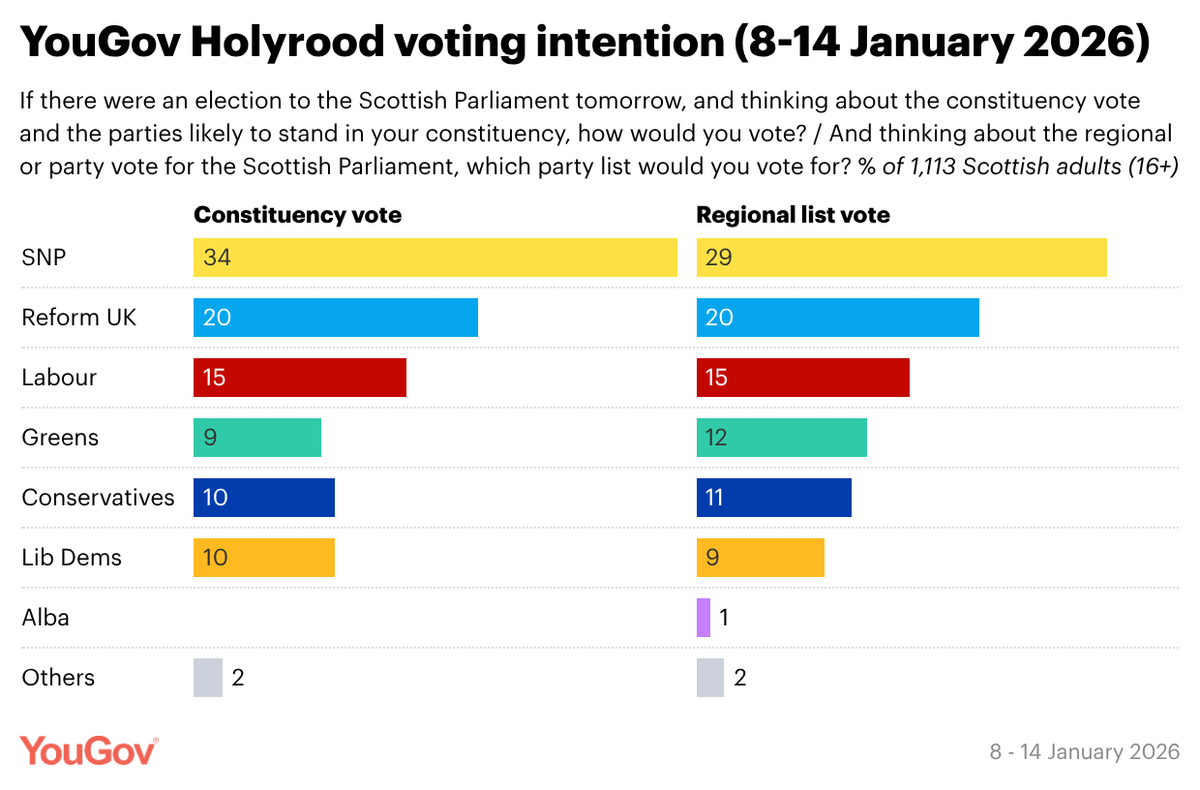
YouGov's first voting intention poll for the 2026 Scottish Parliament election shows clear leads for the SNP, with Reform UK now in second place
Constituency vote
SNP: 34% (-14 from 2021 election)
Ref: 20% (New)
Lab: 15% (-7)
Con: 10% (-12)
LD: 10% (+3)
Grn: 9% (+8)