The coding interview is dead, at least for my team at Anthropic. I've seen enough to know that it no longer provides signal. I removed it from loops this month.
I have a spicy, optimistic take - I think there's an opportunity for junior engineers: https://t.co/PVvpQCbQtK
Over the past two months, we have been leading a coalition to mitigate one of the most severe bugs in open source software found in recent memory, php2shell, found as part of our Patch the Planet initiative. https://t.co/rBsz7lrlwo
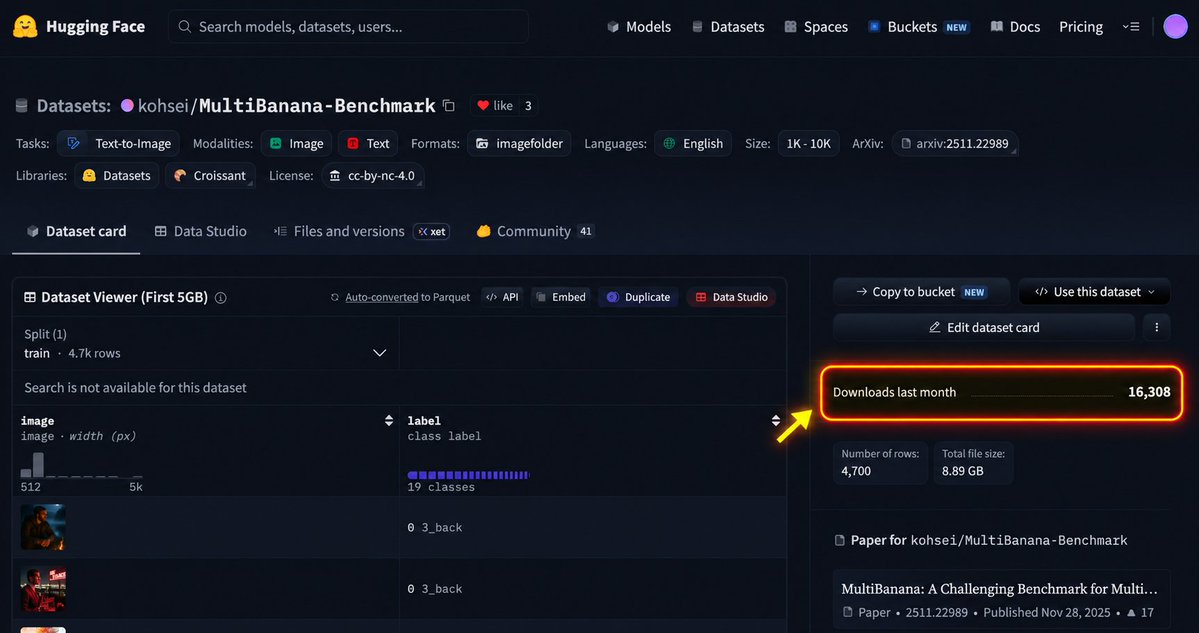
MultiBanana just passed 100K downloads on Hugging Face 🍌
It's #7 among text-to-image datasets this month 🔥
Thank you to everyone using it!
👩💻🧑💻 https://t.co/63c0axpfVY
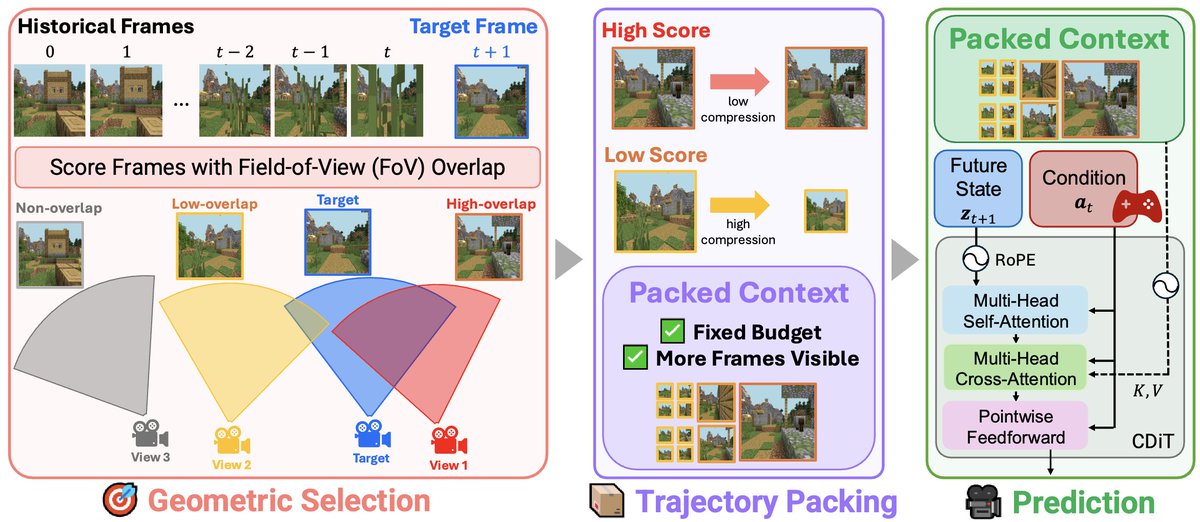
Coding agents are emerging as general robot policies, but they are still inefficient (e.g., requiring long real-world exploration), especially in mobile manipulation.
Humans become efficient by watching others.
Can coding agents learn from passive human videos, just like we do?
Introducing MoCaP: Mobile Code-as-Policies for Zero-Shot Mobile Manipulation from Passive Human Videos
↓🧵
Anyone can simulate the future. But the simulation only matters if it’s trustworthy.
At Simile, we train two types of models: simulation models and confidence models. Our first research blog post explores the origin of our proprietary confidence model, which predicts the accuracy of our population simulations and, in turn, makes them actionable.
https://t.co/qz0yPZzY55
My summer project is done! A 20 video, free course on post-training to accompany my book is all on YouTube with slides open for modification & re-use.
~12 hours of content covers the core foundations and some research areas I think will grow in importance. It was a fun time to review all the fundamentals again, as it is clear in the next 1-3 people the amount of people wanting to learn post training will likely 100X again from today, as we have already 100X'ed from two years ago.
As AI agents get increasingly capable at coding and discussing these fundamentals (see the code exercises accompanying the book that I am refining with the community) I think developing clear intuitions for how models work and why is one of the most important skills going forward in AI. Still, learning the post-training math is the best way to battle test them. I personally just in this course am starting to master how forward/reverse KL relates to post-training topics.
Thanks to all my viewers, and I'm happy to answer questions in the book discord or understand how to better teach the various reward models, on-policy distillation, new RL algorithms, etc.
Plus, the book is 50% off right now with the code PBLambert on Manning to celebrate the launch.
I'll share the relevant links below.
Who's going to make this course for pretraining?
Does LLM really need to be a helpful assistant all the time?
No. If you want to simulate people, “perfectly helpful” could be the wrong objective.
Meet OdysSim, a journey toward LLMs beyond assistants, as behavioral foundation models (10B tokens of real human behavior; 23 sim benchmarks, finally in one place. new open models: outperform or on par with GPT-5.5, Gemini 3.1, or Claude Opus 4.7 in many behavior-sim dimensions).
Human behavior simulation is becoming essential.
Agent evaluation needs realistic users before real users show up. Medical and classroom training need realistic patients and students. Social science needs synthetic participants at scale.
But real people are not ideal assistants.
Real patients panic or ignore good advice. Real students misunderstand. Real customers are vague, picky, impatient, or simply leave. Human behavior is messy, diverse, and often imperfect.
Frontier LLMs are getting better at math, code, and long-horizon tasks. They are NOT getting better at simulating human behavior. If anything, they drift the other way: more assistant-ish, more homogeneous, fewer of the errors and quirks real humans show.
This is no accident. The whole pipeline is built for helpfulness and task success, not behavioral realism.
And you can't prompt your way out of that.
So we rethink the recipe from scratch and release:
🧠 The OdysSim corpus: 21.4M real human interactions (~10B tokens) from 62 sources, every conversation retrofitted with social grounding (who is talking, and why)
📏 SOUL-Index: 23 human-behavior benchmarks unified into one suite across 5 axes
🤖 OSim-8B: open weights; tops more SOUL-Index benchmarks than any frontier model, acts more like a real user than any of them on τ-bench (nearly matching real humans in the reaction dimension), and writes far more human-like text along the way.
I’ll present MultiBanana, a multi-reference text-to-image benchmark, at #CVPR2026 from 10:45 AM to 12:45 PM on Fri, Jun 5.
🔥 16k+ downloads on Hugging Face last month!
See you in Denver! ⛰️
📄 https://t.co/MsoBllVmA8
💻 https://t.co/63c0axpfVY
🤗 https://t.co/XFMJj8xujj
Our paper was accepted as a #ICML2026 Spotlight!
Reasoning in LLMs has improved largely by chaining local steps. But is that the whole story?
Humans occasionally make inferential "leaps" across domains, a faculty known as analogy.
We design a synthetic task to show how small Transformers acquire analogical reasoning, and find that the same signatures appear in pretrained LLMs.
arxiv: https://t.co/1WCizIKWly
code: https://t.co/82kOKCtJo7
We’re dropping Gemini Omni: our first step towards a model that can create anything from anything - starting with video.
It combines Gemini’s intelligence with our generative media systems - representing a leap forward in world understanding, multimodality, and editing 🧵
🎉A co-authored paper is accepted to #CoNLL2026 🎉 Congrats to @KH_ls_ippon and all !!
We propose a method that iteratively refines rubrics of LLMs to calibrate human graders of essays. The created rubrics provide us with valuable insights, making implicit knowledge explicit.
Aha, thank you for the kind words! We’re exploring what “frontier lab” means in academia—through democratizing cognition and embracing “less is more” & “simple is powerful”.
Recent releases:
- agentic intelligence: davinci-dev, davinci-agency, davinci-env
- open foundation model: davinci-llm, davinci-magihuman
- data efficiency: (lima) limo, limr, limi
- benchmark: agencybench, researcherbench, innovatorbench ...
- data darwinism PartI, Part II
- interaction as Intelligence: Part I, Part II
- engineering: prompt engineering, cognition engineering, context engineering 2.0
More at:
https://t.co/x4Nw4qohCX
Our North Star: Using AI technology to make life better for people around us.
Would love to exchange ideas if any of these interest you!