Sometimes it’s hard to know how to stand with fellow pastors when they face hardship—suffering, sickness or the public eye.
Our brother @jonathanparnell has just been thrust into the public eye in ways he never asked for that won’t end quickly.
Join me in blessing him: a coffee, a lunch, some cash for babysitters to rest after this.
I remember watching a Ligoneir Q & A shortly before moving for seminary. Sinclair Ferguson was asked what advice he would give a younger version of himself and he said, “I only wish I’d known my Bible better so I might have been of use to people.”
I knew then and there that I needed to know my Bible A LOT better, especially if I was going to go into ministry.
My first semester in seminary I committed that I would read the whole Bible 4x that year. I have not kept quite that pace but last night I completed my 21st read through of the Bible in the last 7 years.
This discipline requires reading anywhere from 10-15 chapters a day and takes anywhere from 40 minutes to an hour total each day.
Here is how I do it:
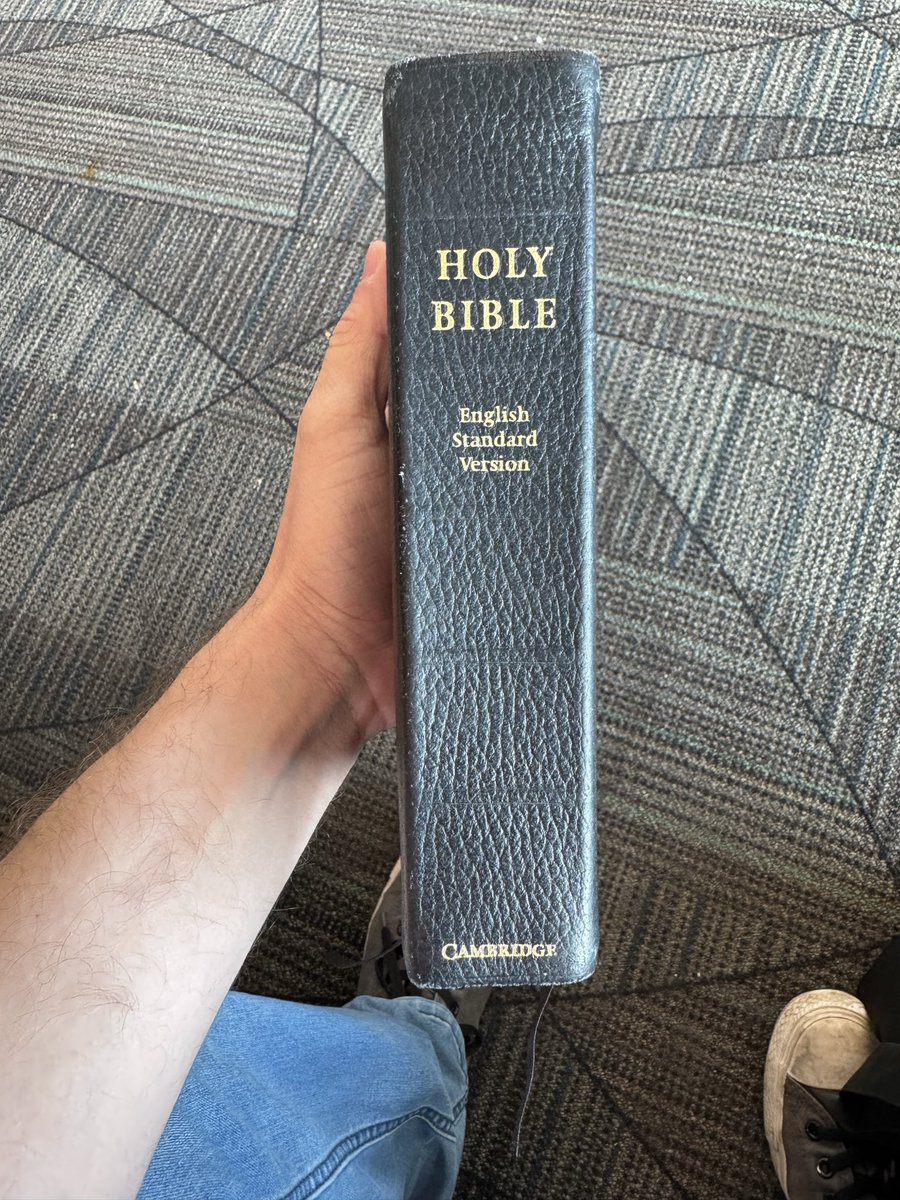
1. I keep a print Bible on my person at all times. I do not try and read for 40 minutes straight at any single point in my day but I read 1-3 chapters as I find time, usually at transition points in my day.
2. I do not attempt to read cover to cover or chronological. I typically have 3 different sections I’m working through at the same time. Being in different parts of the scripture through the day helps to not get bogged down in genealogies, land divisions, etc.
3. I do not feel tied to a particular translation. I usually do my readings from the ESV, but I will often reach for the old KJV, and occasionally the NASB or NKJV just to keep things fresh.
4. I also use multiple different lay outs. Maybe it’s just me, but looking at different fonts and lay outs also helps keep the reading experience fresh. That said, my favorite is the single column paragraph format ESV Clarion by Cambridge bibles.
5. I track it all using an app called: “Bible Box,” that I believe is only available for iPhone. You tell the app the date you want to finish reading by and it gives you a customized reading plan for each day. I don’t pay much attention to *what* chapters it tells me to read (it always works “cover to cover”) but *how many*.
For example if it tells me I have to read 1 Chronicles chapters 1-12 I might read chapters 1-2, then check off a few chapters from Isaiah, and finish out in the gospel according to John. The app will take into account the chapters I actually did read and recalculate the plan accordingly.
Further let’s say I have a day where I don’t complete the full amount of reading. Maybe I only get 1 or 2 chapters in out of the 10-15. The app does not make me read an extra 10 chapters the next day to get me “back on track.” It spreads out the chapters I missed across the duration of the plan so that you don’t get crushed if you fall behind.
You don’t have to read the Bible multiple times in a single year, you don’t even have the whole Bible in a single year (though that is far more achievable than many think). But you ought to be reading God’s Word every day and these are just some ways to read your Bible *more* in the new year.
“It is written, “Man shall not live by bread alone, but by every word that comes from the mouth of God.’”
- Matthew 4:4
Five random thoughts for aspiring leaders desiring to grow in godly influence in their church:
1. Rule your home well. A well-ordered home is essential for fruitful ministry in the church. A disorderly home makes everything harder.
2. Pray through your church’s directory. Grow in time to know the names and needs of every member.
3. Be present in the church’s ministries. Faithful Christians can be Sunday-only attenders, but godly influencers plan to gather with the church’s members whenever they can.
4. Serve eagerly. Don’t ask, “Who else can do this?” or “Is that my gift?” See needs, meet needs, and bring others with you.
5. Champion your pastors (even when you disagree). Often, men think leadership is mostly about fixing things, which means identifying problems and offering solutions. But this is downstream from trust and influence. If you want influence, build trust. If you want to build trust, be your pastor’s biggest public supporter and quickest private encourager, not because you want leadership, but because this is godly and best for the church.
There is a man in the Bible most people have never heard of. His name is Mattithiah, which in Hebrew means “gift of Yahweh.”
He appears in only one verse, 1 Chronicles 9:31: “Mattithiah, one of the Levites, the firstborn of Shallum the Korahite, was entrusted with making the flat cakes.”
That is his entire biography.
Who was he? Mattithiah was a Levite, part of the tribe God set apart for service in his house. His father, Shallum, helped guard the temple gates, and Mattithiah was given a different but equally important job: baking the flat cakes used in the temple offerings (Leviticus 2:4–5; 7:9).
That might sound small, but it mattered. His work made worship possible. Every offering required care, purity, and faithfulness, and Mattithiah provided that.
This baker in the temple did not have a glamorous job. He was not a prophet or a king or even a priest. He was not someone who spoke to crowds or led armies. He was a man who quietly served.
Yet the Holy Spirit saw fit to record his name in the Bible for all generations.
That tells us something about how God sees service. In the community of faith, there are no trivial people. Paul reminds us in 1 Corinthians 12:14–18 that every member of the body of Christ is vital. Some serve in visible ways, others serve quietly. Both kinds of service matter equally to God.
When you serve in your congregation, whether by cooking meals, sweeping the floors, teaching children, greeting worshipers, or praying, you are doing holy work.
Like Mattithiah, you are a “gift of Yahweh” to the people of God.
Mark Dever says the gospel is always fresh to him and tears up as he recognizes he deserves God's judgment. He says, "The fact that we trust the same Christ is far more important than anything that divides us." This is it. This is gospel-centrality.
Welcome to the William Carey Project. A partnership between Reaching & Teaching, Radius International, The Pillar Network, and ACME Fellowship.
Join us over the next 30 days as we pray for unreached language groups and the work happening among them!
The ultimate rebellion to radical secular progressivism that is hell bent on destruction:
Build.
Build beautiful things
Read your Bible
Raise a family
Join a church
Start a business
Serve others
One of the final videos of John MacArthur, posted days before his death.
Jmac was visiting Burton Michaelson, a good friend and founding member of GCC, who passed shortly before he did.
We are so happy to host this event and are hopeful it will spur more missions and evangelism. If you are in the area, consider coming. @RTMinistries
https://t.co/IaBvYvl0Pa
We best follow Jesus when we are least consumed with comparing ourselves with others.
Do not focus on the situations, circumstances, callings, or crosses of others.
Jesus would say, "What is that to you? You follow Me!”