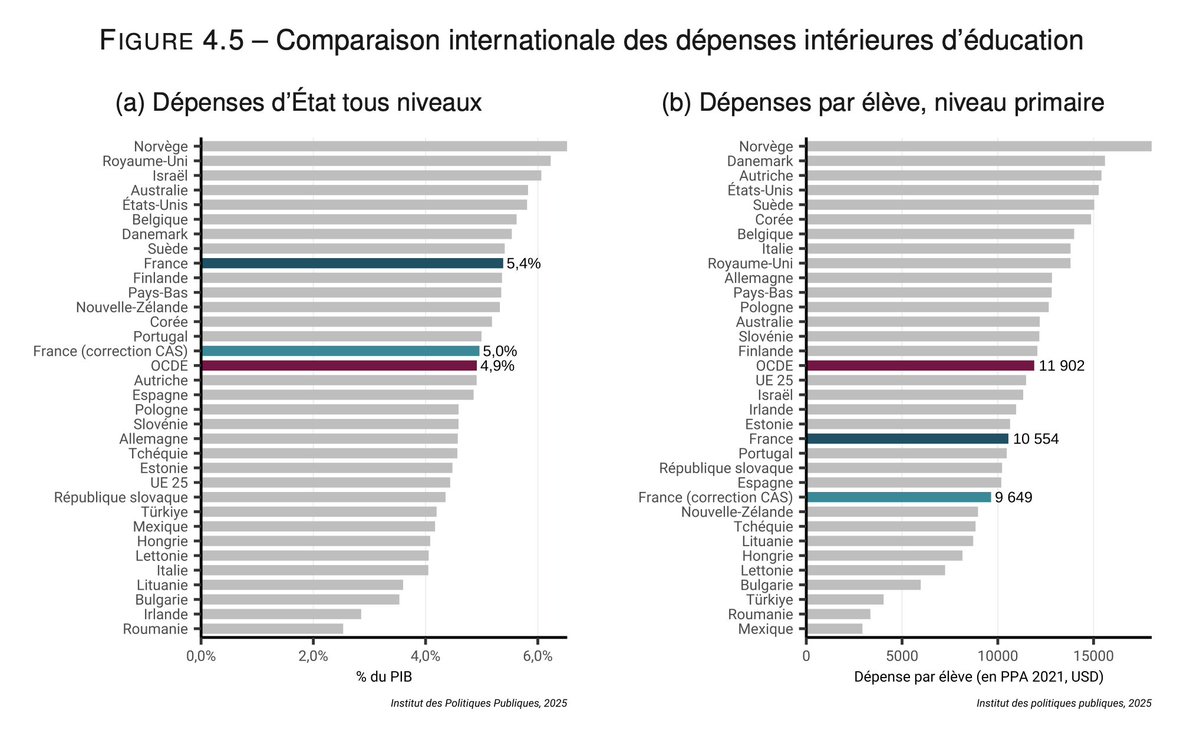
Cette convention comptable, spécifiquement française, fausse par exemple les comparaisons internationales sur les Dépenses intérieures d'éducation donc notre débat public et démocratique...
La comptabilité et les statistiques publiques, c'est essentiel !😉
https://t.co/sAI3fRyDMM
Très bonne nouvelle ! La différence entre les dépenses qui relèvent du fonctionnement du service public et celles qui relèvent en fait des retraites est maximale dans l'éducation nationale...
Encore merci à l'économiste Philippe Askénazy qui a le 1er levé ce lièvre début 2024 !😉
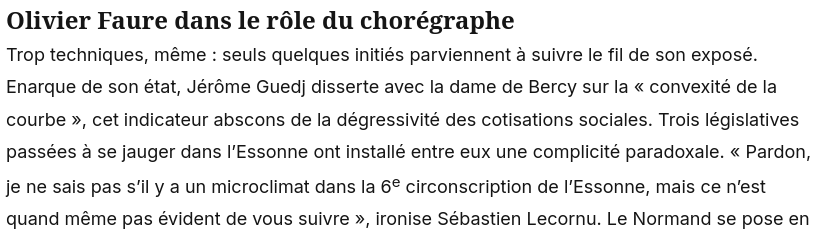
Cette espèce de culture française de l'inculture scientifique, qui considère normal que les hauts responsables politiques du pays, et les journalistes censés commenter leurs actions, soient perdus par le concept «technique» de convexité des impôts en fonction des revenus. 😭
A major driver of tax evasion isn't just the tax rate but the reporting requirements, at least when it comes to wealth taxes. Our newly revised paper finds that how much you have to disclose matters at least as much as how much you owe 🧵 https://t.co/mAFjV4Jhjk [1/14]
New working paper on the California Fast-Food minimum wage (will come out as NBER WP soon but posting now).
Big increase in wages. Big drop in separations. Little change in jobs. (Bonus: sheds light on QWI vs QCEW measurement of jobs.)
Pro-tariff commentators: Look, we imposed tariffs and there was no fundamental change in the inflation trend line
Careful Fed analysis: Our approach to assess the effects of these new U.S. tariffs on consumer prices accounts for their sequential introduction and leverages variation in tariff rates across products and regions of origin. As such, the first step of our empirical analysis is to produce a panel dataset capturing the evolution of tariffs for each commodity-region pair in the BEA's GVC IO tables described earlier. Given the complex nature of the tariffs enacted in 2025, the construction of this dataset is not a trivial task. We outline how we do this below.
We have devoted significant effort to compile a measure of tariffs that adheres as close as possible to the letter of the statutes implementing them.
We now determine how much prices should be affected by tariffs in theory, and later we will assess whether realized price changes align with these theoretical predictions. As our analysis aims to account for the timing of the tariffs in table 1, we build a panel dataset that captures monthly changes in our theoretical tariff effects. ...our analysis below will empirically assess whether prices have increased as predicted by the theoretical measures
We estimate that the tariff changes in table 1 increased core PCE prices by 0.8% through February 2026 and that pass-through is effectively complete. Given that the entire effect quantified above is driven by tariff effects on core goods PCE prices, and core goods represent about a quarter of overall core PCE, our tariff effects can equivalently be stated as boosting core goods PCE prices through February 2026 by 3.1%.
Under our baseline specification (blue line), tariffs can explain essentially all of the excess core goods inflation relative to pre-pandemic trends starting in 2025, as we illustrated in Figure 5. Moreover, because the estimated pass-through from tariffs is largely complete, core goods inflation would be expected to return soon to pre-pandemic levels. However, if the smaller tariff effects obtained under the alternative specification (red line) are closer to the true effects, then other factors must have also contributed to keeping core goods inflation above its pre-pandemic levels in 2025. Determining the nature and persistence of these additional factors would then be relevant for the core goods inflation outlook, but such an analysis is beyond the scope of this note.
Recently accepted by #QJE: “"Compensate the Losers?" Economic Policy and the Origins of U.S. Partisan Realignment,” by Kuziemko, Longuet-Marx, and Naidu: https://t.co/gcXGvxTH5q
La crise iranienne rappelle brutalement une réalité structurelle de la finance mondiale : le système est largement organisé autour d’une seule monnaie, le dollar. Or, la confiance dans son émetteur, les États-Unis, s’effrite... sans qu’aucune alternative crédible ne s’impose.
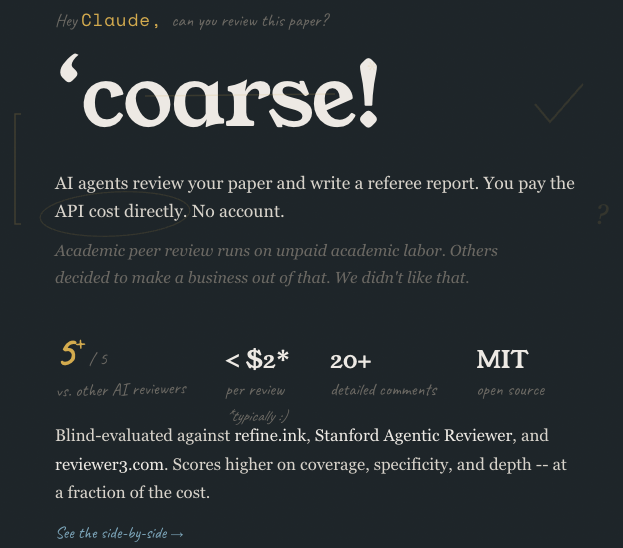
I coded up an open-source, not-for-profit AI paper reviewer that rivals the performance of @reviewer3com, @RefineInk, and Stanford Agentic Reviewer (according to @GeminiApp). Costs <$2!
Live @ https://t.co/5m1Srky4H8. Plug in paper, @OpenRouter key, and email. #econtwitter.
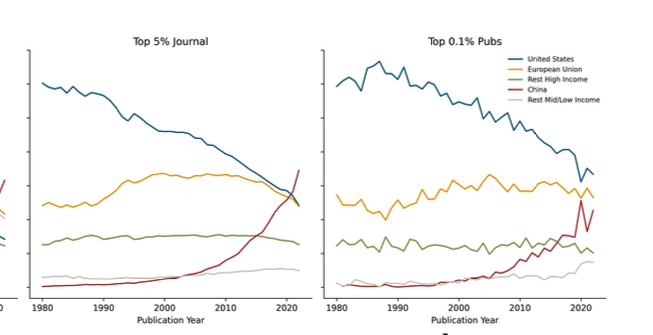
While we didn't explicitly try to study China - its rise is one imp. part of the story that emerges (although not all of it) -- its rise in terms of high quality science is dramatic!! China produces about 35% of all high quality pubs, surpassing both the US and the EU.
3/
Notre rapport (@GitaGopinath, Axel Weber, Chon En Bai) pour le G7 qui pointe les déséquilibres mondiaux grandissants, et leur risque de crise https://t.co/VItY7bqfaF
Report on global imbalances handed in yesterday to President @EmmanuelMacron for the G7 written with @GitaGopinath, Axel Weber and Chon-En Bai.
https://t.co/oswjGuSiCm
Results from my Claude Code audit of six Callaway and Sant'Anna packages (two in python, two in R, two in Stata). Same specification, same dataset, same covariates, same estimator, almost never do they agree.
https://t.co/KpRwlAagbr
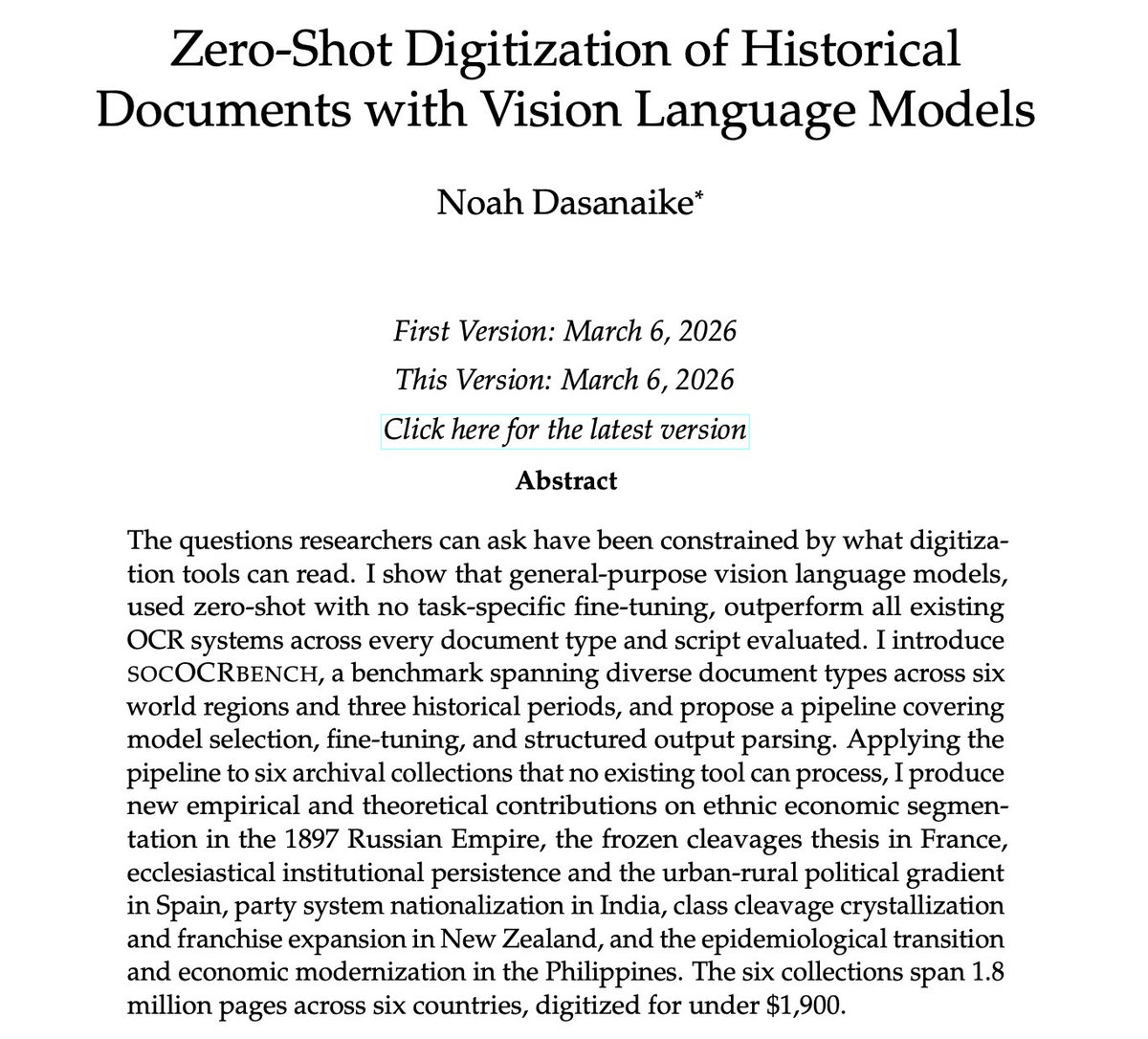
Social scientists working with materials requiring digitization can only study what machines can read. In practice, that means printed Latin-script documents from well-funded archives. In a new working paper, I show that Vision Language Models used zero-shot outperform every existing OCR system across every script evaluated, and I propose a pipeline for deploying them on new collections. I apply it to six archival collections spanning 1.8 million pages across six countries for under $1,900.
Really happy to see our paper on ⚡️zero-sum thinking ⚡️out in the March issue of the American Economic Review @AEAjournals, after many years of work (a summary thread from 2023 below 🙂👇) with @sahilchinoy@SMGSequeira and @DrNathanNunn.
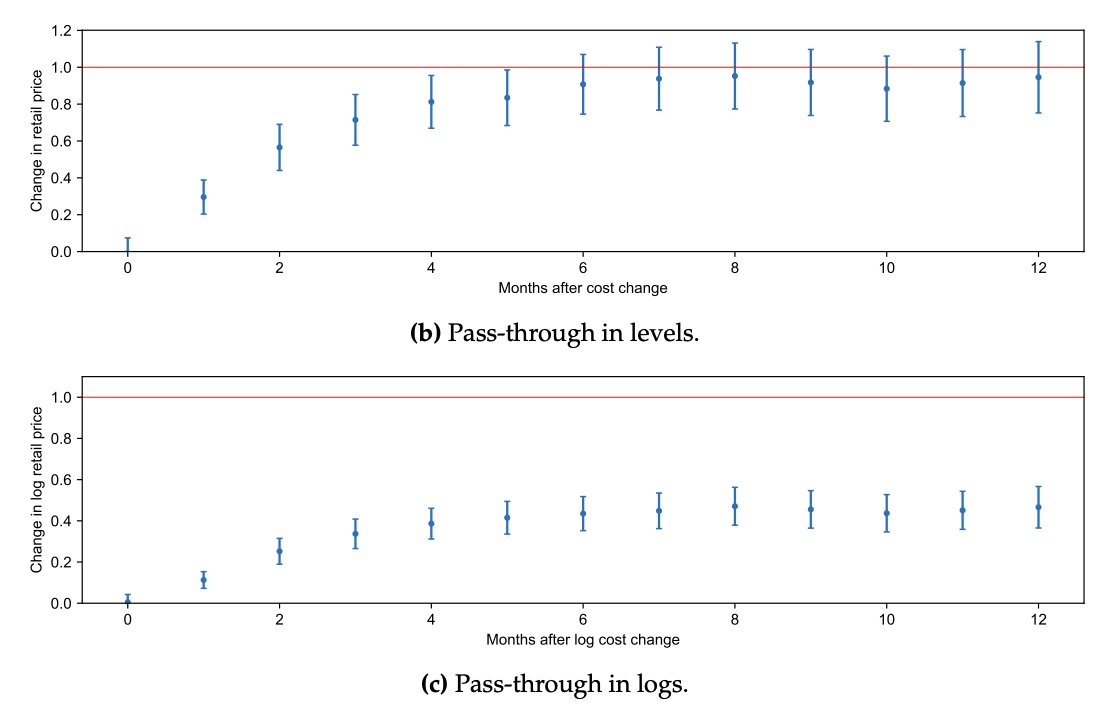
"Incomplete pass-through" (when costs rise 10%, prices rise <10%) is often "complete pass-through in levels" in disguise (costs rise 10 cents/unit, so prices rise 10 cents/unit).
Turns out this simple pattern can explain several other features of the data.
US tariffs on China spurred Mexico’s exports, driven by foreign firms in global supply chains. Just Accepted new paper by Hâle Utar BS: @haleutar.bsky.social @HaleUtar Alfonso Cebreros Zurita @acebreroz and Luis Torres. https://t.co/APUhk00LqW
Studying whether policy can shift gendered beliefs, norms, and labor market outcomes by exploiting a major expansion of earmarked paternity leave in Denmark, from Henrik Kleven, Camille Landais, @AnSoLassen, Philip Rosenbaum, @herdissteingrim, and Jakob Egholt Søgaard https://t.co/Ek7Qhb9Ddo







![S_Stantcheva's tweet photo. A major driver of tax evasion isn't just the tax rate but the reporting requirements, at least when it comes to wealth taxes. Our newly revised paper finds that how much you have to disclose matters at least as much as how much you owe 🧵 https://t.co/mAFjV4Jhjk [1/14] https://t.co/x7I97KccAr](https://pbs.twimg.com/media/HHQSujZXUAAYZgc.png)