Recently, I have started getting appreciable value from AI for my own mathematics research. While model improvements were necessary for this to happen, I think another key factor was reflecting on recent success cases, in order to build a better mental model for the comparative strengths of AI. Previously I would think in terms like "AI is good at extremal combinatorics, but bad at derived algebraic geometry"; a more nuanced perspective allowed me to identify directions where AI could truly accelerate my work.
A few months ago, Tao described AI as a "junior collaborator". Currently I think of it more as an "alien collaborator", which is already superhuman at certain skills (e.g., assembling puzzle pieces, juggling delicate technical conditions, making local optimizations) but lackluster at certain others (e.g., creating new puzzle pieces, generating diverse ideas).
Much of what I write is in the spirit of taming overhype, but it's important to give credit where credit is due: AI has progressed to the point where AI tools, and education on how best to use them, need to become a core part of any mathematics Ph.D. curriculum.
1. Just got off a call with @UnSubtleDesi. I couldn't be happier for her and both of us couldn't help but discuss the harrowing days of post poll violence in West Bengal in 2021. So I am going to share what happened five years ago just so ppl know what happened. #WestBengal2026.
I have launched a website, https://t.co/sGgfmtx7sQ, dedicated to documenting instances where the Indian National Congress has acted against the interests of the people of India.
This endeavour stems not from personal animosity or grudges, but from a sincere conviction that truth and accountability serve the greater good of India. Only an informed citizenry can build a stronger, more just democracy.
i heard dhurandhar 2 had some propaganda, so i watched it with a pinch of salt.
but honestly, I couldn't find any.
the party shown in the movie had done the work, and they got credit for it.
Isn’t that how things should be?
kept the movie as real as it could get - peak detailing by @AdityaDharFilms
Demonetisation and Dhurandhar The Revenge:
Movie neither defends nor justifies demonetisation. It simply mentions that fact in a neutral way and how it obviously shook the Black Money Economy at that time.
Whether or not that exercise brought long-term success is irrelevant.
Liberalism is downstream of a high-trust, low corruption society, which is downstream of a rules based order, which is enabled by raw state power.
In that sense, China is doing the right thing by focusing on corruption first (even if it's for optics).
Indian liberalism was spawned by British sensibilities. After the British left, it was not sustained by high ideals but by endemic corruption in the structures of power and bureaucracy, along with the absence of a rules-based order.
India is a feudal society without severe consequences for the feudal lords - all upside, no downside. And it's designed to be this way.
As a feudal lord you face no consequences for not doing your duty. The liberal legal framework gives unlimited upside while protecting you as a feudal lord.
So there's no 'found out' in FAFO. This obviously can't be sustained for long.
The path to become a first-world society runs through a rules-based order and a largely uncorrupt bureaucracy. But that is impossible without a very strict top-down restructuring that would disrupt the current system. China faces a similar problem: it cannot easily move toward a liberal order even if it wanted to, because doing so would also break its existing system. But it can go after corruption - again even for optics' sake. Graded corruption, basically.
Higher GDP per capita obviously helps alleviate some of these issues eg a better-equipped police force with body cameras. Small institutional improvements like digital systems can increase accountability, but the worrying part is that even when there is a written trail of corruption, the system continues to pursue it blatantly.
So it all comes down to consequences.
Without consequences, there is no rules-based order. Without a rules-based order, there is no liberal society, only a feudal one.
Obviously no system in the world can ensure that everything will be fair without extreme edge cases. So let's say we get a very strict system. Inevitably, mistakes will happen. In a Feudo-liberal society, every single edge case will trigger crying in the streets and people will conclude that the medicine itself is bad.
So being strict won't solve anything. People will just vote out that govt, the next govt will come and remove all friction.
In short - it's probably harder to go the route of:
step 1: liberalism -> step 2: less corruption
than
step 1: less corruption -> step 2: liberalism
Reflecting on @BeerBicepsGuy 's podcast with @protosphinx the takeaway was clear - we need more manufacturing in India. Here is the story of @thooshan - a startup that makes biodegradable products from the cheap and plentiful agricultural waste🧵
The first approved CRISPR medicine in the world for sickle cell disease and beta thalassemia!
A huge victory for biotechnology, patients, and humanity
https://t.co/hsxHRpPlg1
Can we precisely rewrite the genetic code - make a single DNA spelling change - in the liver of a human being for clinical effect?
YES!
Scientific milestone: VERVE-101 provides first proof-of-concept for in vivo DNA base editing in humans
Clinical implication: It’s early but could open the way for an entire new way to treat heart disease; instead of daily pills/intermittent injections, a one-time intravenous infusion procedure to durably (possibly lifelong) lower LDL cholesterol; "surgery without a scalpel"
Takeaways:
1. 10 patients with severe HeFH and ASCVD treated so far across 4 dose levels
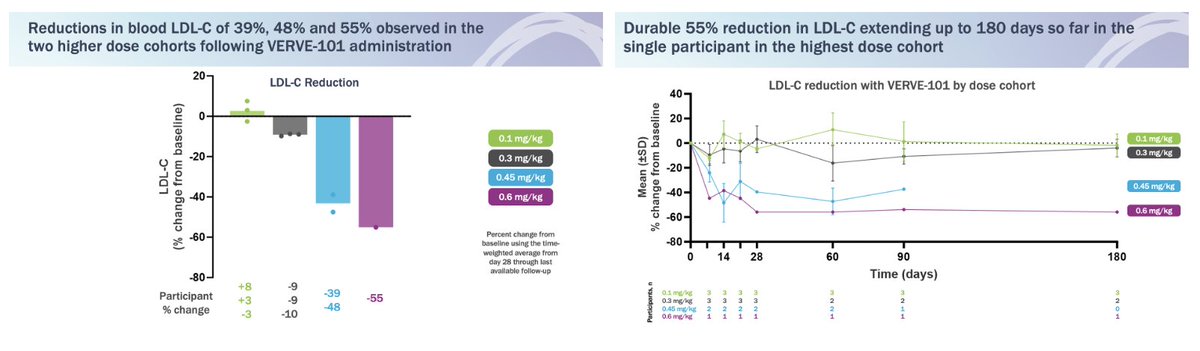
2. Clinical effect on LDL-C (40% - 55% reductions) at potentially therapeutic doses
3. Dose-dependent reductions in blood PCSK9 protein and blood LDL-C
4. Durability so far out to six months, consistent with the pre-clinical data in NHP where the durability is out to 2.5y after a single treatment
5. Consistent with FDA guidance on patients to enroll in a Phase 1 study of gene editing products, we enrolled the sickest of the sick coronary disease patients
6. Safety profile revealed expected LNP-infusion related events: a) transient flu-like symptoms for a few hours after infusion; b) transient, reversible rise in LFTs after infusion
7. Two patients experienced CV events consistent with their underlying severe ASCVD
8. Safety profile supports continued development (DSMB have reviewed these data and requested to continue dosing)
9. These interim heart-1 data were submitted to FDA as part of IND package and we now have clearance to start study in U.S.
10. Next steps: finish dose escalation, complete dose expansion in 2024
11. Phase 2 start in 2025 for PCSK9 program
Foremost, grateful to the patients who have volunteered and their families
Thankful to the amazing @VerveTx scientific and clinical team (led by @andrew Bellinger), the investigators and study staff, the independent DSMB, and our partners
P.S. Deepavali celebrates new knowledge and so thrilled to add today to our knowledge on the intersection of gene editing technology and cardiovascular disease
$VERV
@AHAScience@AHAMeetings@American_Heart #AHA23
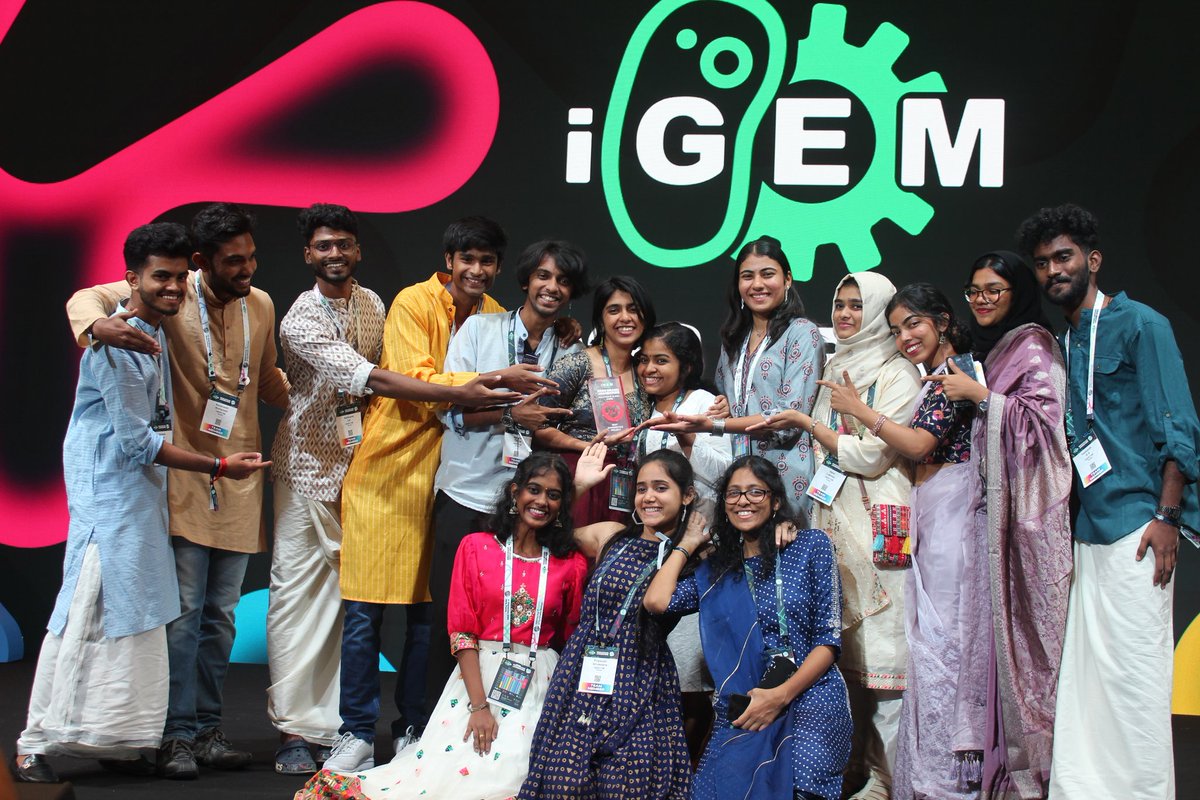
We are happy to inform you that we won The Best Diagnostics Project and a Gold medal at the @iGEM competition along with a nomination for Best Human Practices. Congratulations to @igem_iiserpune for the Best Education Prize and making it to the top ten.
Undergrad - Diagnostics🩺
@igem_iisertvm developed “OASYS”, a microfluidic device that utilizes FRET-based aptasensors and magnetic nanoprobes to analyze peripheral blood biomarkers that can be used as a diagnostic aid & powerful research tool for major depressive disorder
11/n
The team is grateful for guidance and support from advisors, the @tvmiiser community, collaborators, partners, sponsors, and importantly, iGEM 2021 team.