Talk about BELIEVE…I want to believe like this!
June 6, 1944 D-DAY
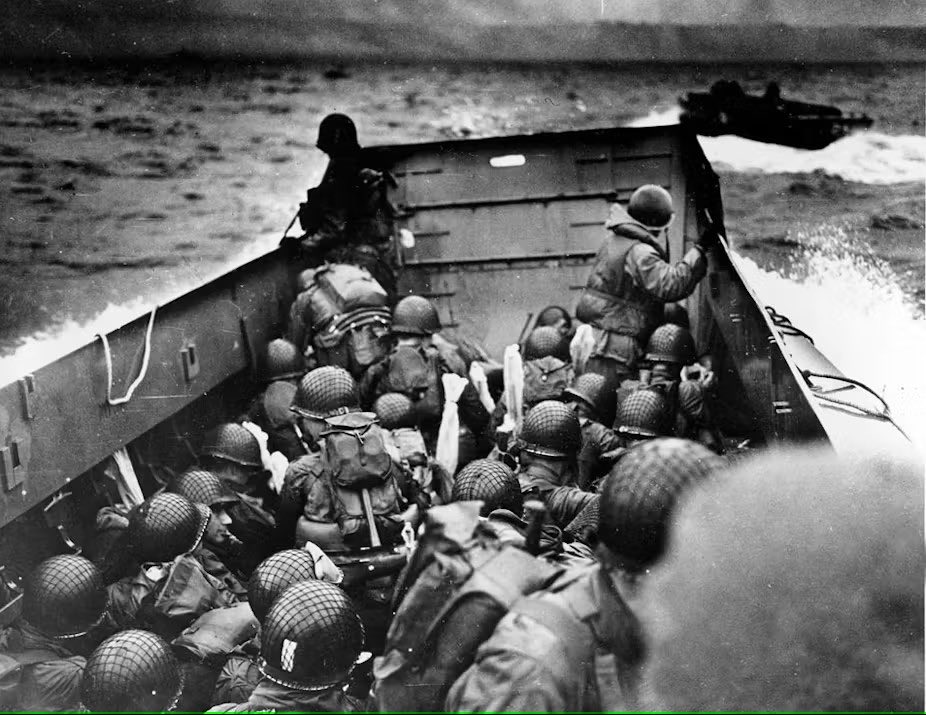
Photo called "Into the Jaws of Death" taken on this day in 1944.
36 men, on the initial storming into the water at Omaha Beach in Normandy.
100 pound backpacks.
Rough seas.
Shores were mined…barbed wire hidden.
Germans shooting from bluffs on high.
Began planning for attack one year earlier in 1943.
The weather on the day selected for D-Day was not ideal, and the operation had to be delayed 24 hours; a further postponement would have meant a delay of at least two weeks, as the planners had requirements for the phase of the moon, the tides, and time of day, that meant only a few days each month were deemed suitable.
Allied casualties were at least 10,000, with 4,414 confirmed dead.
How do you believe at that level? To stare death in the face and still believe.
To BELIEVE like this, it has to become personal! And this mission was personally anchored deep within these soldier’s hearts and souls.
The sacrifice is hard to fathom…the appreciation for them must be amplified!
For those that battled, served, and believed the best was yet to come, even if they knew they would never see it…THANK YOU!
82 years ago today, nearly 160,000 Allied troops stormed the beaches of Normandy on D-Day, launching the liberation of Europe.
We are free because they were brave. 🇺🇸
"The eyes of the world are upon you." - Gen. Eisenhower, @WestPoint_USMA Class of 1915.
Today in 1944, brave soldiers, sailors & airmen showed unwavering courage & devotion to duty on D-Day.
We honor their dedication & remember their fearlessness on the coast of France.
June 6th, 1944.
The English Channel is angry and half the men in the landing craft are seasick. Diesel fumes mix with saltwater and vomit while rifles are checked for the fifth or sixth time by hands that need something to do. Nobody talks much anymore because the jokes have all been told and the bravado has finally burned away somewhere behind the English coast.
You are nineteen years old and carrying more weight than you’ve ever carried in your life. You don’t know it yet, but it’s the most weight you will EVER carry in this life. However long or short it may be.
Your rifle rests across your knees. Your life hangs from a few pounds of steel, wood, and training. Somewhere beyond the gray horizon sits a continent that has spent five years tearing itself apart, and in a few minutes you are going to step into the middle of it.
Across from you sits another kid. He can’t be much older than you. His jaw is clenched. His knuckles are white around his weapon. Neither of you says a word because there is nothing left to say.
Then your eyes drift toward his shoulder.
That red numeral catches your eye: “1”.
You’ve seen it a thousand times before. In barracks hallways, on training fields, in motor pools, and on long marches. It never meant much beyond belonging to the same outfit.
Now it means everything.
Because in a few minutes the world is going to ask something terrible of both of you, and there is comfort in knowing that whatever waits on that beach, neither of you will face it alone.
The historians will eventually reduce this day to arrows on maps and casualty figures. Politicians will give speeches. Journalists will write books. None of that exists inside the landing craft.
What exists is fear, and duty.
What exists is the understanding that courage was never the absence of fear. Courage was always charging into the maelstrom anyway.
The shoreline emerges through the smoke. You can see flashes now. You can hear the distant percussion of artillery. Men stop checking their equipment because there is no point anymore. Whatever mistakes were made are already made. Whatever prayers were going to be said have already been said.
The coxswain throttles down.
The boat grinds forward.
The ramp is about to drop.
Into the abyss.
Overlord.
On this day in 1944, 150,000 Allied soldiers are being loaded onto ships all across southern England. Tomorrow, they'll take part in history's greatest invasion.
“At that time, we didn't know it was D-Day," one veteran would later recall. "We just knew we had a job to do.”
82 years ago today, eight American sailors jumped onto a sinking Nazi submarine in the middle of the Atlantic.
What they pulled out of it changed the war. And the Navy buried the whole story for years.
First, you need to know that U-505 was already cursed. German sailors called her the unluckiest boat in the fleet. In October 1943, during a brutal British depth-charge attack, her own captain shot himself in the head in the control room, in front of his crew. He remains the only submarine commander in history known to have killed himself underwater in combat. His second-in-command calmly took over, rode out the attack, and sailed her home.
Eight months later, her luck ran out completely.
June 4, 1944. Two days before D-Day. Captain Daniel Gallery's hunter-killer group, built around the escort carrier USS Guadalcanal, had been stalking U-boats off West Africa. Gallery had an idea his superiors considered borderline insane: don't sink the next one. Capture it. No US Navy crew had boarded and taken an enemy warship on the high seas since 1815.
The destroyer escort USS Chatelain caught U-505 on sonar and fired a salvo of hedgehog bombs. The U-boat broke the surface 700 yards away. Gunfire raked the conning tower, wounding her captain. He gave the order to abandon ship.
The Germans rushed out so fast they botched the scuttling. The sub was flooding, but her engines were still running. She was circling the battle at six knots, empty, sinking, and very possibly rigged with demolition charges.
So Lt. Albert David and eight men from USS Pillsbury chased her down in a whaleboat, leaped aboard, and climbed down the hatch into a dark, flooding submarine that could explode or go under at any second. They shut the scuttling valves, disarmed the charges, and stopped the flooding.
Down there they found the prize: Enigma cipher machines and roughly 900 pounds of codebooks and charts. Current settings. The keys to the German navy's secret communications.
But here's the catch. The treasure was only valuable if Germany never found out. One leak and Berlin changes every code overnight.
So the Navy ran one of the great cover-ups of the war. The sub was towed 1,700 miles to Bermuda and given a fake American name: USS Nemo. Around 3,000 sailors were sworn to total silence. The 58 captured German crewmen vanished into a POW camp in rural Louisiana, hidden even from the Red Cross. Germany declared U-505 lost with all hands and notified the families. The dead men were alive in Louisiana, and their boat was working for the US Navy.
The secret held until the war ended.
Lt. David received the Medal of Honor, the only one awarded in the Atlantic Fleet in all of WWII.
And the submarine? In 1954, Chicagoans raised $250,000 to bring her home. She was towed across Lake Michigan and dragged through the streets of Chicago to the Museum of Science and Industry.
She's still sitting there right now. You can walk through her.
This Memorial Day, we pause to honor and remember the brave men and women who made the ultimate sacrifice for our country. Their courage and dedication will never be forgotten.
We hope you have a meaningful and safe Memorial Day.