“The flag was still there.”
Long before it flew at ballgames and front porches across America, the flag flying over Fort McHenry National Monument and Historic Shrine became a symbol of survival during the War of 1812.
After enduring hours of British bombardment, the fort’s enormous flag remained standing at sunrise, inspiring “The Star-Spangled Banner.”
This Flag Day, we honor the history, sacrifice, and stories behind the stars and stripes. 🇺🇸
Photo of the Great Garrison Flag by NPS
On this night 251 years ago, two men climbed Old North Church's steeple. They held high two lanterns as a signal from Paul Revere that the British were heading to Concord via the Charles River.
Their famous “one if by land, two if by sea” warning ignited the American Revolution.
NASA 🤝 @forestservice
Mapping America’s oldest trees 🌲
The team created the first-ever inventory of mature and old-growth forests in the U.S. using boots-on-the-ground research and @NASA’s GEDI instrument on the @Space_Station.
More: https://t.co/w2fBUNFgne
A Soviet psychologist walked into a café in 1927 and watched a waiter do something impossible.
He remembered every open order at every table. Perfectly. Without notes. Without effort.
Then a table paid their bill. She asked him to repeat the order.
He couldn't remember a single item.
She spent the next two years figuring out why. What she found is now the operating system underneath every platform fighting for your attention.
Her name was Bluma Zeigarnik, and she was a graduate student at the time, sitting with her professor Kurt Lewin, watching the waiters work the room. What caught her attention was something so ordinary that it had been happening in restaurants for centuries without anyone asking why.
The waiters could remember every open order with perfect accuracy. Table four wanted the schnitzel with no sauce. Table seven had changed their wine twice. Table twelve owed for three coffees and a dessert. Every detail, held without effort, without notes, without any visible system at all.
But the moment a table paid their bill, the information vanished. Completely. Lewin tested it on the spot. He called a waiter back minutes after a table had settled up and asked him to recite the order. The waiter could not do it. Not partially. Not approximately. The information was simply gone.
Zeigarnik went back to her lab and spent the next two years turning that observation into one of the most replicated findings in the history of psychology.
Here is what she proved, and why it changes how you think about attention, memory, and almost every piece of media you have ever consumed.
She gave participants a series of tasks. Some tasks they were allowed to finish. Others were interrupted before completion. Then she tested recall across both groups.
The unfinished tasks were remembered at nearly twice the rate of the completed ones.
Not slightly better. Nearly twice. The brain was holding the incomplete work in a state of active tension, returning to it, keeping it warm, refusing to file it away. The finished tasks were closed, archived, released. The unfinished ones were still running.
She called it the resumption goal. When the brain commits to a task and cannot complete it, it opens a file that stays open until resolution arrives. That open file consumes a portion of your cognitive bandwidth whether you are thinking about it consciously or not. It surfaces in idle moments. It pulls at the edge of your attention during other work. It is the thing you find yourself thinking about in the shower when you were not trying to think about anything at all.
This is not a flaw in human cognition. It is a feature. The brain evolved to finish things. An open loop is a signal that something important is unresolved. Keeping that signal active increases the probability that you will return to it and complete it. In an environment where most tasks had real survival stakes, this was an extraordinarily useful mechanism.
In the modern world, it is the most exploited vulnerability in human attention.
Netflix did not invent the cliffhanger. But it industrialized it in a way no medium before it ever had. When a show ends on an unresolved question, it does not just create curiosity. It opens a file in your brain that stays active until the next episode closes it. The autoplay countdown that begins at 15 seconds is not a convenience feature. It is a precise calculation about how long the average person can tolerate an open loop before the discomfort of not knowing overrides every other intention they had for the evening. One more episode is not a choice. It is your brain doing exactly what it was designed to do: return to what is unfinished.
The writers who built Lost, Breaking Bad, and Succession understood this intuitively without ever reading a psychology paper. Every episode ended on an open question. Every season finale answered three things and opened five more. The entire architecture of prestige television is a Zeigarnik machine running at industrial scale.
But television is not where this gets dangerous.
Every notification on your phone is an open loop. Every unread email is an open loop. Every task you wrote on a list and have not yet crossed off is an open loop. Each one is consuming a small but real portion of your available attention, pulling fractionally at your focus, degrading your capacity to be fully present in whatever you are actually doing right now. TikTok's algorithm does not just serve you content you like. It serves you content that ends one loop and immediately opens another, keeping the resumption system permanently activated so the cost of stopping always feels higher than the cost of continuing.
The research on this accumulation effect is striking. Psychologists studying cognitive load have found that unfinished tasks do not sit passively in memory. They actively interrupt. They surface at the wrong moments. They are the reason you are reading something and suddenly remember an email you forgot to send. The brain is not malfunctioning. It is running its resumption system exactly as designed. It is just running it across forty open loops simultaneously, in an environment that generates new ones faster than any human nervous system was built to process.
The most important practical implication Zeigarnik's research produced is one that most people use backwards.
David Allen built his entire Getting Things Done system on the insight that the only way to close a cognitive open loop is to either complete the task or make a trusted commitment to complete it later. Writing something down in a system you actually trust has the same effect on the brain as finishing it. The file closes. The bandwidth is released. This is why writing a task down feels like relief even before you have done anything about it. You have not solved the problem. You have simply told your brain that the loop is registered and will be returned to, which is enough for the resumption system to stand down.
The inverse is equally true and far more destructive. Every task that lives only in your head, unwritten and unscheduled, is an open loop burning cognitive resources around the clock. The mental cost is not proportional to the size of the task. A tiny nagging obligation consumes the same active tension as a major project. Your brain does not discriminate by importance. It discriminates by completion.
Zeigarnik published her findings in 1927. The paper sat in academic literature for decades before anyone outside psychology paid attention to it.
Then television got good. Then the smartphone arrived. Then the entire attention economy was engineered, largely by people who understood intuitively what she had proven scientifically: an open loop is the most powerful hook available to anyone who wants to hold human attention.
Netflix knew it. Instagram knew it. Every designer who ever made a notification badge red instead of grey knew it.
The café in Vienna is long gone.
The mechanism she discovered there is now the operating system underneath every platform fighting for your time.
Every "to be continued."
Every unread notification.
Every thread that ends with "part 2 tomorrow."
All of it is the same waiter, the same unpaid bill, the same brain refusing to let go of what it has not yet finished.
Zeigarnik noticed it over coffee in 1927.
A century later, it is the most valuable insight in the history of media.
And nobody taught it to you in school.
We see our home planet as a whole, lit up in spectacular blues and browns. A green aurora even lights up the atmosphere. That's us, together, watching as our astronauts make their journey to the Moon.
NASA has released the first full image of Earth in 54 years.
The photo was taken from the Orion spacecraft, which is currently traveling to the Moon.
The last time Earth was photographed in its entirety from deep space was in 1972 during the Apollo 17 mission. Since then, such images have been created by stitching together multiple shots taken from Earth’s orbit.
El Crawler-Transporter es una mole de 3,000 toneladas que avanza a solo 1.6 km/h, su estructura es tan inmensa que mide lo mismo que un estadio de béisbol y quema 625 litros de combustible por cada kilómetro que recorre hacia la plataforma de lanzamiento.
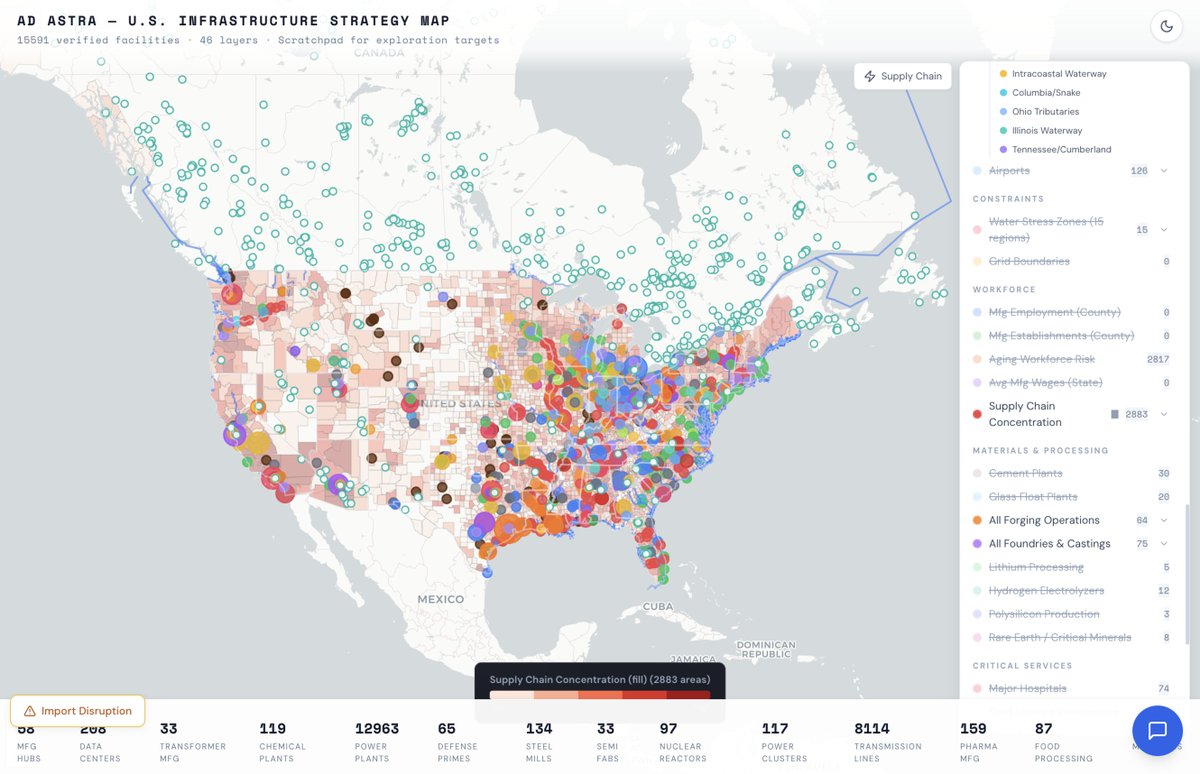
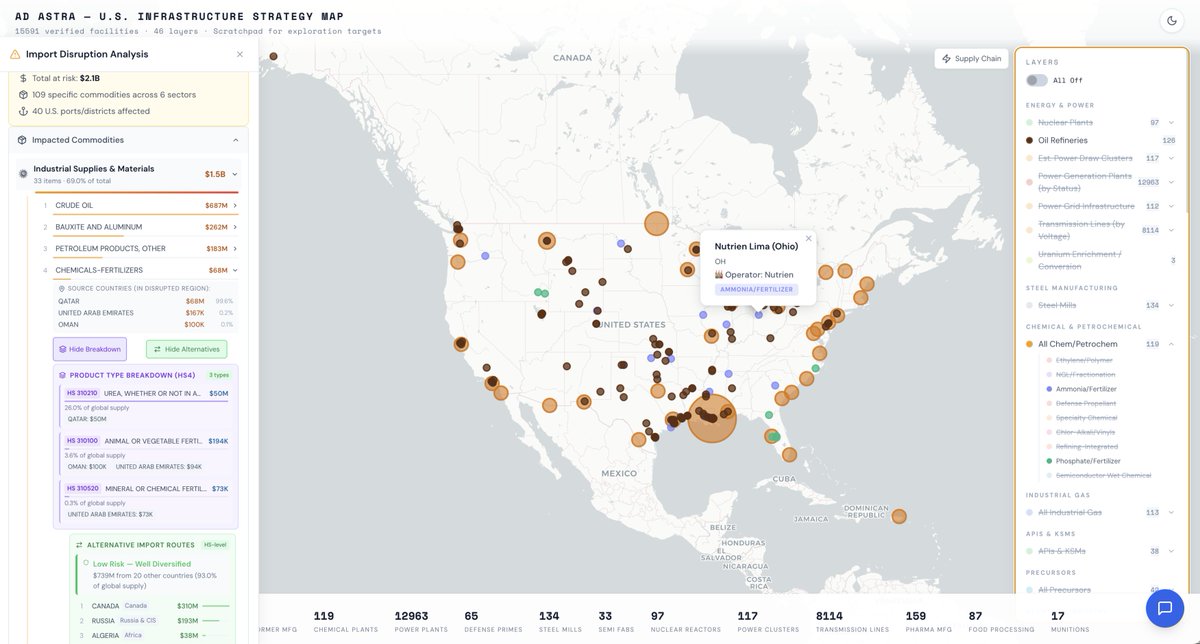
We are building an intelligence map and coordination resource for the industrial base.
Specifically for the chokepoints of critical supply chains and what it takes to unblock them.
Different code systems exist for imports (HS), industries (NAICS), defense contractors (CAGE), workforce skills (SOC), and training programs (CIP). The bridge between them that has always been missing is an ontology of the industrial base itself. So we built one: thousands of entities spanning policy, capital, minerals, and workforce, mapped to verified facilities across the country.
We are now mapping subsystems of critical finished goods and the industrial processes each one requires. We are already seeing recurring subsystems. From there, the physical infrastructure, resources, and workforce needed to unblock them become clear.
The end state is a live resource plan that tells you exactly where to move capital, resources, legislation, and workforce, geographically and by sector.
Many of you have asked us how you can help. Here's how: if you know sharp data scientists and researchers who want to work on this, send them our way. Have them email us at [email protected]
Follow the first crewed lunar mission since Apollo #WithWolfram—trajectory data, 3D visualizations and both Earth-centric and Moon-centric views.
https://t.co/eZgIXaZhGm
The coolest orbital animation I've seen of Artemis 2
Just really shows you how far away they're flying today and also how precise they need to be to go to the moon
Corky Miller finished his big league career with exactly one stolen base... and it is perhaps the greatest SB of all-time.
Happy birthday, @Corky_Miller!