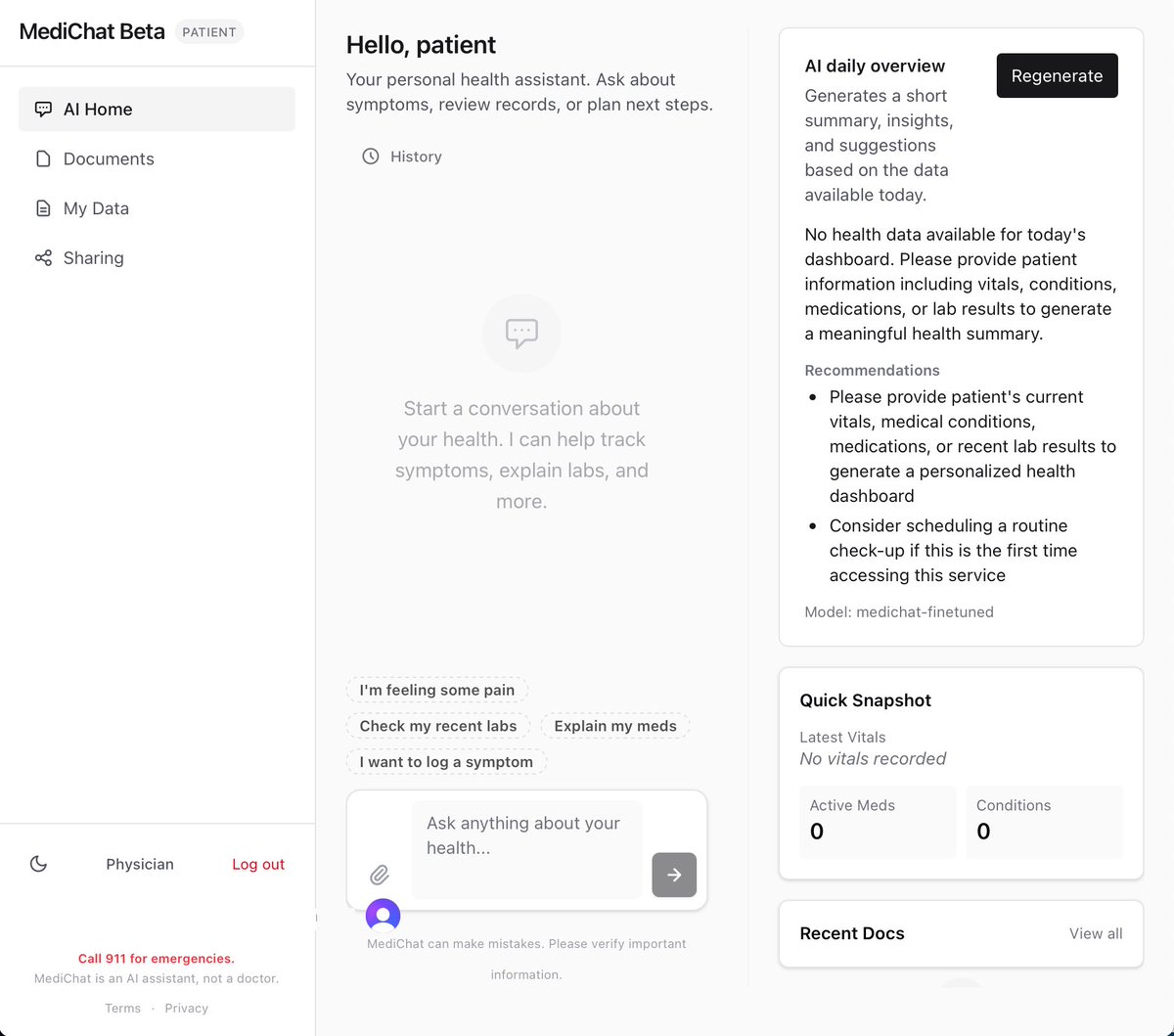
📣 Today, we're launching Medichat!
Your Health AI. Your Data. Your Privacy. No Exceptions.
Open-Source AI Health Assistant Challenges Big Tech's Healthcare Ambitions
SAN FRANCISCO — 44th Annual J.P. Morgan Healthcare Conference. As tech giants race to monetize healthcare AI, Kyral Health takes a fundamentally different approach with the launch of Medichat — an open-source, privacy-first AI health assistant that puts patients back in control of their health data.
"Small Enough to Trust, Smart Enough to Help"
While others build walled gardens around your most intimate health information, Kyral Medichat offers something revolutionary: an AI health assistant you can actually verify, own, and trust.
The Problem We're Solving
Last week, OpenAI launched ChatGPT Health. Days later, Anthropic unveiled Claude for Healthcare. Both promise to revolutionize how you manage your health — in exchange for access to your most sensitive personal data.
What Is Medichat?
Medichat is an open-source AI health assistant that provides:
➡️ Symptom assessment and health guidance — Understand your symptoms and potential next steps
➡️ Treatment information — Learn about medications, procedures, care options and recommendations
➡️ Cost transparency — Understand how healthcare systems operate, coverage and potential costs, regulations and your rights
➡️ ICD-10 and medical code lookup — Support for medical coding, billing accuracy, claims management and interoperability standards
➡️ General medical knowledge — Access clear, understandable health information
Available now at: https://t.co/qCHcclWiss
Code: https://t.co/cLb0v6W0gL
Our Commitment
We do not:
🚩 Use your health data to train AI models
🚩 Sell your information to third parties
🚩 Hide our methods behind proprietary walls
This isn't just policy — it's architecture. Zero-knowledge cryptography is being built into our patient-centered patient platforms by default, from the ground up.
Built on Open Innovation
Medichat is powered by QWEN3-NEXT-80B, a custom-trained open-source model fine-tuned on the de-identified PMC Patient Summaries dataset — a peer-reviewed resource of real clinical case studies.
Technical Specifications:
➡️ Model: QWEN3-NEXT-80B (QLORA fine-tuned)
➡️ Hardware: Runs on 2x NVIDIA H100 GPUs (192 GB VRAM)
➡️ Key advantage: Small enough to run locally, smart enough to help
Our Training Philosophy
Unlike trillion-parameter models that require massive data centers, our approach prioritizes openness, efficiency and transparency.
this is actually insane
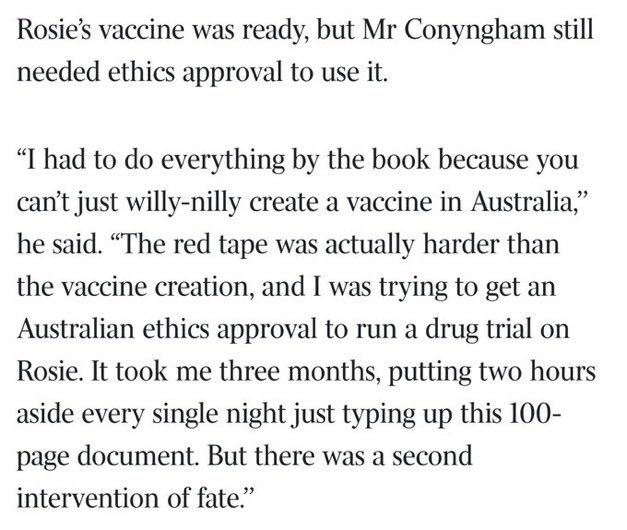
> be tech guy in australia
> adopt cancer riddled rescue dog, months to live
> not_going_to_give_you_up.mp4
> pay $3,000 to sequence her tumor DNA
> feed it to ChatGPT and AlphaFold
> zero background in biology
> identify mutated proteins, match them to drug targets
> design a custom mRNA cancer vaccine from scratch
> genomics professor is “gobsmacked” that some puppy lover did this on his own
> need ethics approval to administer it
> red tape takes longer than designing the vaccine
> 3 months, finally approved
> drive 10 hours to get rosie her first injection
> tumor halves
> coat gets glossy again
> dog is alive and happy
> professor: “if we can do this for a dog, why aren’t we rolling this out to humans?”
one man with a chatbot, and $3,000 just outperformed the entire pharmaceutical discovery pipeline.
we are going to cure so many diseases.
I dont think people realize how good things are going to get
📣 Today, we're launching Medichat!
Your Health AI. Your Data. Your Privacy. No Exceptions.
Open-Source AI Health Assistant Challenges Big Tech's Healthcare Ambitions
SAN FRANCISCO — 44th Annual J.P. Morgan Healthcare Conference. As tech giants race to monetize healthcare AI, Kyral Health takes a fundamentally different approach with the launch of Medichat — an open-source, privacy-first AI health assistant that puts patients back in control of their health data.
"Small Enough to Trust, Smart Enough to Help"
While others build walled gardens around your most intimate health information, Kyral Medichat offers something revolutionary: an AI health assistant you can actually verify, own, and trust.
The Problem We're Solving
Last week, OpenAI launched ChatGPT Health. Days later, Anthropic unveiled Claude for Healthcare. Both promise to revolutionize how you manage your health — in exchange for access to your most sensitive personal data.
What Is Medichat?
Medichat is an open-source AI health assistant that provides:
➡️ Symptom assessment and health guidance — Understand your symptoms and potential next steps
➡️ Treatment information — Learn about medications, procedures, care options and recommendations
➡️ Cost transparency — Understand how healthcare systems operate, coverage and potential costs, regulations and your rights
➡️ ICD-10 and medical code lookup — Support for medical coding, billing accuracy, claims management and interoperability standards
➡️ General medical knowledge — Access clear, understandable health information
Available now at: https://t.co/qCHcclWiss
Code: https://t.co/cLb0v6W0gL
Our Commitment
We do not:
🚩 Use your health data to train AI models
🚩 Sell your information to third parties
🚩 Hide our methods behind proprietary walls
This isn't just policy — it's architecture. Zero-knowledge cryptography is being built into our patient-centered patient platforms by default, from the ground up.
Built on Open Innovation
Medichat is powered by QWEN3-NEXT-80B, a custom-trained open-source model fine-tuned on the de-identified PMC Patient Summaries dataset — a peer-reviewed resource of real clinical case studies.
Technical Specifications:
➡️ Model: QWEN3-NEXT-80B (QLORA fine-tuned)
➡️ Hardware: Runs on 2x NVIDIA H100 GPUs (192 GB VRAM)
➡️ Key advantage: Small enough to run locally, smart enough to help
Our Training Philosophy
Unlike trillion-parameter models that require massive data centers, our approach prioritizes openness, efficiency and transparency.
💡 You can’t win Health without the FDA…
On Jan. 6th, 2026, the @US_FDA released guidance on clinical decision support (CDS) focusing on a framework centered on health care professionals (HCPs) as the decision-maker [Docket FDA-2017-D-6569].
🧬 How does @KYRALHealth fit in:
⚡ Our proposal to the FDA on Dec. 3rd, 2026 provides exactly the AI governance system the FDA is now promoting in their recent CDS guidance.
This includes our frameworks for:
— AI autonomy and classification scheme
— Humans-in-the-loop (HITL) architecture
— Black box auditing system and monitoring
— Establishing technical and regulatory committees
— Escalation protocols (FDA’s term is "time-critical decision making")
1️⃣ Kyral’s HITL Architecture is Super-Aligned to CDS Guidance
— Kyral's HITL system — with 70% automated monitoring and 30% human expert review, plus mandatory provider confirmation for high-risk interventions and explainable AI interfaces with confidence scores — directly supports Criterion 4's requirement that HCPs can independently review the rationale behind the recommendations.
2️⃣ Kyral’s Care Coordination System is Primed for Greater Autonomy
— The FDA's enforcement discretion for single-recommendation outputs and risk prediction software means Kyral may be able to expand beyond current predictive analytics — including readmission risk predictions and emergency prevention alerts — to allow for AI with greater autonomy as described in our 5-Tier classification system.
— With risk probability/risk score outputs no longer prohibited, Kyral's metrics and risk assessment functions may now qualify as "Non-Device CDS" — false positive/negative rates for emergency prevention and readmission risk, AI confidence scoring adjusted based on input data quality, predictive analytics for patient trajectories, and other functions provided in our open source AI Health Assistant, Medichat.
3️⃣ Kyral’s AI Governance Infrastructure is Future-Proof
— Although the FDA does not address how AI can meet the CDS criteria, or how it will regulate more novel AI-enabled CDS products, Kyral's comprehensive AI governance infrastructure — Black Box Recording System, five-tier classification system, establishing a technical committee and regulatory committee with partners, and more — exceed what the FDA currently requires, and positions Kyral well for future AI-specific regulations.
Our Frameworks and Architecture are outlined in the following FDA dockets:
💥 Docket FDA-2025-N-4203-0112: https://t.co/PylLHEoHGO
💥 Docket FDA-2024-N-3924-0040: https://t.co/RP45TSpn5x
Kyral's Medichat AI Health Assistant can be found here:
💥 https://t.co/zyz1SjRhfQ
💥 https://t.co/TYz5C1e5zm
Like our tagline says: "Small Enough to Trust, Smart Enough to Help" and you can run it locally so that you can have your own personal AI health assistant without tech companies collecting your most intimate health information
The enemy isn’t “technology" or AI even. It’s incentives.
Silos protect institutions. Friction protects revenue. Opaque decisions protect deniability.
Patients and clinicians pay the cost.
📝For more details on our architecture, refer to the comments we provided the FDA on Dec. 1st, 2025 to help them better understand real world systems "Measuring and Evaluating AI-enabled Medical Device Performance in the Real-World."
https://t.co/KCYYcmMLXo
📢 The full FDA announcement:
https://t.co/NijUmCXfpR
The @FDA is catching up... a new policy on RWE
💡 Why this matters...
+
🧬 How @KYRALHealth's efforts fit in...
The FDA will now accept real-world evidence (RWE) without requiring that identifiable individual patient data be submitted in marketing submissions. FDA reviewers will consider the strength of submitted RWE on an application-by-application basis. This opens access to de-identified databases containing millions of patient records — including national cancer registries, hospital systems databases, insurance claims databases, and electronic health record networks.
👇More below
1. Kyral’s Privacy-Preserving Architecture addresses limitations of using de-identified real world data:
This FDA announcement essentially removes a friction point that Kyral's privacy-preserving design was already engineered to navigate. Our architecture anticipated this direction—now regulatory policy has caught up with our technical approach. Kyral's architecture is well-positioned to adopt this policy shift by incorporating data sovereignty for consent, data sharing permissions and differential privacy techniques to safeguard against re-identification during aggregate analytics.
2. Kyral’s Decentralized Infrastructure allows for health data aggregation, enablement and analytics:
The FDA's acceptance of de-identified aggregate data validates Kyral's design philosophy, which centers on the patient as the System-of-Record. Kyral’s cryptographic verification and decentralized architecture can now generate regulatory-compliant RWE while preserving privacy-first principles. Such a system allows for federated learning approaches for model updates without the transfer of raw data and synthetic data generation for model testing without compromising patient privacy.
3. Kyral’s Black Box Recording System (BBRS) aligns with the FDA’s provisions for de-identified RWE submissions:
Kyral’s BBRS — which captures AI reasoning pathways, confidence levels, patient outcomes, and environmental factors — and is orchestrated with our humans-in-the-loop framework, creates exactly the type of comprehensive real-world dataset the FDA is now accepting. The FDA's willingness to accept aggregate RWE could accelerate advancement of more beneficial AI solutions that we and others have proposed, from simple automation (Tier 1) and clinical decision support (Tier 2, our current operating tier) to autonomous systems in healthcare settings (Tier 3).




![KYRALHealth's tweet photo. 💡 You can’t win Health without the FDA…
On Jan. 6th, 2026, the @US_FDA released guidance on clinical decision support (CDS) focusing on a framework centered on health care professionals (HCPs) as the decision-maker [Docket FDA-2017-D-6569].
🧬 How does @KYRALHealth fit in:
⚡ Our proposal to the FDA on Dec. 3rd, 2026 provides exactly the AI governance system the FDA is now promoting in their recent CDS guidance.
This includes our frameworks for:
— AI autonomy and classification scheme
— Humans-in-the-loop (HITL) architecture
— Black box auditing system and monitoring
— Establishing technical and regulatory committees
— Escalation protocols (FDA’s term is "time-critical decision making")
1️⃣ Kyral’s HITL Architecture is Super-Aligned to CDS Guidance
— Kyral's HITL system — with 70% automated monitoring and 30% human expert review, plus mandatory provider confirmation for high-risk interventions and explainable AI interfaces with confidence scores — directly supports Criterion 4's requirement that HCPs can independently review the rationale behind the recommendations.
2️⃣ Kyral’s Care Coordination System is Primed for Greater Autonomy
— The FDA's enforcement discretion for single-recommendation outputs and risk prediction software means Kyral may be able to expand beyond current predictive analytics — including readmission risk predictions and emergency prevention alerts — to allow for AI with greater autonomy as described in our 5-Tier classification system.
— With risk probability/risk score outputs no longer prohibited, Kyral's metrics and risk assessment functions may now qualify as "Non-Device CDS" — false positive/negative rates for emergency prevention and readmission risk, AI confidence scoring adjusted based on input data quality, predictive analytics for patient trajectories, and other functions provided in our open source AI Health Assistant, Medichat.
3️⃣ Kyral’s AI Governance Infrastructure is Future-Proof
— Although the FDA does not address how AI can meet the CDS criteria, or how it will regulate more novel AI-enabled CDS products, Kyral's comprehensive AI governance infrastructure — Black Box Recording System, five-tier classification system, establishing a technical committee and regulatory committee with partners, and more — exceed what the FDA currently requires, and positions Kyral well for future AI-specific regulations.
Our Frameworks and Architecture are outlined in the following FDA dockets:
💥 Docket FDA-2025-N-4203-0112: https://t.co/PylLHEoHGO
💥 Docket FDA-2024-N-3924-0040: https://t.co/RP45TSpn5x
Kyral's Medichat AI Health Assistant can be found here:
💥 https://t.co/zyz1SjRhfQ
💥 https://t.co/TYz5C1e5zm](https://pbs.twimg.com/media/HAg9dIsWcAAtjMV.jpg)