Thinker, Professor in Digital Marketing, Innovation & Entrepreneurship. (Urban Dad, Indie Rock, Food & Wine, Video Games, Science & Science Fiction IRL. Shhh!)
Google anuncia, en colaboración con la comunidad de Schema(.)org un nuevo repositorio con datos de uso de los diferentes marcados de datos estructurados a lo largo de Internet.
Estos datos, que se actualizarán de manera mensual, estarán disponibles para su análisis o descarga (en .csv o .json) desde el GitHub oficial de Schema: https://t.co/jL1s9lMAz2
Una manera de ver la adopción de los datos estructurados con el paso del tiempo, así como para ver cuál de ellos escoger en base a su nivel de implantación en casos de duda ante otros similares.
Puedes ver el comunicado oficial de Schema en: https://t.co/sZRRJBMjMh
Así como algo más de información adicional en: https://t.co/wG57AjzdKs
So the flotilla activists were rightly and justly held by Israel, though for just half a day, then released and deported. And the world went into complete meltdown. Outrage went to delirious levels.
Now the same flotilla activists have been detained and imprisoned in Libya for the past 10 days, and that prison term has been extended significantly.
And the reaction from the world?
Total silence. Not a peep.
Weird huh? 🤔
NEW EXCLUSIVE CONTENT FOUND ON WOMAN BEHIND SAVAGE NYC SUBWAY ATTACK
Diana Smith, identified by police as the suspect in the antisemitic subway assault, is a New York creative who works under the name “Lädy Millard.” She currently serves as a creative director for BRIC (Block Realty Investment Coin).
But this is not her first run-in with the law. 🧵
🎥 @CombatASemitism
During Brad’s (unsuccessful) run for mayor, he went on an Orthodox Jewish radio show and bragged about investing in Elbit Systems, Israel’s largest weapons manufacturer. Then, after facing backlash, he blamed the decision on his staff.
@bradlander, you had the chance to take a stand when you were in office and you cowered. Worse, you lied about it. Worse yet, you blamed your staff.
New Yorkers have zero reason to believe you’d be any different in Congress.
This says everything you need to know about @bradlander. You cannot believe anything he says.
If he will edit out the most important part to mislead voters, what else is he lying about?
atlassian factura $1.79 mil millones al trimestre.
despidieron al ingeniero que construyó su infraestructura.
¿la respuesta del ingeniero? publicar un vídeo de 38 minutos contando exactamente cómo lo hizo.
gratis, para todo el mundo.
lo que reveló:
→ Envoy proxy en vez de load balancers de empresa
→ arquitectura sidecar para auth, logs y rate limits
→ DynamoDB + SQS para aprovisionamiento asíncrono
→ Packer + SaltStack para desplegar VMs a escala
atlassian cobraba a 350.000 clientes diferentes.
el señor que lo diseñó acaba de darte el mismo manual por cero dólares.
sí, 0$.
les acaba de destruir.
guarda esto.
There’s only one person in this race who has taken a massive amount of dark money — and it’s Brad Lander.
After posting an ALTERED video of me last night, a New York Times article came out this morning revealing that Brad is taking super PAC money. The hypocrisy is next level.
New Yorkers deserve better. And NY-10 deserves a representative you can trust.
Hello @AOC, while you smiled in a hijab at a New York event, I was in Federal Court facing the 4th hitman hired by the Islamic Republic to assassinate me, for campaigning for Iranian women to have the same freedom you performed for a photo op. Will you come to court with me in August when I face the 5th hitman? Or does solidarity only work when it doesn't offend the Islamic regime?
You wore hijab voluntarily in New York. Women are killed in Iran for taking it off.
You are the very woman who, at every opportunity, protests against violence against women, decries gender segregation, and champions "inclusion." Yet here you stand, smiling and wearing a hijab, at an event in New York, in the heart of the West, where men and women are strictly separated. To me and millions of Iranian women, this does not look like a choice. It is no longer "My body, my choice," but rather "My body for votes."
They who claim to fight for women's self-determination in the name of feminism voluntarily embrace an ideology that mandates our women cover their hair simply because they are women. They enjoy the prosperity, freedom, and privileges of the Western world, where they may live as autonomous individuals , yet they simultaneously accept that other women should not be afforded the same rights.
#LetUsTalk
BREAKING: 1,500 UNRWA staff suspected of terror ties under growing federal investigation. U.S. considering to strip UNRWA of its diplomatic immunity—opening it to lawsuits from terror victims—and fully designating UNRWA a foreign terrorist organization.
https://t.co/YQho6jLTtr
The October 7th massacre did not end with Hamas. It continued in UN reports.
A rigorous review of UN documentation reveals a pattern of systemic bias: laundered data, distorted statistics, the systematic omission of Hamas' conduct - Read the Full Report
Goldman Sachs MDs make $1-3M/year doing one thing: keeping CEOs of Fortune 500 firms on speed dial.
This 23-min UVA Law lecture by Goldman's Vice Chairman of Global Client Coverage teaches you the exact 18 rules he uses to do it.
worth more than any $5K business school elective on client management.
bookmark & watch today.
A California mayor just pled guilty to being a literal foreign agent of the Chinese government. She ran a CCP propaganda website disguised as local news.
NBC's angle? The real problem is that reporting on it "reignited fears of anti-Asian discrimination."
As an Asian American: accurately reporting that a foreign agent infiltrated local government is not anti-Asian. Framing it that way to suppress the story is.
Using "anti-Asian bias" as a shield to protect an actual CCP agent from scrutiny is the most anti-Asian thing I can think of. It implies that Chinese Americans are so fragile, or so suspect, that we can't handle the truth about foreign espionage in our own communities.
We can handle it. We're the ones most harmed by it.
https://t.co/bbODvOVmZG
I broke my own rule to never post about AI detection as it is fraught in many ways.
The problem is that if you use AI a lot, you know AI writing on sight, which makes the difficulty of objectively proving that AI use to others very frustrating
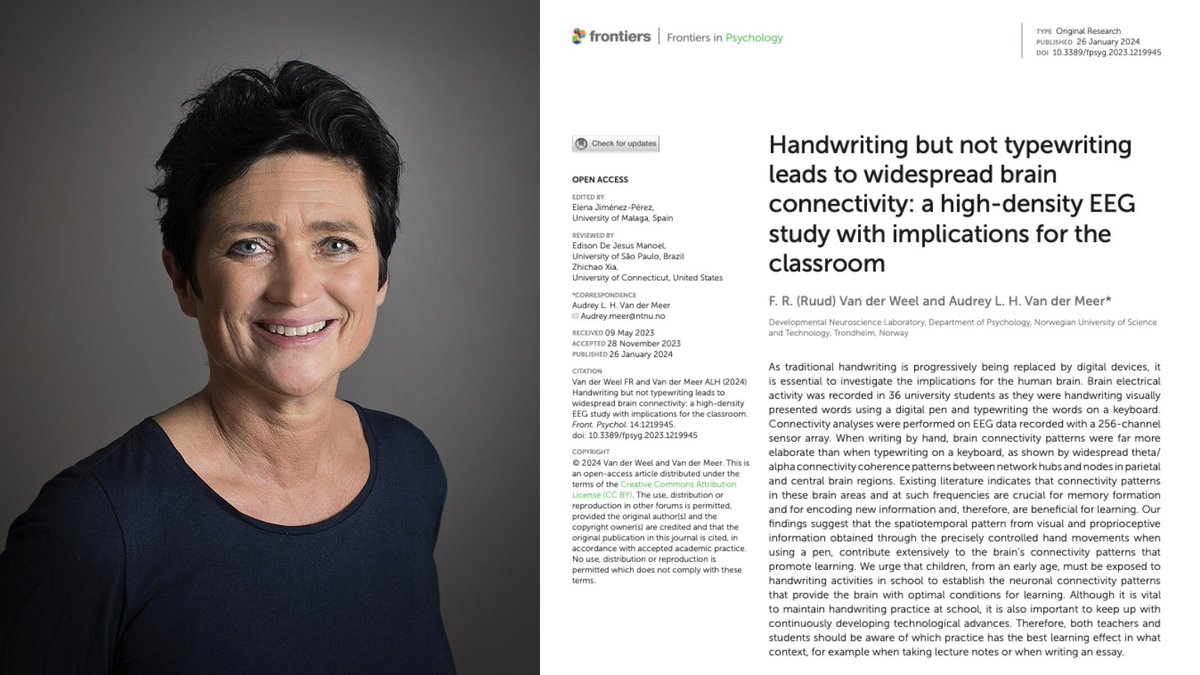
A Norwegian neuroscientist spent 20 years proving that the act of writing by hand changes the human brain in ways typing physically cannot, and almost nobody outside her field has read the paper.
Her name is Audrey van der Meer.
She runs a brain research lab in Trondheim, and the paper that closed the argument was published in 2024 in a journal called Frontiers in Psychology. The finding is brutal enough that it should have changed every classroom on Earth.
The experiment was simple. She recruited 36 university students and put each one in a cap with 256 sensors pressed against their scalp to record brain activity. Words flashed on a screen one at a time.
Sometimes the students wrote the word by hand on a touchscreen using a digital pen, and sometimes they typed the same word on a keyboard. Every neural response was recorded for the full five seconds the word stayed on screen.
Then her team looked at the part of the data most researchers had ignored for years, which is how different parts of the brain were communicating with each other during the task.
When the students wrote by hand, the brain lit up everywhere at once.
The regions responsible for memory, sensory integration, and the encoding of new information were all firing together in a coordinated pattern that spread across the entire cortex. The whole network was awake and connected.
When the same students typed the same word, that pattern collapsed almost completely.
Most of the brain went quiet, and the connections between regions that had been alive seconds earlier were nowhere to be found on the EEG.
Same word, same brain, same person, and two completely different neurological events.
The reason turned out to be something nobody had really paid attention to before her work. Writing by hand is not one motion but a sequence of thousands of tiny micro-movements coordinated with your eyes in real time, where each letter is a different shape that requires the brain to solve a slightly different spatial problem.
Your fingers, wrist, vision, and the parts of your brain that track position in space are all working together to produce one letter, then the next, then the next.
Typing throws all of that away. Every key on a keyboard requires the exact same finger motion regardless of which letter you are pressing, which means the brain has almost nothing to integrate and almost no problem to solve.
Van der Meer said it plainly in her interviews.
Pressing the same key with the same finger over and over does not stimulate the brain in any meaningful way, and she pointed out something that should scare every parent who handed their kid an iPad.
Children who learn to read and write on tablets often cannot tell letters like b and d apart, because they have never physically felt with their bodies what it takes to actually produce those letters on a page.
A decade before her, two researchers at Princeton ran the same fight using a completely different method and ended up at the same answer. Pam Mueller and Daniel Oppenheimer tested 327 students across three experiments, where half took notes on laptops with the internet disabled and half took notes by hand, before testing everyone on what they actually understood from the lectures they had watched.
The handwriting group won by a wide margin on every question that required real understanding rather than surface recall.
The reason was hiding in the transcripts of what the two groups had actually written down.
The laptop students typed almost word for word, capturing more total content but processing almost none of it as they went, while the handwriting students physically could not write fast enough to transcribe a lecture in real time, which forced them to listen carefully, decide what actually mattered, and put it in their own words on the page.
That single act of choosing what to keep was the learning itself, and the keyboard had quietly skipped the choosing and skipped the learning along with it.
Two studies. Two countries. Same answer.
Handwriting makes the brain work. Typing lets it coast.
Every note you have ever typed instead of written went into your brain through a thinner pipe. Every meeting, every book highlight, every idea you captured on your phone instead of on paper was processed at half depth.
You did not forget those things because your memory is bad. You forgot them because typing never woke the part of the brain that would have made them stick.
The fix is the thing your grandmother already knew.
Pick up a pen. Write the thing down. The slower road is the faster one.
Congrats to LiveRamp and the team for the sale to Publicis. This deal was a steal for Publicis (more on that below).
LiveRamp was a shining gem and still is such an important part of the ad tech and marketing tech industry. It has so many amazing people and has a really incredible product, which has not changed that much over the last 10 years or so. It has bittersweet seeing a company that one created and was a part of for almost a decade go into decline.
But despite that, the company is still in really good position. Unfortunately they were not able to take advantage of their position. For the last decade they traded long-term positioning for short-term gain. That trade resulted in the ire of their customers and even more so their partners.
Now that they will be in a new home in Publicis, I hope that we will see a renaissance of LiveRamp and LiveRamp will continue to be an incredible part of the industry going forward.
The company has a lot it needs to do:
It needs to focus on the core product. The core product is 70% of their revenues and 500% of their profits.
They need to focus on making that product better. The core product really hasn't changed in about a decade.
They have to focus on making the middleware product better: making it easier to use, making it so you can onboard partners faster, onboard customers faster, onboard connections.
the most important LiveRamp metric The number of connections per customer is the most important metric for LiveRamp. That number is surprisingly low.
Most customers only have a small number of connections using the LiveRamp system, not because they don't want to use LiveRamp but because either LiveRamp is way too expensive or takes too long or it's too bureaucratic or too burdensome (or usually all of the above). Now that there is going to be new ownership of LiveRamp, hopefully they can focus more on the product and customers can go from, let's say, 10 connections in LiveRamp to 400 connections, 500 connections, even 1,000 connections. That's how we know LiveRamp is really doing a good job.
Also the next way we know LiveRamp is doing a good job is if they can increase the number of customers. Today most of the customers that use LiveRamp are quite large ... which is great. They have still the largest B2C customers in the world. It would be amazing if everybody can use LiveRamp: mid-market companies ... even small companies (would be awesome to have a self-service system).
all that said, I'm long the core engineering team and product team of LiveRamp and LiveRamp's position in the market. This deal was a steal for Publicis. It was a great deal for Publicis, assuming they can even make LiveRamp a tiny bit better. this definitely could be a deal that transforms Publicis. There's no reason why LiveRamp can't be a $100 billion market cap company by itself. It should be. It should have that position. It should be well over $100 billion and with the right product vision. it can get there. Let's make LiveRamp great again!
Can causal value be learned jointly with auction mechanics in a first-price RTB setting?
A new paper from researchers at NYU and elsewhere argues that RTB bidding in first price auctions is fundamentally a causal inference problem, not simply an auction optimization problem. This is because advertisers only observe censored outcomes conditional on winning or losing, while the contextual signals used to value an impression are observed by all participants and correlated with market-clearing prices.
The paper is dense and entirely theoretical, but it proposes a novel idea: that in a first-price setting, advertisers can implement an online learning framework that jointly learns not just the incremental value of winning the impression but also the context-dependent (eg., device model, location) competitive dynamics that define the clearing price. This is done under three constraint regimes: no constraints, budget constriants, and ROAS (which they call it RoS) constraints.
The paper acknowledges that bidding policy impacts the data generation process: bidding conservatively vs. aggressively generates a vastly different distribution of observed data, resulting in endogeneity issues. As a result, exploration, pricing, pacing, and causal estimation combine into a joint optimization problem. This is exacerbated in a first-price setting because the clearing price is a noisy signal of competitor valuations and because a firm's own bid model is dictated by its historical dataset, which, circularly, is determined by its bid model.
To correct for this endogeneity, the authors model both impression value and competing bids as functions of the same contextual variables, then use inverse propensity weighting to debias outcome observations that are only revealed conditional on auction participation. The framework combines contextual bid-distribution estimation, weighted least squares, and primal-dual optimization to jointly learn causal value and bidding strategy under pacing and ROAS constraints.
Paper linked below.