@OrinKerr "...by coercive means." I also find it interesting that a number of courts have held that even a police request for ID can become a seizure if the officer holds onto the identification document for more than a very short period of time. 2/2
@IlyaSomin Even changing "atheist" to "agnostic" causes the odds of a Trump vote to go up significantly, and that's the case even if one never attends religious services.
@OrinKerr "the second would have none in the house, and it advances no purpose served by the Fourth Amendment to permit either of them to object to the lawfulness of the search."
@ProfRobAnderson One more thought, actually. In other words, "actual notice" under this definition includes constructive knowledge, but "actual notice" doesn't require actual knowledge.
@ProfRobAnderson "Under subsection (a), a person has notice of a fact when, inter alia, the person has received a notification of the fact in question." 2/2
@ProfRobAnderson "(1) it comes to that person's attention; or
(2) it is duly delivered in a form reasonable under the circumstances at the place of business through which the contract was made or at another location held out by that person as the place for receipt of such communications." 2/2
@ProfRobAnderson There is a difference. Article 1 § 202(b) defines "knowledge" as follows: "'Knowledge' means actual knowledge. 'Knows' has a corresponding meaning."
On the other hand, § 202(e) says that a person "'receives' notice or notification when:" 1/2
Dean and Donald J. Farage Professor of Law Danielle M. Conway and Professor Andrea M. Matwyshyn will serve as panelists at the Intellectual Property Rights in Government Contracting Symposium on April 17. Thttps://bit.ly/4sPf059 #WeAre#PennState#DickinsonLaw
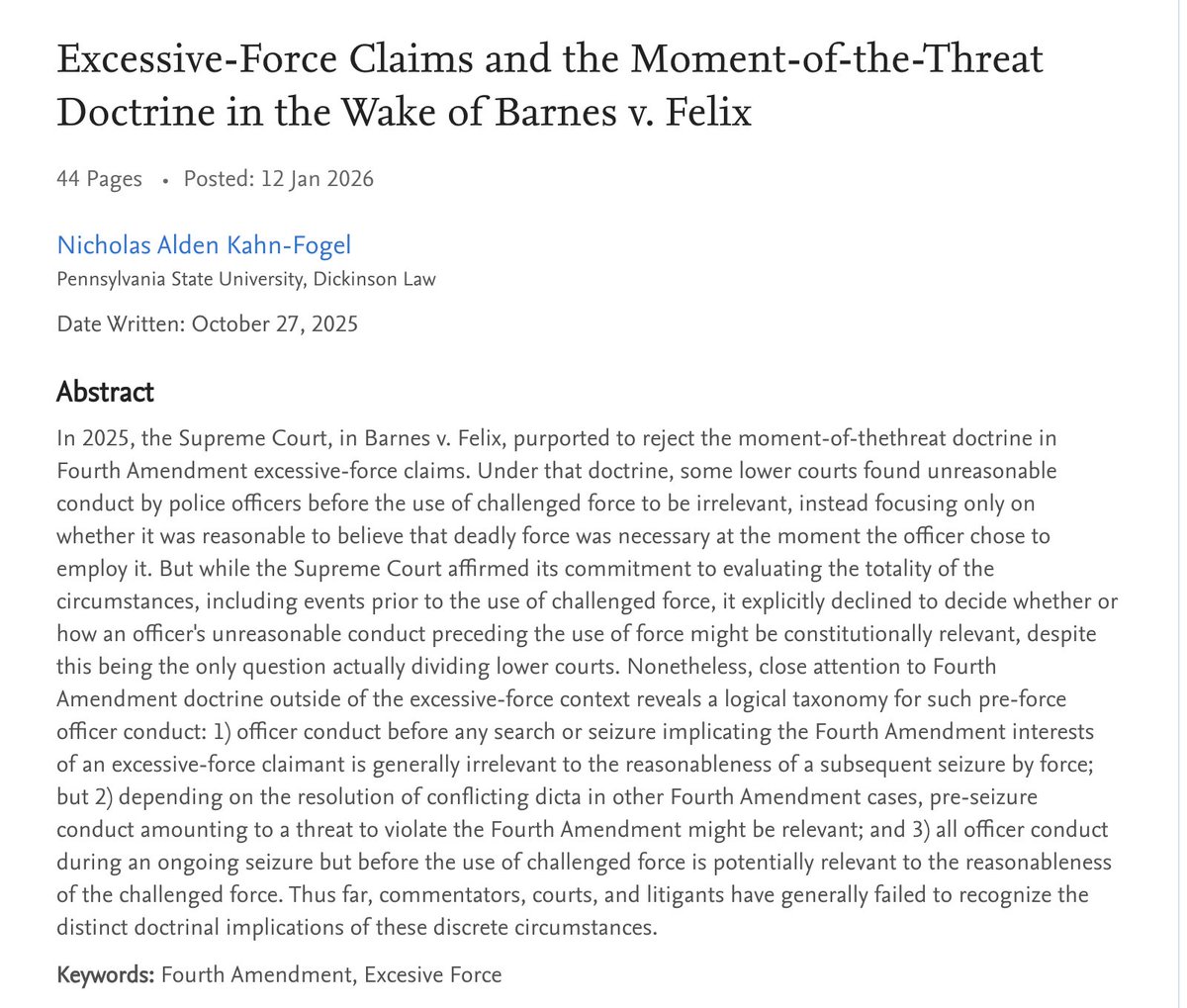
I'm very happy to share that my new article, Excessive-Force Claims and the Moment-of-the-Threat Doctrine in the Wake of Barnes v. Felix, is forthcoming in the William & Mary Bill of Rights Journal. @wmborj.
https://t.co/2hYwsvMDGx
@derektmuller Interesting question. I would also be interested to see how this breaks down by career stage. For example, a person who just got tenure and plans to work in the academy for another forty years might place a 1/