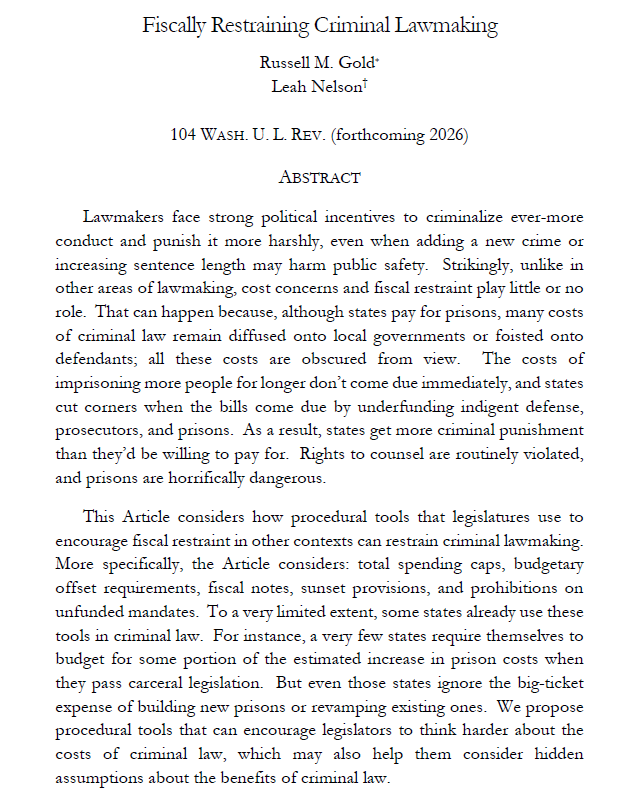
Fiscally Restraining Criminal Lawmaking by @leahanelson and me is forthcoming in @WashULRev and up on SSRN: https://t.co/OeTojT75NT. We analyze how legislative tools to promote fiscal restraint could (and occasionally already do) work in criminal law.
It has been interesting to watch Alabama, Texas, and Florida remove the bar admission requirement to graduate from an ABA-accredited law school. Did they realize that their war on wokeness was following California’s lead?
I’m honored to receive an award for Outstanding Contribution to Teaching Development from the University of Alabama Teaching Academy. I’m extraordinarily grateful for my time as a Faculty Fellow there over the past two years. I have learned a ton and met so many amazing teachers.
I’m humbled and honored to receive the Dean Thomas Christopher Award for service to @UALawSchool. It’s an incredible privilege to get to work with amazing students and colleagues.
Law profs/students/anyone doing legal scholarship:
If you're not using @zotero to manage cites and research, you should. An unbelievable time saver.
I've revised the Bluebook style for rendering footnotes, w/ detailed instructions on using Zotero:
https://t.co/FHgW7xlMHM
@OrinKerr I tell my students that “invocation” of Miranda rights is a misnomer under existing doctrine and that they ought to think instead of the right to cut off questioning under Miranda (albeit for different lengths of time depending on whether the suspect mentions silence or counsel).
In Fiscally Restraining Criminal Lawmaking, we argue that state legislatures should estimate the costs and appropriate money to pay for them before passing new criminal laws or increasing punishments. Is the new law worth the money? We think that question is worth asking.
Alabama's legislature passed a new felony for eluding law enforcement. Did they consider how much a new felony would cost our vastly underfunded and incredibly dangerous state prisons? What about for district attorneys or county jails? Not that I can tell.
I don't mean to pick on Alabama though. Legislatures do this kind of thing regularly in criminal law. Sometimes they ignore fiscal note requirements entirely. @leahanelson and I take up this issue in a forthcoming article in @WashULRev: https://t.co/OeTojT75NT.
...with a publication date of 2026. The prize will be awarded at the 2027 AALS Annual Meeting in New York. Please send submissions and nominations to Professor Samuel Levine at Touro Law Center: [email protected]. The deadline for submissions and nominations is September 1, 2026
Submissions and nominations of articles are being accepted for the seventeenth annual Fred C. Zacharias Memorial Prize for Scholarship in Professional Responsibility. To honor Fred's memory, the committee will select from among articles in the field of Professional Responsibility
Fiscally Restraining Criminal Lawmaking by @leahanelson and me is forthcoming in @WashULRev and up on SSRN: https://t.co/OeTojT75NT. We analyze how legislative tools to promote fiscal restraint could (and occasionally already do) work in criminal law.
@MikeJShowalter@OrinKerr For example, my forthcoming article cites about 275 sources. It has several statutory cites but still cites a significant number of journal articles and some books. I couldn’t have read all of those sources in 15 hours, let alone the sources I read that didn’t make the cut.
@MikeJShowalter@OrinKerr Nice to virtually meet you too. As you probably know, law review articles are supposed to engage with all of the relevant literature; that seems to me to far exceed what “well substantiated” might mean in other contexts. My guess is that that’s where we’re diverging.
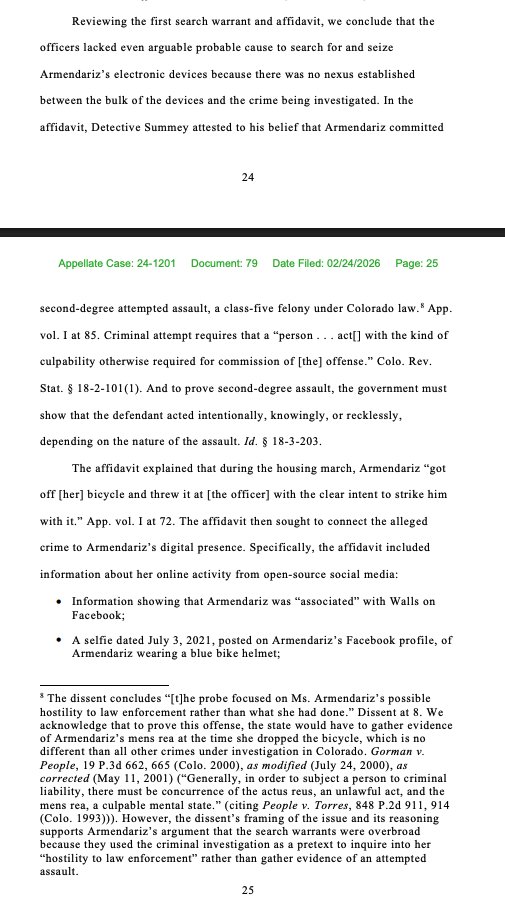
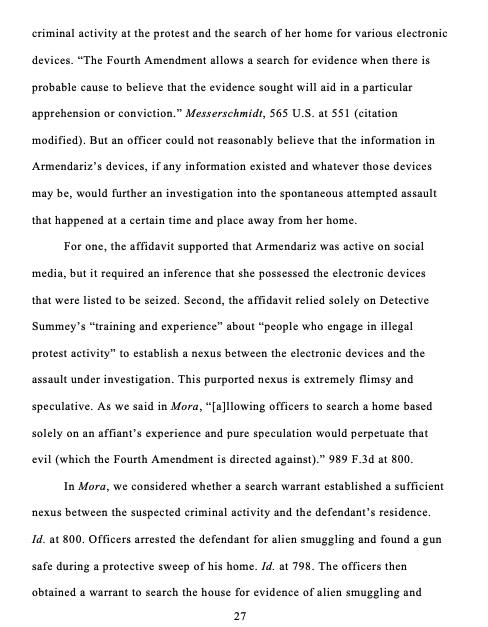
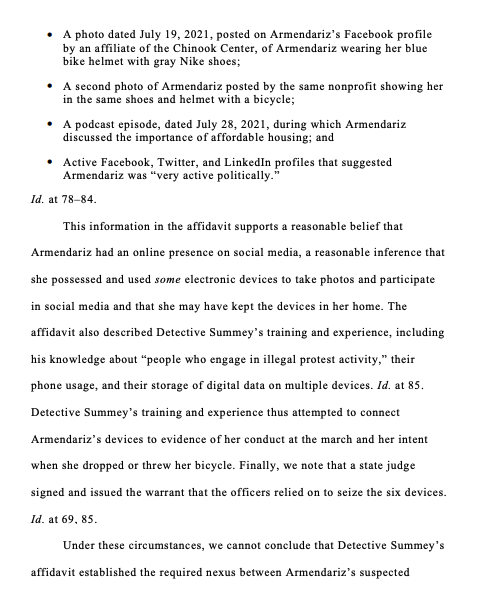
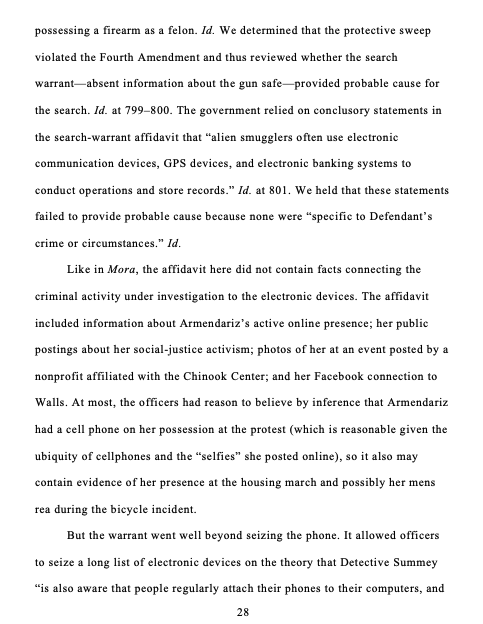
Important decision from the 10th Circuit on computer searches, suggesting new limits on the scope of computer search and seizure—at least in the CA10. And not only new limits, but no QI, at least in the 2-1 majority's view. https://t.co/Ocpt16cHQ6 #N
There's a ton going on here, but brief recap:
Police get warrant to enter home & search for evidence (including computers) of protester who attempted to assault officer during protest, arguing that there was likely evidence of the assault in the home, including on the protester's phone—and that could have been transferred to other computers in the protester's home.
First warrant just allows seizure; second allows search; third allows obtaining contents Facebook account. No charges are ultimately filed, and the protester sues.
Tenth Circuit, 2-1, holds:
1) No QI for officer as to the first warrant, as even if there was arguable PC as to cell phone, there wasn't even arguable PC to seize the bulk of the computers seized.
(see tweet below for more, so I can add more screenshots)