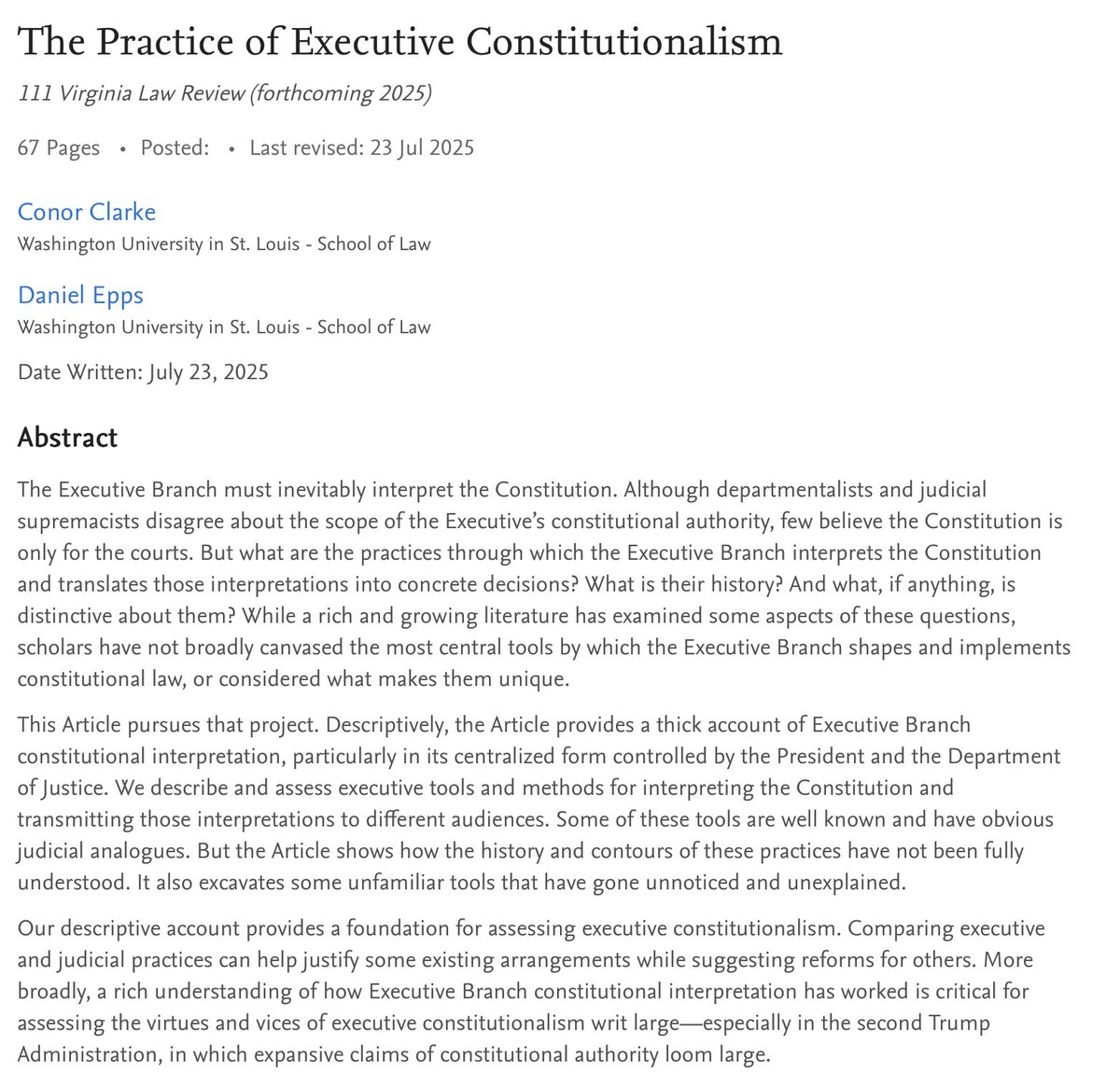
NEW ARTICLE on @SSRN: "The Practice of Executive Constitutionalism," by me and @conorjclarke (forthcoming in @VirginiaLawRev). Check it out! (Link in next tweet to avoid being crushed by the @X algorithm).
@OrinKerr@WilliamBaude I think turning something that would take a day or two (and be quite boring) into a 10-minute task seems like a big win, especially if you're madly scrambling to hit the law review submissions window...
@btfitzpat I think that's pretty standard with a lot of enterprise contracts, unfortunately. But it's possible you can ask them to upgrade you to a higher tier that does have it.
Update: improved both sets of skills a little bit, and more importantly made the web instructions a ton clearer and simpler for new users!
https://t.co/iMq9KKH3ty
Law folks: If you’re not using Claude Code or ChatGPT’s Codex, you have no idea what you’re missing. So I’m distributing my research tools that provide a huge boost to legal scholarship. Research assistance, cite-checking, proofreading, and more (thread):
https://t.co/iMq9KKGvE0
Law folks: If you’re not using Claude Code or ChatGPT’s Codex, you have no idea what you’re missing. So I’m distributing my research tools that provide a huge boost to legal scholarship. Research assistance, cite-checking, proofreading, and more (thread):
https://t.co/iMq9KKGvE0
@BenAdamsO_O Effectively, it gives Claude clearer instructions, and a much more structured workflow in terms of how to delegate chunks of a task to subagents, to produce work product that is useful for legal research.
@DDi90@poorlywhoorly I took a look at it a while back, but at the time I did, I had some questions about privacy protections because it seemed like stuff ran through their servers too. I will take another look at some point.
Note also that if you combine these skills with my Zotero style + plugins, they're even more powerful because they can search your library of articles.
https://t.co/FHgW7xmkxk