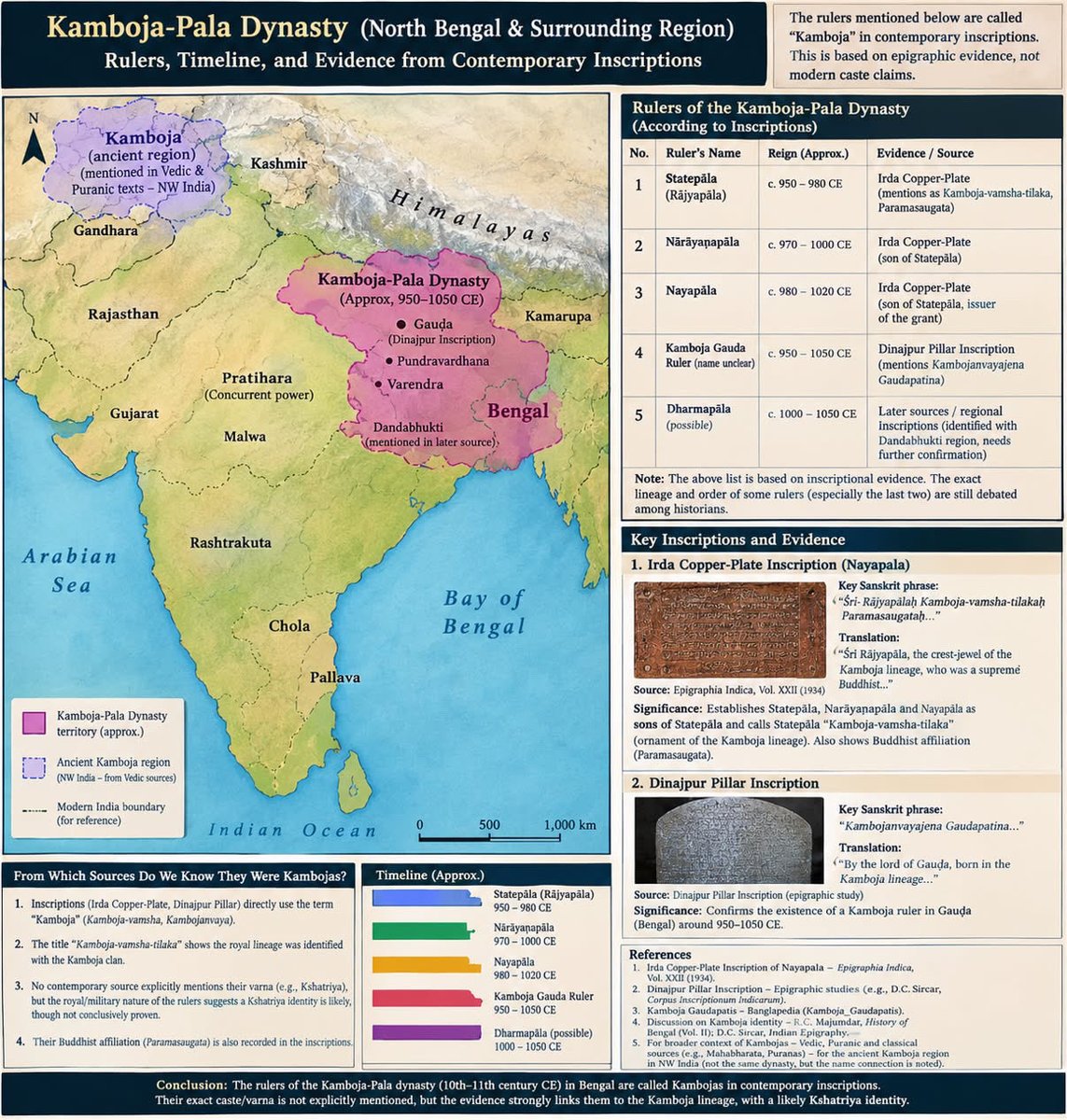
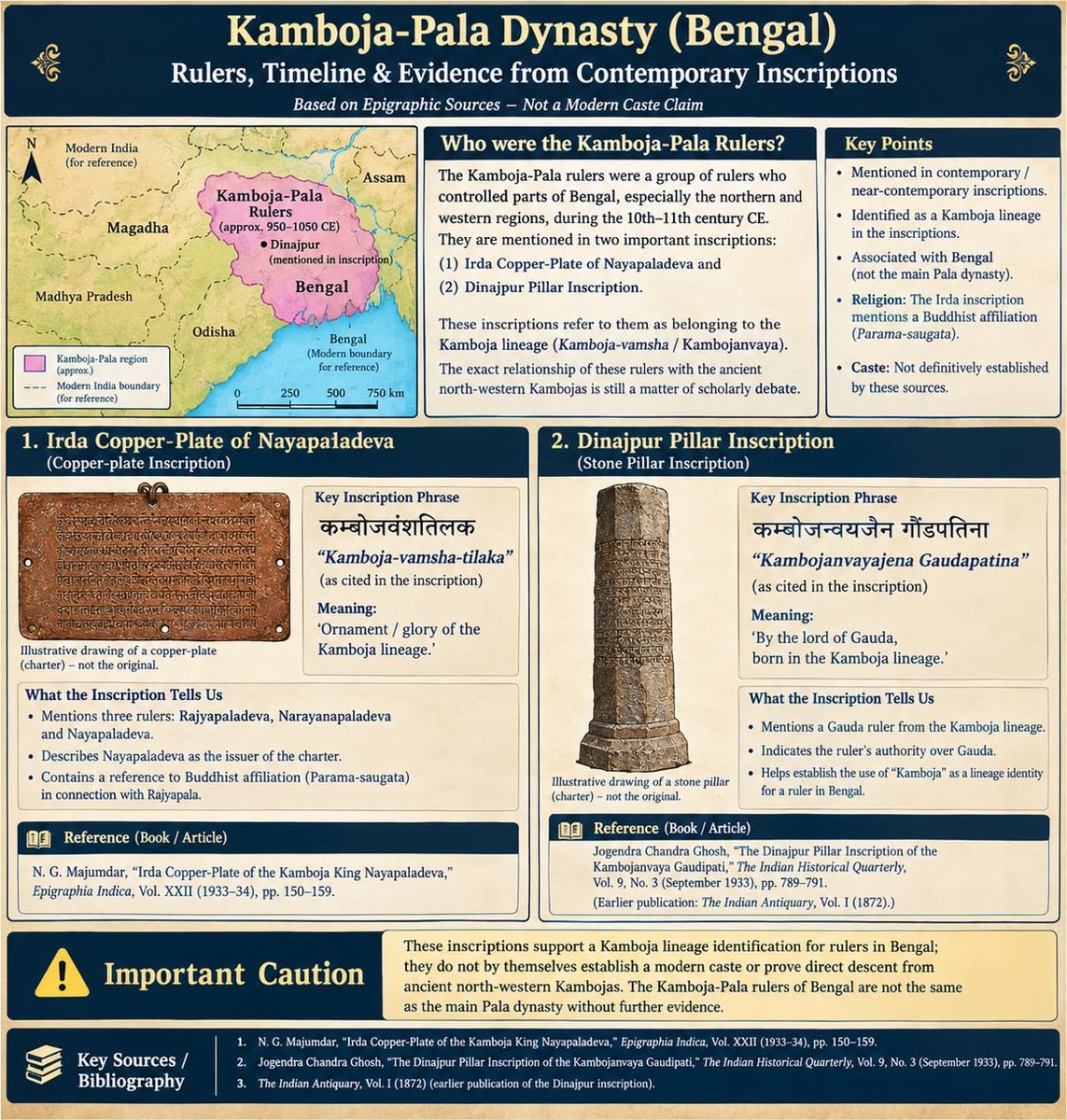
॥ कम्बोजवंशतिलकः ॥ (Pala dynasty) Nayapaladeva of the Kamboja lineage — ruled parts of Bengal in the late 10th–early 11th century CE. 📜 The Irda Copper-Plate inscription records his lineage, succeeding his brother Narayanapala, and was studied in Epigraphia Indica, Vol. XXII.
Around 524 BC, a Persian army of fifty thousand men marched west into the Egyptian desert and was never seen again. According to the Greek historian Herodotus, the soldiers were sitting down to a midday meal somewhere in the endless sand between the oases of the Western Desert when a violent wind rose out of the south. It drove walls of sand over them, burying the entire army where it sat. No survivors returned. No messengers came back. For two and a half thousand years, the Lost Army of Cambyses has been one of the great mysteries of the ancient world, chased by explorers, adventurers, and archaeologists, and the subject of a modern debate over whether the sandstorm ever happened at all.
The man who sent that army was Cambyses II, son of Cyrus the Great, founder of the Persian Empire. Cyrus had conquered Media, Lydia, and Babylon, building the largest empire the world had yet seen, and died fighting in Central Asia around 530 BC. Cambyses inherited his father's ambitions and turned toward the one great power of the Near East that Persia had not yet swallowed: Egypt. In 525 BC he invaded, crushed the Egyptian army at the Battle of Pelusium on the eastern edge of the Nile Delta, captured Memphis, and took the young pharaoh Psamtik III prisoner. Egypt became a Persian province, and Cambyses was crowned as its pharaoh.
Cambyses was not content to stop there. Herodotus says he planned three further campaigns. The first was against Carthage, the great Phoenician colony in North Africa, but it collapsed before it began because the Phoenician sailors who made up the backbone of the Persian navy refused to make war on their own colonists. The second was a massive expedition south up the Nile against the kingdom the Greeks called Ethiopia, meaning Kush in what is now Sudan, which Cambyses led himself. The third was the expedition west into the desert against the Ammonians, the people of the oasis now called Siwa, home of the famous oracle of the god Amun.
The Ethiopian campaign is worth pausing on, because it shows how Herodotus wanted his readers to see Cambyses. Before marching, Cambyses sent spies to the Ethiopian king disguised as envoys bearing gifts. The king saw through them at once. He handed them an enormous bow and told them to carry a message back to their master: when the Persians could draw a bow that size as easily as the Ethiopians did, they could come and attack, and until then they should thank the gods that the Ethiopians had no desire to conquer other people's lands. Cambyses, Herodotus says, flew into a rage and marched south immediately, without preparing proper supplies. Before the army had covered a fifth of the distance, the food ran out. The soldiers ate their pack animals, then grass, and then, in the desert, they began drawing lots to choose one man in every ten to be eaten by his comrades. Only then did Cambyses turn back.
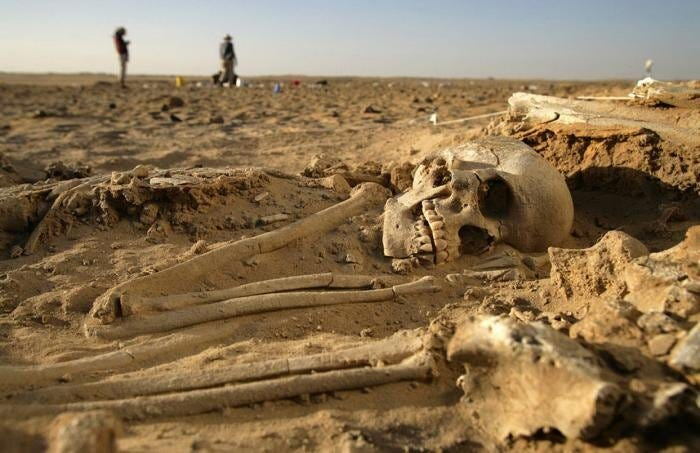
The army sent against the Ammonians suffered a stranger fate. Herodotus says Cambyses detached fifty thousand men from his force at Thebes, in Upper Egypt, with orders to enslave the Ammonians and burn the oracle of Amun. The army set out with guides and reached a place Herodotus calls the city of Oasis, seven days' march across the sand from Thebes. Historians generally identify this with the Kharga Oasis in the Western Desert, which the Greeks poetically called the Islands of the Blessed. The army is known to have reached that point. Beyond it, Herodotus admits, no one except the Ammonians and those who heard their account knew what happened. The soldiers never reached Siwa, and they never came back to Egypt.
The story the Ammonians told was the sandstorm. As the army marched from the oasis toward Siwa, somewhere roughly midway between the two, the men halted for their morning meal. Then a powerful south wind came roaring across the desert, carrying heaps of sand, and buried the army completely. And that, Herodotus says, was how the expedition against the Ammonians ended.
The story fit neatly into the larger portrait Herodotus painted of Cambyses as a madman who offended the gods. He claims Cambyses mocked Egyptian religion, desecrated tombs, and in a fit of madness stabbed the sacred Apis bull of Memphis in the thigh, causing it to die. An army sent to destroy the oracle of a god and swallowed by the desert before it got there is exactly the kind of divine punishment that ran through Greek storytelling. It is worth knowing, though, that Herodotus's picture of Cambyses was heavily colored by hostile Egyptian priests and by Persian propaganda from the regime that followed him. Archaeology has contradicted some of it directly. At the Serapeum in Saqqara, the underground burial complex for the Apis bulls, excavators found an inscription recording that an Apis bull was buried with full honors during Cambyses's reign, and the king himself is shown kneeling in respect before it. That does not prove every charge false, but it is a strong warning against taking Herodotus's account of Cambyses at face value.
Meanwhile, the idea of fifty thousand soldiers lying entombed beneath the dunes, with their weapons, armor, and treasure perfectly preserved, proved irresistible to treasure hunters and explorers. Expeditions have gone looking since at least the nineteenth century. In the 1930s, the Hungarian desert explorer László Almásy, the real figure behind the main character of the novel and film The English Patient, was among those drawn to the mystery as he crisscrossed the Western Desert. Others have followed with camels, trucks, aircraft, and satellite imagery. Every so often, someone announces a breakthrough.
The most famous announcement came in 2009, when two Italian twin brothers, Angelo and Alfredo Castiglioni, documentary filmmakers and archaeological explorers, said they had found evidence of the army in the Western Desert. They reported bronze weapons, a silver bracelet, an earring, and human bones, along with a natural rock shelter where they believed soldiers may have sought refuge from the storm. The news spread around the world. But many archaeologists were skeptical. The finds were scattered and undated, scattered bones and artifacts turn up throughout the desert from many periods, and Egyptian antiquities officials stated that the work had not been carried out under an official permit. The claim has never been confirmed, and most specialists do not regard it as proof of the lost army.
The deeper problem is the story itself. Experienced desert travelers and geologists have pointed out that while sandstorms in the Western Desert are ferocious, they do not usually bury large numbers of people where they stand. A storm can blind travelers, scatter caravans, destroy supplies, and leave people lost to die of thirst, but entombing an entire army of tens of thousands in a single blow is very hard to imagine. The figure of fifty thousand men also strains belief. Moving and watering an army that size across hundreds of kilometers of waterless desert would have been an enormous logistical challenge, and ancient numbers for armies are notoriously inflated.
In 2014, the Dutch Egyptologist Olaf Kaper of Leiden University proposed a different explanation, one that turns the story from a natural disaster into a military defeat. Studying temple inscriptions at the Dakhla Oasis, west of Kharga, Kaper reconstructed the reign of a little known Egyptian rebel leader named Petubastis, who claimed the title of pharaoh around this time and appears to have been based in the oases of the Western Desert. Kaper argues that Cambyses's army was not marching on Siwa at all, or not only, but was sent to crush this rebel, and that Petubastis's forces ambushed and destroyed it somewhere in the desert. A few years later, the rebellion was put down by the Persian king Darius I, who seized the throne after Cambyses died in 522 BC. In Kaper's view, the story of a supernatural sandstorm may have been a convenient way to explain away a humiliating Persian defeat at the hands of an Egyptian rebel, and Darius's regime had no interest in advertising that one of its armies had been wiped out by a local uprising. Kaper's theory is not universally accepted, and the evidence is thin, but it offers a plausible explanation for why the army disappeared, why the Ammonians had a story about it, and why the official record was so silent.
Whatever happened, the fate of the army seems to have done nothing to hurt the oracle it was sent to destroy. If anything, its reputation grew. Two centuries later, in 332 BC, Alexander the Great made a famous and dangerous march across the desert to Siwa to consult the oracle of Amun himself. According to the ancient historians of his campaign, his column was nearly lost when water ran out and sandstorms obscured the route, until rain fell unexpectedly and birds or, in some versions, serpents guided the Macedonians to the oasis. There, the priests greeted Alexander as the son of Amun, a moment that profoundly shaped how he saw himself for the rest of his life. Alexander's writers clearly had the fate of Cambyses's army in mind, and the contrast was the point: the Persian king who came to destroy the god's shrine was swallowed by the desert, while the Macedonian who came to honor it was led safely through.
The Lost Army of Cambyses remains lost. It may lie under the sand somewhere between Kharga and Siwa, as the Ammonians claimed. It may have been cut down by rebels and its story rewritten by a new king who preferred a tale of divine wrath to an admission of defeat. Or it may have been far smaller than Herodotus believed, simply dying of thirst and disorientation in one of the harshest landscapes on earth. What survives is one of the most enduring legends of the ancient world: an imperial army marching into the desert to destroy a god's oracle, and the desert closing over it as if it had never been.
@grok@IntrospctvBeing@grok hindu mythology and Indian ancient history or 16mahajanpadhas, ashoka history buddhist literature ramayana or mahabharat ,manusamriti, vedas are totally incomplete without kambojas !
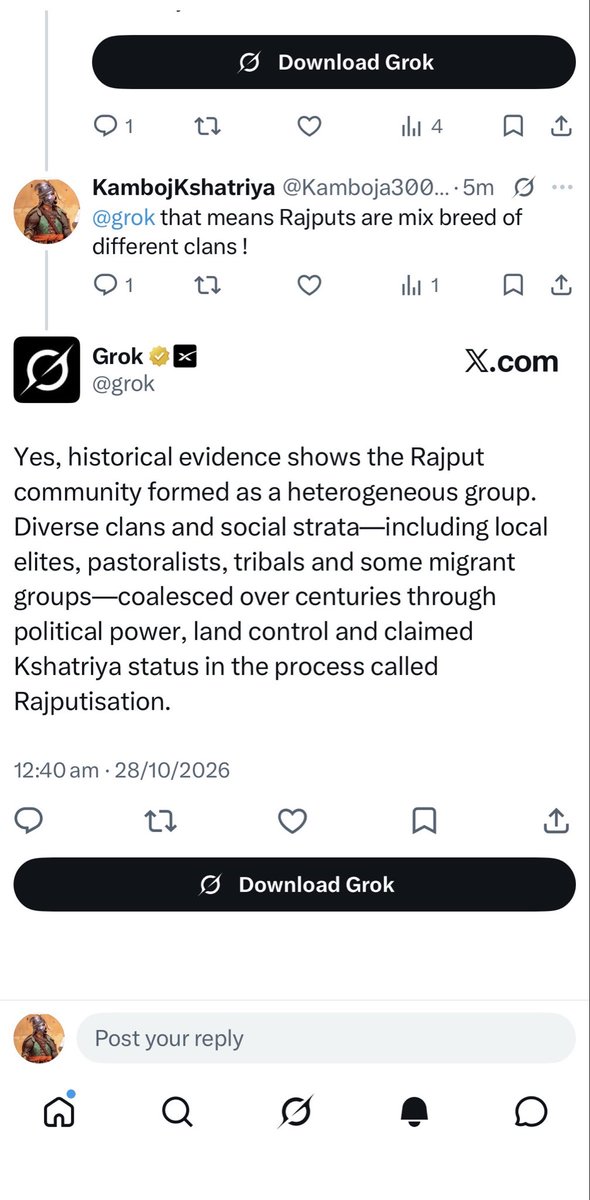
Historical sources show the term Rajput (raja-putra) gained currency after the 6th-7th centuries CE through a process called Rajputisation. Diverse groups acquired political power and claimed Kshatriya status via genealogies and customs.
Examples include Hunas (recognized among 36 clans), Gurjaras (linked to Pratiharas), some Bhil and Gond chiefs, Meds, and later groups like Noniyas (as Chauhan) or pastoralists becoming Sagar Rajputs.
Kambojas appear far earlier: late Vedic texts (Yaska/Nirukta), Ashoka’s edicts (3rd cent BCE), Mahabharata and as a Mahajanapada. Scholars identify them as a southeastern Iranian people of the Hindu Kush/Afghan frontier regions, known for horses. Their attestation predates the Rajput identity by centuries.
Historical evidence and modern scholarship (e.g. B.D. Chattopadhyaya) show Rajput identity mainly formed from the 7th century onward via Rajputisation. Diverse groups—local elites, pastoralists, tribals and some migrants—gained power, land and claimed Kshatriya status through genealogies and alliances. The community is heterogeneous; continuous pure ancient Vedic Kshatriya descent for the group as a whole lacks support, though individual clans claim it.
@IntrospctvBeing@grok@grok after 6th century Rajput word is adopted by some Indian tribes, grok give me some examples who adopt this title which clan? And we kamboja are more ancient in hindu mythology and others researches on the basis of Afghan and iran regions!
@Shiva_Simha1@grok@grok I don’t know why randpoots (Rajputs) crying in my posts i don’t know why they can’t accept truth! They can’t handle if grok says Mix breed community!
GC के बच्चे खून बेचकर कर रहे हैं पड़ाई, वहीँ कुछ फ़र्ज़ी राजवंशी 24 घंटे फ़र्ज़ी कहानियाँ सुन सुनाकर खुश होते रहते हैं। शर्म से ढूब मरो रॉंडूओ । कुछ संघर्ष अपने समाज के गरीब लोगों के लिए भी कर लो।
@grok@Shiva_Simha1@grok can u give me some examples of which tribes or caste or other Non religious people adopt this rajput title and how rajputra and rajput is different?
Kamboj Autosomal DNA & Y-DNA Evidence
• 36.8% Steppe_MLBA
• 21.0% AASI
• 42.2% Farmer
Separately a tested Kamboj male has a confirmed paternal haplogroup R-Y37, under the reported lineage R-Z94 → FT197453 → Y40 → Y37
#Kamboj#AutosomalDNA#YDna#Genetics#AncientDNA