📄 Paper: https://t.co/QQBLR7o5sY
💻 Code: https://t.co/MLdWwjwEb9
To endorse: log in to arXiv → endorsement page → choose https://t.co/e9IZnwXJz2 → enter SKAMH7
Happy to return the favor and review your work too. Thank you!
#arXiv#ExplainableAI#DiffusionModels
Looking for an arXiv endorser (https://t.co/e9IZnwYhoA)
I just finished a paper on diffusion-based counterfactual explainability and I'm ready to submit, but as a first-time author I need an endorsement.
Endorsement code: SKAMH7
Not eligible? A repost helps a lot
Counterfactual Diffusion with Intrinsic Explanations for Medical Image Editing
The goal: not just editing chest X-rays, but making each edit controlled, localized, and explainable through an auditable Guidance Map.
#AI#MedicalImaging#ComputerVision
So much to unpack @deepseek_ai ‘s expanded R1 paper. So valuable.
Regardless DeepSeek releases R2 or V4 in Feb or not, 2026 R1 paper v2 update is probably the most cutting-edge, transparent benchmark in the current publicly available research materials on reasoning models by humanity. A true gift to the world.
1. It publicly shares the expensive lessons from their failures, so the others can save significant amount of trial/error costs. It points out some highly anticipated methods by the industry will actually only teach the model to "cut corners." This restores what were originally closed commercial secrets into engineering science that can be publicly verified & improved upon.
2. It confirms acquisition of reasoning capabilities does not rely on large-scale human annotation; simply by designing reasonable incentive mechanisms through "reinforcement learning," it is sufficient to induce the model to naturally emerge w complex thinking patterns that surpass human presets, shattering the superstition that "the upper limit of intelligence depends on human data."
3. It closed the generational gap in reasoning capabilities between the open-source community and the closed-source giants.
This paper will go down the AI history that a small team of smart human beings offered the most advanced alternative that is accessible by the entire world rather than guarded in handful expensive walled gardens. Thank you. 🫶
https://t.co/NtEr52Snm8
Terence Tao says the math behind today’s LLMs is actually simple. Training and running them mostly uses linear algebra, matrix multiplication, and a bit of calculus, material an undergraduate can handle. We understand how to build and operate these models.
The real mystery is why they work so well on some tasks and fail on others, and why we cannot predict that in advance. We lack good rules for forecasting performance across tasks, so progress is largely empirical.
A key reason is the nature of real-world data. Pure noise is well understood, perfectly structured data is well understood, but natural text sits in between, partly structured and partly random. Mathematics for that middle regime is thin, similar to how physics struggles at meso-scales between atoms and continua.
Because of this gap, we can describe the mechanisms but cannot yet explain capability jumps or give reliable task-level predictions. That mismatch, simple machinery versus hard-to-predict behavior, is the core puzzle.
----
Video from 'Dr Brian Keating' YT Channel (Link in comment)
Don't sleep on this! 🔥
@Meta dropped swiss army knives for vision with A2.0 license ❤️
> image/video encoders for vision language and spatial understanding (object detection etc)
> VLM outperforms InternVL3 and Qwen2.5VL 🔥
> Gigantic video and image datasets 👏
Introducing VLM-R1!
GRPO has helped DeepSeek R1 to learn reasoning. Can it also help VLMs perform stronger for general computer vision tasks?
Our preliminary answer is YES and it generalizes better than SFT.
https://t.co/iffweRXcpO
Large language models (LLMs) are typically optimized to answer peoples’ questions. But there is a trend toward models also being optimized to fit into agentic workflows. This will give a huge boost to agentic performance!
Following ChatGPT’s breakaway success at answering questions, a lot of LLM development focused on providing a good consumer experience. So LLMs were tuned to answer questions (“Why did Shakespeare write Macbeth?”) or follow human-provided instructions (“Explain why Shakespeare wrote Macbeth”). A large fraction of the datasets for instruction tuning guide models to provide more helpful responses to human-written questions and instructions of the sort one might ask a consumer-facing LLM like those offered by the web interfaces of ChatGPT, Claude, or Gemini.
But agentic workloads call on different behaviors. Rather than directly generating responses for consumers, AI software may use a model in part of an iterative workflow to reflect on its own output, use tools, write plans, and collaborate in a multi-agent setting. Major model makers are increasingly optimizing models to be used in AI agents as well.
Take tool use (or function calling). If an LLM is asked about the current weather, it won’t be able to derive the information needed from its training data. Instead, it might generate a request for an API call to get that information. Even before GPT-4 natively supported function calls, application developers were already using LLMs to generate function calls, but by writing more complex prompts (such as variations of ReAct prompts) that tell the LLM what functions are available and then have the LLM generate a string that a separate software routine parses (perhaps with regular expressions) to figure out if it wants to call a function.
Generating such calls became much more reliable after GPT-4 and then many other models natively supported function calling. Today, LLMs can decide to call functions to search for information for retrieval augmented generation (RAG), execute code, send emails, place orders online, and much more.
Recently, Anthropic released a version of its model that is capable of computer use, using mouse-clicks and keystrokes to operate a computer (usually a virtual machine). I’ve enjoyed playing with the demo. While other teams have been prompting LLMs to use computers to build a new generation of RPA (robotic process automation) applications, native support for computer use by a major LLM provider is a great step forward. This will help many developers!
As agentic workflows mature, here is what I am seeing:
- First, many developers are prompting LLMs to carry out the agentic behaviors they want. This allows for quick, rich exploration!
- In a much smaller number of cases, developers who are working on very valuable applications will fine-tune LLMs to carry out particular agentic functions more reliably. For example, even though many LLMs support function calling natively, they do so by taking as input a description of the functions available and then (hopefully) generating output tokens to request the right function call. For mission-critical applications where generating the right function call is important, fine-tuning a model for your application’s specific function calls significantly increases reliability. (But please avoid premature optimization! Today I still see too many teams fine-tuning when they should probably spend more time on prompting before they resort to this.)
- Finally, when a capability such as tool use or computer use appears valuable to many developers, major LLM providers are building these capabilities directly into their models. Even though OpenAI o1-preview’s advanced reasoning helps consumers, I expect that it will be even more useful for agentic reasoning and planning.
Most LLMs have been optimized for answering questions primarily to deliver a good consumer experience, and we’ve been able to “graft” them into complex agentic workflows to build valuable applications. The trend of LLMs built to support particular operations in agents natively will create a lot of lift for agentic performance. I’m confident that large agentic performance gains in this direction will be realized in the next few years.
[Original text: https://t.co/gginTyOgwe ]
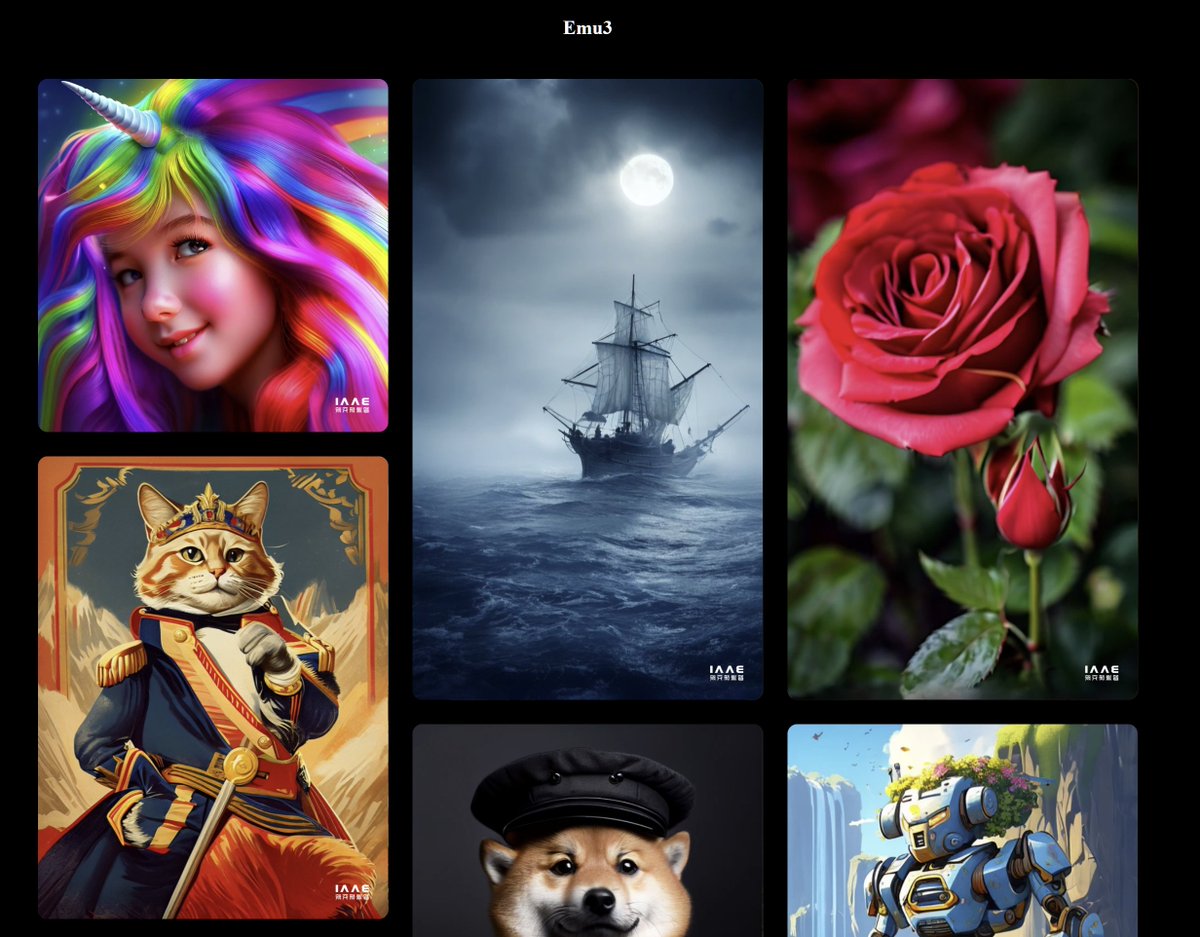
Emu3: Next-Token Prediction is All You Need
abs: https://t.co/qFbpsTZJDY
project website: https://t.co/ERXBwXsMt4
models: https://t.co/csAZwtwKJZ
Singe transformer trained with next-token prediction on multimodal mixtures, performs image generation, video generation, vision-language understanding, outperforms SDXL, LLaVA-1.6, OpenSora 1.2
dataset day today, dataset day tomorrow.
it's cool then non-tech people think of ml engineers sitting like freaking nerds and working with algorithms and big systems, but 80% of the time its dataset monkey manual work (if it new unusual case ofc)
I somehow missed this...
A new series of Falcon models were released last month:
- Falcon 2 11B LLM
- Falcon 2 11B VLM
Blog post: https://t.co/VneR1e0MxH
Trained on >5T tokens of RefinedWeb
The model performs on benchmarks better than models such as Llama3-8B, which is trained on 3x more data, and Mistral-7B, but this model is also slightly bigger. This model is on par with Gemma-7b.
The VLM model beats LLaVA-1.6 models on multimodal benchmarks.
I guess maybe the reason I hadn't heard of it yet is because the benchmarks are pretty underwhelming.
But it sounds like they are training new models, including MoEs.
From the Newsletter: China Enters the Doom Loop
"China's authoritarian gerontocracy has built a Doom Loop with Chinese characteristics, with over half the economy now crashing."
https://t.co/dKWBMNVhG2