2025 marked a pivotal year in Kappa Lab’s operations and performance. We’re proud to have supported some of the industry’s most ambitious protocols and builders.
We expanded to Dubai, added 4 new business verticals, 13 new partnerships, 18 new exchange integrations, and sustained $15B in monthly trading volume. Together, these milestones reflect a broader trend: institutional-grade crypto infrastructure is scaling rapidly.
Now in 2026, we’re building on this momentum with new initiatives already underway. Stay tuned.
👇 More from this week:
→ @CMEGroup launched Bitcoin Cash and Uniswap futures on Oct 19, with @FalconXGlobal and GSR executing the first block trade. $BCH $UNI
→ @StanChart signed definitive agreements to acquire 100% of Zodia Custody, subject to regulatory approvals.
→ @Grayscale opened in-kind investing across 10 products, letting eligible investors exchange tokens such as $BTC, $ETH, $SOL and $XRP directly for fund shares.
→ The CFTC registered @tZERO's subsidiary as a derivatives clearing organization. tZERO's DCM application is still pending.
→ DEXs Aerodrome and Velodrome merged into @aeroxyz, which is launching across seven networks.
→ @BlackRock filed for the iShares Bitcoin Managed Protection ETF ($PBIT), which would use $IBIT call options to offer downside protection with capped upside.
→ Tokenized $META shares issued by @Backpack went live on @solana via @sunrise.
Industry Catch-Up | October 22, 2026
$BTC at ~$81K. $ETH at ~$2.2K.
1) @USOCC issued its final GENIUS Act rule for the stablecoin issuers it oversees, effective Jan 18, 2027. Issuers must hold reserves at least equal to outstanding stablecoins and generally pay redemptions within two business days. The OCC dropped a proposed presumption that some third-party reward deals breach the yield ban, and AML and sanctions rules will follow separately.
2) @Lighter_xyz said on its Q3 investor call that it plans to apply to the CFTC in November. The application would cover DCM and DCO licenses, which allow a firm to run a regulated exchange and clearinghouse. CEO Vladimir Novakovski said the team has held extensive early talks with CFTC staff and gave no approval timeline.
3) @OndoPerps listed a pre-IPO OpenAI perp on Oct 21, with up to 3x leverage, hourly funding and a $1,600 seed price. It is a separate market from OPAIPon, the fully funded OpenAI note on Ondo Perps' spot order book. US persons cannot trade it.
4) @extendedapp was scheduled to start moving its settlement layer from Starknet to @circle's @arc on Oct 22 at 13:00 UTC. It described the move as part of a strategic partnership with Circle. Trading was set to continue, with deposits and withdrawals paused for up to two hours.
US Spot ETF Flows (Oct 15 to Oct 21):
🟢 $BTC: +$1B
🔴 $ETH: -$244.4M
🔴 $SOL: -$31.3M
🔴 $HYPE: -$17.6M
🔴 $ZEC: -$9.6M
🔴 $XRP: -$1.9M
→ On Oct 21, $IBIT (+$235.0M) and $FBTC (+$212.7M) led $BTC ETF inflows. In $ETH, $ETHA posted -$29.3M, offset by Grayscale's $ETH fund (+$28.1M) and $FETH (+$13.0M).
→ Cumulative net inflows since launch: $XRP ETFs $1.80B, $SOL ETFs $1.55B, $HYPE ETFs $311.4M and the $ZEC ETF $169.0M.
→ As of Oct 21, $BTC ETFs held $109.31B in net assets (6.42% of $BTC market cap) and $ETH ETFs $15.36B (5.05% of $ETH market cap).
TOKEN2049 Singapore takeaways
A bit late with this post, but here it is.
I left more optimistic than I arrived. Bull market energy is back, and so is retail. The crowd felt younger — more people there for themselves rather than a company badge. I didn’t see a booth I’d call fluff.
A few things stayed with me:
- Prediction markets have my attention. Once you’re inside the book, @Polymarket feels closer to a crypto exchange than a traditional bookmaker. Quoting, latency, inventory risk, adverse selection — the problems are familiar. I think there’s more room here than people assume.
- Tokenized stocks are launching with a market maker already in the seat. @Securitize launched on Solana with Jump. Nobody is waiting for liquidity to show up on its own.
- Nasdaq plans to move to 23-hour trading, five days a week, from December 6. Longer hours make liquidity harder. Overnight books can be thin, and someone has to keep quoting.
- The same stock is trading as different tokens across different venues. Keeping those prices aligned means understanding what each token represents and how you can hedge or redeem it. There’s a lot of market making work ahead.
- I also heard that “vaults are dead.” I don’t agree. People underestimated the work involved. Launching a vault is the beginning. Designing, running, and risk-managing the strategy is the ongoing commitment.
We’re building in this space at @KappaLab_io. We run three HLP-style vaults, including FLP on @hibachi_xyz and MLP on @meridiandotxyz. Separately, we run a USDe credit vault on @WildcatFi.
If you’re issuing or listing tokenized assets on your exchange, or launching a venue / rethinking a vault, my DMs are open. We can help with both the liquidity and the strategy behind it.
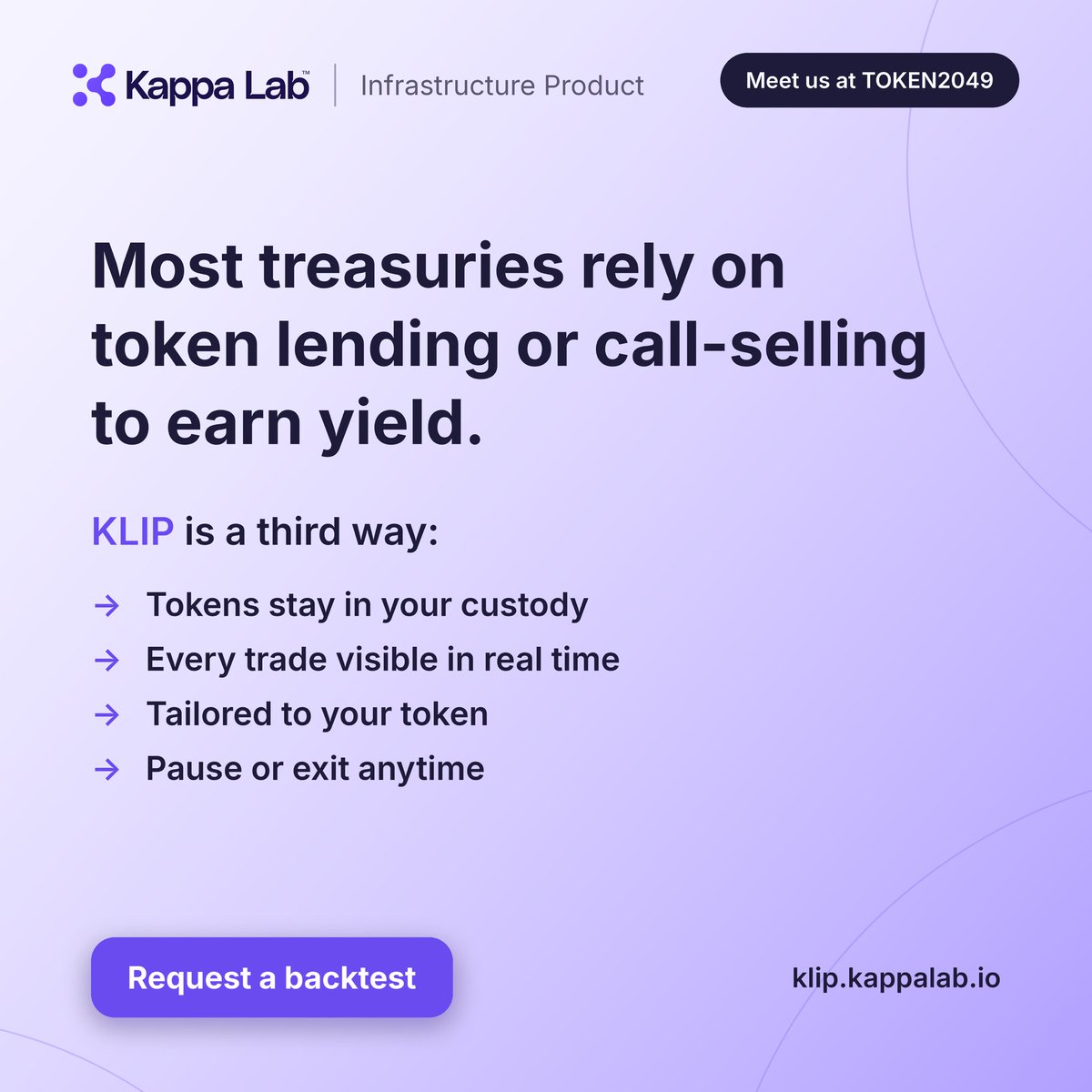
We had more KLIP conversations than I expected, too. Foundations already hold their native token and bear its volatility. KLIP is our dedicated yield strategy for your treasury’s assets. It generates yield from the volatility while you retain custody.
People wanted to know what their treasury would have earned. We ran the backtests, and they were impressed by the numbers. Curious what yours would look like? Request a free backtest at https://t.co/KtgU7jCGGu. Results within 48 hours.
Also, some of the sharpest trading conversations I had came from very small teams. There’s more good work happening outside the big names than the headlines suggest.
Thank you to everyone who made time for a meeting, a coffee, or a conversation that ran far too late. I came home with new connections, and I expect a few of them to turn into things we build together.
See you at the next one.
@TOKEN2049 Singapore through a market maker’s lens: more assets, more venues, more hours. Who’s providing the liquidity?
Our conversations with institutions, venues and foundations pointed to three opportunities.
>Institutions
On October 8, @Securitize launched 12 tokenized US stocks on @solana, combining a PropAMM with Jump Trading as market maker.
Tokenized equities introduce pricing, liquidity and hedging challenges that traditional AMMs were not designed to address. We’re building onchain infrastructure to address those needs. Are you issuing or listing tokenized RWAs? Let’s talk.
@Nasdaq is taking a different approach. Its SEC-approved model allows eligible tokenized and traditional shares to trade on the same order book, under the same ticker and execution priority. The settlement infrastructure changes, but liquidity remains unified.
Beyond trading, tokenization could unlock significant efficiencies in collateral management, capital utilization and prefunding requirements.
But extending market hours doesn’t automatically extend market depth.
>Venues
Prediction markets have become a market structure business. @Polymarket, @Kalshi and emerging venues trade more like exchanges than bookmakers: order books, latency, inventory risk, adverse selection. Every book needs someone willing to quote, manage risk and provide consistent liquidity.
Meanwhile, @HyperliquidX’s options ambitions and @coinbase’s upcoming options powered by @DeribitOfficial add another opportunity: quoting volatility and hedging across products. Coinbase’s unified portfolios bring collateral efficiency into the competition.
Vaults face the same need for active risk management.
Our view is that the vault model was misunderstood, not broken. A vault is not a feature a venue switches on. It is a strategy someone has to design, run, risk-manage and continuously optimize. Venues treating it as an ongoing service are still growing theirs.
We run multiple HLP-style vaults, including FLP on @hibachi_xyz and MLP on @meridiandotxyz, plus a separate USDe credit vault on @WildcatFi.
Are you launching a venue or reconsidering your vault strategy? Let’s talk: https://t.co/gXYykIvDeP
>Foundations
Foundations already carry substantial exposure to their native tokens. The question is whether their treasuries are capturing enough value from the token volatility.
This is precisely the opportunity behind KLIP, our dedicated treasury yield strategy, designed to monetize native-token volatility while allowing foundations to retain custody of their assets.
One question came up repeatedly in our conversations: What could our treasury have earned using KLIP?
We ran backtests and shared results that generated considerable interest.
Want to see what KLIP could have generated for your treasury? Reach out, your backtest is minutes away. https://t.co/jG6yNXkUpr
>What comes next?
Some products are live; others remain roadmaps. Securitize has launched, vaults are running, and Nasdaq has secured approval for its model.
The next wave is taking shape. Nasdaq targets 23/5 trading from December 6. @okx and @ICE_Markets plan a tokenized US stock venue using permissioned @Uniswap v4 pools. And Nasdaq and @Payward target Q2 2027 for Nasdaq Equity Tokens.
We expect two things: more hours needing reliable quotes, and more tokenized versions of stocks whose prices need to stay aligned.
Nasdaq’s model keeps one order book. The wider market may not. Different settlement, redemption and hedging arrangements make that alignment a market making problem.
By the next TOKEN2049, we expect the conversation to move from who is tokenizing assets to who will keep them liquid.
👇 Also in this edition:
- ChainCatcher reported over $678B in Papertrade's launch-day notional volume, citing its dashboard, and raised concerns about incentive-driven trading.
- The SEC approved Cboe's rules for binary options on company metrics, including $COIN, $MARA and $HOOD. Trading remains subject to clearing approvals.
- ESMA said MiCA-authorized firms should stop services involving non-compliant stablecoins for EU clients. Existing exposures must be addressed within three months of its Oct 8 opinion, with limited services allowed for the wind-down.
- The EBA classified $USDC as the EU's first significant e-money token under MiCA, bringing it under joint EBA and French supervision from Nov 12.
- GSR committed $100M over several years to Hare, mainly through a credit facility. The venture with Turtle plans Aave-powered vaults.
- VanEck requested withdrawal of the registration statement for its proposed Lido Staked Ethereum ETF.
- @binance said it will close Binance Pool and related mining services on Nov 10.
- @Ledger asked resellers in seven Asian markets to suspend sales during a hardware-tampering investigation.
Industry Catch-Up | October 15, 2026
$BTC at ~$81K. $ETH at ~$2.3K.
1) @coinbase said on Oct 7 that its @DeribitOfficial integration is complete, creating the Coinbase Global Exchange. US institutions can begin onboarding through Coinbase Prime via Coinbase Financial Markets. The rollout would connect them to Deribit's global options liquidity through the same platform they use for spot trading and custody. Options trading for those clients is expected in the coming weeks. US retail options are planned for later this year.
2) @variational_io has overtaken @tradexyz’s long-held lead in weekly onchain RWA derivatives volume. Blockworks data for Oct 5–11 shows $13.40B in notional volume for Variational versus $12.35B for Tradexyz, a difference of about $1.05B. The shift highlights competition for order flow in traditional-asset derivatives traded onchain.
3) @BNYglobal said on Oct 13 that it completed a tokenized Treasury repo transaction with @citsecurities. The security settled within minutes on BNY's private digital ledger. Citadel Securities then used it as collateral for overnight financing from BNY. Linking settlement and financing this way could make collateral available for borrowing sooner. The bank also said it plans to add tokenized deposits and extend settlement hours.
4) The @CFTC proposed on Oct 9 to classify event contracts on sports, politics, culture and weather as swaps. The agency says the proposal would resolve uncertainty over whether these contracts fall under its derivatives oversight. Comments are due within 30 days of publication in the Federal Register. A separate interim rule excludes sportsbook wagers and casino games from the swap definition. That rule takes effect upon Federal Register publication.
US Spot ETF Flows (Sep 30 to Oct 14):
🔴 $ETH: -$884.4M
🔴 $BTC: -$688.5M
🔴 $ZEC: -$119.3M
🔴 $SOL: -$43.5M
🔴 $HYPE: -$13.4M
🟢 $XRP: +$12.8M
- Oct 14 fund flows: $FBTC (-$152.7M) and $IBIT (-$110.9M) led $BTC outflows, while $BITB saw +$2.2M. In $ETH, $ETHA (-$109.8M) and Grayscale's $ETH fund (-$18.8M) led outflows.
- Cumulative net inflows since debut: $XRP ETFs at $1.80B, $SOL ETFs at $1.58B, $HYPE ETFs at $329.1M, and $ZCSH at $178.7M.
- As of Oct 14, $BTC ETFs hold $104.83B in net assets, 6.38% of $BTC market cap. $ETH ETFs hold $15.20B, 5.15% of $ETH market cap.
More below👇
#cryptonews #digitalassets #fintech #defi #web3
Great engagement between our team and foundations at TOKEN2049.
Every foundation asked the same question: how much would KLIP have earned on our token?
Request a free backtest and find out at https://t.co/2QUycVL3Wn
Week 22 of The Playoffs is complete.
Points
- 76.5M in circulation (+1.31% WoW)
- Weekly activity distribution is 500,000 this week. The other 500,000 is reserved for the Hibachi Open
- EUR and BTC still earn up to a 1.5x boost
Hibachi Open
- $102.8M eligible volume
- 47 traders past the $500k threshold
- Ends Sunday Oct 18, 23:59 UTC
- Leaderboard below
$300M in total volume unlocks the cash prize pool. 6 days left.
Product
- Institutional FX spot is the main engineering priority
Vaults
- FLP by @KappaLab_io : (+16.2% APR), allocation available, new cap $2.5m
- GAV by @GrowiFinance : (+2.9% APR), allocation available
Vault deposits earn yield and points.
Day 2 at @token2049 Singapore, and our team is in town until Saturday.
Exchanges, foundations, vaults, partners: @kiranxyz_
Collabs, KOLs, creators, research, PR, events: @vickbln
Message them on Telegram: https://t.co/PZ114N0ZbG - https://t.co/X5mFWsq8PK
Your foundation already carries your token's market risk. Looking for yield?
→ Lend it: you take on credit and protocol risk.
→ Sell calls: you hand the upside to the option buyer.
KLIP is a third way.
- Tokens stay in your custody.
- Every trade visible in real time.
- Exit anytime.
Every foundation that started with KLIP is still running it, and most have increased their size.
We're at TOKEN2049 this week. What's your token? We'll show you what it would have earned with KLIP.
DM us, or book a call: https://t.co/CSUS4KsViw
For qualified institutional clients outside the UK, US and UAE. Not financial advice.
I'll be in Singapore for TOKEN2049 next week!
If you're an agency, creator, designer, researcher, or KOL, work in PR or events, or you're open to collaborations or co-marketing with Kappa Lab, let's chat.
Available on 6-9 October. Message me on Telegram: https://t.co/h9uzMcAUYd
The best conversations at @TOKEN2049 happen off stage.
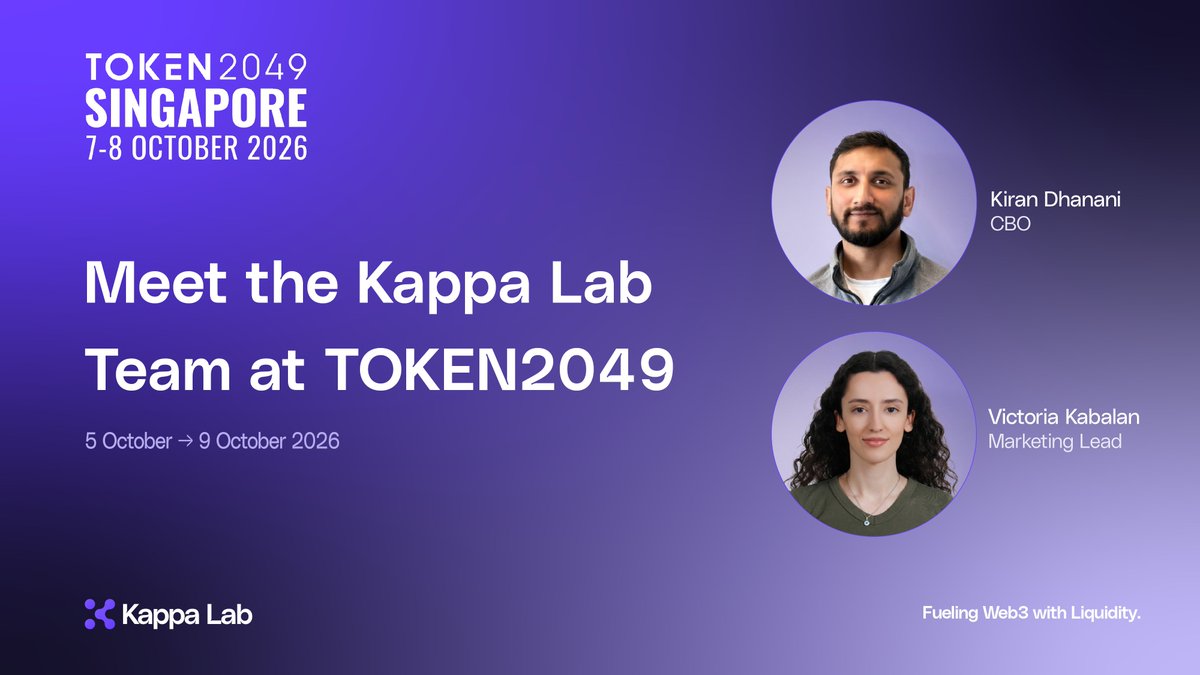
Kappa Lab will be in Singapore from 5 to 9 October, and we'd like to meet you.
We're a digital asset market maker. We provide liquidity across 1,500+ markets on 50+ centralized and decentralized exchanges.
Kiran Dhanani (@kiranxyz_), our CBO, is meeting exchanges, foundations, vault operators, trading firms, traders, and potential partners.
→ Telegram: @ Kirandhanani - https://t.co/pE5gsvJxYk
Victoria Kabalan (@vickbln__), our Marketing Lead, wants to meet agencies, creators, designers, researchers, KOLs, PR and events teams, and anyone up for co-marketing.
→ Telegram: @ vickbln - https://t.co/5tK4x1dKcE
Reach out to Kiran or Victoria on Telegram to schedule a meeting.
Learn more about Kappa Lab: https://t.co/zIS2oejPMX