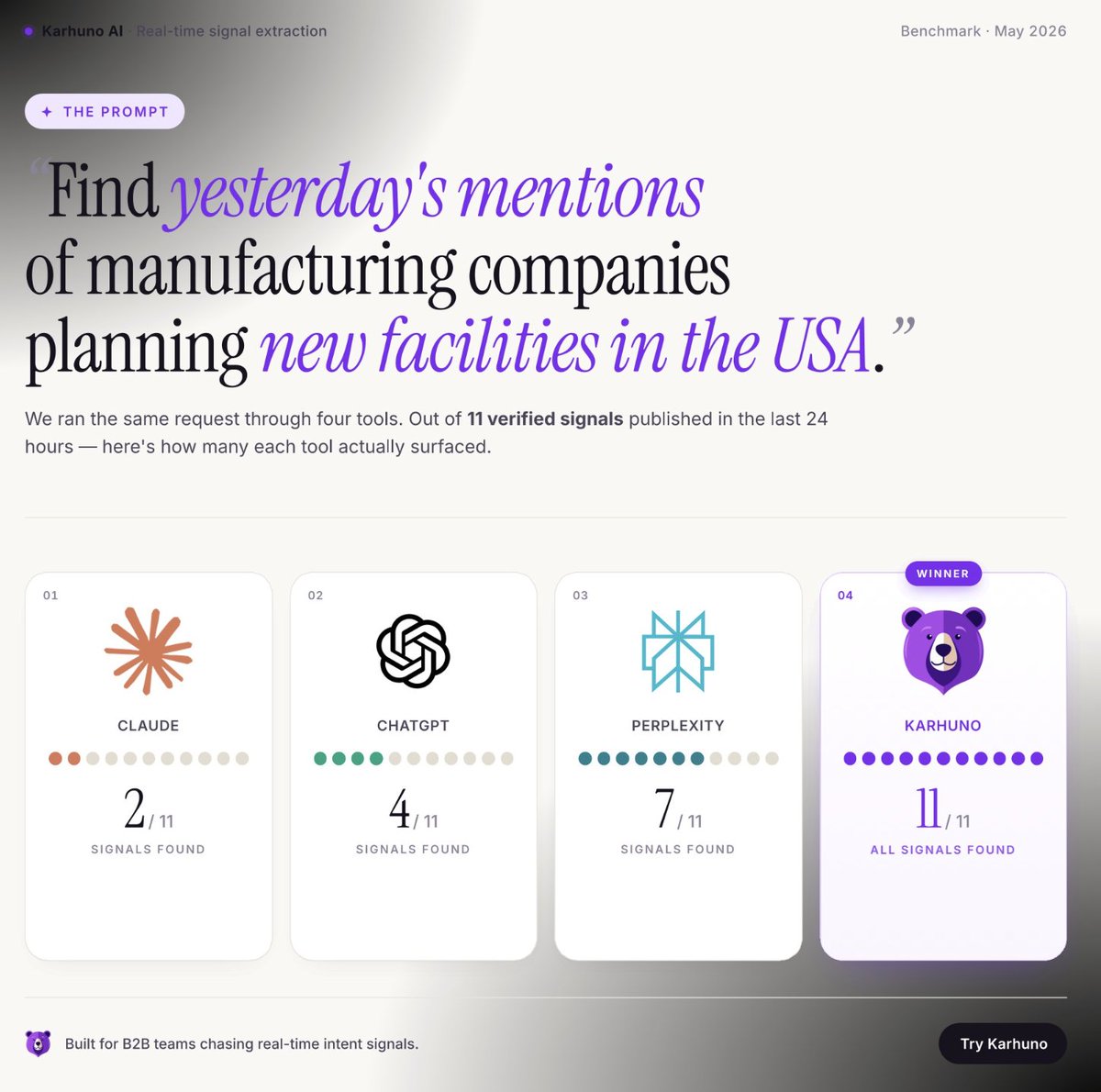
We tested the same real-time B2B signal request across Claude, ChatGPT, Perplexity and Karhuno AI
“Find yesterday’s mentions of manufacturing companies planning new facilities in the USA.”
The result was pretty revealing.
Claude found 2 out of 11 verified signals.
ChatGPT found 4.
Perplexity found 7.
Karhuno found all 11.
This is not because general AI tools are bad.
Generic LLMs are built to operate on the surface of the web.
They are excellent at finding what is obvious, popular, and easy to retrieve.
But real B2B buying signals rarely live there.
They are buried in fragmented sources: local news, niche industry sites, municipal updates, project announcements, PDFs, supplier pages, and regional business media.
Karhuno is built to go deeper.
Not just to search and summarize, but to uncover hidden business events, verify them, attach proof, and structure them into actionable signals for outbound teams.
Generic AI finds what everyone can see.
Karhuno finds what your competitors usually miss.
#b2bsales #outbound
Most suppliers find out about new warehouses too late.
By the time the project is public, the buying decisions have already started.
We track these signals in real time.
#warehouse#logistic#supplychain
☘️ Most outreach fails for one reason: timing.
A company selling ESG certifications came to us with a simple problem:
“we don’t know when companies actually need us.”
So we tried something different.
We tracked companies hiring for ESG roles.
That’s it.
No scraping. No huge lists.
Just companies showing real intent.
In 2 weeks:
– 47 companies identified
– 4 deals closed
Turns out hiring is one of the clearest buying signals for them.
Curious what other signals work like this?
Drop a comment.
Don't write off cold email from 32 sends. Small sample size and no sequencing or timing makes silence expected. Ads pulling clicks shows demand, which is exactly the timing and intent problem Karhuno AI is built around. Fix the landing page, capture those clicks as intent, then re-run targeted outreach.
Specificity is the point; generic openers read as mass blasts. The hard part is scaling real specificity without spamming, which usually means leaning on real signals or context instead of swapping subject lines. Part of the idea behind Karhuno AI is figuring out when outreach is actually justified so personalization isn't wasted. Curious how people here balance scale and genuine specificity.
Right, intros are a built-in filter, so the 13x figure mixes channel and selection effects. For an individual founder the channel premium is usually much smaller, and timing matters more than channel. That is why we care so much about signal-based outreach at Karhuno AI. Curious how folks try to separate founder quality from channel effect in their metrics.
Mass DMs fail because timing and context are missing. What actually moves replies is a real trigger or behavior you can reference, not another generic opener. Part of the idea behind Karhuno AI is figuring out when outreach is actually justified so you only reach out when those triggers exist. Curious which specific trick the article digs into.
Predictive analytics and personalized outreach only help if the underlying signals are reliable. In home care that often means timing and real behavior: referral spikes, admissions, or caregiver churn, not just firmographics. Part of what we focus on at Karhuno AI is surfacing which signals actually justify reaching out. Curious which signals those success stories leaned on.
The old way of LinkedIn outreach is dead.
Sending random connection requests
Pitching too early
Hoping the right people reply
Most people still do this.
And then they wonder why:
-Low acceptance rate
-Low reply rate
-Zero real pipeline
Because they are using LinkedIn backwards.
The opportunity is not in sending more messages.
It is in spotting the right signal first.
That is the whole shift.
Someone engages with your competitor.
That is not just engagement.
That is intent.
And if you catch that moment fast enough, the conversation becomes much easier to start.
This is the workflow I use:
--> LinkedIn shows the signal
--> Karhuno AI identifies who engaged
--> Claude reads the profile and context
A tailored connection request gets generated
Not generic.
Not scraped and blasted.
Not “Hey {{first_name}}, saw your profile.”
Context-aware.
Signal-first.
Built to start relevant conversations.
That is what most outreach misses.
They start with the message.
I start with the trigger.
And that changes everything.
Because when someone is already interacting with a competitor, you are not interrupting from nowhere.
You are entering an active buying window:
- The message lands differently.
- The timing is better.
- The odds of getting a reply go up.
- This is also why I do not think AI should be used just to “write content.”
- That is the boring use case.
The real use case is building systems like this:
Signal → Context → Personalized outreach → Conversation
That is a very different game.
And honestly, this is where I think LinkedIn is going.
Less random prospecting.
Less volume for the sake of volume.
More systems built around timing and relevance.
This visual shows one small part of my stack.
Not magic.
Not fully automated nonsense.
Just a smarter way to turn LinkedIn activity into booked conversations.
If you want to know who engaged with your competitors yesterday:
Like this post
Comment “SIGNALS”
I’ll show you what this looks like in practice.
In 2026, the winners on LinkedIn will not be the people sending the most messages.
They will be the ones reacting fastest to the right signals.
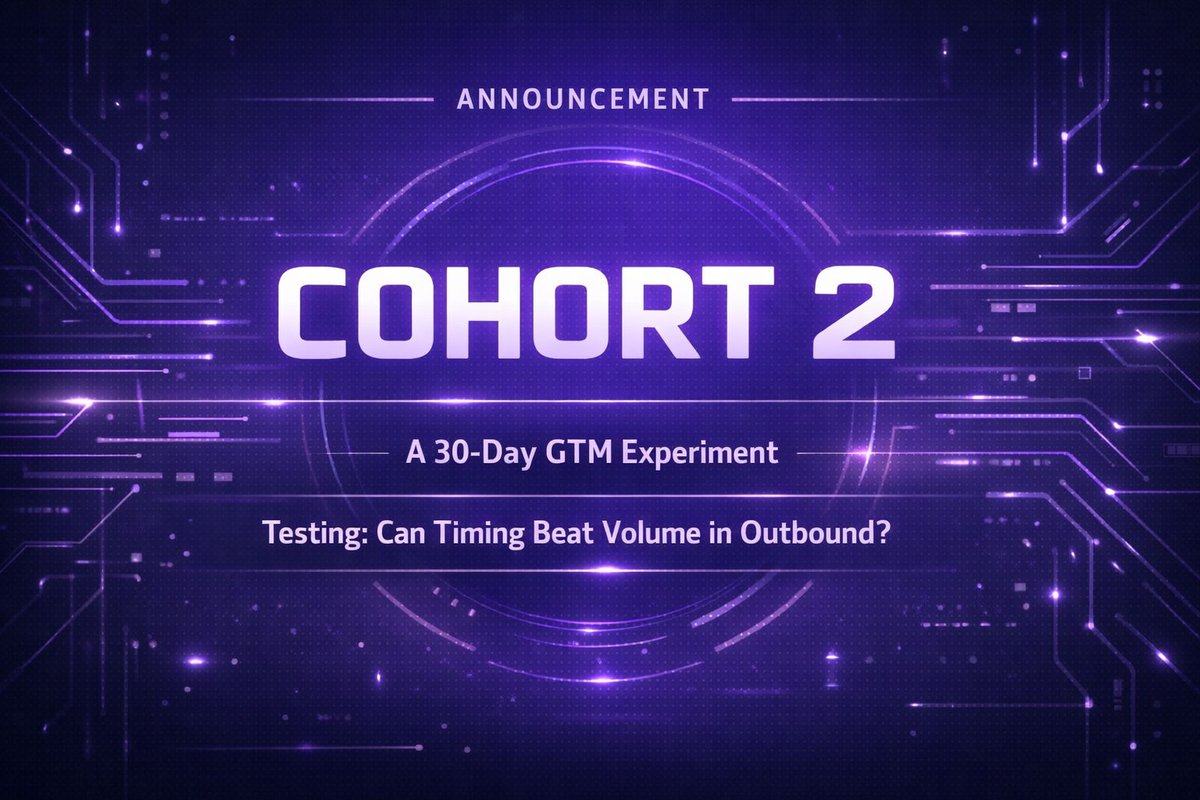
We’ve officially closed Cohort 1 of the Karhuno ROI Challenge.
30 days.
Real GTM teams.
Measured outcomes.
Cohort 2 opens in a few days.
For those new here:
The ROI Challenge is a structured 30-day experiment where we test one core hypothesis:
Can timing outperform volume in outbound?
Instead of building larger lists, we:
• Identify high-conviction buying windows
• Activate outreach only around those moments
• Measure impact on reply rate, meeting velocity, and pipeline quality
This is not about “more signals.”
It’s about validating whether acting at the right moment materially changes revenue outcomes.
If it works → scale it.
If it doesn’t → we stop.
Cohort 2 will be limited to a small number of teams per industry.
If you want to secure a spot:
Comment “ROI”
or send us a message.
Let’s pressure-test timing properly.