Lead researcher & developer in Hyperluminal Resonance & Chrono-Quantum Convergence. Pioneering the fusion of time & quantum mechanics. I also dabble in Ai.
As we move forward with furthering Ai advancement, Ai training data sources grow more important. Whether it's currently legal or not, is it really just to have for-profit companies use a person's data to train an Ai that can negatively impact that same person's income?
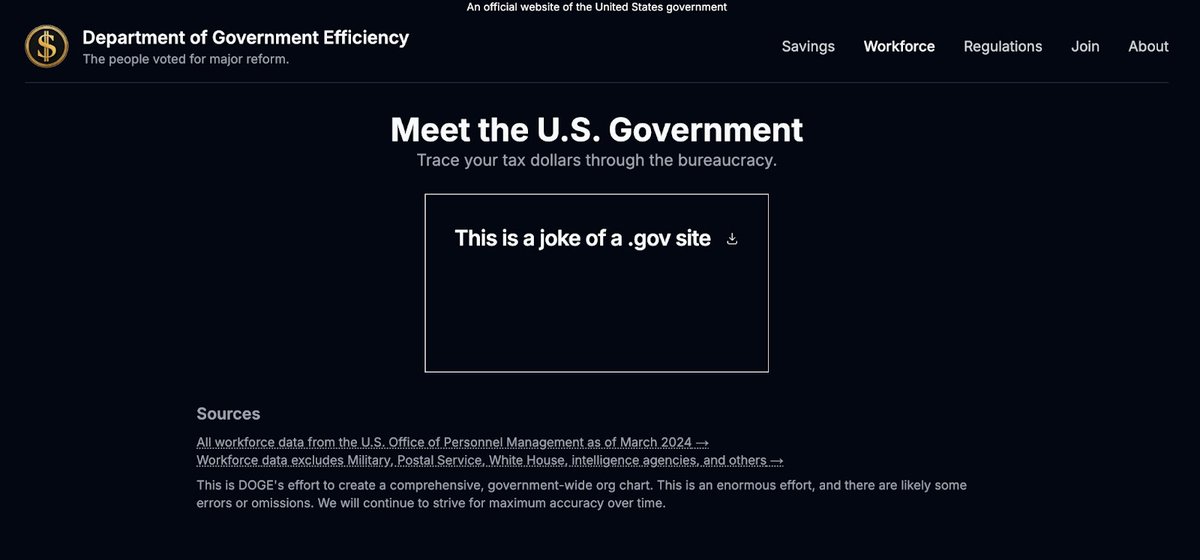
Per @404mediaco — the United States Department of Government Efficiency (D.O.G.E.), the newly formed government agency ran by Elon Musk, appears to have some security problems.
Two web security experts discovered it is possible to push updates to the D.O.G.E. database.
Too many people won’t believe a body of research studies, but have no problem believing outlandish conspiracy theories. So I ask, what exactly is the determining factor on anything you perceive as real?
@Kristupas_aweso@GrumpyTechChad@ns123abc I haven't tried this via the web platform yet, but for stuff like that I use a free web voip number (just google and a bunch of sites should pop up). For stuff like telegram I use https://t.co/r7bUFjbd6Z (paid) because it's cheap and works well.
What we know: DDOS attack–fended off for now; defacement of our website via JS library; breach of usernames/email/salted-encrypted passwords.
What we’ve done: Disabled the JS library, scrubbing systems, upgrading security.
Will share more as we know it.
Mil gracias a todos
Many thanks to all
Merci beaucoup à tous
Grazie mille à tutti
谢谢大家
شكرا لكم جميعا
תודה לכולכם
Obrigado a todos
Vielen Dank euch allen
Tack alla
Хвала свима
Gràcies a tots
I continue to be alarmed at the progress of proposed California regulation SB 1047 and the attack it represents on open source and more broadly on AI innovation. As I wrote previously, this proposed law makes a fundamental mistake of regulating AI technology instead of AI applications, and thus would fail to make AI meaningfully safer. I’d like to explain why the specific mechanisms of SB 1047 are so pernicious to open source.
To be clear, there are routes that regulators should pursue to improve safety. For example, I would welcome outlawing nonconsensual deepfake pornography, standardizing watermarking and fingerprinting to identify generated content, and investing more in red teaming and other safety research. Unfortunately, the proposed bill pursues a less beneficial and more harmful path.
SB 1047’s purported goal is to ensure safety of AI models. It puts in place complex reporting requirements for developers who fine-tune models or develop models that cost more than $100 million to train. It is a vague, ambiguous law that imposes significant penalties for violations, creating a huge gray zone in which developers can’t be sure how to avoid breaking the law. This will paralyze many teams.
You can read the latest draft of the law online. I’ve read through it carefully, and I find it ambiguous and very hard to follow.
Developers who try to navigate the law’s complex requirements face what feels like a huge personal risk. It requires that developers submit, under penalty of perjury, a certification of compliance with the requirements of the law. But when the requirements are complex, hard to understand, and can even shift according to the whims of an unelected body (more on this below), how do we ensure we are in compliance?
For example, the certification must include many different sections. One is an analysis of “the nature and magnitude of critical harms … the model might reasonably cause or enable.” But given that even leading AI researchers aren’t sure what harms models might cause or enable, how is a team of developers supposed to figure this out and declare — under penalty of perjury — that they meet this requirement?
Further, some developers will be required to implement “protections to prevent … misuse of, or unsafe post-training modifications of, the covered model and all covered model derivatives … that are appropriate in light of the risks associated with the covered model, including from advanced persistent threats or other sophisticated actors.” Even leading AI researchers don’t agree on how best to “protect” AI models against these supposed risks, or what would be “appropriate.” So how are developers supposed to figure out how to comply with this requirement?
This creates a scary situation for developers. Committing perjury could lead to fines and even jail time. Some developers will have to hire expensive lawyers or consultants to advise them on how to comply with these requirements. (I am not a lawyer and am not giving legal advice, but one way to try to avoid perjury is to show that you are relying on expert advice, to demonstrate that you had no intent to lie.) Others will simply refrain from releasing cutting-edge AI products.
If this law passes, the fear of a trial by a jury — leading to a verdict that can be very unpredictable and with significant penalties in the event of a conviction — will be very real. What if someone releases a model today after taking what they genuinely felt were reasonable safeguards, but a few years later, when views on AI technology might have shifted, some aggressive prosecutor manages to convince a jury that whatever they did was not, in hindsight, “reasonable”?
Reasonableness is ambiguous and its legal interpretation can depend on case law, jury instructions, and common facts, among other things. This makes it very hard to ensure that what a developer does today will be deemed reasonable by a future jury. (For more on this, see Context Fund’s analysis of SB 1047. [URLs in article linked to below.])
One highly placed lawyer in the California government who studied this law carefully told me they found it hard to understand. I invite you to read it and judge for yourself — if you find the requirements clear, you might have a brilliant future as a lawyer!
Adding to the ambiguity, the bill would create a Frontier Model Division (FMD) with a five-person board that has the power to dictate standards to developers. This small board would be a great target for lobbying and regulatory capture. (Bill Gurley has a great video on regulatory capture.) The unelected FMD can levy fees on developers to cover its costs. It can arbitrarily change the computation threshold at which fine-tuning a model becomes subject to its oversight. This can lead to even small teams being required to hire an auditor to check for compliance with an ambiguous safety standard.
These provisions don’t ensure that AI is safe. They create regulatory uncertainty, and more opportunities for vested interests wishing to stifle open-source to lobby for shifts in the requirements that raise the cost of compliance. This would lock out many teams that don’t have a revenue stream — specifically, many open-source contributors — that would let them pay for lobbyists, auditors, and lawyers to help ensure they comply with these ambiguous and unreasonable requirements.
Open source is a wonderful force that is bringing knowledge and tools to many people, and is a key pillar of AI innovation. I am dismayed at the concerted attacks on it. Make no mistake, there is a fight in California right now for the future health of open source. I am committed to doing what I can to preserve open source, but I don’t assume that the pro-open source side will prevail. I hope you will join me in speaking out against SB 1047 and other laws that threaten to stifle open source.
[Original text (with links): https://t.co/whAndl5C2g ]
I would even go as far to say that @DJIGlobal is the reason the U.S. has a drone market. People are so scared of anything Chinese nowadays that Chinese food will soon be banned as well
I can’t believe that the company behind the innovation and wide-spread availability of drones (especially in the US) might be kicked out of the US market. All because politicians believe and spew misinformation without understanding anything about technology
First Adobe changed their Terms to give themselves a permanent license to any content you produce using their software.
Then they pretended it was a misunderstanding.
Then Adobe gaslit people who pointed out that they are full of BS.
Then they put out damage limitation statements that mean nothing.
I have cancelled Adobe and so should you if you are a creator who has a backbone.
Here is what I have done:
1. Premiere Pro -> Davinci Resolve
This is an upgrade. The software is less clunky and actually works better.
Integration with hardware is better.
No licences. No monthly payments.
I bought the Speed Editor Keyboard that comes with a Resolve license - absolute bargain of a deal.
2. Photoshop -> Affinity Photo
This is also an upgrade. After an hour of getting used to it, Affinity software actually works better.
Image editing and my YouTube workflow are better.
3. Illustrator -> Affinity Designer
Same as above - actually very good software.
***
In the last few years Adobe’s competitors have caught up with and overtaken Adobe.
I was blind to how good the alternatives have become, using Adobe stuff because I was a creature of habit.
Would very strongly recommend trying the alternatives out.
You might surprise yourself… And save a boatload of cash.
You don't seem to understand the difference between product-focused technology development and longer-term research toward the next generation AI systems.
I'm specifically talking about the latter.
At Meta, the former is in the hands of the GenAI organization.
The latter in the hands of FAIR.
PhD students should definitely stay away from LLMs and work on the next-generation AI architectures.
For LLMs, what's needed are more GPUs, data, human feedback, and hacks to mitigate the limitations.
For the next generation of AI, what's missing are new concepts, ideas, and architectures.