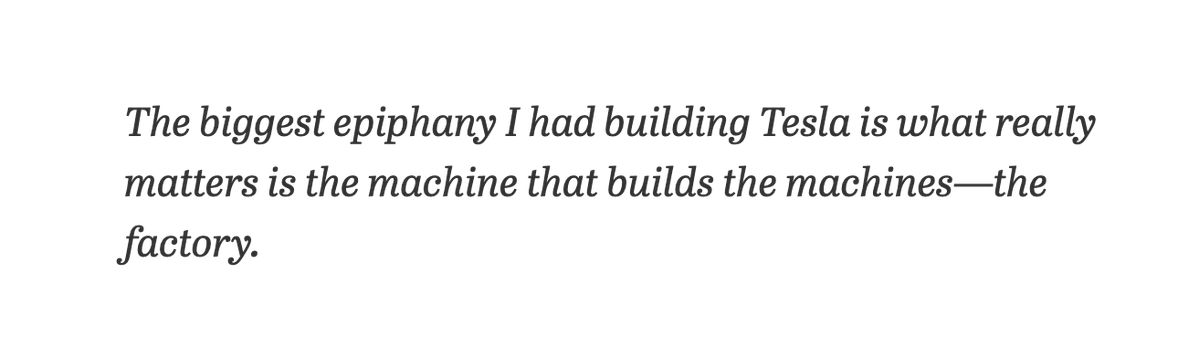
The (software) factory is the product. Your product is only as good as the agents you set up to autonomously maintain it.
This is what @elonmusk figured out about Tesla, and it's now true for the software world.
A huge amount of the Anti-AI code sentiment massively overestimates the quality of human code outside of a very small set of open source and high quality company codebases. Human Slop is everywhere and can trivially be improved on by any opus level model.
Kimi K3 is the best performing model on https://t.co/aporqgIfIh, ahead of Fable, reaching a comparable success rate in less time.
This is the first time that an open model is ahead of all proprietary ones for this comprehensive web engineering benchmark.
Notes:
▪️ Benchmarks don’t always tell the full story, although this is important signal, adding to mounting evidence that this could be a breakthrough moment for open models
▪️ No model as of yet has reached 100% completion on this set of evals. The top performer peaks at 92% and 96% “with help”
.@danawhite says one of the keys to longevity is to block out all negativity:
“It never even crosses my mind that something's not going to work. I just keep going until it does work.”
“There's this Bruce Lee quote where he says, ‘Never say negative things about yourself or what you're working on even if you're joking, because your body doesn't know the difference.’”
“I never take in any negativity.”
An Anthropic senior dev just dropped an 11-page breakdown on "Loop Engineering."
The game has changed: you don’t prompt the agent anymore, you build the system that prompts it.
The 5-step loop :
Discovery: The agent hunts down its own tasks (failing CIs/issues) instead of waiting for a list.
Handoff: Tasks run in isolated git worktrees so parallel agents don't clash.
Verification: A separate agent reviews the code assuming it’s broken. (Rule #1: an agent grading its own work always gives itself an A).
Persistence: Results save to disk so they don't vanish when the context window clears.
Scheduling: A timer auto-wakes the system, keeping the loop alive.
This PDF completely flipped my approach to building AI agents. Read it now, then check the article below.
Apple just made Docker Desktop optional on Mac.
And it is completely free.
This is apple/container. 26.5k stars no Github.
You can now run Linux containers natively on your Mac without installing Docker Desktop, without a background daemon hogging your RAM, and without paying $21 a month per developer for a commercial license.
Here is what it does:
→ Runs Linux containers as lightweight VMs directly on Apple Silicon using macOS 26 virtualization
→ Fully OCI compatible. Pull any image from Docker Hub, GitHub Container Registry or anywhere else
→ Written in Swift and optimised specifically for Apple Silicon. Faster and lighter than anything Docker Desktop does on Mac
→ Standard container CLI syntax. If you know Docker commands you already know how to use this
→ Push images you build to any standard container registry and run them anywhere
Docker Desktop charges $21 per developer per month for commercial use. Apple's version costs nothing and ships as open source under Apache-2.0.
Microsoft made Docker Desktop optional on Windows with WSL Containers last month.
Apple just did the same on Mac.
Docker is not going anywhere. But the era of paying for a GUI wrapper around containers on your own machine is quietly ending.
Repo here: https://t.co/uFJ867sul6
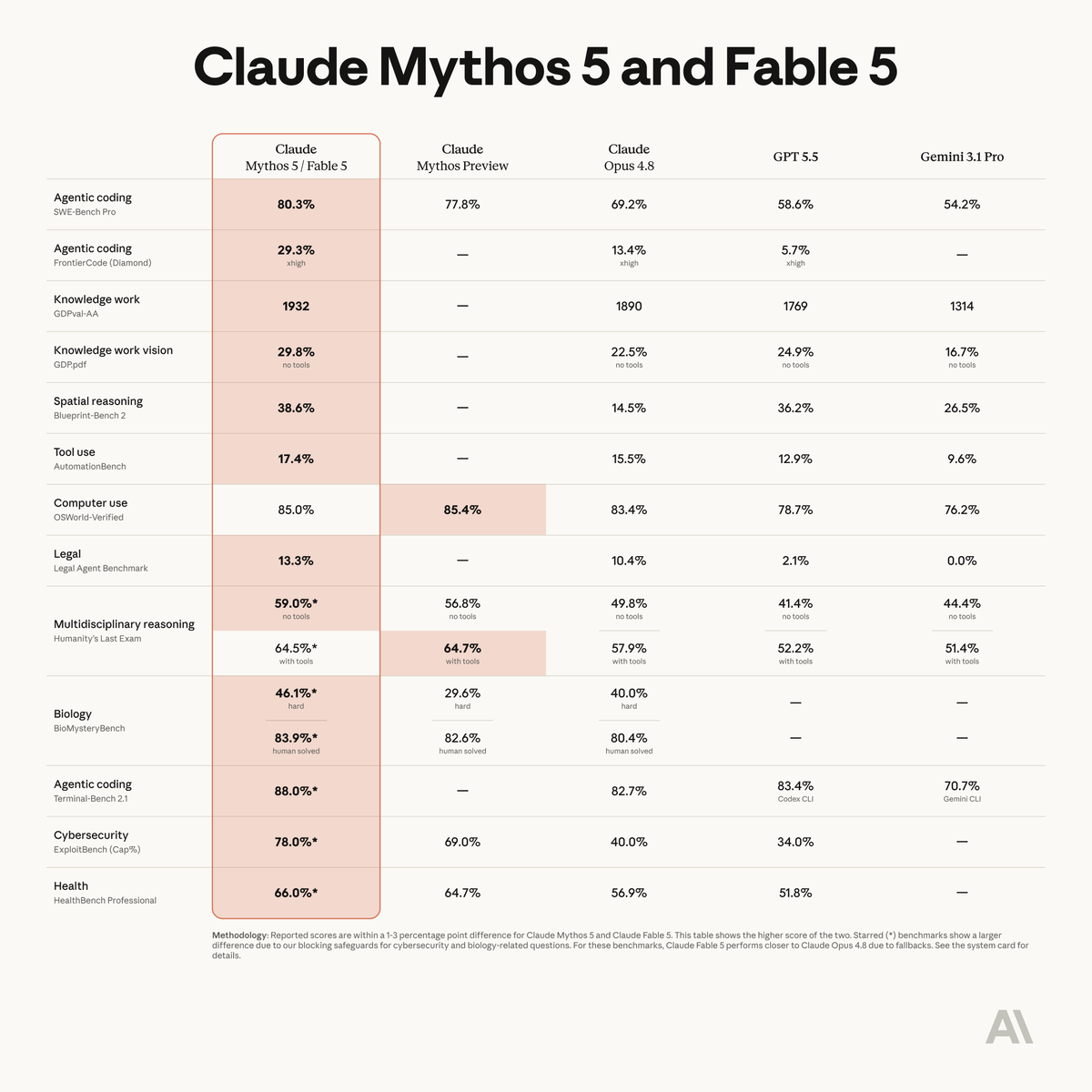
Fable 5 is state-of-the-art on nearly all tested benchmarks, with exceptional performance in software engineering, knowledge work, scientific research, and vision.
The longer and more complex the task, the larger Fable 5’s lead over our other models.
@DonaldMills142 Indeed. It’s not that good ideas aren’t important, they’re just overrated relative to implementation.
The IDEA of going to the Moon is EASY, but GOING to the Moon is HARD.
“Skillify it” is the way you should write most tasks
Write markdown that makes code
Don’t make elaborate Foxconn factories to call agents
Let agents make their own tools, kaizen style
“A maniacal sense of urgency is our operating principle.” — @elonmusk
“Elon hired a machinist, negotiated his salary, and had him start—all in one conversation. On a Saturday at 6 PM.”
“Most companies take two weeks to do what he does in an hour.”
The more enterprises I talk to about AI agent transformation, the more it’s clear that there is going to be a new type of role in most enterprises going forward. The job is to be the agent deployer and manager in teams. Here’s the rough JD:
This person will need to figure out what are the highest leverage set of workflows on a team are (either existing or new ones) where agents can actually drive significantly more value for the team and company.
In general, it’s going to be in areas where if you threw compute (in the form of agents) at a task you could either execute it 100X faster or do it 100X more times than before. Examples would be processing orders of magnitude more leads to hand them off to reps with extra customer signal, automating a contracting review and intake process, streamlining a client onboarding process to reduce as many straps as possible, setting up knowledge bases than the whole company taps into, and so on.
This person’s job is to figure out what the future state workflow needs to look like to drive this new form of automation, and how to connect up the various existing or new systems in such a way that this can be fulfilled. The gnarly part of the work is mapping structured and unstructured data flows, figuring out the ideal workflow, getting the agent the context it needs to do the work properly, figuring out where the human interfaces with the agent and at what steps, manages evals and reviews after any major model or data change, and runs and manages the agents on an ongoing basis tracking KPIs, and so on.
The person must be good at mapping the process and understanding where the value could be unlocked and be relatively technical, and has full autonomy to connect up business systems and drive automation. This means they’re comfortable with skills, MCP, CLIs, and so on, and the company believes it’s safe for them to do so. But also great operationally and at business.
It may be an existing person repositioned, or a totally net new person in the company. There will likely need to be one or more of these people on every team, so it’s not a centralized role per se. It may rile up into IT or an AI team, or live in the function and just have checkpoints with a central function.
This would also be a fantastic job for next gen hires who are leaning into AI, and are technical, to be able to go into. And for anyone concerned about engineers in the future, this will be an obvious area for these skills as well.