*விடுதலை படத்தில் வரும் கலிபெருமாள் தமிழ்தேசிய போராளியா? வன்னிய சாதிக்காக போராடியவரா?*
வெற்றிமாறன் இயக்கத்தில்,சூரி,விஜய்சேதுபதி நடிப்பில் வெளிவந்துள்ள விடுதலை திரைப்படம் உண்மையிலே தமிழ்தேசிய சித்தாந்த கொள்கையை பேசுகிறதா? அல்லது தமிழ் நிலவுடைமை சாதியான வெள்ளாளர்களுக்கு எதிராக
@arcot2arctic 11.08.26 அன்று PSG Convention நடந்தது. கோவையிலிருந்து நீலம்பூர் NH544 போகவே முடியல. ட்ராஃபிக் ஜாம். என்னடான்னு பாத்தா இந்த மாநாடு. ஏகப்பட்ட பஸ்கள் கார்கள் சர்வீஸ் ரோடு முழுக்க பார்க்கிங். தமிழ்நாடு இனிமே இந்த தலித் and செக்யூலர் அரசியலில் இருந்து மாற்றம். மாநிலப் பிரிவும்தான்...
CJP நடத்திய போராட்டக் களத்திற்கு சக்கர நாற்காலியில் ஒரு முதியவர் வந்தார். பிரதமர் மோடியை வெறுப்பவராக அவர் இருப்பார் என்று நினைத்த அபிஜீத் டிப்கே, அவரை நேரில் வரவேற்க மேடையிலிருந்து கீழே இறங்கிச் சென்றார். அவர் வந்தவுடனேயே, CJP போராட்டக்காரர்கள் அவருக்கு முன்னால் "மோடி ஒரு திருடன்" என்று முழக்கமிட்டு, மோடிக்கு எதிரான கோஷங்களை எழுப்பத் தொடங்கினர்.
ஆனால், அந்த முதியவர் CJP போராட்டக்காரர்களைக் கடுமையாகச் சாடினார். "முற்றிலும் அமைதியாக இருங்கள். பிரதமர் மோடி திருடன் அல்ல. உங்கள் வயதை விட நீண்ட காலமாக நரேந்திர மோடி நாட்டிற்குச் சேவை செய்து வருகிறார். அவர் 12 ஆண்டுகள் குஜராத் முதல்வராகப் பணியாற்றினார், அதன்பிறகு தொடர்ந்து பிரதமராகச் சேவை செய்து வருகிறார். பிரதமர் மோடி நேர்மையானவர். அமைப்பிற்குள் இருக்கும் சிலரின் செயல்பாடுகளால் தான் நரேந்திர மோடியின் பெயர் களங்கப்படுத்தப்படுகிறது. இப்படிப்பட்ட விஷயங்களைப் பேசுவது உங்கள் முட்டாள்தனத்தைக் காட்டுகிறது" என்று அவர் கூறினார்.
இதைக் கேட்டதும் அபிஜீத் டிப்கேவின் முகம் வாடிப்போனது. பிரதமர் மோடிக்கு எதிராக அந்த முதியவர் பேசுவார் என்று நினைத்து அவரை வரவேற்கச் சென்றிருந்ததால், அவர் அமைதியாக நின்றுகொண்டு அதைக் கேட்டுக்கொண்டிருந்தார். ஆனால் அதற்கு மாறாக, அந்த முதியவர் நாகரிகமற்ற முறையில் நடந்துகொண்ட CJP போராட்டக்காரர்களுக்கு ஒரு பாடத்தைப் புகட்டினார்.
இதை எல்லாம் தமிழக பிஜேபி ஐடி விங்க் செய்யனும்…கிரகம்
@RailwaySeva@DRMKhurdaRoad PNR : 4439653759
But Train was reached in Howrah junction at 4.30am only on 19'th july
4 hours late
If any chance, will i go to Consumer court?
10. Why do political demands for smaller states and bifurcation arise?
There are, of course, emotional considerations like culture, language, religion and a sense of economic and regional deprivation.
A common notion is that alarger share of central funds would flow into a new state compared to when it is a region in a larger state? More targeted governance:
Division of states means that every state will have its own leaders. Looking at the bigger picture, this means that a government, who had to formulate policies for 5 crorespeople, will now have to do the same for only 2-3 crores.
By simple maths, there will be more efficiency in the administration and less pressure of performance on the governance. Better administration fuels growth.
Proximity of capital city: It is a known fact that the capital city is where the people of the state go to air their grievances as all major government offices, judicial houses like state high courts and political quarters are housed there.
A new state would more often than not, mean a closer capital city and thus provide relief to the people. This cannot be said about larger states.
For e.g. : If a citizen in western UP were to be heard in any of the state commissions or courts, he has to travel over 600 km to Lucknow, spending large amounts of money in an attempt to get justice.
Similarly the state capitals of Karnataka and Tamil Nadu where it takes Kalaburagi to Bangalore is 640 Kms, Kanyakumari to Chennai is 705 Kms respectively.
Thus, reduced distances between the state capital and peripheral areas would improve the quality of governance and administrative responsiveness and accountability. Proper utilization of central funds: In a larger state, the problem is that the allocation of funds by the centre can never be evenly distributed.
So some parts stand to lose and thus remain backwardly developed, while the part which holds maximum political affiliate gains.
Dividing states definitely solves this problem. In recent times smaller states are being proposed on the ground of better governance and development. The reason why states should be broken upshall be for administrative ease, the need to respond to the regions of economically, politically, and culturally ignored areas.
When development goals are compared to with Euro zone and G-7 , Why not for better governance and for administration. United States of America has a population of 32.9 crores with 50states, while Germany has a population of 8.24 crores has 16 states, India has only 28 states for 137 crores population.
9. “India is a Union of states”- Article 1 of Indian Constitution.
This means that states were created for administrative convenience. States have no right to secede from the union and hence states do not have a say in their creation.
The demands for a separate state rose because of underdevelopment of certain regions of the country.
But, it is not necessary that these demands are always justified. It is for national benefit that smaller states are formed. The last 40 years have shown that smaller states can economically, financially do better including administrative aspects as well. Punjab, Haryana, Goa, Delhi prove the fact that small is better.
Bigger states like Uttar Pradesh, West Bengal, Maharashtra, Madhya Pradesh, Karnataka, Tamil Nadu, Bihar, and Rajasthan suffer from all aspects of needs such as economic development to growth in social up-liftment of all levels of the society.
States like Maharashtra, Tamil Nadu has witnessed rapid growth in some areas but also witnessed backwardness in areas within them.
8. The Constitution of India:
PART 1
THE UNION AND ITS TERRITORYName and territory of the Union
(1) India, that is Bharat, shall be a Union of States.
(2) The States and the territories thereof shall be as specified in the First Schedule.
(3) The territory shall comprise• The territories of the States
• The Union territories specified in the First Schedule
• Such other territories as may be acquired Admission or establishment of New states – Parliament may by law admit into the Union, or establish, new States on such terms and conditions as it thinks fit.
Formation of new states and alteration of area boundaries or names of existing states.
The makers of our Constitution empowered the Union Parliament to reorganise the States by a simple procedure, the essence of which is that the affected State or States may express their views but cannot resist the will of Parliament.
The reason why such liberal power was given to the national government to reorganise the States is that the grouping of the Provinces under the Government of India Acts was based on historical and political reasons rather than the social, cultural or linguistic divisions of the people themselves.
The question of reorganising the units according to natural alignments was indeed raised at the time of the making of the Constitution but then there was not enough time to undertake this huge task, considering the magnitude of the problem.
The provisions relating to the above subjects are contained in Artcles, 3 -4 of the Constitution.
Article 3 Says:
“ Parliament may by law –Form a new State by separation of territory from a State or by uniting two or more states or parts of States or by uniting any territory to a part of any State;
❖ Increase the area of any State;
❖ Diminish the area of any State;
❖ Alter the boundaries of any State;
❖ Alter the name of any State;
❖ [ Provided that no Bill for the purpose shall be introduced in either House of Parliament except on the recommendations of the President and unless, where the proposal contained in the Bill affects the area, boundaries or name of any of the States.*** The Bill has been referred by the President to the Legislature of that State for expressing its views thereon within such period as may be specified in the reference or within such further period as the President may allow and the period so specified or allowed has expired.]
❖ ‘Explanation I – In this article, in clauses (a) to (e), “State” includes a Union territory, but in the provision, “State” does not include a Union territory.’
❖ ‘Explanation II – The power conferred on Parliament by clause (a) includes the power to form a new State or Union territory by uniting a part of any State or Union territory to any other State or Union territory.’
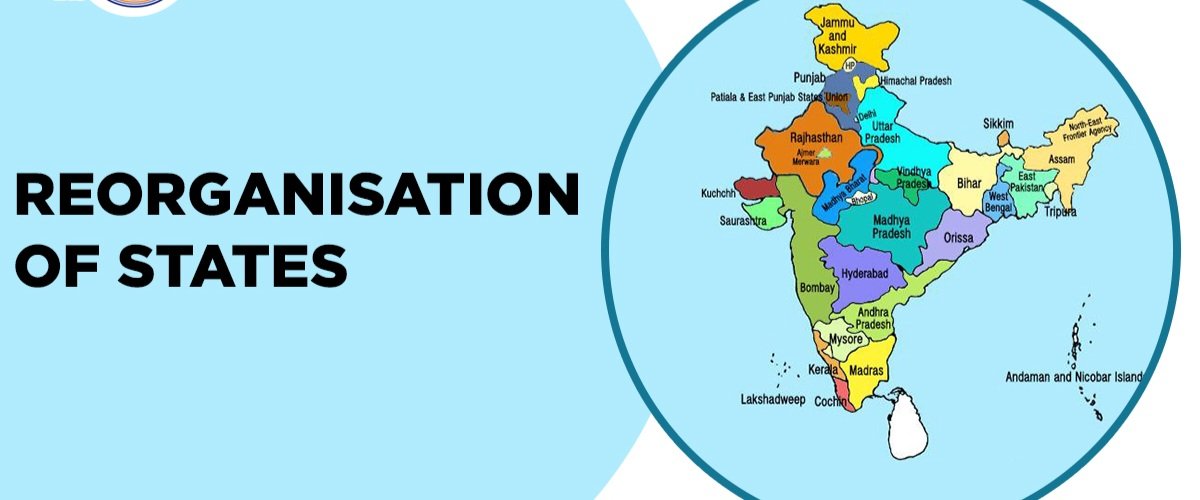
7. Reorganization of Smaller States:
• Ease of Administration.
• Ease of dealing Judicial matters.
• Local issues can be solved very much faster.
• Can meet the Elected Representatives and Government officers.
• Can reduce burden on the government administration.
• Can increase Local People’s participation in the Government - for collective progress.Collected revenues can be spent evenly to all areas working.
• Growth will be distributed and not concentrated to one location.
• Infrastructure planning and developments accordingly to the needs of the local people.
• Economic policy will be decentralised for growth distribution. • Time spent now travelling to state capital for accessing govt services will be reduced.
• A state Capital will be very much closer where everyone can come and solve their issues and return on the same day.
• More Districts can be carved out to ease the Administration of Densely Populated areas.
Reorganization Factors Administrative Set Up:
• River Basins – 45%
• Regional Aspirations – 30%for Consideration with Today’s
• With Present District Boundaries – 10%
• Traditional & Cultural Factors – 15%
6. Solving Water Woes through River Basins:
In our traditions, administrative land mass was considered with the following factors as prime factors.
For Today’s Considerations:
• Topography
• Water Catchments
• Water Basins
• Soil, Geography
• Traditional Habits – Culture.
Advantages:
• Water woes can be solved with local centric approach between states.
• Environmental Conservation along with local people participation will lead to inclusive development.
• Will Boost Rural Economy and will elevate poverty to some extent.
People Structure Based on River Basins:
• Self Empowerment
• Native Structure
• Social-Cultural-Unity
• Collectiveness in Communities
• Environmental Diversity
• Empower Local People
• Administration rooted with land & Connectivity
5. Tackling Policies with Right Adaptation of Local Interferences:
The policy makers must come out with a best plan to sort out the right way to direct the FUTURE of INDIA, as vast majority of INDIA is very young with its population striving for up in standards of life, facilities and basic amenities.
If this is not sorted out in right direction, there will be an imbalance to the all walks of life. India is projected to add 404 million urban dwellers, China 292 million By 2030, the world is projected to have 41 mega-cities with more than 10 million inhabitants and Nigeria 212 million.
Mumbai, Delhi, Kolkatta, Chennai, Bengaluru, Hyderabad, Ahmedabad would be added to that and others cities like Surat, Kochin, Patna, Kanpur, Gurgaon, Chandigarh, Coimbatore etc would have more than 20 lakh population, and again down the lane with more than 200 towns with 3lakh population will have to accommodate with current flow of people movement towards the shift in lifestyles.
This means there is a huge need for Infrastructure spending needed to accommodate the entire floating class of population, meeting their demands for resources like energy, water, food, healthcare, connectivity to locals, the public spending will increase to eight fold where the country’s entire growth needs to accommodate the spending for this challenges.
Centralizations of Economic Policies and its derivatives of connected chains of parameters in sectors like imports and exports, manufacturing have made the large junk of work force to move towards the job generation areas.
Chennai floods in 2015, Kerala Floods in 2018, has resulted in creating frame works & policies for better Rural, Urban population settlements such that the impact is lowered in its future course.
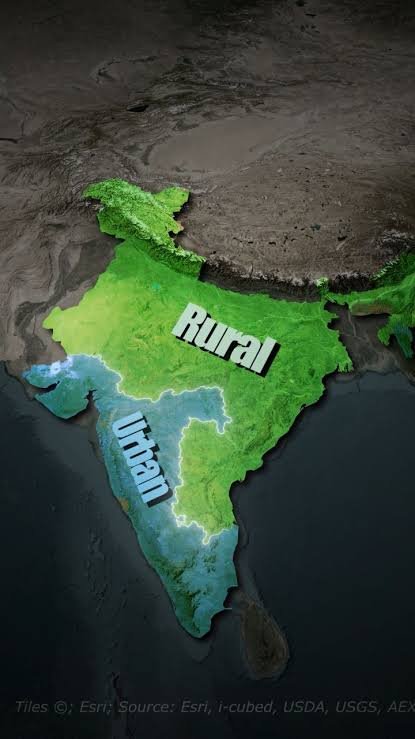
4. Once India’s back bone is rural or village based modules of life practices and economics was involved with in the few kilometres of surroundings.
But today INDIA is competing with others in Global Markets for its products and Manufacturing. India’s population during 1951 is 33.7 Crores of Rural Population and 2.3 Crores of Urban Population.
In 2011 Rural India has 83.31 Crores Population and 37.71 Crores in Urban Areas. It’s projected that by 2041 India would have 108.25 Crores of Rural Population and 47.5 Crores of Urban Population which would be the biggest and largest accommodator of Urban Centre in the World.
3. Ambedkar Thoughts on Linguistic States:
Ambedkar, after working on the Constitution of India came out with a vision for a reorganised India. He felt that a state should have a people of one language to have uniformity and to retain linguistic culture.
At the same time, there could be two states where people spoke the same language. He proposed splitting single-language states. For instance, he wondered at Uttar Pradesh’s huge size (still it is the fourthlargest in India) and wanted to split it into three states.
Ambedkar seemed to have solutions to all such problems — all written down 70 years ago. On splitting one-language states, he said: “Into how many States a people speaking one language should be cut up, should depend upon
(1) the requirements of efficient administration,
(2) the needs of the different areas, (3) the sentiments of the different areas, and
(4) the proportion between the majority and minority.”
In fact, BR Ambedkar had argued for smaller states rather than larger ones. He had also set out a criterion of two crores population as a viable size for administration.
In a critique of the States Reorganisation Commission, his point was that smaller states made for more uniform balance of power within the country, satisfied social needs and, most importantly, created units that can be administered with ease, leading to better growth performance in the country as a whole.
He was, in fact, quite aghast at the disparity in population sizes across states, calling it a ‘fantastic’ result bound to cost the nation dearly.
2. Late Pranab Mukherjee advocated increasing the number of seats in Parliament—kept frozen on the basis of 1971 Census figures, saying it had created an “anomalous situation”.
“As a result (of the freeze), the House of the People (Lok Sabha) today represents the population figure of 1971 Census whereas our population has increased manifold in the recent decades,” Mukherjee said while inaugurating a seminar on electoral reforms during his speech as President of India, on 8th April,2017.
Wherein today, India has over 900 million voters and 543 Lok Sabha constituencies’ represent 137 crores people,” which is a bigger growth in terms of Administration is concerned.
1. Building New India:
Prime Minister Shri. Narendra Modi bowed before the Constitution in Central Hall on 25th May, 2019. During his speech, Modi acknowledged the importance of coalitions for the future of the country, and coined a new slogan — “NARA (National Ambition + Regional Aspirations)” —for taking the country forward.
Though regional aspirations had figured in his 2014 campaign, he had not made a mention of it in his maiden speech.
Shouldn't the central government look for creating supreme court benches in all three directions East,
West, and South?
If the government is people Centric, why not create infrastructure for it?
East - Durgapur
West - Ujjain
South - Denkanikottai
Let's Built New India!



![soorasamharam's tweet photo. 8. The Constitution of India:
PART 1
THE UNION AND ITS TERRITORYName and territory of the Union
(1) India, that is Bharat, shall be a Union of States.
(2) The States and the territories thereof shall be as specified in the First Schedule.
(3) The territory shall comprise• The territories of the States
• The Union territories specified in the First Schedule
• Such other territories as may be acquired Admission or establishment of New states – Parliament may by law admit into the Union, or establish, new States on such terms and conditions as it thinks fit.
Formation of new states and alteration of area boundaries or names of existing states.
The makers of our Constitution empowered the Union Parliament to reorganise the States by a simple procedure, the essence of which is that the affected State or States may express their views but cannot resist the will of Parliament.
The reason why such liberal power was given to the national government to reorganise the States is that the grouping of the Provinces under the Government of India Acts was based on historical and political reasons rather than the social, cultural or linguistic divisions of the people themselves.
The question of reorganising the units according to natural alignments was indeed raised at the time of the making of the Constitution but then there was not enough time to undertake this huge task, considering the magnitude of the problem.
The provisions relating to the above subjects are contained in Artcles, 3 -4 of the Constitution.
Article 3 Says:
“ Parliament may by law –Form a new State by separation of territory from a State or by uniting two or more states or parts of States or by uniting any territory to a part of any State;
❖ Increase the area of any State;
❖ Diminish the area of any State;
❖ Alter the boundaries of any State;
❖ Alter the name of any State;
❖ [ Provided that no Bill for the purpose shall be introduced in either House of Parliament except on the recommendations of the President and unless, where the proposal contained in the Bill affects the area, boundaries or name of any of the States.*** The Bill has been referred by the President to the Legislature of that State for expressing its views thereon within such period as may be specified in the reference or within such further period as the President may allow and the period so specified or allowed has expired.]
❖ ‘Explanation I – In this article, in clauses (a) to (e), “State” includes a Union territory, but in the provision, “State” does not include a Union territory.’
❖ ‘Explanation II – The power conferred on Parliament by clause (a) includes the power to form a new State or Union territory by uniting a part of any State or Union territory to any other State or Union territory.’](https://pbs.twimg.com/media/HN5B9TaaMAA6mob.jpg)