Increasingly, #mythos seems to be a brilliant marketing launch more than anything else. Saying it is so good at what it does that it can only be released to a select few. Classic scarcity marketing at its best.
Q1 earnings are in: 2026 is off to a terrific start.
Our AI investments and full stack approach are lighting up every part of the business: Search queries are at an all-time high with AI continuing to drive usage. Google Cloud revenue grew 63%, Gemini models have incredible momentum, and it was our strongest quarter ever for consumer AI subs, driven by @GeminiApp.
Thanks to our partners + employees around the world. Much more to share on our earnings call in 20 minutes… and at Google I/O in 20 days!
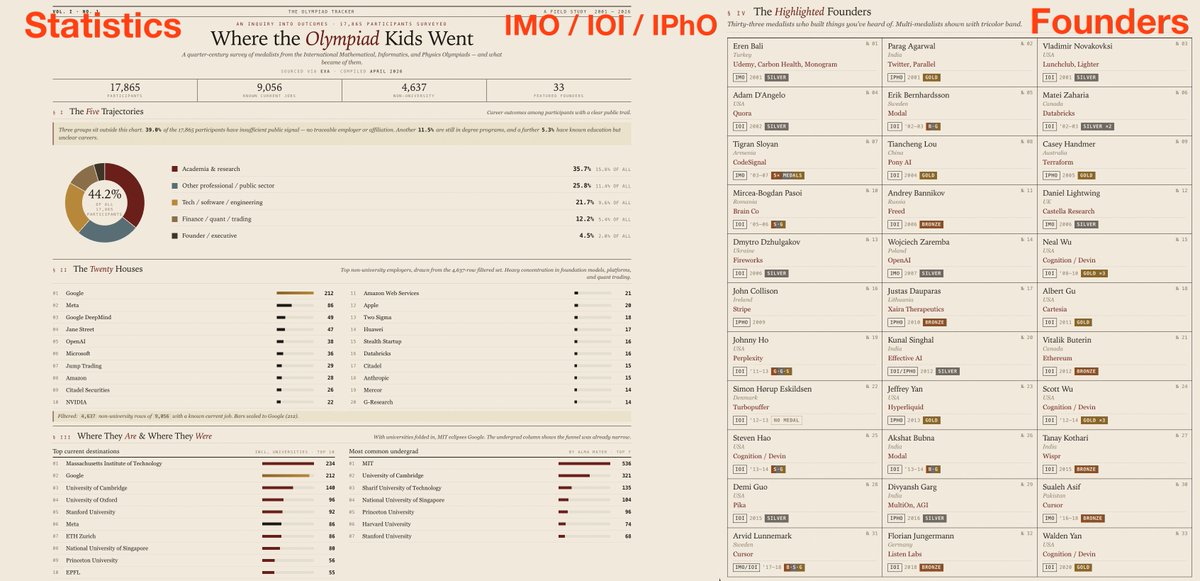
What do the smartest kids in the world do when they grow up?
I did the largest study of ~18,000 International Olympiad medalists (IMO, IOI and IPhO) over the last 25yrs, arguably the sharpest analytical minds of the world in high school, to see where they ended up and traced ~50% of them.
Founders of ~20 unicorns and ~7 decacorns and ~10 billionaires: OpenAI, Cursor, Stripe, Databricks, Perplexity, Ethereum, Cognition, Hyperliquid, Fireworks, Modal, Quora, Parallel, Cartesia, Wispr
Most kids went to MIT, a whopping 12% of them, followed by Cambridge (7%) and Sharif (3%)!
The career paths they chose (of those who graduated) were:
— 36% Academia (professors)
— 26% Other
— 22% in Software / Tech
— 12% in Quant / Finance
— 5% Founders!
The biggest employer was Google, by far, at 6%.
Others interesting tidbits were:
— 47 of them work at Jane Street (#3)
— 38 at OpenAI (#5)
— 15 at Anthropic
— 8 at Cognition
— 6 at Isomorphic Labs
Olympiaders were 1500x more likely to be billionaires and 4000x more likely to be unicorn founders than the average person!
Founders should know the sobering reality for enterprise SaaS venture funding today. Here’s the math.
Say you’re a $1M ARR company raising a Series A with a classic 33222 growth expectation. That gets you to $72M in 5yrs and say $250M in 8yrs. By then you’re usually growing <<50% and the public markets might give you a 7x or $1.75B, if you can even go public. If you get $10M at $100M post-money for the A, that’s a 17.5x and maybe 10x after dilution. That would be ~33% IRR and $10M invested becomes $100M.
In the venture model, you have to outperform the SP500 which is 15% and a Google which is 25%. Here, with perfect execution, a lot of work, time and risk, you get 33% in a near optimal (95 percentile) case. And usually, you expect 7/10 things to not work out: execution risk, market size, competition. Plus, this math is for a Series A. You need investors to underwrite even more growth at the B / C / D. It’s really hard to see this sort of deal driving fund returns.
Now, of course, there’s tons of caveats. You could pay less than $100M post, try to grow faster, do pro rata to avoid dilution, stay private longer etc, but the point remains. There might be exceptional growth stories like Databricks, Snowflake and Applied Intuition, but most deals look like what I described.
In a previous time, SaaS multiples were higher in public (20x), entry valuations were lower ($30M) and the money you needed to hire talent was lower ($150k). You could get 100% IRR before. Now, it’s harder than ever to justify investing here, unless they are true outliers.
@levie This isn’t new. Doctors started complaining about the same as far back as when WebMD came out. As AI become subsumed into society at large, it’ll be just another step in the process of going to a doctor and having informed convos about one’s health.
In #2026, #enterprise buyers will continue to be skeptical of #AI but they will continue to buy as well. It will be the #marketer’s job to not only market and help sell the products, but also to build them as well. #PMMs gear up.
@Xiomi has produced an absolutely brilliant car and I say this without having driven it. Proper forward thinking. I’ve been driving top end #EVs from @Tesla and @Porsche since 2019, and am absolutely stoked that there’s a new player with new ideas of what a car should be.
Jane Goodall was one of a few people to earn a PhD without an undergraduate degree.
It was thought that her lack of formal academic training would allow her to remain unbiased by traditional thought and study the chimps with an open mind.
It worked. ❤️
AI agents can prototype apps… But shipping real software takes hours of testing, debugging, and refactoring.
Agent 3 is 10× more autonomous — it keeps going where others get stuck.
The “Full Self-Driving” moment of software.
#Pricing#AgenticAI is a currently a minefield. Everyone understands seat-based doesn’t apply. Consumption and outcome-based are tempting but can prove to be expensive for either side. There’s a lot yet to be proven. Till then, putting outcomes and ROI first must be the way to go
THE biggest question no one seems to be willing to address is what’ll happen when every platform and app that an #enterprise uses today has its own #agents? How’s the #CIOs org going to manage 100s of agents running across 100s of systems? #techdebt turning into #agentdebt.
It was mid 2017 and I was working feverishly to explain #RPA to the world (alongside a handful of others). Now, with #AgenticAI, I’m having a serious case of Deja vu. So much of the terminology and so many of the issues remain the same in #b2b almost a decade later.
#LLMs are fast becoming commoditized. It is the application layer where the battles will be fought and categories will be created. Just like the cloud, there will be a handful of frontier model providers and thousands of companies on top of that infrastructure. Plan accordingly.