Our paper on the effect of herpes zoster vaccination on dementia is now out in Nature! 🎉
Huge thanks to Felix Michalik, Seunghun Chung, @PGeldsetzer1, and especially Min Xie (@mx_sci) & Simon Heß(@simonhhess) for making the analysis so much fun!
🔗 https://t.co/F38NGWbnz9
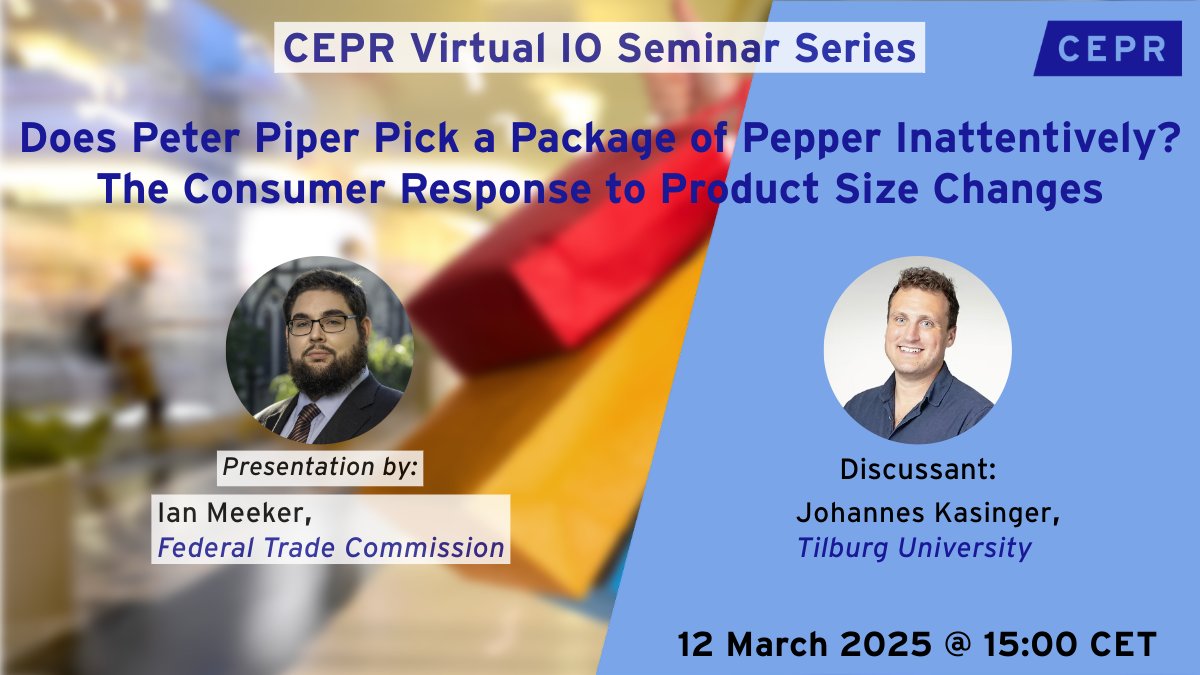
📆 12 Mar @15:00 CET - CEPR Virtual IO Seminar Series #VIOS
🗣️Ian Meeker @FTC presents "Does Peter Piper Pick a Package of Pepper Inattentively? The Consumer Response to Product Size Changes".
Discussant: @Kasinger_J@TilburgU
✍️https://t.co/qvoEXMGesx
📆 12 Mar @15:00 CET - CEPR Virtual IO Seminar Series #VIOS
🗣️Ian Meeker @FTC presents "Does Peter Piper Pick a Package of Pepper Inattentively? The Consumer Response to Product Size Changes".
Discussant: @Kasinger_J@TilburgU
✍️https://t.co/qvoEXMGesx
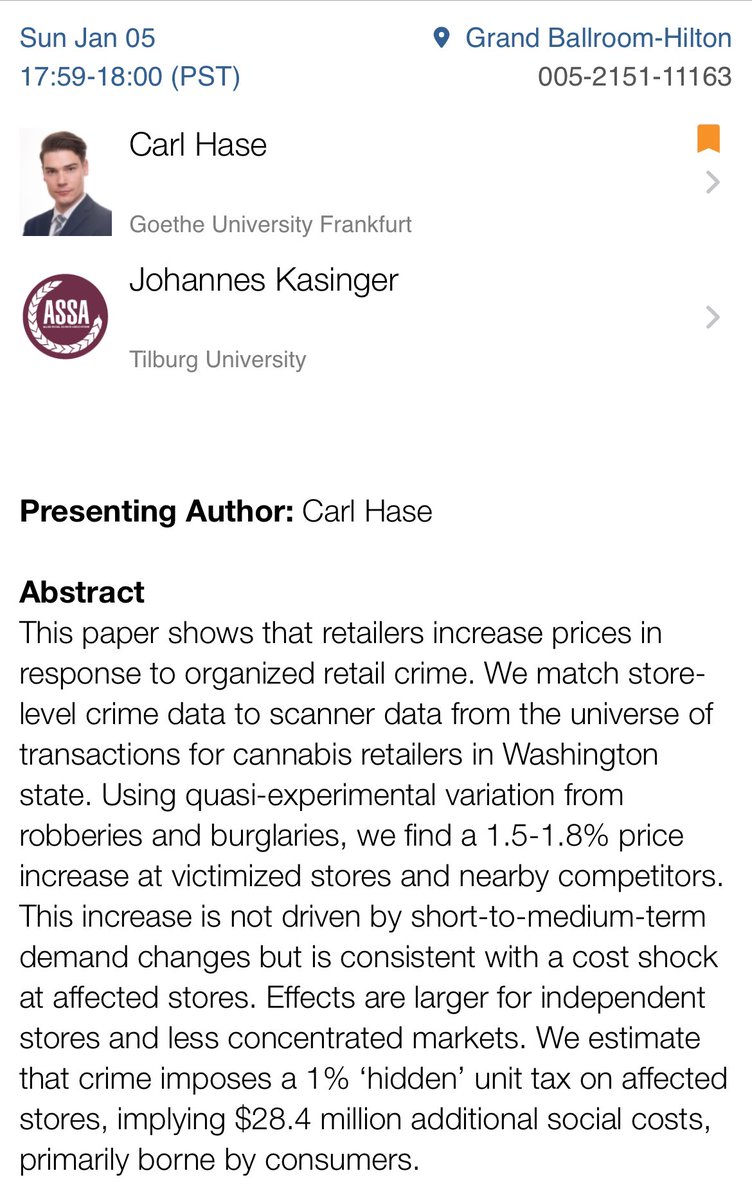
Today, @Kasinger_J (@TilburgU_TISEM) presented “The Pass-through of Retail Crime” (w/ Carl Hase @goetheuni).
Using WA cannabis store data, they find robberies & burglaries drive a 1.8% price hike at victim stores & competitors, comparable to a hidden 1% tax ($28M in social costs)
Now available online at #QME: "Discrete choice in marketing through the lens of rational inattention"
by Sergey Turlo, Matteo Fina, Johannes Kasinger (@Kasinger_J), Arash Laghaie (@ArashLaghaie) & Thomas Otter.
https://t.co/828FNvzCcx
The new semester is approaching, and we are thrilled to welcome the speakers for the Econ Spring 2025 Seminar Series in Lugano!
📅 Check out the full schedule below and join us if you're interested:
👉 https://t.co/71gXxlTDNr
#USIEcon
For those at #ASSA2025, come stop by our poster during one of the poster sessions (Fri/Sat 1-2pm, Grand Ballroom Hilton).
We look at how stores respond to retail crime incidents and investigate the welfare implications.
Shrinkflation—the practice of reducing the quantity, size, or weight of a product while maintaining its price—appears to be an increasing irritant.
But the phenomenon is not new, according to @sgSMU’s @AljoschaJ and @TilburgU_TiSEM’s @Kasinger_J. https://t.co/zrV8YVZfHa
New research indicates a surge in traffic accidents since the introduction of shared e-scooters. ''Shared e-scooters carry higher safety risks in cities with an underdeveloped bicycle infrastructure'', says economist @Kasinger_J.
Read more: https://t.co/G6Wg0fqjdN
🎄JMP🎄
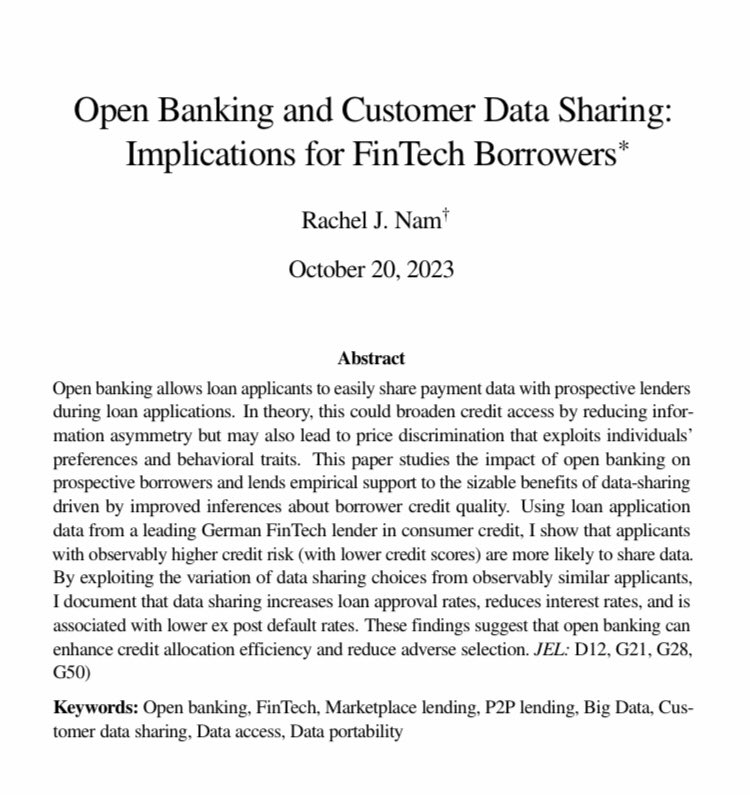
Suppose you want a loan from a lender who doesn’t know much about you. During the loan application, you are given the option to share your transaction details from your other bank accounts with this new lender easily and securely. Would you share?
🧵👇🏻
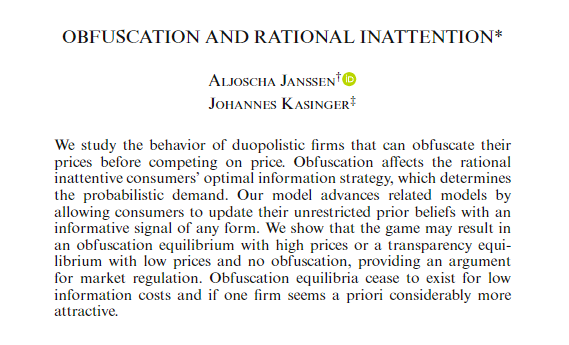
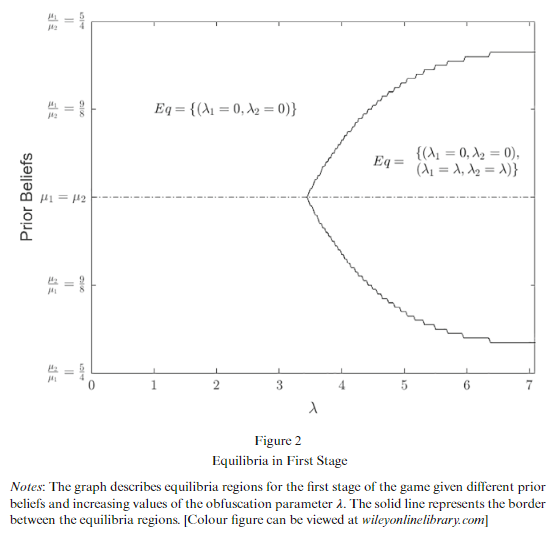
Our findings suggest two market regulation strategies to curb obfuscation: A) Enhance price comparability, e.g., via digital tools or limiting complex pricing features; B) Reduce barriers for new, less known competitors. Both lead to more competition & improved consumer welfare.
🧵 Just out in @J_Ind_Econ (joint with @AljoschaJ): We explore when firms, facing rational inattentive consumers, optimally obfuscate prices, e.g., by hiding fees or choosing complex add-on pricing structures. https://t.co/vHbGbxGzdz
Our model helps to explain the shift in mobile subscription markets from complex add-on to simpler, fixed pricing schemes. It suggests digital tech lowering info costs of consumers could have prompted this shift, favoring transparent pricing as the dominant firm strategy.
Are e-scooters making our city streets more dangerous?🛴💥Our latest research in the European Economic Review studies the impact of shared e-scooter services on urban traffic accidents and the critical role of public policy (joint with @simonhhess and @WinCannonWin)👇
#EScooters