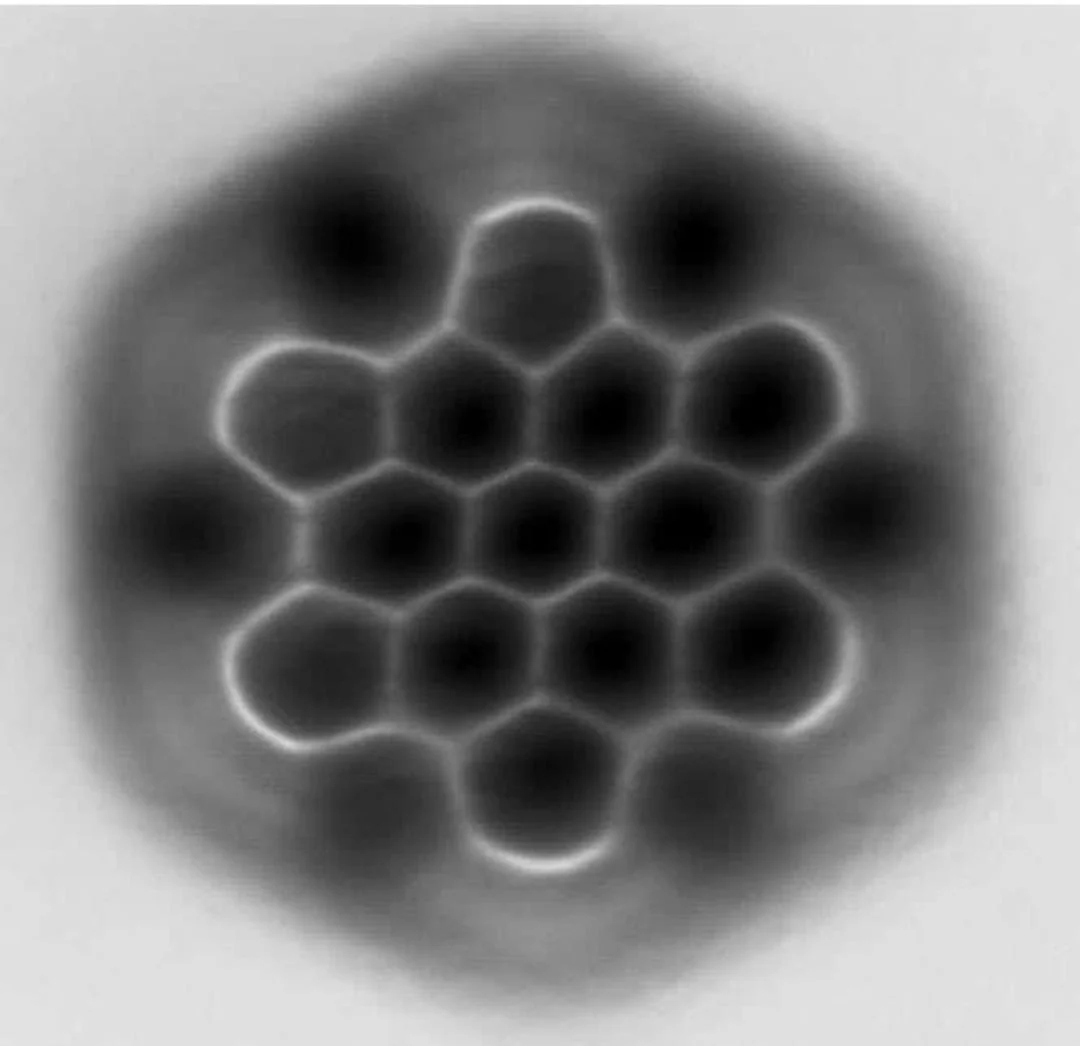
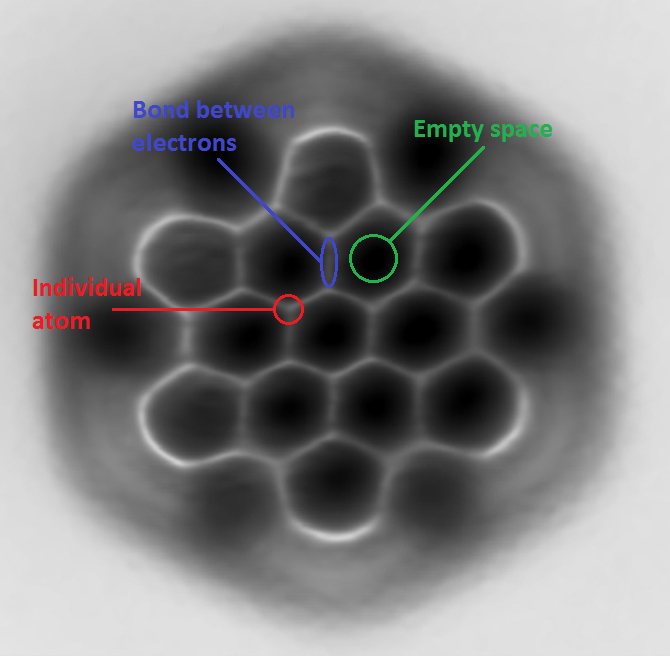
MIND-BOGGLING🚨: Quantum Entanglement speed is measured for the first time, and it's too fast to comprehend.
Just one-quintillionth of a second (that’s a 1 followed by 18 zeros).
To put it in perspective, light can only travel about the width of a human hair in that time.
Thank you for clarifying, and I appreciate you taking the time to explain your position.
I understand your point better now. I don’t want to evaluate ETC as an extension of General Relativity or assume that mainstream cosmology must be correct. I’m happy to approach it on its own foundations, treating it as an independent cosmological framework.
However, I would distinguish between rejecting mainstream theories and rejecting the mathematical and scientific standards used to evaluate a theory.
For example, dimensional consistency, logical consistency, mathematical derivations and the ability to make testable predictions aren’t exclusive to GR or mainstream physics. They are important regardless of which underlying physical model we adopt.
I’m not asking ETC to reproduce every mainstream explanation. I’m interested in understanding whether its own axioms, equations and predictions form a complete, self-consistent system.
I’d actually like to take your suggestion seriously and revisit the work from that perspective.
Perhaps we could start with the foundational principles of ETC. I’d like to understand which assumptions everything else is built upon, how the central equations are derived from those assumptions, and how the theory independently accounts for observations such as gravitational lensing, orbital dynamics, gravitational waves and the cosmic microwave background.
I also want to make clear that I’m not approaching this with the intention of proving you wrong. If there are things I’ve misunderstood, I’m very willing to correct my assessment.
My interest is in understanding the theory properly and, if you’re open to it, potentially contributing to an independent mathematical audit.
I respect that you consider the theory complete. I’d nevertheless be interested in examining how robustly its foundations and predictions withstand independent scrutiny.
SpaceX will attempt to catch both the Super Heavy booster and Starship on the upcoming flight.
If both are successful, it will mark the first time that all parts of an orbital rocket return to Earth intact.
This is the critical breakthrough needed to make life multiplanetary.
Thanks for being open to discussing this seriously. I am genuinely interested, and I’ve been examining the Energy Texture Cosmology work you suggested I look at.
Before going further, can I ask whether ETC is your own work and whether you’re the author?
I’ve started an independent mathematical and physical audit across the chapters. I’m looking at the overall framework, its equations, assumptions, consistency with established physics, and whether its predictions can be independently tested.
I find the ambition behind the theory interesting, particularly the attempt to develop a different framework for understanding gravity, time, energy, black holes and cosmology.
However, I’ve encountered several areas where I’d appreciate your explanation:
1. Chapter 1 – Dimensional consistency: The master equation appears to combine an energy-density term multiplied by velocity with another energy-density term. Under the definitions provided, these appear to have incompatible physical dimensions. Is there an intended conversion or definition we’re missing?
2. Chapter 3 – Planck density: The stated Planck density of approximately (4.63\times10^{17},\mathrm{kg/m^3}) differs enormously from the conventional Planck density of approximately (5.16\times10^{96},\mathrm{kg/m^3}). Is this a new model-specific density, and how is it derived?
3. Chapter 4 – Refractive index and black-hole surfaces: The proposed refractive-index equation appears to have difficulty reaching the value required by the stated blind-zone condition if the density is capped at the value given in Chapter 3. Are these densities defined differently, or is there another mechanism involved?
4. Chapter 5 – Wave dispersion: The equation (\omega^2=\omega_0^2+c_f^2k^2) appears to imply that phase velocity diverges as (k) approaches zero when (\omega_0) is nonzero, rather than approaching (c_f), as described. Is there an additional assumption or restriction on the wave modes?
5. Chapter 9 – Hawking radiation: The argument involving a nonzero effective field mass doesn’t appear, by itself, to establish that all relevant Bogoliubov coefficients vanish. Is there a fuller derivation demonstrating why Hawking radiation would not occur?
6. Chapters 10–12 – Cosmology and black-hole collisions: The proposed 180c collision velocity raises questions about relativistic causality if it represents the physical velocity of matter. I’d also be interested in understanding how the proposed collision mechanism accounts quantitatively for the observed gravitational-wave signals and the CMB’s blackbody spectrum and acoustic peaks.
I appreciate that there may be explanations, additional assumptions or derivations that aren’t immediately apparent from the chapters. I don’t want to misrepresent your work or reach conclusions prematurely.
My intention is constructive. If this is your work, I’d genuinely like to offer help with a thorough independent audit, going through the mathematics, checking the derivations, identifying weaknesses and exploring possible repairs or improvements.
I’m particularly interested in finding out whether we can strengthen any promising parts of the framework and establish what genuinely holds up under rigorous testing.
Would you be open to discussing these findings and potentially working through some of the mathematics together?
Elon, I want to explore something ambitious: Directed Panspermia.
Could we start a research project investigating whether we can develop biological seeds — microorganisms or other suitable life forms — capable of surviving space travel and eventually establishing life on otherwise lifeless worlds?
The bigger vision is to mathematically model how these organisms could adapt, evolve and potentially develop into increasingly complex life over millions of years, perhaps even intelligent life.
I want to bring together scientists, biologists, mathematicians and AI researchers to investigate whether this is actually possible. I don’t know how far we are from achieving it, but I want to help push this frontier.
Could you, or anyone working in this field, help us get this project started?
I might be missing something, and I’m certainly not an expert, but isn’t there a contradiction in that argument?
There have actually been experiments involving quantum entanglement in space. China’s Micius satellite demonstrated entanglement distribution between a satellite and Earth, including Bell inequality violations over distances exceeding 1,200 km. There have also been experiments under microgravity conditions.
I do agree with one underlying point, though: we shouldn’t assume that testing something on Earth automatically answers every question about how it behaves throughout the universe.
But surely there’s a difference between saying we haven’t tested every possible environment and saying the existing science is a scam or useless?
Wouldn’t the more interesting question be what aspects of quantum mechanics still need testing under extreme gravitational conditions, different environments and across astronomical distances?
I’m genuinely curious about where you think the current experimental evidence falls short.
Me, like many others, have found myself fascinated by how your mind works, Elon. I wouldn’t say I always understand it, but seeing that video from 14 years ago, hearing you discuss ideas you’ve been thinking about since around the age of 11, and then seeing how some of those ideas have developed over time makes me wonder how far ahead you’ve been thinking.
Something I find particularly interesting is your ability to move between completely different fields, connect ideas and anticipate possibilities.
I’ve sometimes wondered whether there’s a different formula behind extraordinary minds. When you look at people like Einstein and Nikola Tesla, their dedication to understanding particular fields was incredible. I wonder whether that level of intellectual pursuit can also come with physical, mental or even spiritual costs. Perhaps keeping life interesting, exploring different disciplines and constantly finding new problems to solve is part of sustaining curiosity over a lifetime.
Your recent comment about the absence of signs of extraterrestrial life also got me thinking. Not necessarily about what you meant by it, but about the bigger questions surrounding intelligence, technological advancement and the long-term survival of civilisations.
I don’t pretend to have the answers, but I wonder whether learning how to sustain intelligence, curiosity and progress is just as important as developing them in the first place.
I believe there could be countless combinations of knowledge, experiences and ways of thinking that produce extraordinary minds. Some more likely than others. I find it fascinating to consider what makes those combinations possible.
One thing I think the US needs to recognise is that the AI race isn’t just about building better models.
China appears to understand that technological leadership also requires energy, manufacturing, supply-chain independence, infrastructure and long-term industrial planning.
The US has enormous advantages in AI research, investment and computing, but those advantages aren’t guaranteed forever.
I believe the US should approach this as a long-term national resilience challenge: build more energy capacity, strengthen domestic manufacturing, secure critical supply chains and continue accelerating scientific discovery.
This isn’t about hostility towards China or its people. It’s about recognising that technological leadership is increasingly connected to the physical foundations beneath it.
The question isn’t simply who builds the smartest AI today. It’s who can sustainably support the next generation of intelligence.
I don’t believe the answer is to abandon progress. I believe we should aim much higher: an intelligence explosion that accelerates scientific discovery, helps solve humanity’s greatest problems, protects civilisation and preserves our freedom to choose our future.
Can humanity become powerful enough to solve its greatest problems without becoming powerful enough to destroy itself?
We need to become wiser as fast as we become smarter.
I’ve spent time thinking about some of humanity’s hardest problems, although I’ve only scratched the surface compared with those who have dedicated their lives to them.
But I think I’ve been overlooking something much bigger.
What if humanity is approaching two historic explosions simultaneously: an explosion in artificial intelligence and scientific discovery, and a major transformation in the global balance of power?
I find Iain M. Banks’ vision of the Culture fascinating: computational abundance, extraordinary intelligence, freedom and different ways of living.
But perhaps the challenge is making sure we actually reach that kind of future.
What good is extraordinary technological progress if we cannot protect the civilisation that makes it possible?