Turns out something good in life is free. CUNY's Newmark J-School is offering tuition- and fee-free master's degrees to eligible New York State residents. Aspiring journalists, take note.
https://t.co/SOsPAlteXN
https://t.co/AqhGipK8vL Tenure-Track-Assistant-or-Associate-Professor-in-Media-and-Technology: Gainesville, University of Florida
Tenure-Track Assistant or Associate Professor in Media and Technology
Job No: 541507
Work Type:… https://t.co/ucSeqf75Sk https://t.co/6XoKBEbZRZ
Bobby McIlvaine was 26 when he died in the September 11 attacks. In 2021, @JenSeniorNY wrote about grief, conspiracy theories, and one family’s search for meaning in the decades since 9/11. Revisit the Pulitzer Prize–winning story: https://t.co/M2r5gmgU5g https://t.co/8kCX0sHIZ2
New pod/transcript: PANGRAM VS THE MACHINE
Since 2022, the share of English-language webpages that are partly or entirely written by AI has increased from roughly 1 percent to nearly 40 percent. Like a tsunami of sludge, AI writing is inundating everything from high school essays to Twitter and LinkedIn longposts, to Amazon biographies, to the oped pages of the Wall Street Journal and Washington Post.
The war on AI writing has turned Pangram into a surprising cultural phenomenon, a tool that is also a meme. I wanted to know more about how the company's technology works and how its leaders think about the fact that their invention is becoming an icon of the anti-AI moment.
So I spoke with founder and CEO @max_spero_ about:
- how Pangram works
- why we should trust it
- what the technology says about the fundamental differences between machine vs. human writing
- whether AI-writing witch hunts are something we should welcome or fear
- whether Pangram is at risk of getting displaced by an AI detector from the frontier labs or tech platforms
https://t.co/LtyJcNIuPG
In the Pentagon Papers case, the Supreme Court ruled that it is legal to publish top-secret info and that the free press has a responsibility to do so to prevent the government from deceiving the public, especially during wartime.
One reason that some childhood vaccines are grouped together is to increase uptake. Asking parents (who, for example, may work multiple jobs and/or be under- or uninsured) to take a child to the doctor four extra times (as Trump is saying) will decrease the rate of vaccination.
Trump: "At one year, you should have 5 separate visits for vaccines rather than getting them all in the same day. I've seen proof of where they have a vaccination thing that looks like the size of a bottle of soda and pour it into a little child's body."
Important study (and story). Lowering the cancer death rate isn’t just about more science. It’s about better access to the latest drugs, better education of patients and doctors and less shame around diagnosis. Heartbreaking to read that so many patients lives were cut short.
“More than half of patients with metastatic lung cancer don’t receive life-extending treatments, like chemotherapy, immunotherapy and targeted therapy, a new study found.” https://t.co/4r1RaDISYD
.@voxdotcom Future Perfect is hiring three fellows.
If you want to spend a year writing about the biggest stories the media is missing — AI, global health, animal welfare, catastrophic risk — apply by May 12. Fellowships begin in July, remote option. https://t.co/4h1QY2x1V8
NEWS: NPR receives $113M toward digital transformation and to offer stations greater services as the loss of federal funds takes a big bite out of budgets.
$80M from philanthropist Connie Ballmer
$33M from anonymous donor
My initial story:
https://t.co/4utjEOR0Un
More to come
Trump: When you look at CNN, "The New York Times," ABC fake news, NBC fake news, they report things that they know are false. It's almost treasonous. The NYT’s circulation is way down. I’m proud to report that.
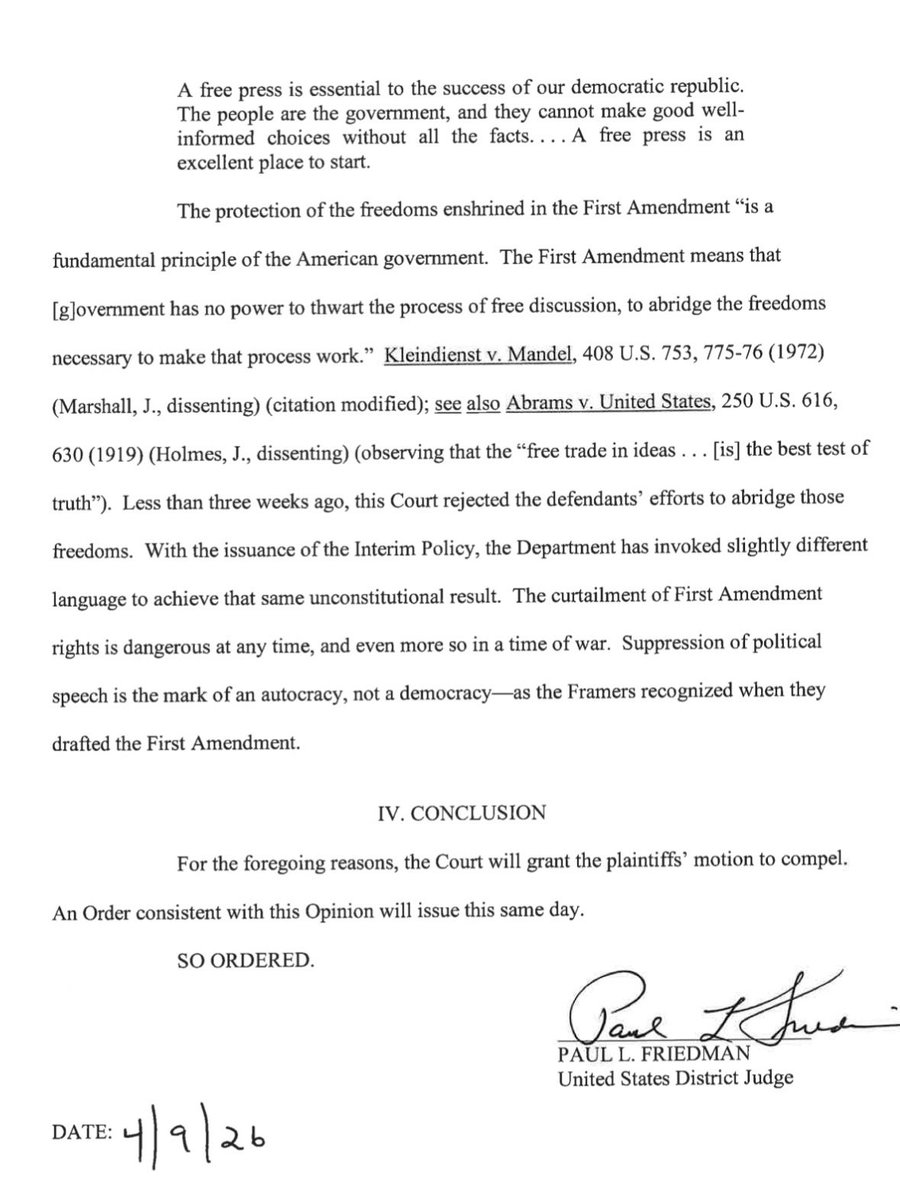
JUST IN: Judge Friedman has rejected the Pentagon’s revised press policy, saying it flouted his earlier order and represents a bid by Hegseth and the Trump admin to “dictate” coverage, what he calls “the mark of an autocracy, not a democracy.” https://t.co/PWlEpcXVHd
All the President’s Men turns 50 today.
This famous “six‑minute shot” is a masterclass in phone acting and pure technical nerve.
Director Alan J. Pakula and cinematographer Gordon Willis pull off a single, unbroken slow zoom: from a wide, humming newsroom to a tight close-up on Redford. No cuts. No safety net. Tension builds in real time.
Redford carries it with typical quiet confidence. Six minutes of note-taking and talking into a phone, no flashy “Oscar clip.” He even flubs a name (“McGregor” for “Dahlberg”), corrects himself naturally, and Pakula keeps it because it feels authentic.
The background is part of the story. As Woodward hones in on his phone call, everyone behind him huddles around a TV watching Senator Tom Eagleton resign. The contrast is deliberate: they chase the “obvious” headline, while the camera drifts past them to Woodward, and the real story.
To hold Redford and the busy background in focus early on, they used a split‑diopter lens, then had to ease it out as the camera moves in. A technical tightrope. The timing of both actor and cinematographer is spot on.
As Woodward closes in on the truth, the world literally falls away: the newsroom blurs, the noise fades, and we lock into his obsession. It’s one of cinema’s great moments: Redford doing almost nothing—and somehow everything at the same time.
What makes this shot brilliant is the contrast it carves between Redford and the newsroom around him. The visual language does the talking: he’s locked in, disciplined, driven, all focus and fire. He stands apart because the work matters more than anything else.