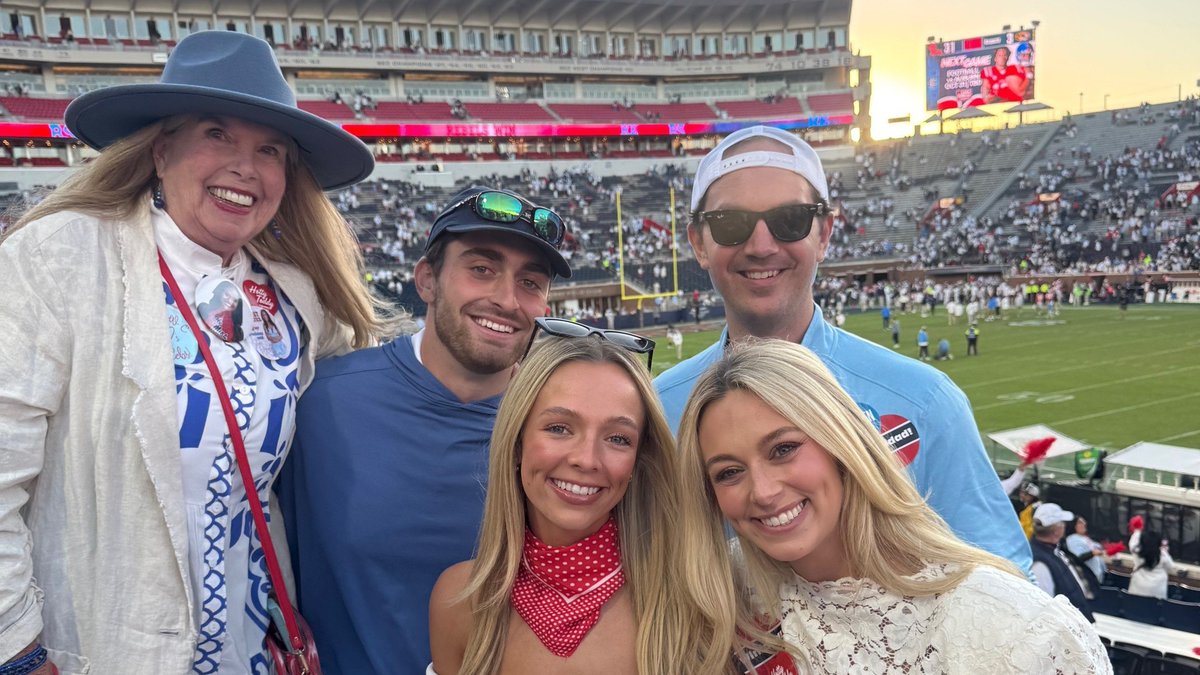
Cheryl Chambliss is the kind of Rebel we could all hope to emulate. Gracious, wise, and caring. @OleMiss is blessed to have the Chambliss family as part of our family.
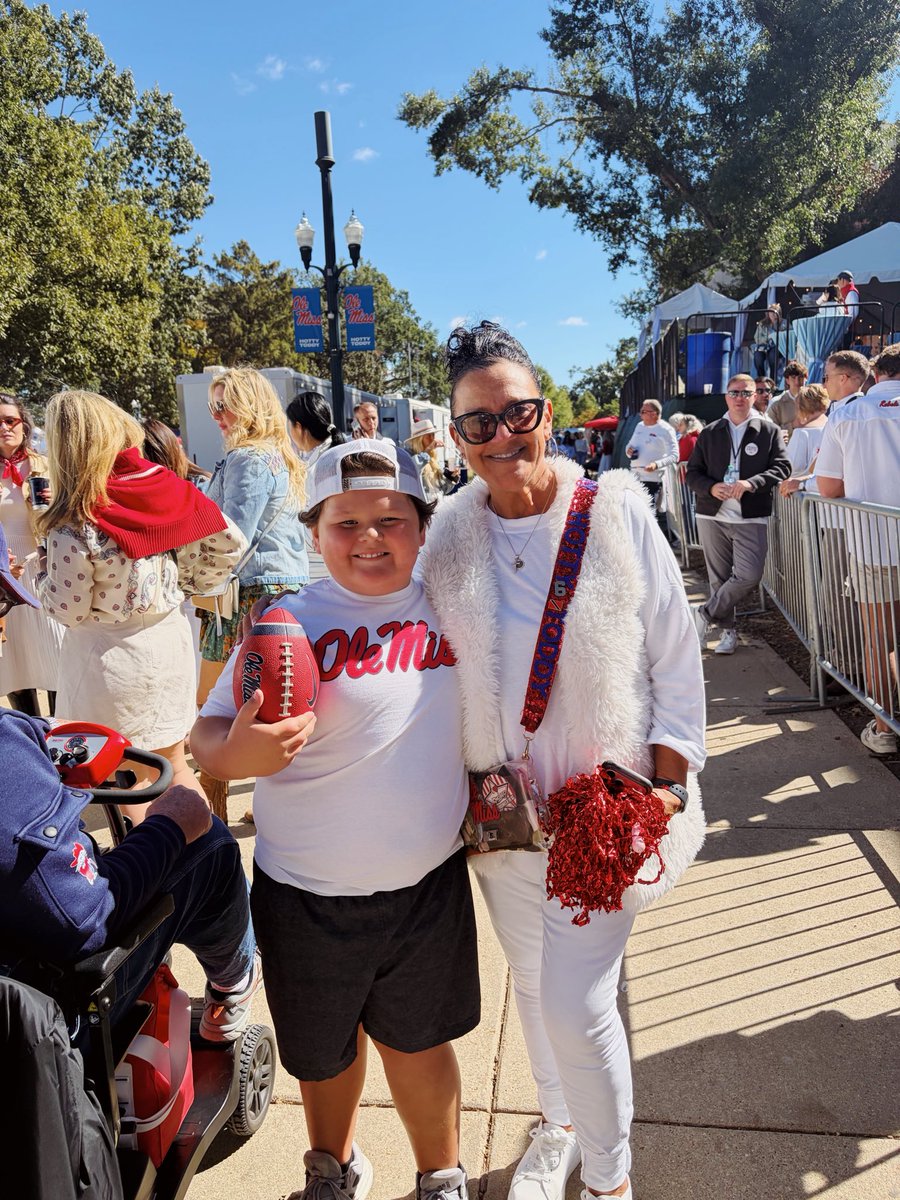
My son recognized Trinadad’s mom yesterday and was determined to go say hey to her. Mrs Cheryl was so gracious with her time. He told her he plays football. She spoke to him about listening to coaches and being a good teammate and giving God the glory in all that we do. Abundance of character flowing from that family. Core memory made for my little Rebel. Hotty Toddy!
I fully understand that Louisiana is “just different”and that the trial judge in Baton Rouge can do anything. But he may realize he is probably the only person on the planet who can prevent LSU from committing “suicide by SEC” and will decide to save LSU from itself.
I fully understand that Louisiana is “just different”and that the trial judge in Baton Rouge can do anything. But he may realize he is probably the only person on the planet who can prevent LSU from committing “suicide by SEC” and will decide to save LSU from itself.
Dr. Jon C. Ziarko has gifted $660K to establish the Jon C. Ziarko Memorial Scholarship Endowment at Ole Miss—supporting students preparing for careers in teaching.
STORY: https://t.co/VIq3ZY41u9
#OleMiss#OleMissEDSchool
Is this a bad time to revisit the fact that two of LSU players still owe Ole Miss buyout money that LSU promised they’d pay on their behalf and then didn’t?
When an organization is being subjected to contempt of court it is appropriate to use every defense, particularly given that the athletes bringing the claim have themselves agreed to arbitrate this issue in MD CA Federal Court and have waived claims that may be included in this case. Whether it is initially successful, it is essential to bring forward the argument, for potential appeals and to negate the suggestion that the NCAA or an athletic conference is just responding “in your face”. The House settlement is an injunction. Protecting that order is not contempt of anyone.
@KathrynHHester House settlement preclusion arguments are more fulsome in federal courts (and certainly interesting in Wisne).
To this point, they have tended to feed state law contact claims though, (especially since Chambliss) because House created financial entitlements in the bylaws.
The student athletes agreed to the four in five NCAA eligibility rule under the House v. NCAA Injunction in return for Rev Share and NIL. They also agreed to arbitrate eligibility disputes in the CA court that authorized their ability to make money.
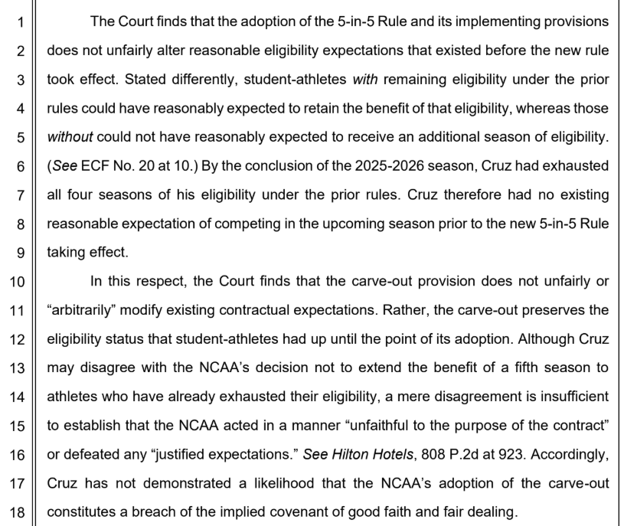
Lost in the whirlwind of eligibility suits was a notable NCAA win on Friday: a court agreed with the NCAA's argument on its c/o '22 5-in-5 exclusion.
The NCAA's repeated position has been that the c/o '22 received everything they were promised under the old rule- 4 seasons of play- and that it's not unfair or arbitrary to exclude them from the new 5-in-5 rule.
Most if not all courts have rejected that breach-of-contract defense until Friday, when Judge Miranda Du in Nevada federal court denied a former baseball player an injunction in Cruz v. NCAA. The key excerpt adopting the NCAA's argument is below.
Interestingly, Judge Du also rejected Cruz's antitrust claim. She had previously granted an antitrust injunction in an athlete-favorable ruling (Braham) last summer. But in the year between, federal courts have overturned antitrust injunctions, which decisions show up in this new Cruz ruling.
Jurisdiction is the MD CA federal court which retained jurisdiction to enforce the House v. NCAA Injunction, and it is the venue in which the student athletes agreed to arbitrate eligibility claims.
@austinmasseySBI The jurisdiction piece is interesting. We've seen that a few times now: Branch in Colorado and Koonin in New Jersey had a lot of plaintiffs dismissed for that reason. Really curious to see the merits determination though.
The 2022 players have earned Rev Share and NIL via the House v. NCAA Injunction. They agreed to the four for five NCAA rules and to arbitrate eligibility claims in the CA Court that allowed them to make money. If anyone is breaching an agreement, it is the students
Interesting. We're starting to see some judicial pushback against the breach of contract claims that were for a while easy wins for the Class of 2022 plaintiffs. I'll be interested to see the full opinion.
@ChildersRadio Errata! Class of 22 college athletes actually agreed to the NCAA four in five eligibility in return for Rev Share and NIL and to arbitrate eligibility disputes before the California Court that authorized both. The NCAA and @SEC are authorized to enforce that bargain.
@ChildersRadio, the class of 22 college athletes agreed to the NCAA four for four rule in return for Rev Share and NIL and to arbitrate any eligibility disputes before the California Court which allowed both. @SEC is entitled and indeed required to have that agreement enforced.
The Players and the Conferences settled the matter when everyone agreed to the House v. NCAA Settlement, and Judge Wilken ordered it as an injunction. The issues in this and every other eligibility lawsuit are pretermitted by the House Injunction, and the Conferences are entitled to enforce it.
The college football season is here, and state court judges have remade CFB rosters by making NFL players eligible.
Some don't like this, but there's no short-term solution.
The NCAA and power conferences have to follow antitrust law. There's no immediate path to the U.S. Supreme Court. Congress talks a lot but doesn't act.
The best fix is the passage of time. My @Sportico column:
https://t.co/a3uou2coXd.