”This is exactly the kind of controlling, coercive messaging that our research showed can backfire. And more applied research confirms our surprising findings.”
Fifteen years ago I published a paper I still think about a lot. We handed college students a pamphlet written in the anti-prejudice language of the day with words like "Erase Racism" and "Stop Prejudice". Compared to students who got nothing, it actualy made them measurably more prejudiced. We didn't believe it, so we ran it again and got the same results. The samples were small and no one has replicated us as far as I know, so the usual caveats hold. But I've spent a decade watching a coercive style of anti-racism become the default, and I keep thinking about those pamphlets. I wrote about it because the last few weeks in academia have made it feel urgent again.
https://t.co/r3qBa4oVjq
"Whatever final judgement is reached on the plagiarism allegations, Arday is not the point. Institutions saw a story that flattered their values and forgot to ask whether it was true. Academia should be society’s most sceptical institution."
Every appointment in which demographic optics outweigh merit displaces somebody else. Every weak paper contaminates the literature and can influence policy. Every pound of funding allocated on criteria other than research quality is unavailable for potentially groundbreaking work.
Yet those in the privileged position of academia rarely recognise their own privilege. Nobody at Cambridge appears to have asked the obvious questions. The Lords, Dames, Sirs and Professors who rushed first to celebrate Arday and then to denounce his critics never have to worry about losing a faculty position or a research grant – they already have theirs. They can pull up the drawbridge while making themselves feel, and look, virtuous by saluting the flag of DEI. Indeed, the most revealing aspect of the [Hilary] Cremin video was not what she said, but that Cambridge chose to film it, publicise it and celebrate it. Universities appoint outstanding academics every year. They do not normally produce promotional videos announcing their moral satisfaction with the appointment.
Whatever final judgement is reached on the plagiarism allegations, Arday is not the point. Institutions saw a story that flattered their values and forgot to ask whether it was true. Academia should be society’s most sceptical institution. If it cannot scrutinise its own heroes, it has no moral authority to instruct anyone else.
My @Telegraph op-ed on the Jason Arday affair.
https://t.co/STttu1sx6S
Bernard Arnault going direct is remarkable and worth reading in full
The single most impressive thing is that Arnault (personally, not via company spokesman) responds to a major hit piece without at all accepting the role of defendant
He never complains about “biased reporters” or “they ignored our fact check” etc. He instead:
1) Does not flinch. He starts by giving the rebuttal a title: “Thank You.” Not “Addressing Recent Allegations” or whatever but implying the expose has backfired and made him look good.
Eg: “They used to call me The Terminator. I prefer ‘the last royal family.’ It’s more elegant, and probably better for Dior sales.”
Tone stays measured and bemused throughout; it’s giving Logan Roy
2) Lampoons the allegations. His wry humor makes the expose seem silly and theatrical, his tone is like he’s divulging a stupid child.
He opens with, “Apparently I am the head of ‘the last royal family of France’.”
And drops gems like, “At the Arnault family, apparently, we don’t argue, we conspire. We don’t deliberate, we plot. It’s novelistic… What, in an ordinary family, is simply called Sunday lunch becomes, in our case, an intrigue. It’s a matter of vocabulary.”
3) Reframes the whole narrative. From billionaire to steward, from an oligarch pursuing power to a patriarch preserving an institution built by and for others
Eg: “You describe power as though it were a prize to be won. I experience it as a responsibility to be passed on.
The houses entrusted to me are older than I am. Most will outlive me. My role is to hand them on stronger than I found them. That is why I reject the idea of a dynasty. Dynasties exist to preserve privileges. We work to preserve craftsmanship.”
Interestingly, in the very act of doing this Arnault shows how masterful he is at wielding power, and he summons that skill here to make the reporters look like bumbling neophytes
Capitalism is just so beautiful.
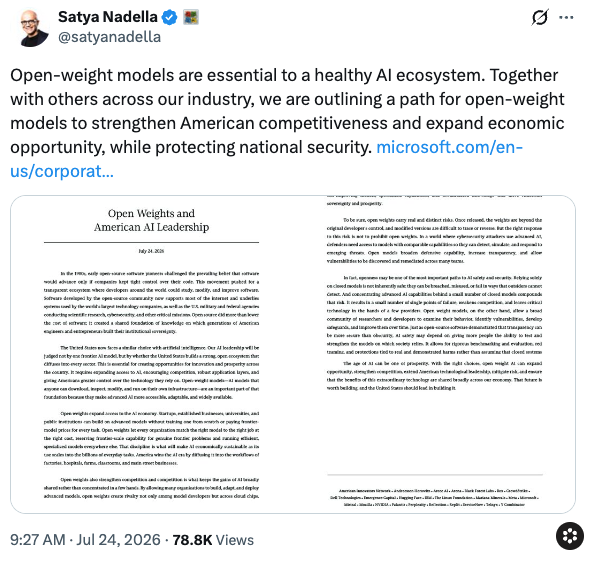
$8 trillion worth of market cap coming out in support of open-weight models because it's good for their business and makes them look good...
and, totally coincidentally, it also happens to be better for us consumers and practically every business except for a couple of labs. we just get that benefit for free with MSFT and NVDA's self-interest.
it brings a tear to the eye 🥲
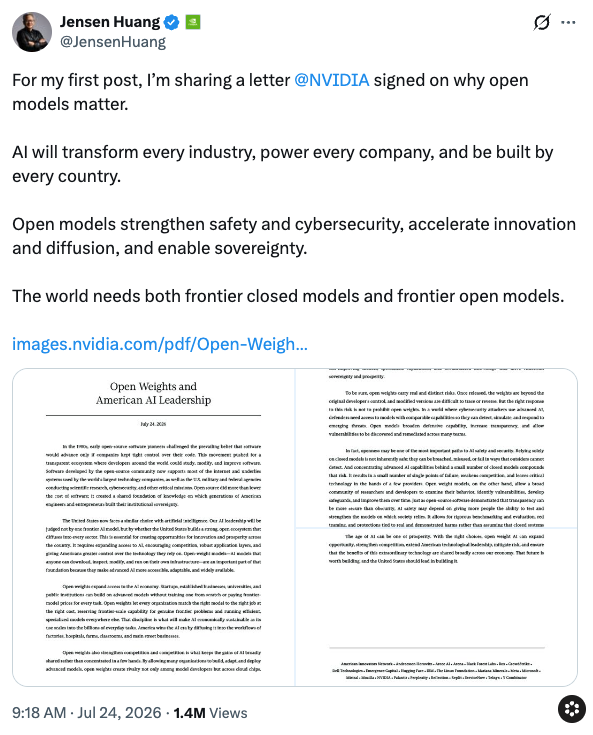
For my first post, I’m sharing a letter @NVIDIA signed on why open models matter.
AI will transform every industry, power every company, and be built by every country.
Open models strengthen safety and cybersecurity, accelerate innovation and diffusion, and enable sovereignty.
The world needs both frontier closed models and frontier open models.
https://t.co/AUKzoQ5Ikb
I love when you talk things through with someone and realize neither of you was wrong, you just saw things differently. That’s what real communication is: understanding, not winning.
@lennysan you mention NVC skills in an episode with Molly Graham (loved the episode) and mention it's a framework you use. Have you written about it somewhere? Would love to learn your perspective on it
claude cowork is making me think maybe we’ll look back and it’ll be obvious that humans were never meant to spend their lives working behind a screen. we’ll see it as inevitable that computers do everything for us on computers and the future of work is cooler than we can imagine
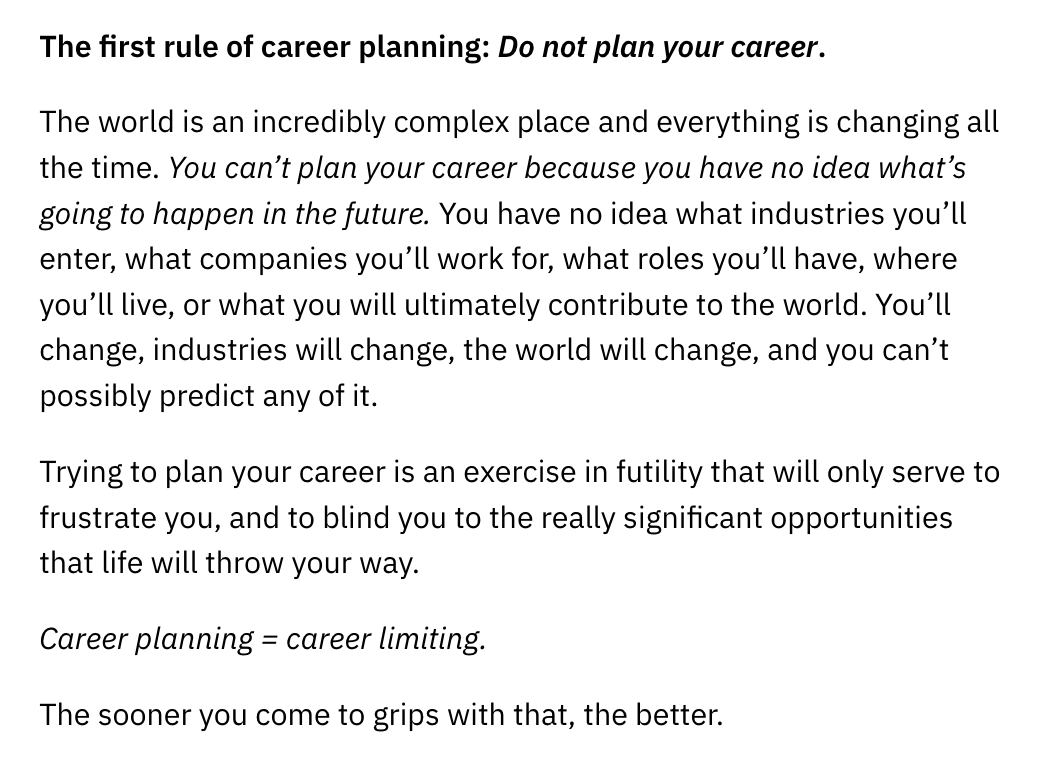
Every country has an energy. And that energy rewires you whether you notice it or not. People move to Japan and become minimal. People move to Mexico and their entire relationship with time softens. People move to New York and suddenly they can't sit still. Your personality is far more malleable than you think. We treat it like something fixed, but new surroundings give you new defaults. New pace. New habits. New values absorbed through proximity instead of effort. You're not just the average of the 5 people closest to you. You're the average of the 5 places, the 5 routines, and the 5 inputs you're exposed to most. Your commute shapes you. The weather shapes you. Every space you occupy is voting on who you become. That's why I believe choosing where you live is one of the most important decisions you'll ever make. More important than your job title. Maybe more important than your five-year plan. Because the place shapes the plan. The place shapes your energy, your habits, your relationships, your default state. Get the place right and half of the other decisions start making themselves. Get it wrong and you'll fight yourself every day.