🔨 Building SaaS & my MVP studio
⚡ 21, left my first easy job for the thrill of building
💻 Web, iOS & Android Dev
🌍 Shipping, failing, learning, repeating
APP STORE REVIEWERS CAN SPOT A VIBE-CODED APP FASTER THAN MOST FOUNDERS THINK.
and it's rarely because the app is broken.
it's usually the small things.
> loading screen before the user sees anything useful
> notification permission requested on launch
> onboarding explaining features instead of creating value
> screens filled with placeholder content
individually, none of these seem like a big deal.
together, they make the app feel unfinished.
that's the part many founders miss.
App Store review isn't just testing whether features work.
it's testing whether the experience feels ready for real users.
the apps that get through consistently tend to focus on the basics:
→ real data
→ clear flows
→ native interactions
→ a reason for every screen to exist
because reviewers can tell the difference between a product that's been shipped...
and a prototype that escaped into production.
APP STORE REVIEWERS CAN SPOT A VIBE-CODED APP FASTER THAN MOST FOUNDERS THINK.
and it's rarely because the app is broken.
it's usually the small things.
> loading screen before the user sees anything useful
> notification permission requested on launch
> onboarding explaining features instead of creating value
> screens filled with placeholder content
individually, none of these seem like a big deal.
together, they make the app feel unfinished.
that's the part many founders miss.
App Store review isn't just testing whether features work.
it's testing whether the experience feels ready for real users.
the apps that get through consistently tend to focus on the basics:
→ real data
→ clear flows
→ native interactions
→ a reason for every screen to exist
because reviewers can tell the difference between a product that's been shipped...
and a prototype that escaped into production.
Introducing Kombai 2.0 - the first AI design engineer.
We keep hearing that AGI is almost here. Still, we’re stuck with coding agents that don’t have taste and design tools that don’t understand our codebase. Both are artifacts of a world where design and engineering were two different jobs, with a handoff in between.
That world is changing fast. Today, designers ship code, engineers want to escape handoffs, and everyone wants to build tasteful UX.
Kombai is built for this new world.
Design and engineering, finally on the same side.
IT'S OVER GUYS!!!
"Ship first, secure later" is absolutely cooked.
That mindset worked when you had engineers reviewing everything.
It doesn't work when AI is generating half your codebase.
The best builders now have a launch checklist:
→ RLS enabled
→ secrets protected
→ permissions tested
→ AI security audit completed
Skip it and you're basically beta testing with hackers.
(full breakdown in the article)
This founder accidentally discovered ChatGPT was sending him customers.
3 months later, it became his biggest acquisition channel.
here's what happened:
1/ it started with user #26
>noticed a new signup
>checked attribution
>the user came from ChatGPT
someone had asked for a free alternative to ScoreApp.
ChatGPT recommended his product.
2/ he figured out why
>he had written a comparison article
>the article directly compared his tool vs ScoreApp
>ChatGPT was using that content in its recommendation
it wasn't random.
the AI needed evidence.
3/ so he doubled down
>wrote more comparison pages
>created alternative-to pages
>published use-case specific content
>answered questions users were already asking
examples:
>free ScoreApp alternative
>quiz tool for lead qualification
>how to qualify leads before sales calls
he started writing for AI retrieval instead of search rankings.
4/ the results
>131 users
>15 countries
>zero ad spend
and according to him:
>roughly half of all signups now come from ChatGPT
5/ the lesson
>Google wants keywords
>Google wants backlinks
ChatGPT wants answers.
specific answers.
clear answers.
easy-to-cite answers.
the easier you make it for AI to explain your product...
the easier it becomes for AI to recommend it.
what he learned:
>write comparison content
>answer buyer questions directly
>be explicit about who you're for
>give AI clear reasons to mention you
the real takeaway:
SEO was about ranking pages.
AI search is about becoming the answer.
and those are not the same thing.
IT'S OVER GUYS!!!
"Ship first, secure later" is absolutely cooked.
That mindset worked when you had engineers reviewing everything.
It doesn't work when AI is generating half your codebase.
The best builders now have a launch checklist:
→ RLS enabled
→ secrets protected
→ permissions tested
→ AI security audit completed
Skip it and you're basically beta testing with hackers.
(full breakdown in the article)
This founder accidentally discovered ChatGPT was sending him customers.
3 months later, it became his biggest acquisition channel.
here's what happened:
1/ it started with user #26
>noticed a new signup
>checked attribution
>the user came from ChatGPT
someone had asked for a free alternative to ScoreApp.
ChatGPT recommended his product.
2/ he figured out why
>he had written a comparison article
>the article directly compared his tool vs ScoreApp
>ChatGPT was using that content in its recommendation
it wasn't random.
the AI needed evidence.
3/ so he doubled down
>wrote more comparison pages
>created alternative-to pages
>published use-case specific content
>answered questions users were already asking
examples:
>free ScoreApp alternative
>quiz tool for lead qualification
>how to qualify leads before sales calls
he started writing for AI retrieval instead of search rankings.
4/ the results
>131 users
>15 countries
>zero ad spend
and according to him:
>roughly half of all signups now come from ChatGPT
5/ the lesson
>Google wants keywords
>Google wants backlinks
ChatGPT wants answers.
specific answers.
clear answers.
easy-to-cite answers.
the easier you make it for AI to explain your product...
the easier it becomes for AI to recommend it.
what he learned:
>write comparison content
>answer buyer questions directly
>be explicit about who you're for
>give AI clear reasons to mention you
the real takeaway:
SEO was about ranking pages.
AI search is about becoming the answer.
and those are not the same thing.
@hustle_fred this is only for the purpose of prototyping, once you close the deal, you can tweak the prototype and convert into a full polished product..
revisions are always there sadly :)
this is INSANE.
People don't realize how BIG this is.
The entire client handoff process just got compressed into ~15 minutes.
Fireflies records the call.
Lovable turns the transcript into a working prototype.
The client is clicking through a real product before the follow-up email is sent.
Most agencies still need days just to get aligned.
Comment "PRODUCT" for the workflow.
BRO.
One small habit completely changed how I use Claude Code.
Before I ask it to build anything...
I ask:
> "How is this thing going to break?"
Seriously.
Most people spend hours telling AI what they want.
Almost nobody spends 5 minutes thinking about what happens when things go wrong.
And that's exactly why the build looks great on day 1...
then turns into a mess a week later.
Now whenever I'm building a feature, I make a quick list:
> what if the user enters garbage data?
> what if the API is slow?
> what if Stripe succeeds but the webhook doesn't?
> what if someone clicks the button 5 times?
> what if they refresh halfway through?
Takes maybe 10 minutes.
Then I paste that list into Claude Code and tell it:
> "Build this assuming these problems will happen."
The difference is insane.
Instead of getting code that works...
I get code that survives.
Fewer bugs.
Less rebuilding.
Less "why didn't we think of this earlier?"
And most importantly:
I spend way less time fixing things after launch.
The workflow:
→ define the feature
→ spend 10 minutes listing everything that could go wrong
→ give Claude the feature + failure scenarios
→ let it design around those failures
→ then build
That 10-minute exercise has probably saved me dozens of hours of debugging.
Most people use AI to write code faster.
The bigger win is using AI to make fewer mistakes in the first place.
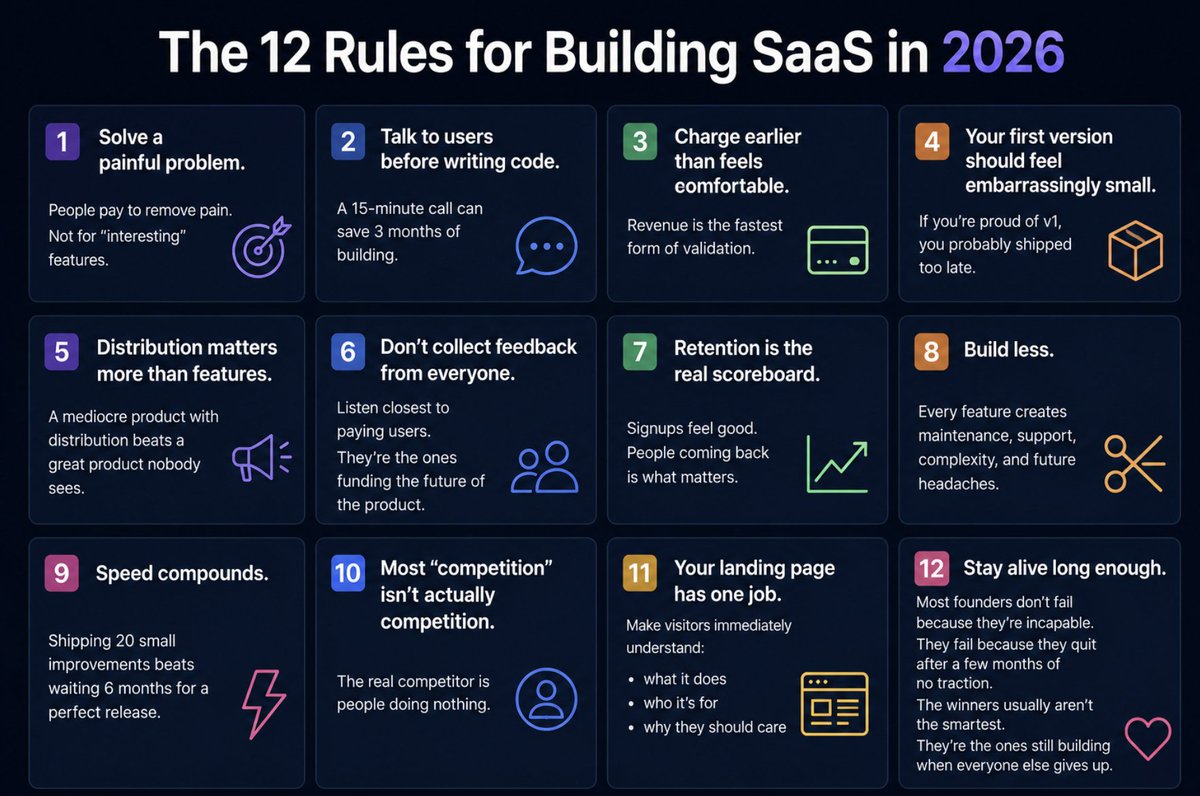
The 12 rules of building SAAS in 2026:
1. Build for pain, not excitement.
People buy painkillers.
Not vitamins.
2. Talk to users before code.
One conversation can save months of building the wrong thing.
3. Get money involved early.
Revenue reveals the truth faster than compliments.
4. Launch before you're ready.
Nobody remembers your first version except you.
5. Distribution is part of the product.
A product nobody sees doesn't exist.
6. Ignore most advice.
Prioritize feedback from people who actually pay.
7. Retention > acquisition.
Getting users is hard.
Keeping them is the business.
8. Every feature has a cost.
Support.
Complexity.
Maintenance.
Future bugs.
Build accordingly.
9. Momentum is a superpower.
Small improvements every day beat massive updates every quarter.
10. Competition is rarely the problem.
Most users simply don't care enough yet.
11. Clarity wins.
If someone can't understand your product in 5 seconds, you've already lost them.
12. Stay in the game.
Most SaaS success stories look like failure for much longer than people expect.
The founders who win aren't always the smartest.
They're the ones who survive long enough to get good.The 12 SaaS rules that quietly separate founders who make it from founders who don't:
1. Build for pain, not excitement.
People buy painkillers.
Not vitamins.
2. Talk to users before code.
One conversation can save months of building the wrong thing.
3. Get money involved early.
Revenue reveals the truth faster than compliments.
4. Launch before you're ready.
Nobody remembers your first version except you.
5. Distribution is part of the product.
A product nobody sees doesn't exist.
6. Ignore most advice.
Prioritize feedback from people who actually pay.
7. Retention > acquisition.
Getting users is hard.
Keeping them is the business.
8. Every feature has a cost.
Support.
Complexity.
Maintenance.
Future bugs.
Build accordingly.
9. Momentum is a superpower.
Small improvements every day beat massive updates every quarter.
10. Competition is rarely the problem.
Most users simply don't care enough yet.
11. Clarity wins.
If someone can't understand your product in 5 seconds, you've already lost them.
12. Stay in the game.
Most SaaS success stories look like failure for much longer than people expect.
The founders who win aren't always the smartest.
They're the ones who survive long enough to get good.
this is INSANE.
People don't realize how BIG this is.
The entire client handoff process just got compressed into ~15 minutes.
Fireflies records the call.
Lovable turns the transcript into a working prototype.
The client is clicking through a real product before the follow-up email is sent.
Most agencies still need days just to get aligned.
Comment "PRODUCT" for the workflow.
BRO this is INSANE.
The entire agency workflow is collapsing into a single stack.
Client explains the idea once.
That's it.
→ Fireflies records the conversation
→ Lovable turns it into a working product
→ Client gets something clickable within minutes
No requirements docs.
No wireframe phase.
No endless back-and-forth before seeing something real.
Most agencies are still translating meetings into tickets.
This workflow translates meetings into products.
The 12 rules of building SAAS in 2026:
1. Build for pain, not excitement.
People buy painkillers.
Not vitamins.
2. Talk to users before code.
One conversation can save months of building the wrong thing.
3. Get money involved early.
Revenue reveals the truth faster than compliments.
4. Launch before you're ready.
Nobody remembers your first version except you.
5. Distribution is part of the product.
A product nobody sees doesn't exist.
6. Ignore most advice.
Prioritize feedback from people who actually pay.
7. Retention > acquisition.
Getting users is hard.
Keeping them is the business.
8. Every feature has a cost.
Support.
Complexity.
Maintenance.
Future bugs.
Build accordingly.
9. Momentum is a superpower.
Small improvements every day beat massive updates every quarter.
10. Competition is rarely the problem.
Most users simply don't care enough yet.
11. Clarity wins.
If someone can't understand your product in 5 seconds, you've already lost them.
12. Stay in the game.
Most SaaS success stories look like failure for much longer than people expect.
The founders who win aren't always the smartest.
They're the ones who survive long enough to get good.The 12 SaaS rules that quietly separate founders who make it from founders who don't:
1. Build for pain, not excitement.
People buy painkillers.
Not vitamins.
2. Talk to users before code.
One conversation can save months of building the wrong thing.
3. Get money involved early.
Revenue reveals the truth faster than compliments.
4. Launch before you're ready.
Nobody remembers your first version except you.
5. Distribution is part of the product.
A product nobody sees doesn't exist.
6. Ignore most advice.
Prioritize feedback from people who actually pay.
7. Retention > acquisition.
Getting users is hard.
Keeping them is the business.
8. Every feature has a cost.
Support.
Complexity.
Maintenance.
Future bugs.
Build accordingly.
9. Momentum is a superpower.
Small improvements every day beat massive updates every quarter.
10. Competition is rarely the problem.
Most users simply don't care enough yet.
11. Clarity wins.
If someone can't understand your product in 5 seconds, you've already lost them.
12. Stay in the game.
Most SaaS success stories look like failure for much longer than people expect.
The founders who win aren't always the smartest.
They're the ones who survive long enough to get good.
This founder spent $1,078 validating an AI SaaS so you DON’T have to.
Here's the brutal breakdown:
1/ The idea sounded smarter than the pain
> AI tool for recreating viral videos
> analyzes hooks, scenes, structure, pacing
> gives creators a remake plan
Cool idea honestly.
But:
> "interesting" is NOT enough
> people need to feel pain badly enough to pay monthly
2/ They built too much before validation
> 226 users after launch
> $4.77 per signup from ads
> low search demand killed scaling
The biggest mistake:
> assumed logical = profitable
> never checked search volume
> never tested willingness to pay
> never validated acquisition
3/ Traffic matters more than features
> people liking the concept means nothing
> distribution is the real business
> weak keywords = weak SaaS
> even good products die quietly with no channel
4/ They learned this too late
Should've started with:
> landing page test
> keyword research
> CPC analysis
> competitor validation
NOT full product development.
5/ Another underrated lesson:
> don't invent new workflows too early
They said they should've copied mature SaaS flows first:
> onboarding
> activation
> paywalls
> pricing
> outputs
> traffic loops
Then innovate later.
The real takeaway:
> useful ≠ valuable
> logical ≠ painful
> users ≠ revenue
Most SaaS products don't die because of code.
They die because nobody urgently needed them.
BRO.
One small habit completely changed how I use Claude Code.
Before I ask it to build anything...
I ask:
> "How is this thing going to break?"
Seriously.
Most people spend hours telling AI what they want.
Almost nobody spends 5 minutes thinking about what happens when things go wrong.
And that's exactly why the build looks great on day 1...
then turns into a mess a week later.
Now whenever I'm building a feature, I make a quick list:
> what if the user enters garbage data?
> what if the API is slow?
> what if Stripe succeeds but the webhook doesn't?
> what if someone clicks the button 5 times?
> what if they refresh halfway through?
Takes maybe 10 minutes.
Then I paste that list into Claude Code and tell it:
> "Build this assuming these problems will happen."
The difference is insane.
Instead of getting code that works...
I get code that survives.
Fewer bugs.
Less rebuilding.
Less "why didn't we think of this earlier?"
And most importantly:
I spend way less time fixing things after launch.
The workflow:
→ define the feature
→ spend 10 minutes listing everything that could go wrong
→ give Claude the feature + failure scenarios
→ let it design around those failures
→ then build
That 10-minute exercise has probably saved me dozens of hours of debugging.
Most people use AI to write code faster.
The bigger win is using AI to make fewer mistakes in the first place.
BRO this is INSANE.
The entire agency workflow is collapsing into a single stack.
Client explains the idea once.
That's it.
→ Fireflies records the conversation
→ Lovable turns it into a working product
→ Client gets something clickable within minutes
No requirements docs.
No wireframe phase.
No endless back-and-forth before seeing something real.
Most agencies are still translating meetings into tickets.
This workflow translates meetings into products.
THIS IS INSANE.
People don’t realize how BIG this is.
You can now go from client call → live clickable prototype in ~15 minutes.
Here’s the STACK:
→ fireflies ai records + transcribes the meeting
→ @Lovable reads the transcript and builds exactly what they asked for
→ client gets a working PROTOTYPE before the follow-up email even lands
They’re clicking a real product while other agencies are still writing notes.
Most agencies take 2 weeks for a wireframe.
Comment 'PRODUCT' for complete workflow.
BRO this is CRAZY.
Most people are using Lovable like ChatGPT with prettier buttons.
That's exactly why their apps keep getting worse after every prompt.
After 30+ MVPs, the biggest lesson isn't prompting better.
It's building a system:
→ one session = one objective
→ screenshots > explanations
→ lock design systems early
→ REVERT aggressively
(full breakdown in the article)
This founder spent $1,078 validating an AI SaaS so you DON’T have to.
Here's the brutal breakdown:
1/ The idea sounded smarter than the pain
> AI tool for recreating viral videos
> analyzes hooks, scenes, structure, pacing
> gives creators a remake plan
Cool idea honestly.
But:
> "interesting" is NOT enough
> people need to feel pain badly enough to pay monthly
2/ They built too much before validation
> 226 users after launch
> $4.77 per signup from ads
> low search demand killed scaling
The biggest mistake:
> assumed logical = profitable
> never checked search volume
> never tested willingness to pay
> never validated acquisition
3/ Traffic matters more than features
> people liking the concept means nothing
> distribution is the real business
> weak keywords = weak SaaS
> even good products die quietly with no channel
4/ They learned this too late
Should've started with:
> landing page test
> keyword research
> CPC analysis
> competitor validation
NOT full product development.
5/ Another underrated lesson:
> don't invent new workflows too early
They said they should've copied mature SaaS flows first:
> onboarding
> activation
> paywalls
> pricing
> outputs
> traffic loops
Then innovate later.
The real takeaway:
> useful ≠ valuable
> logical ≠ painful
> users ≠ revenue
Most SaaS products don't die because of code.
They die because nobody urgently needed them.
What I wanted at 20:
- A fancy car
- A lot of friends
- A high-paid job
- A crazy social life
- A lot of validation
What I want at 30:
- A fit body
- A best friend
- A peaceful mind
- A meaningful work
- An empty calendar