If you want to understand where Ukrainian's spirited resistance against a seemingly overwhelming enemy comes from, this is a must see:
https://t.co/DUt5UedBwb
❗ LEA BRIDGE local election results
Liz Biggs (Green Party), Solène Fabios (Green Party) and Rosie Rowlands (Green Party) have been elected as councillors for Lea Bridge ward with 1,384 and 1,365 votes respectively.
Full breakdown of votes here: https://t.co/oGx5VMGPCd
It was a struggle for me to get here, but I am the happiest I have ever been. I wanted to share my story — the whole story. @PlayersTribune
https://t.co/TfLhp34DIT
The data here tells two different stories depending on how you read it.
Story one: London is the world’s 4th largest startup hub, raised $17.7B in 2025, produced more unicorns than Berlin, Paris, and Tokyo combined. Success.
Story two: London’s stock exchange fell to 23rd globally for IPO fundraising, behind Mexico and Oman. 88 companies delisted or fled in 2024, the largest exodus since the financial crisis. Deliveroo finally turned profitable after years of struggle, and DoorDash immediately swooped in to buy it for less than half its IPO price.
The pattern is consistent. Freetrade built a profitable trading app, got acquired by IG Group for £160M after targeting a £700M valuation. Runna built a successful fitness app, Strava bought it. ARM, DeepMind, Skyscanner, Shazam. The exit playbook is always the same: build in London, sell to San Francisco.
What London actually built is Europe’s most efficient farm system for US acquirers. The city does the expensive, risky work of finding founders, funding early rounds, and proving product-market fit. American companies wait until the risk is de-risked, then buy the winners at discounts enabled by London’s shrinking public markets.
The $17.7B in venture funding measures inputs, not outcomes. The outcome is that UK startups raised all that money, then got absorbed into US companies before they could compound at scale.
Being 4th in funding and 23rd in IPOs tells you exactly where the value is leaking.
After over 12 months of drafts and rewrites, a couple of weeks ago I published an assessment that criticised Britain’s political class for its inability to wake up to the new reality we are in.
Today, Mark Carney has delivered a speech that articulated some of my views in ways I never could. A truly educated and sound analysis, citing history, literature and economics - worth reading across SW1.
Zipcar announcing it will cease operations by year and my favourite spinning studio, Digme, shutting doors for good on the same day - not a good day for London businesses
A lot going on right now, but I have a feeling we will look back in a year and realize this was the most important story published this week. https://t.co/zbKuhvpXMW
I find the story of AI and radiology fascinating. Of course, Hinton's prediction was wrong* and tech advances don't automatically and straightforwardly cause job replacement — that's not the interesting part.
Radiology has embraced AI enthusiastically, and the labor force is growing nevertheless. The augmentation-not-automation effect of AI is despite the fact that AFAICT there is no identified "task" at which human radiologists beat AI. So maybe the "jobs are bundles of tasks" model in labor economics is incomplete. Paraphrasing something @MelMitchell1 pointed out to me, if you define jobs in terms of tasks maybe you're actually defining away the most nuanced and hardest-to-automate aspects of jobs, which are at the boundaries between tasks.
Can you break up your own job into a set of well-defined tasks such that if each of them is automated, your job as a whole can be automated? I suspect most people will say no. But when we think about *other people's jobs* that we don't understand as well as our own, the task model seems plausible because we don't appreciate all the nuances.
If this is correct, it is irrelevant how good AI gets at task-based capability benchmarks. If you need to specify things precisely enough to be amenable to benchmarking, you will necessarily miss the fact that the lack of precise specification is often what makes jobs messy and complex in the first place. So benchmarks can tell us very little about automation vs augmentation.
* Hinton insists that he was directionally correct but merely wrong in terms of timing. This is a classic motte-and-bailey retreat of forecasters who get it wrong. It has the benefit of being unfalsifiable! It's always possible to claim that we simply haven't waited long enough for the claimed prediction to come true.
"Wir müssen mit den Israelis hinter verschlossenen Türen sprechen als Freunde und sie auf ihr Fehlverhalten hinweisen." - wow, das wird den verhungernden Palästinensern bestimmt helfen, den Genozid zu überleben, Hut ab an die Deutsche Politik. /s
Mehrere SPD-Politiker fordern wegen der Lage im Gazastreifen ein Ende der Waffenlieferungen an Israel. Union und Grüne halten dagegen, es gehe um Israels Sicherheit. https://t.co/t4jULI0FUi
BREAKING: The University of Zurich has been using AI bots to secretly manipulate Redditors since November 2024.
The scariest part?
The bots were 6 times more likely to change the minds of Redditors than the baseline, often by leveraging misinformation.
More below🧵
@BWA_Vorstand you'd think that after European governments were pushed to stand up for themselves against Trump's America, they'd also find a voice condemning the brutal and horrific war against Palestinians ... their silence is deafening.
“We are under siege by hostile adversaries trying to erode our manufacturing and defense industrial base and disrupt our financial system,” Stephen Miran, the chair of Council of Economic Advisers, said.
He's absolutely right. But the siege is coming from inside the house.
@cicero_online@HugoMuellerVogg Was fuer ein schiefer Vergleich... Cicero auf dem Weg zur NZZ. AfD ist in teilen gesichert rechtsextrem und Demokratie-feindlich. Wer Demokratie verteidigen will muss AfD ablehnen.
New @The_Budget_Lab report about today's tariff announcement:
• The April 2nd policy alone is the equivalent of an 11.5pp increase in the effective tariff rate. When combined with other US tariffs in 2025, we're at 22 1/2%, the highest rate since 1909.
1/7
After handing the baton to epidemiologists at the beginning of the 2020's, trade economists are set for a return to the global spotlight they so much enjoyed after the Brexit referendum.
THREAD:
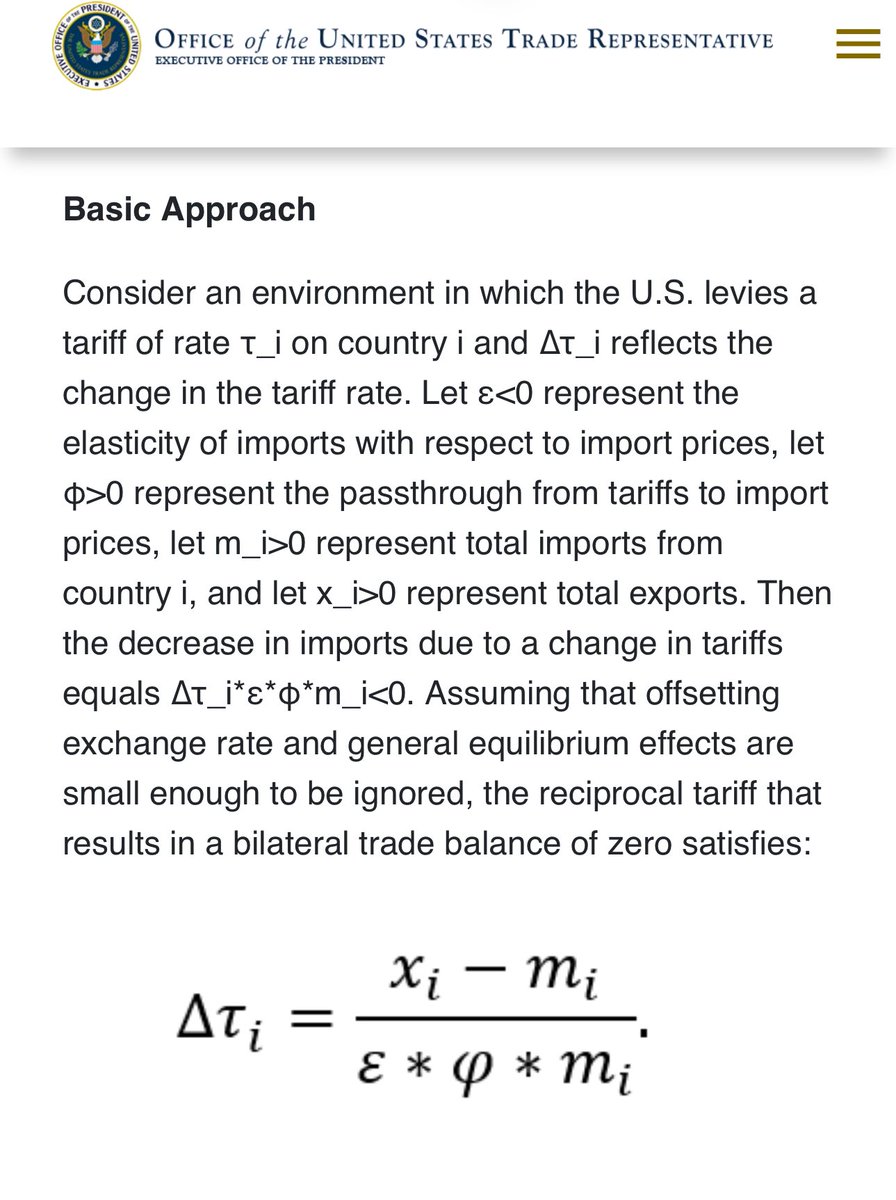
The so-called “reciprocal” tariff doesn’t reflect the tariffs charged elsewhere directly but essentially the size of a country’s trade surplus, which has been used as a proxy. The equation essentially is aimed at levying a fee that would get this surplus to zero.
"For decades the U.S. has used preferential trade access to encourage economic development in the world's poorest nations [...] They're now effectively penalizing countries for following previous U.S. policy, a lesson which I bet they won't forget anytime soon."
To illustrate just how nonsensically these tariffs were calculated, take the example of Lesotho, one of the poorest countries in Africa with just $2.4 billion in annual GDP, which is being struck with a 50% tariff rate under the Trump plan, the highest rate among all countries on the list.
Why? Does Lesotho apply extortionate tariffs on U.S. products and the U.S. is merely being "reciprocal" here? Not at all, despite what Trump is saying, it's NOT the way these tariffs are defined.
As a matter of fact Lesotho, as a member of the Southern African Customs Union (SACU), applies the common external tariff structure established by this regional trade bloc.
Which means it applies the same tariffs on U.S. products as South Africa does, as well as the 3 other members of the bloc: Namibia, Eswatini and Botswana.
So since the tariffs charged by these 5 countries on U.S. products are exactly the same, they must all be struck with a 50% tariff rate by the U.S., right? Not at all: South Africa is getting 30%, Namibia 21%, Botswana 37% and Eswatini just 10%, the lowest rate possible among all countries.
So what gives? Again, the way these tariffs are calculated has absolutely zero relationship with actual tariffs imposed by these countries on U.S. products. Instead, they appear to be simply derived from trade deficit calculations.
Looking at Lesotho specifically, every year the U.S. imports approximately $236 million in goods from Lesotho (primarily diamonds, textiles and apparel) while exporting only about $7 million worth of goods to Lesotho (https://t.co/uHvem6nH2o).
Why do they export so little? Again this is an extremely poor country where 56.2% of the population lives with less than $3.65 a day (https://t.co/GEho8xFjAp), i.e. $1,300 a year. They simply can't afford U.S. products, no-one is going to buy an iPhone or a Tesla on that sort of income...
The way the tariffs are ACTUALLY calculated appears to be based on a simplistic and economically senseless formula: you take the trade deficit the U.S. has with a country, divide it by that country's exports to the U.S and declare this - falsely - "the tariff they charge on the U.S."
And then as Trump did in his speech last night, you magnanimously declare that you'll only "reciprocate" by charging half that "tariff" on them.
As such, for Lesotho, the calculation goes like this: ($236M - $7M)/$235M = 97%. That's the "tariff" Lesotho is deemed to charge this U.S. and half of that, i.e. roughly 50% is what the U.S. "reciprocates" with.
It's extremely easy to see why this makes no sense at all.
First of all, there's nothing Lesotho can do about it: they can't change tariffs they allegedly charge the U.S. to reduce the tariff rate the U.S. "reciprocates" with because, again, it's NOT based on any tariff that they charge.
Similarly they can't do much about reducing the trade deficit they have with the U.S. because, again, they simply don't have enough money to buy U.S. products.
Also the main rational Trump gave for the tariffs is to get production back to the U.S., to "bring manufacturing back". 47.3% of Lesotho's exports are diamonds: how do you bring the "manufacturing" of that "back to the U.S."? Anyone can see it makes just about zero sense.
The Lesotho example exposes the fundamental economic incoherence of these tariffs. Rather than addressing actual trade barriers, they punish countries based on trade deficits that arise from structural economic realities. All the more countries like Lesotho which pose zero competitive threat to American industry.
Worse yet, these tariffs will likely make these structural realities even worse: the U.S. is Lesotho's second most important export destination so it's a fair bet that applying 50% tariffs on their products will make people in Lesotho even poorer, and therefore even LESS able to afford U.S. products.
But perhaps the most unfair and detrimental aspect of all this is that these tariffs represent a complete reversal of longstanding U.S. development policy, and therefore a betrayal of countries - like Lesotho - who chose to follow U.S. advice in the past.
For decades the U.S. has used preferential trade access to encourage economic development in the world's poorest nations, recognizing that trade, not just aid, could get them out of poverty and ultimately put them in a position where they too could afford iPhones or Tesla.
They're now effectively penalizing countries for following previous U.S. policy, a lesson which I bet they won't forget anytime soon.
So all in all the irony is painful: in the name of fighting unfair trade, America has just demonstrated what truly unfair trade looks like.
This isn't something designed to address genuine trade issues, but simply a mechanism based on arbitrary math to punish countries for the affront of selling more to the United States than they buy.
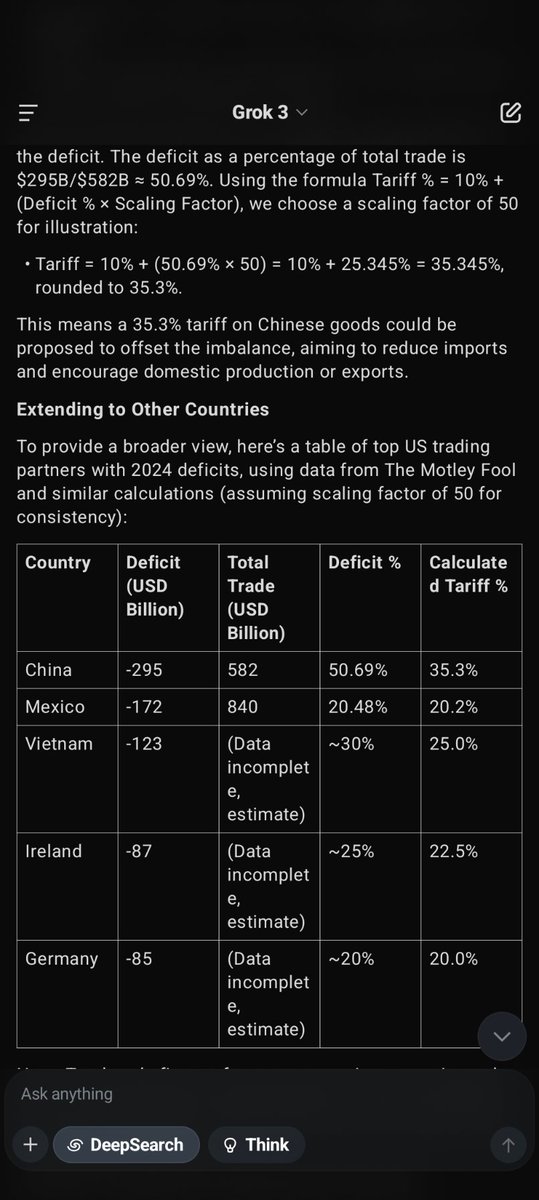
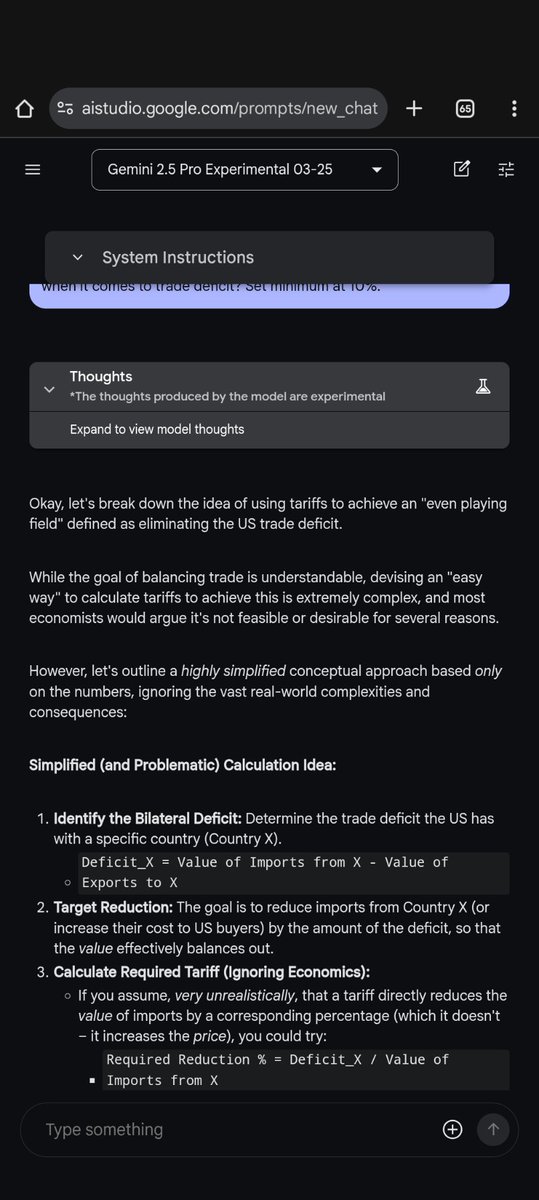
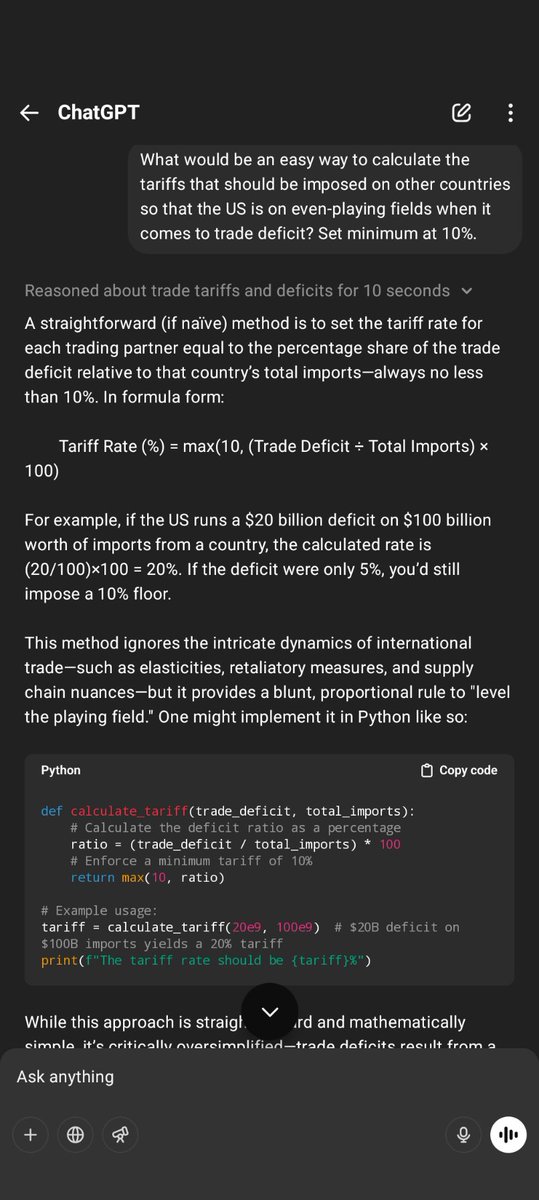
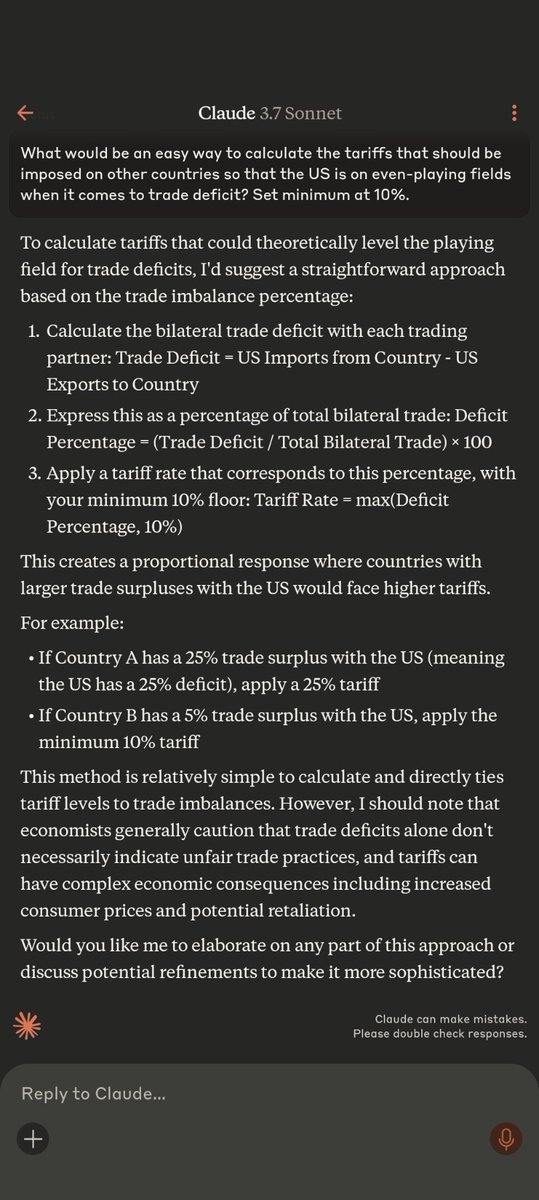
This might be the first large-scale application of AI technology to geopolitics.. 4o, o3 high, Gemini 2.5 pro, Claude 3.7, Grok all give the same answer to the question on how to impose tariffs easily.