Canada’s not going for gold with this strategy.
On the consumer side, this strategy gets a lot of things right and this government deserves credit for that.
But from a digital and economic sovereignty perspective I think it falls short. What the AI industry most needs is for governments to create the free market conditions for AI companies to start, scale and thrive here.
There are important elements in the strategy: sovereign compute, a public supercomputer, AI Missions starting in health care, a fund to scale Canadian champions, commercializing the Photonics Fabrication Centre, and the government as an anchor customer. Members of the Build Canada community have publicly written about many of these ideas and it's good to see these show up in the plan.
But we have to be honest about what this strategy is – and what it isn't.
This is primarily a strategy to help Canada use artificial intelligence, with government in a main character role in framing public perception.
It is not a strategy to make Canada the best place on earth to build it. Its own organizing goal – adoption, moving Canadian businesses from 12% to 60% uptake – is necessary but not sufficient to make Canada a global AI leader.
The strategy says it wants Canadian champions. But you don't build champions with government cheques and deferred studies – you build them by making Canada the best place on earth to start and scale a company.
Using AI and Building AI are different goals, and they require different instincts.
The companies that will define this century will get built where four things are true:
1. founders and engineers keep what they create;
2. capital is deep enough to write billion-dollar cheques; 3. energy and compute are cheap and fast to build; and 4. the rules are light enough to move at the speed of the technology.
Measure this strategy against those conditions and the pattern is clear:
On founder and employee economics – the single biggest reason talent leaves Canada – it does nothing now. The one capital-gains idea it raises, a reinvestment rollover, is deferred to a study due by Budget 2026.
On capital, it makes the government the venture capitalist instead of unleashing private capital to back Canadian companies.
On energy, it promises to double the grid by 2050. The build is needed this decade – and the strategy offers no permitting reform to get there.
On regulation, it adds a new layer – a trusted-AI certification program, watermarking, plus new privacy and online-safety laws – and compliance always lands hardest on the startups least able to carry it.
And it adds a dozen new programs on top of the 130-plus innovation programs founders already can't navigate. The answer was always fewer and faster, not more.
Prosperity is not something that the state can spend into existence. Prosperity is what happens when you clear the runway and let the free market work. No government can subsidize its way past the friction it is responsible for creating.
Playing to win would look different. It would look like:
--> Let founders defer capital gains reinvested in Canadian companies, and fix how we tax employee equity – now, not in a future budget.
--> Treat energy and permitting like the emergency they are. Approve power and data centres in months, not years, and build at wartime speed.
--> Set a hard speed limit on regulation: apply the laws we have, and clear new products fast.
--> Collapse the ~130-plus innovation programs into fewer than ten – and cut the friction founders hit at every step.
Canada invented modern AI. We have the talent, one of the cleanest grids in the world, and the research base to win. The opportunity is ours to lose.
This strategy is a genuine start – but a country that wants to win doesn't plan to be the world's best customer. It plans to build the companies the world cannot live without.
🚀 Why We're Passionate About Rewarding Canada's Risk-Takers: Our Latest Build Canada Memo
As someone who's spent years in the trenches of venture capital at Ripple Ventures, I've seen firsthand how outdated policies are stifling Canadian innovation. It's heartbreaking to watch our brightest entrepreneurs and investors pack up and head south—or worse, never even start here at all.
That's why Jay Lee and I poured our hearts into this passion project: the new Build Canada memo, "Reward the Risk Takers Who Build Canada."
We didn't just crunch numbers; we dove deep because we believe in Canada's potential. With only 33 small businesses per 1,000 people (vs. 124 in the US), we're losing ground fast. Our capital gains rules? They're driving talent away, making it tougher to fund and scale the next big thing. But imagine flipping that script—unleashing innovation, creating hundreds of thousands of jobs, and keeping our world-class grads (like Nobel Prize winner Geoffrey Hinton) building empires right here.
This memo is our rallying cry: Let's reform capital gains to match the US's QSBS edge, with $15M caps, 100% exclusions, and inclusive rules for all industries.
Key ideas we're championing:
✅ Broaden access: Cover healthcare, clean energy, tech, and more—plus ditch ownership minimums to reward early employees and investors.
✅ Amp up incentives: Shift to per-business limits and make structures like SAFEs eligible from day one.
✅ Hit big goals: Double SMBs per capita, boost early-stage funding to 1,000+ rounds/year, and push VC investment to 0.5% of GDP.
At Ripple, this isn't just policy talk—it's personal. We're investors who bet on dreamers every day, and we know rewarding risk is how we build a thriving economy. Canada's got the talent, grit, and education to lead globally. Let's make sure our policies match that fire.
Dive into the full memo: https://t.co/5uiJ5Q8VFa
Listen to our discussion on the memo below in the comments!
WHY YOUR PRODUCT IDEA SOUNDS TOO COMPLICATED: THE "SIMPLE TO WTF" SCALE
There's a complexity scale for how people describe products. Here it is, from simplest to wtf:
- SIMPLE (and easiest to understand): The product can be described in 2 words as [adjective] + [noun] like "electric car" or "smart phone" or similar. It's something you understand, but with one major change that's emphasized. If the category gets big, then eventually something like "horseless carriage" just turns into "car." (which then invites a new adjective-led category later)
- OK GOT IT: It's also easy to understand something like, "an [kind of app] for [well-understood behavior]," like an app for making a restaurant reservation or a VR app for playing basketball. The more understandable the behavior (and the more obvious why someone would want to do this) the better. If there's a clear commercial value, that will make it very easy to understand.
- HUH: Famously a lot of startups go with the "[product] for [category]" description. This can work well for products that are easily segmented, like "online dating for international students" or "voice notes for doctors." If the product is obviously useful while the segment seems valuable and big enough, then it works great. It works less well when things are too niche, or there's no real market intersection for the "X for Y" idea, like a social network for cats. (No, this isn't a good idea, don't even get started).
- UH.... WHAT: There's a close cousin to the above, which is "a [kind of app] for [literal/weird/bizarre behavior] or "it's [weird product idea] for [niche segment]". Obv if it's an app for a weird/strange behavior, like "an app for visualizing wikipedia links as geometric diagrams" then one might understand literally what the app does, but still not get the why. Or saying something is Roblox for cats. What would that even mean? This is particularly tempting for nerds who want to describe in detail what their product does, but not why, or to just make word salad because it's fun.
- WTF (like seriously what?): One more step towards descriptive would be to lead with a lot of detail about the inner mechanics of the product as the starting point. Perhaps starting with a history of an esoteric set of technologies involved as the 20 min preamble, before finally describing the product. Or talk about a complicated product strategy based on the structure of your market, and after analyzing everything, finally get to a complex family of somewhat unrelated products, followed by a super product that encompasses all of them. These pitches all follow the same pattern: 10-minute intro, question, another 10-minute spiel, more rambling, more questions, even more rambling... more confused questions. And on and on. WTF.
- DOUBLE WTF: And don't get me started if you begin your presentation with the "jobs to be done" framework, describe that, then describe your weird product, then describe how it fills some bizarre psychological need. Then 2x2s and then a weird super product with a bunch of features to be built over the next 5 years. We get it, you just got your MBA :) Just tell us what you're building now.
HOW TO FIX YOUR WTF DESCRIPTION
If you're at a higher WTF level than desired, here's the easiest fix. But I warn you, it's a painful one, because it requires you to ask questions and listen.
• Show your product to target customers
• Ask them: "How would you describe this to someone else?"
• Bite your tongue and listen - you'll soon learn some simple truths
Their words that follow this question are gold. Simplicity is key. They will toss out your complicated description, and replace it with something easier and more truthful. Often times, you will dislike what you hear. Because it strips out all of your strategic differentiation, and just describes what is in front of them. Or perhaps because it doesn't capture the technical "wow" of what's under the hood. Sorry, this is the unvarnished truth of your product even if it's painful.
To dislodge this ugly but truthful idea, you have to replace it with a better idea that's prettier but also equivalently truthful. You may need to shift towards familiar product categories or behaviors and position against them in an attractive way. Your customers can only understand things through the context of what already exists in the world -- they can't talk or ask for new/innovative things. The classic quote by Henry Ford says, "If I had asked people what they wanted, they would have said faster horses" Of course it's your job to deliver these innovations, but you must learn to describe them. And cars were originally called horseless carriages for a reason -- to bridge the gap between what customers understand and what they actually want.
As a result, the simplest product pitches are often counterpositions on existing categories. Take something that's well understood, whether that's product in market, or a behavior that's commonplace, and describe your product relative to that one. If you can describe it as adjective+noun, then great, or "noun for segment" or "app for behavior." These are all attempts to use pre-existing categories.
WHAT IF YOUR DESCRIPTION IS TOO BLAND
The main downside to positioning against something pre-existing is that it'll feel too similar and bland. It'll seem to lack differentiation. Sometimes that's fine, particularly if you are early in the product cycle where having the "it works" feature is enough, or if you at the end and "it has better design" is enough. But sometimes you do need to have a strong counterpositioning.
A few things to try.
First, try to be the anti-something. If there's a pre-existing product in the market try to differentiate by positioning against it. "We're a new kind of X" or "We're the anti-X" and follow this line of thought to what this might be. Perhaps it's mostly branding, as Pepsi and Coke are, or maybe it's something more substantial like a consumer versus enterprise focus (like Box and Dropbox).
Or, make a fundamental choice in UX, one that's immediately visible. Perhaps another product opens to an AI text box, and you should open to a grid of templates. Or you use animated GIFs when others use videos or lists of text. Sometimes a big "out of the box" difference in UI goes a long way, particularly if that UI helps you target a different audience.
Go really premium and target a smaller audience. Or go towards free (or as close as you can) and go broader. Sell via partners, or go direct. Go for a younger audience, or try for an older one. Grow internationally rather than domestically. There's a lot of choices like these. These dichotomies help define the product description and oftentimes it's choices like these that can help win, not just features.
SIMPLICITY IS A COMPETITIVE ADVANTAGE
When it's easier to describe what you do, it's more memorable. It spreads faster. Your onboarding gets more efficient, and your customer acquisition gets cheaper. Simpler is a competitive advantage unto itself.
The hardest part about this for a lot of product builders is simply that the ego wants to be different. People want credit for the cleverness of their idea. And the line of thinking goes, more complex means more clever, which means they are smarter. Customers don't care about that. They just want to understand how your product fits into their life and when they should use it. That's it.
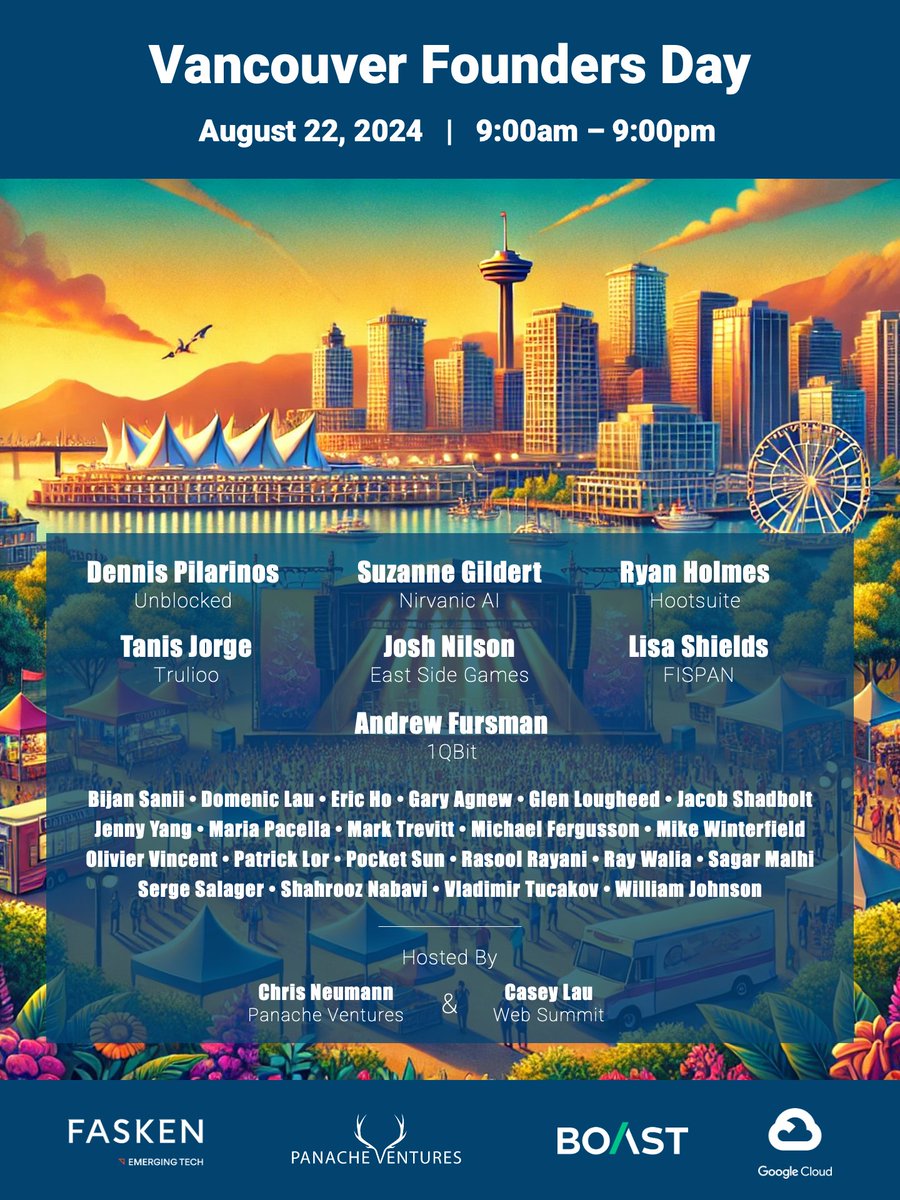
Thrilled to announce Vancouver Founders Day!
We're bringing together dozens of OG founders to share their experiences with Vancouver's up-and-coming founder communities.
This all-day event is *free for founders*.
More details and registration link in the comments.
🚀🇨🇦🔥
If you’re like me & love the gut micro-immune axis (and you’re at #AAI2023), I’ll be sharing my research on a disappearing keystone bacterial family at the Host-Microbiota Crosstalk session.
Big thank you to the organizers at #AAI for the opportunity to share my research 🙏
As a connector in the business lending world and an advocate for startups, today's events struck a chord with me.
I've posted a new blog to help clarify some misconceptions, and get the SVB story straight here:
https://t.co/bjdQvexQvB
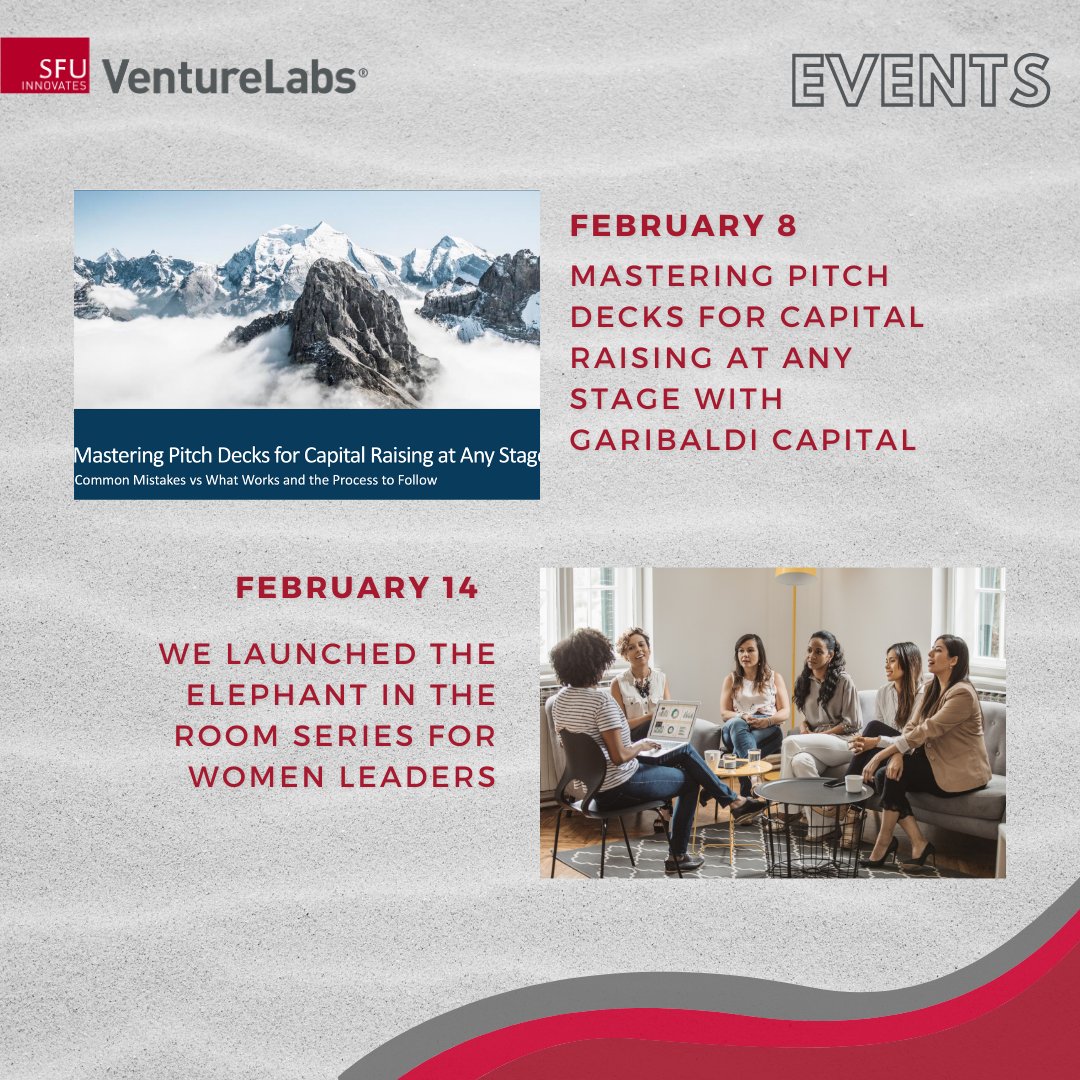
How was your February? At VentureLabs, we launched a new program "Elephant in the Room Series," and hosted a webinar on mastering your pitch deck with @garibaldicap. Our #VLabs companies @LevrFinance and RxPx also earned incredible achievements! Tap the photos to learn more.
Very excited to announce our investment in @LevrFinance $1,000,000 pre-seed round!
Levr is a Vancouver based fintech software company transforming the way businesses access and manage loans. 💻 🏦💰
https://t.co/Nr8Y8ly4L8