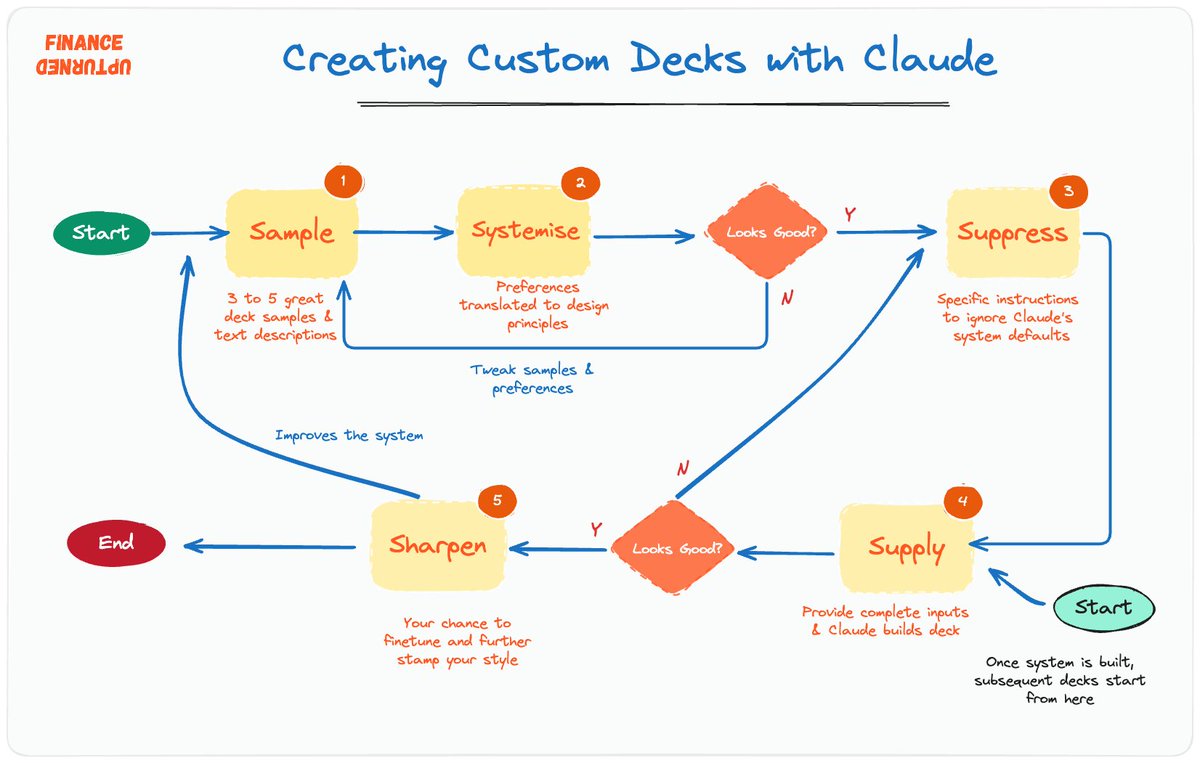
The biggest divide in business today is between those who are vehemently against the use of AI in creating decks and those who say "what's wrong with it?"
What if you could use AI to generate decks that don't look like AI?
Threading that line is tricky but can be done, here's a proven 5 step process.
Try it out and you'll be pleasantly surprised.
https://t.co/TfuWjhVKEO
Always sad when this happens but reminder that failure is the default outcome for tech startups.
If you find modest success, get out when you can.
Anything is better than zeros though VCs disagree
https://t.co/4YZJqy8lP9
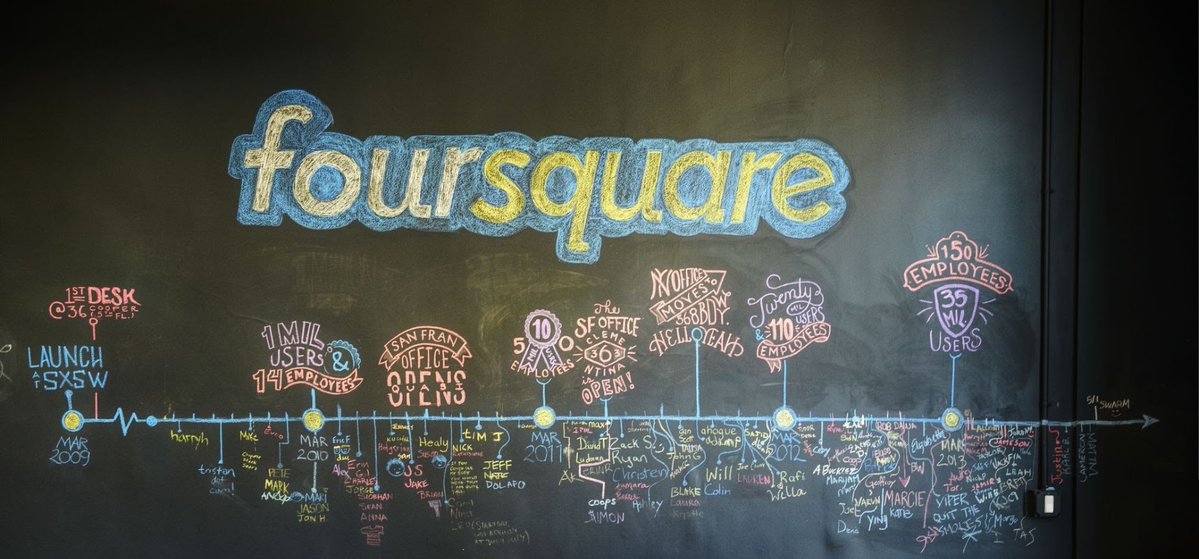
Foursquare was acquired last month. The outcome was disappointing. It's taken me a while to write this, but I think I'm finally done grieving it. Here are some thoughts on our final years, an effort to honor the team who helped build & maintain FSQ's legacy, and my attempt to finally get some closure. https://t.co/HgcgI9DWvy
If I knew what I knew now, I wouldn't have raised venture capital."
This is what a founder friend told me the last time we caught up.
Two big headaches he's facing:
🥵 sheer weariness from fundraising every year for the past 12 years
❌ constant challenge of meeting sky-high targets after his recent growth equity round
And he's one of the lucky ones who has taken some "chips off the table."
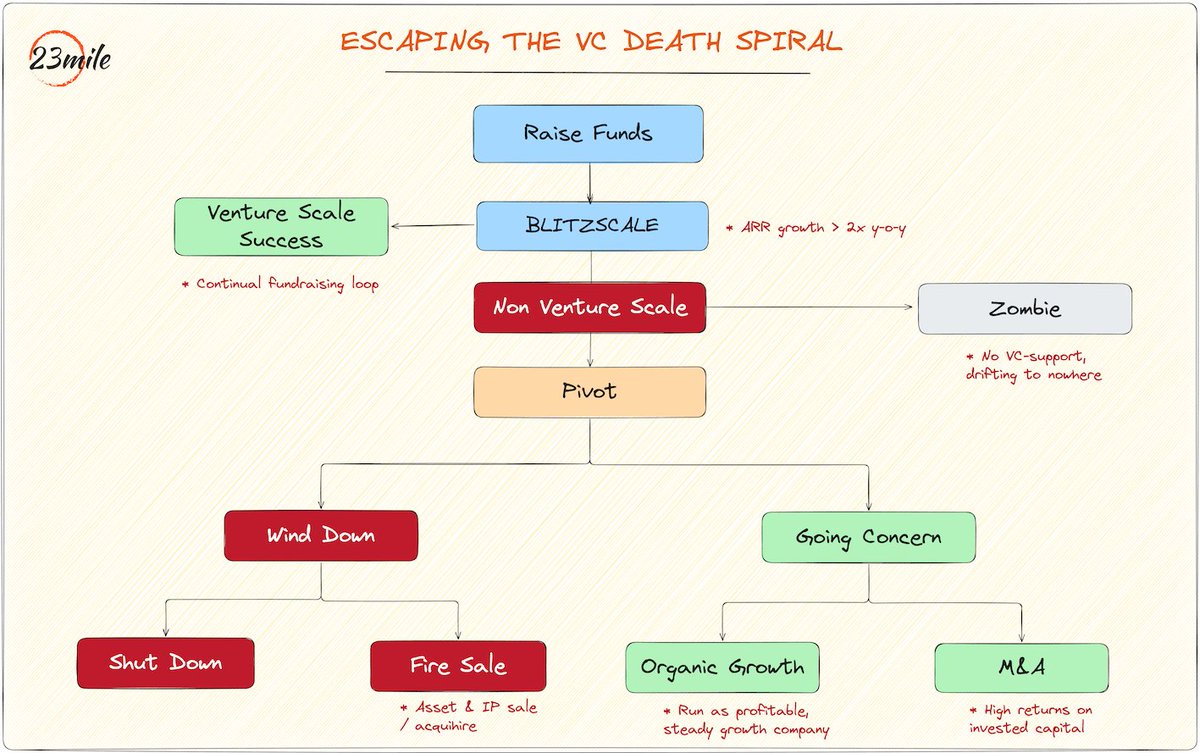
The fact is that for many founders, the VC path becomes a death spiral, leaving them broken with nothing to show for it
That's why we've put together a framework to help founders think through their options and escape the VC hypergrowth model
Give it a read if you're on the venture path, thinking of it, or just want to know how venture really works💡
Details below 👇🏽
@23milecapital
Venture capital is just a group of men (mostly) writing cheques into companies founded by their friends, creating this giant boys club.
Right?
I surely believed this for a long time. Looking back, I has no idea what I was doing when I was raising funds for my startup.
I'd started multiple businesses over many decades before then, but when you hear that a venture-backed startup is a different beast, it truly is.
Surely, there's some nepotism as in every area of human endeavour but mostly, it is strictly through the lens of one question.
❓ What are the chances that this founder can build a breakout company?
And that's why founders that complain that their seed VC "ghosted" them when they were in trouble just don't understand venture capital.
VCs go back to that single question all the time. Let's say a VC invests in 20 seed stage companies at ~$200k ARR, for simplicity.
After 18 months years, a typical distribution would be something like this:
1️⃣ 3 failed and shut down completely
2️⃣ Of the 17 alive, 1 would have grown exponentially, to ~$2 million ARR
3️⃣ 2 others would have enjoyed high growth, and be around $1 million ARR
4️⃣ The largest cohort of 8 would only have recorded moderate growth and be at $450k ARR
5️⃣ The final 6 will have seen revenue fail to pick up but just enough to keep them alive, so around $250k ARR
What this means is that this VC only cares about 3 to 5 of the original 20. These "chosen ones" get the follow-on funding, portfolio support and intro to other investors.
What about the ~12 that are alive and revenue generating? Well, they are left to fend for themselves.
Many end up coasting along for many years as zombies until they eventually run out of funds and shut down.
Unfair and brutal? Yep, that's how it feels to be one of the startups that are basically "venture orphans", but no one can blame VCs.
That's just how things work.
If you’re raising capital and meet with a VC who does not proactively follow up after the meeting, you may be wondering what their level of interest is. There’s no need to wonder: they are not interested.
Venture capital is just a group of men (mostly) writing cheques into companies founded by their friends, creating this giant boys club.
Right?
I surely believed this for a long time. Looking back, I has no idea what I was doing when I was raising funds for my startup.
I'd started multiple businesses over many decades before then, but when you hear that a venture-backed startup is a different beast, it truly is.
Surely, there's some nepotism as in every area of human endeavour but mostly, it is strictly through the lens of one question.
❓ What are the chances that this founder can build a breakout company?
And that's why founders that complain that their seed VC "ghosted" them when they were in trouble just don't understand venture capital.
VCs go back to that single question all the time. Let's say a VC invests in 20 seed stage companies at ~$200k ARR, for simplicity.
After 18 months years, a typical distribution would be something like this:
1️⃣ 3 failed and shut down completely
2️⃣ Of the 17 alive, 1 would have grown exponentially, to ~$2 million ARR
3️⃣ 2 others would have enjoyed high growth, and be around $1 million ARR
4️⃣ The largest cohort of 8 would only have recorded moderate growth and be at $450k ARR
5️⃣ The final 6 will have seen revenue fail to pick up but just enough to keep them alive, so around $250k ARR
What this means is that this VC only cares about 3 to 5 of the original 20. These "chosen ones" get the follow-on funding, portfolio support and intro to other investors.
What about the ~12 that are alive and revenue generating? Well, they are left to fend for themselves.
Many end up coasting along for many years as zombies until they eventually run out of funds and shut down.
Unfair and brutal? Yep, that's how it feels to be one of the startups that are basically "venture orphans", but no one can blame VCs.
That's just how things work.
If customers won't buy your stuff, try asking what they would buy. This sounds obvious, but surprisingly few founders do it, and it often yields valuable insights.
This lays near the inefficiencies of VC.
935 staff means the company was never going to tune a profit.
As long as money was cheap, no problem.
Founders have to cut the fat or sell to PE with balls to do the cutting
When you sell to Bending Spoons, most of your team will be promptly laid off.
This may be capitalism and may be necessary for Bending Spoons to hit its 25%+ unlevered IRR goals.
But certainly, most of Airtable and Miro employees losing their jobs is a bitter pill to swallow.
👉 Airtable had 935 employees when it signed. The entire Bending Spoons core team is smaller than that.
This is evil.
I guess there’s a level of success you get to that you lose all perspective.
Nothing holds meaning anymore, not even someone else’s life.
It’s deeply evil