A few weeks ago, I used this effect in one of my posters.
The post ended up getting:
• 9,000+ likes
• 300,000 impressions
A lot of people asked how I made it.
So here's the breakdown 👇
Eiichiro Oda, the creator of One Piece, wanted his own anime remade from scratch, even though the original already runs more than 1,160 episodes. The reason is money. One Piece is a franchise worth around 20 billion dollars, and a new fan in 2026 has almost no way in.
Start the original anime today and you face over 460 hours of television, most of it drawn in the boxy old format that aired on Sunday mornings back in 1999. George Wada, who runs WIT Studio, said it straight in an interview: a teenager raised on modern shows struggles to sit through those early episodes. The story is as good as ever; the way in is what broke.
That broken door sits on a fortune. The One Piece manga has sold more than 600 million copies, which makes it the best-selling comic ever sold in book form, ahead of even Superman. Doraemon, the next manga on the list, sits at roughly half that. The video games on their own have pulled in 4.3 billion dollars, and the comic is the engine that drives the whole thing. Netflix wants far more people on board.
Netflix already tested whether it could open that door wider. Its live-action One Piece, out in 2023, cost about 18 million dollars an episode, more than Game of Thrones, one of the most expensive shows it had ever made. It worked. The series became the most-watched show in 44 countries and the only English-language show to ever land at number one in Japan. Season 2 pulled 136 million viewing hours in its first six days this past March.
So here comes the animated version. WIT Studio, the team behind Attack on Titan and Spy x Family, is rebuilding the opening of the story from zero. The plan is seven episodes, about five hours total, out in February 2027. They cover the same East Blue arc the old 1999 anime needed dozens of episodes to tell.
Look past the teaser and the bright blue sky everyone is sharing today, and the real move is simple. Netflix is swapping a 460-hour wall for a five-hour door, and the house behind it is worth 20 billion dollars.
iOS app scaling hacks I wish I knew earlier:
1. Always install an analytics SDK so ad platforms can optimize for subscriptions.
2. Remove trials from day one.
3. Prioritize these audience locations: USA, Japan, UK, then the rest.
4. If you’re running ads on TikTok, disable Pangle and Lemon8.
5. Don’t remove trials and change the price at the same time. Change one thing at a time.
6. The before/after format is your friend.
7. Show the transformation in the video.
فريق Unsloth المرعب قاموا بخطوة جنونية وأخذوا العملاق الصيني GLM 5.2 وضغطوه بتقنية متطرفة جدا تسمى 1-bit وحولوه لصيغة GGUF الخفيفة
المفاجأة؟ قاموا بتشغيله محلياً (Locally) بالكامل على جهاز Mac Studio وبدون أي اتصال بالإنترنت أو سيرفرات خارجية وبسرعة ممتازة بلغت 21 توكن في الثانية
ولم يكتفوا بذلك بل وضعوا هذا الموديل المحلي المضغوط في مواجهة حية ومباشرة ضد أعتى وأقوى سيرفرات العالم المدفوعة والسحابية Claude 4.8 Opus و GPT-5.5
الصدمة التي أذهلت المطورين في الكومنتات هي أن الموديل المحلي وقف نداً لند أمام سيرفرات بمليارات الدولارات وقدم إجابات ذكية ودقيقة جدا تضاهي العمالقة
الفائز الحقيقي اليوم ليس مجرد موديل بل هو مفهوم التشغيل المحلي؛ من الآن تصبح بياناتك آمنة 100% في جهازك وتكلفة فواتير الـ APIs الخاصة بك صفر دولار وبذكاء ينافس أقوى شركات أمريكا
لا تنسوا الإعجاب والمشاركة ليصل المنشور لكل مهووس بالتقنية والذكاء الاصطناعي !
Just ask Codex the following and you will feel better:
Analyze the disk space used by Codex on my computer, without deleting anything.
Measure separately:
~/.codex
/Applications/Codex.app
~/.cache/codex-runtimes
the main Codex SQLite files
archived_sessions, sessions, worktrees, plugins, generated_images, memories
Then create a clear, polished visualization of this breakdown:
premium dashboard style, readable and understated
main chart as a donut chart or treemap
figures in GB/MB
distinct colors by category
title: “Disk Space Used by Codex”
subtitle with the measurement date
add a short conclusion: what takes up the most space, what is probably safe to clean up, and what should not be deleted while Codex is running
do not show any secrets, tokens, conversation content, or full sensitive paths
do not delete anything, do not modify anything
Ask it to generate an html preview:
How do you make $750,000/month with no free trial and no pricing decoy?
You weaponize EMPATHY.
Yuka (an Apple Editors' Choice app) uses a "Pay what you want" slider for their premium features.
The psychology is brilliant:
- Defaults to $15/year to anchor the price.
- You can slide down to $10, but the cute carrot mascot loses its smile.
- Slide up to $20, and the mascot cheers.
By shifting the checkout from a "transaction" to a "donation to the project," it frames the purchase as supporting the developer rather than just paying for the app.
انسى فواتير الذكاء الاصطناعي المرعبة ورسميا حقبة دفع الأموال لقراءة ملفاتك وكتبك انتهت للأبد
إذا كنت تظن أنك مجبر على رفع ملفات الPDF الضخمة لموديلات مثل GPT أو Claude ودفع مئات الدولارات شهريا مقابل استهلاك التوكنز فأنت تعيش في الماضي
فريق PaddlePaddle فجر مفاجأة الموسم وأطلق أداة Unlimited-OCR المجانية والمفتوحة المصدر بالكامل بنسبة 100% لتسحق احتكار الشركات الكبرى نهائيا
SIM swapping.
Your phone number receives your password reset codes. Your banking OTPs. Your two-factor authentication. Whoever controls your number controls your accounts.
Attackers collect your name, date of birth, and last four digits of your SSN. All available from data breaches for a few dollars on dark web markets.
Then they call your carrier pretending to be you.
Traditionally, this required a convincing human impersonation. In 2026, it doesn't.
AI voice cloning tools can replicate your voice from 3 seconds of audio. Your voicemail greeting, a social media video, or a podcast appearance is enough.
And with eSIM, there's no waiting for a physical card. The number transfers digitally. in under 5 minutes.
Your phone shows "no service."
The attacker's device is now you.
They reset your email. Your bank. Your crypto wallet. your iCloud. everything tied to that number.
One arrest last year: a 19-year-old Canadian. $13 million in Bitcoin.
How to protect yourself:
— Call your carrier and add a SIM lock or port freeze. It's free.
— switch from SMS-based 2FA to an authenticator app or a hardware key.
— Your phone number should not be the recovery method for your email or bank. ever.
10 GITHUB REPOS THAT SCRAPE THE ENTIRE INTERNET FOR YOU
Bookmark every single one. Each one pulls clean data off any website on earth, the kind of access companies sell behind a sales call and a contract.
1. https://t.co/yjhB8qsY2r
Point it at any website and it crawls every page, renders the JavaScript, and hands back clean structured data an AI can read instantly. It crossed 130K stars and landed in GitHub's top 100 repos. The scraping backbone half the AI startups quietly run on, open for anyone.
2. https://t.co/H8tTZjwd7O
The #1 trending crawler on GitHub. Turns any site into clean, LLM-ready markdown, faster than the paid services and with no API key, no account, no per-page fee. A dev built it in days after getting fed up paying $16 for a gated scraper. 51K stars. Apache 2.0.
3. https://t.co/xgLQDLB4HL
An AI agent that drives a real browser like a human, clicking, scrolling, logging in, filling forms, and pulling data off sites it has never seen before. Two ETH Zurich researchers built it and it hit 95K stars in about a year. The thing that scrapes pages no simple crawler can reach. MIT.
4. https://t.co/bBDy50sR9R
The full professional scraping framework, with rotating proxies, automatic retries, browser fingerprint spoofing, and queue management, all the machinery that keeps you from getting blocked. The exact stack scraping companies charge thousands to operate, handed to you for free.
5. https://t.co/nKhjeJxe1F
The original industrial-strength scraper that has quietly powered data teams for over a decade. Crawl millions of pages, extract anything, export it clean. Battle-tested at a scale most paid tools never reach, and free the entire time.
6. https://t.co/0NeYEdAWDt
Microsoft's own tool that converts any file or web page, PDFs, Office docs, HTML, images, into clean markdown an AI can actually use. The messy-data-to-clean-data step companies build whole pipelines around, open-sourced by Microsoft itself.
7. https://t.co/vyKqqy18Pi
A stealth scraper built to stay invisible, adapting automatically when a site changes its layout and slipping past the bot detection that stops everything else. The cat-and-mouse layer that anti-scraping vendors sell as a premium feature, free and open.
8. https://t.co/o9TuMdEQ1l
Mirror and control any Android phone from your computer to pull data and automate apps that have no website at all. The bridge into mobile-only platforms that most scrapers can't touch. 130K+ stars. Apache 2.0.
9. https://t.co/24FQISv92x
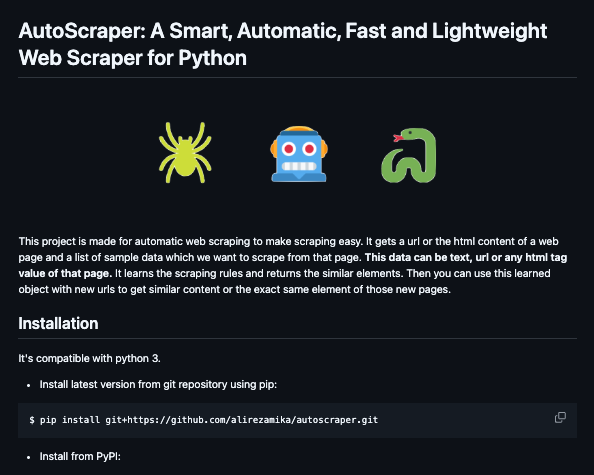
Show it one example of what you want and it figures out the pattern and scrapes the rest of the site automatically. No selectors, no code to maintain. The "just get me this data" button, in a few lines of Python.
10. https://t.co/BgL79bWL89
A version of curl that perfectly mimics a real browser's fingerprint, so the requests sneaking past every defense look exactly like a human with Chrome open. The lowest-level trick the expensive scraping APIs are quietly built on top of.
Companies sell this access for $2,000 a month. The source code is right here.
@anshuc Thanks for sharing this, I was actually currently going through the same scenario trying to figure out how I can improve the animations and flow of the app since claude and codex as well preferred using swift UI and it was not where near great. This helps thanks again 👍
I learned this the hard way: do NOT use SwiftUI if you want your app to look and feel amazing. At least when coding with AI. (sorry, Apple colleagues reading this 😅)
I'm sharing my process vibe coding this calorie tracker. I get a lot of questions about the fluid transition in the video. Here's the whole story.
Initially, Claude built the grid with SwiftUI. It was quick and easy, and looked good! But the transition to the day view was a boring navigation push/pop. No fun. I wanted something custom.
I asked Claude to make it a fluid transition that remaps the food tiles from their source to destination positions. All hell broke loose.
Claude tried a bunch of horrible things. Initially it used matched geometry effects, which worked OK but didn't lend themselves well to gesture-driven animations. So it resorted to SwiftUI preference keys + geometry readers to figure out the source and destination positions and calculate the interpolated position based on gesture progress, coordinating across grid and day views. But this meant it had to write a custom layout because it couldn't reposition tiles inside the native SwiftUI grid. And it had to do an awkward handoff between views, which always created ugly pops or jumps. And don't get me started on trying to put it on a bouncy spring, that only made the math 10x buggier.
Fortunately, Claude Fable was smart enough to see that this was becoming a disaster (and discover most of the issues itself, in the simulator), so it pivoted away from SwiftUI. Opus might not be so wise, so you'll have to pay attention and intervene.
Ultimately, it rewrote it in plain UIKit and everything turned out great. After that, we moved from 2D images to 3D assets, which introduced a new set of performance challenges and yet another rewrite to a single Metal layer, which is what you see below. I can write more about the 2D-to-3D saga if anyone's interested.
If I were to do it again, I'd just say "Don't use SwiftUI" from the very first prompt, and save a few hours of headaches. SwiftUI can be amazing for a human iterating directly in code. But agents don't benefit from any of its advantages. Plus, agents have seen decades of UIKit training data, so they're great at writing it, and it's far more flexible.
Here's hoping we see more agent-friendly iterations of SwiftUI in the future. Till then, I'm probably going to avoid it.
This "loop" automation is nuts inside of Codex.
"/goal go over every single feature in this app create a user story with expected behaviour based on the code keep a single canonical spreadsheet tracking the features status
- when done switch loop to testing every user story and documenting all errors
- when done fix every logistical error or ux error
- test every user behaviour again post fix"
Shoutout to @MatthewBerman for the heads up.
Hundreds of user stories being worked through like it's nothing.
Want a good "first loop" to use with Codex?
"When you are done designing the API, get a second opinion from Opus with 'claude -p'"
This has significantly improved the quality of the code I get out of OpenAI models.
Alot of Ecom guys learned how heavy online biz can be
switched to affiliate and ended up making 100s of thousands a month pure profit
Most of the TikTok aff killers started in ecom now just run pages like this and make 6 figures a month