#analytics#fintech “Any intelligent fool can make things bigger, more complex. It takes a touch of genius - and courage to move in the opposite direction”
If you’re like most investors, you’re asking the wrong questions.
I was chatting with a group of advisors awhile back down in La Jolla and a question arose. I’ll paraphrase:
"Meb, thanks for the talk. We get a steady stream of salespeople and consultants in here hawking their various asset allocation models. Frankly, it can be overwhelming. Some will send us a 50-page report, all to explain a strategic shift from 50% equities to 40%. I want to do right by my clients, but I have a hard time reading all the various research pieces and models, let alone reconciling their differences. Any thoughts?”
The advisor followed up by emailing me this summary of all of the institutional asset allocation models by the Goldmans, Morgan Stanleys, and Deutsche Banks of the world. And as you’ll see, they are HIGHLY different. Morgan Stanley says only 25% in US stocks, while Silvercrest says 54%! Brown Advisory says 10% in emerging markets and JPMorgan 0%.
So what is an advisor to do? What’s the most effective asset allocation model?
Turns out, that’s actually, that’s the wrong question.
The correct starting question is, “Do asset allocation differences even matter?”
In the summary article that the advisor sent me, there’s a link to a data table showing the asset allocations of 40 of the nation’s leading wealth management groups. I teased out all the data from the table to examine three allocations:
The allocation with the most amount in stocks (Deutsche Bank at 74%).
The average of all 40.
The allocation with the least amount in stocks (Atlantic Trust at 44%).
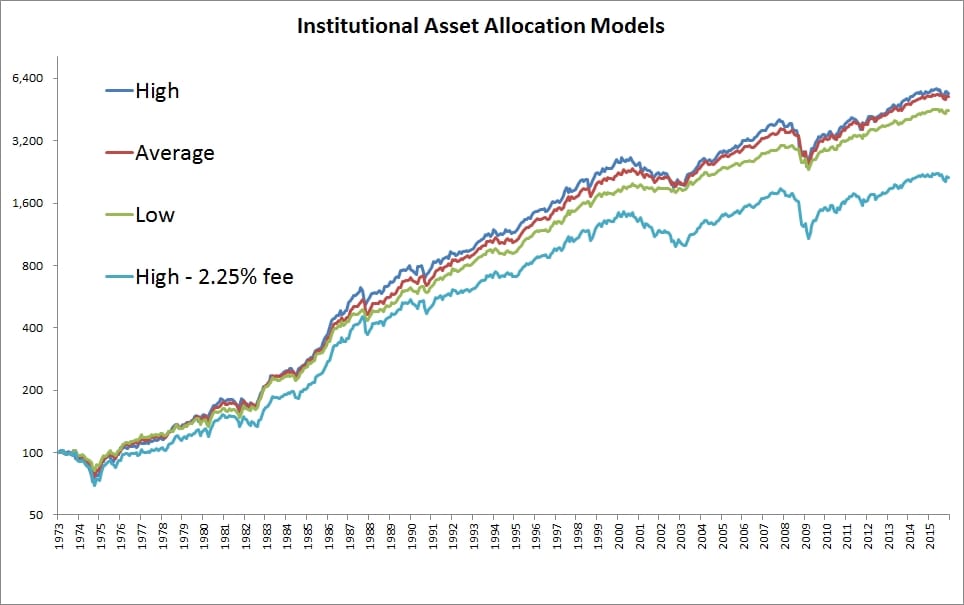
Below is the equity curve for each. Unless you have hawk-like vision, you’ll likely have a hard time distinguishing between the curves, and this is for the most different. The other 40+ firms live somewhere in the middle!!
Below are the returns for each allocation over the entire 1973-2015 period.
Most aggressive (DB): 9.72%
Average: 9.60%
Least aggressive (AT): 9.19%
There you have it – the difference between the most and least aggressive portfolios is a whopping 0.53% a year. Now, how much do you think all of these institutions charge for their services? How many millions and billions in consulting fees are wasted fretting over asset allocation models?
Let’s try one more experiment…
Overlay a simple 1% management fee on the most aggressive portfolio and look again at the returns. Simply by paying this mild fee (that is lower than the average mutual fund, by the way) you have turned the highest returning allocation into the lowest returning allocation – rendering the entire asset allocation decision totally irrelevant.
And if you allocate to the average money manager with an average fee (1%) that invests in the average mutual fund, well, you know the conclusion.
So all those questions that stress you out…
“Is it a good time for gold?”
“What about the next Fed move – should I lighten my equity positions beforehand?”
“Is the UK going to leave the EU, and what should that mean for my allocation to foreign investments?”
Let them go.
If you’re a professional money manager, go spend your time on value added activities like estate planning, insurance, tax harvesting, prospecting, general time with your clients or family, or even golf.
If you’re a retail investor, go do anything that makes you happy.
Either way, stop reading this long ass tweet and go live your life.
Guest column: "When I signed with the Green Bay Packers in 1999 and spent over 11 years in the NFL, I had no idea that nearly 25 years later I would spend a large portion of my life fighting the NFL for the benefits included in my contract." https://t.co/8f0HYpslRX
“Whenever I’m about to do something, I think ‘Would an idiot do that?’ and if they would, I do not do that thing.” – Dwight Schrute
And what is the best way to spot an idiot? Look for the person who is cruel.
This beautiful girl was listed for euthanasia in a Fresno shelter. She is good with cats, livestock, all dogs and is friendly with all people.
Saint is approximately 2 years old. She is easy to walk and good in her crate. https://t.co/NlI6hkQPpW
"To be a good manager, you want things to run smoothly. And insights are not ways of running smoothly. Insights are disorganizing and disruptive. And so, that’s a major reason that organizations, without even intending to, block the insights that come their way.”