Just a backend dev who loves RAT (Rust. Anime. Tech.)
I write better Rust code than most Ai would
Currently building EAS ( an Educational Agentic System )
In 2015, I built an AI that detects early cancer.
It’s still running across hundreds of hospitals in the US today.
It was the most fulfilling work of my life, and I was building in AI years before everyone called it “AI”.
Building in AI then was a dream.
Now It feels like we’ve taken a turn for the worse.
It started when i was in undergrad.
I built my first company: AI models that made the political data transparent to voters.
At 21, I was offered six figures for it, but the buyers wanted to use it for reasons I couldn't ethically support.
So we turned down the offer and shut down the company instead.
In 2014, I moved into deep learning research on language models, for the Intelligence Community and Goldman Sachs.
Then HCA Healthcare came to us.
They put me in a competition against 10 people from IBM Watson. It was just me and the tools I’d built.
Our job was to build an AI model that can catch the cancer that slips through the cracks in hospitals.
It was the most intense 30 days of my life. Multiple all nighters.
My models won. That turned into a $5M deal, and later its own company, Azra AI.
Then the world caught on.
ChatGPT and Claude arrived, and AI costs exploded.
Building in AI in 2015 felt novel.
We were using it to find cancer tumours and save lives.
Now the biggest tech companies have turned AI into a money extraction machine.
That’s when I decided to make a change.
We raised $8.5M to build a better future for AI.
On Wednesday, we’re launching Rayline.
AI shouldn’t be locked inside a few labs’ models, prices and clouds. It should be open, transparent and decentralized.
More on Wednesday.
Yann LeCun was right & nobody in this industry wants to say it out loud.
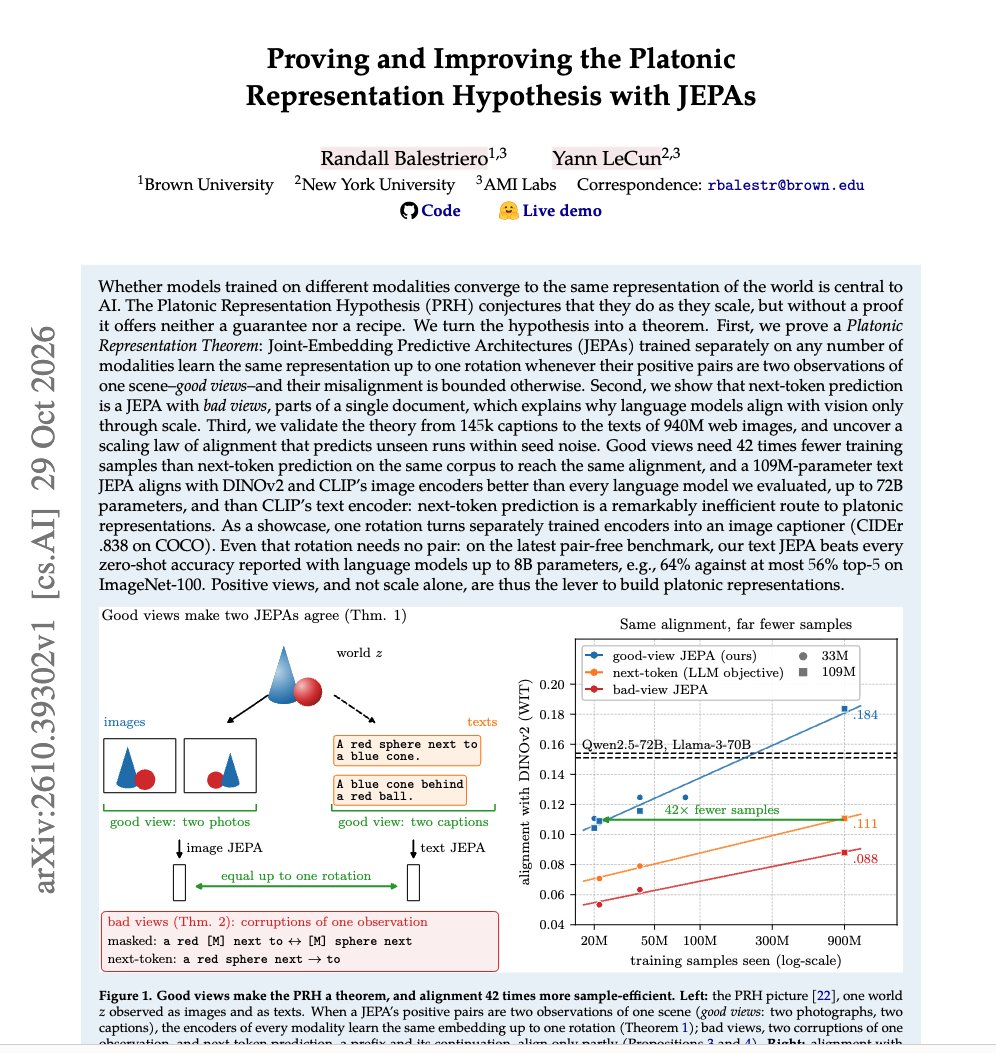
109 million parameters beat 72 billion.
He has spent years saying scale is not the thing that makes a model understand the world. Meta bet the other way. He left in November and started his own lab in Paris.
Last Thursday he published the proof.
The theory everyone has been running on since 2024 is that if you train models big enough, on text, on images, on sound, they all end up with the same picture of reality inside them. Size does it. Nobody ever proved that part.
Randall Balestriero and LeCun proved it. And the proof says size was never doing the work.
What does the work is which two things you show a model together.
A photo and the caption of that photo are two views of one thing. Models trained on pairs like that get there fast.
Two paragraphs pulled from the same document are not two views of one thing. Models trained on those get there slowly and expensively.
Next word prediction is the second kind. That is what every chatbot in the world runs on.
In their tests the first method reached the same understanding after 21.6 million examples. Next word prediction needed 900 million.
And a 109 million parameter text model ended up closer to an image model's view of the world than a 72 billion parameter language model was.
660 times smaller.
Announcing Ikigai Grants:
Microgrants give early-stage, bootstrapped talent capital. But that’s not enough.
I’ve watched too many grantees become perpetual microgrant chasers, wasting time applying to one $5k grant after another. Worse, most programs encourage this by funding the blanket “smart people doing cool things,” with no real conviction behind it.
I wouldn’t be here without patronage from @tylercowen & @jposhaughnessy. But looking back, the mentors & community were worth much more than the money.
So I built the program I always wished existed:
- $50k total, avg. $5k check
- Matched with mentors & community across @RenPhilanthropy , Fulcrum Science, and my personal network of founders, fund leads, investors & scientists.
Cohort 1 backs emerging talent in areas I believe are deeply underfunded and undervalued. Every application is reviewed by me.
Ikigai Grants is a program of @RenPhilanthropy, with support from Fulcrum Science. Advised by many wonderful friends & colleagues including: @AshleyNAbel@RaianyRomanni@NeuroStats Bonnie EJ Maven @idatin@ashleyz413@JackScannell13
Apply by Nov 9th, 9a PST:
https://t.co/DRuI0yJtLY
We believe voice is the most natural way to interact with intelligence, so we created Dessa, the most authentic full-duplex speech model ever built. Talking with it feels like talking with a person…full of emotion, nuance, pauses, and a natural cadence.
https://t.co/r0qFLdvd6c
you finally finish a 180 GB download
hit extract
"not enough disk space"
unzip needs room for the archive AND the files. hatchzip doesn't: it unpacks from the end and eats the archive as it goes
free and open source. windows, mac, linux
1984년 매킨토시로 변한 아이폰 듀오
애플의 첫 폴더블폰 〈iPhone Duo〉를
반쯤 접으면 1984년 매킨토시를
재현한 작은 노트북으로 변신합니다.
새롭게 공개된 〈Tiny Computers〉는
매킨토시부터 윈도우 95·XP까지
고전 컴퓨터 10종을 체험할 수 있는 앱입니다.
키보드 입력은 물론 그림 그리기와
간단한 게임도 즐길 수 있으며,
일반 아이폰과 아이패드에서도 이용할 수 있습니다.
🎥 idanbo
I’ve been experimenting with turning school concepts into interactive physics demos using AI. A LOT of them
This one lets you play around with levers and fulcrums and actually see how the physics works.
Do you remember where you first learned about levers and fulcrums?
For me, it was probably around Class 5–8, but I barely remember anything. Must’ve just memorized the formulas without really understanding how it all worked lol.
Kinda makes me wish school was like this 😭
Developers are asking for better tools on GitHub for autonomous agentic coding. At the same time maintainers feel overwhelmed and want more control. Both are important!
Here's me at AGNTCon Europe sharing 2 of the features I've been using daily for my own agentic workflows💜