“Ethically, children should be treated as a protected group, where the benefits of any intervention should clearly outweigh harms.”
Proud to have been asked for my very small contribution to this paper. Great work by all the other authors.
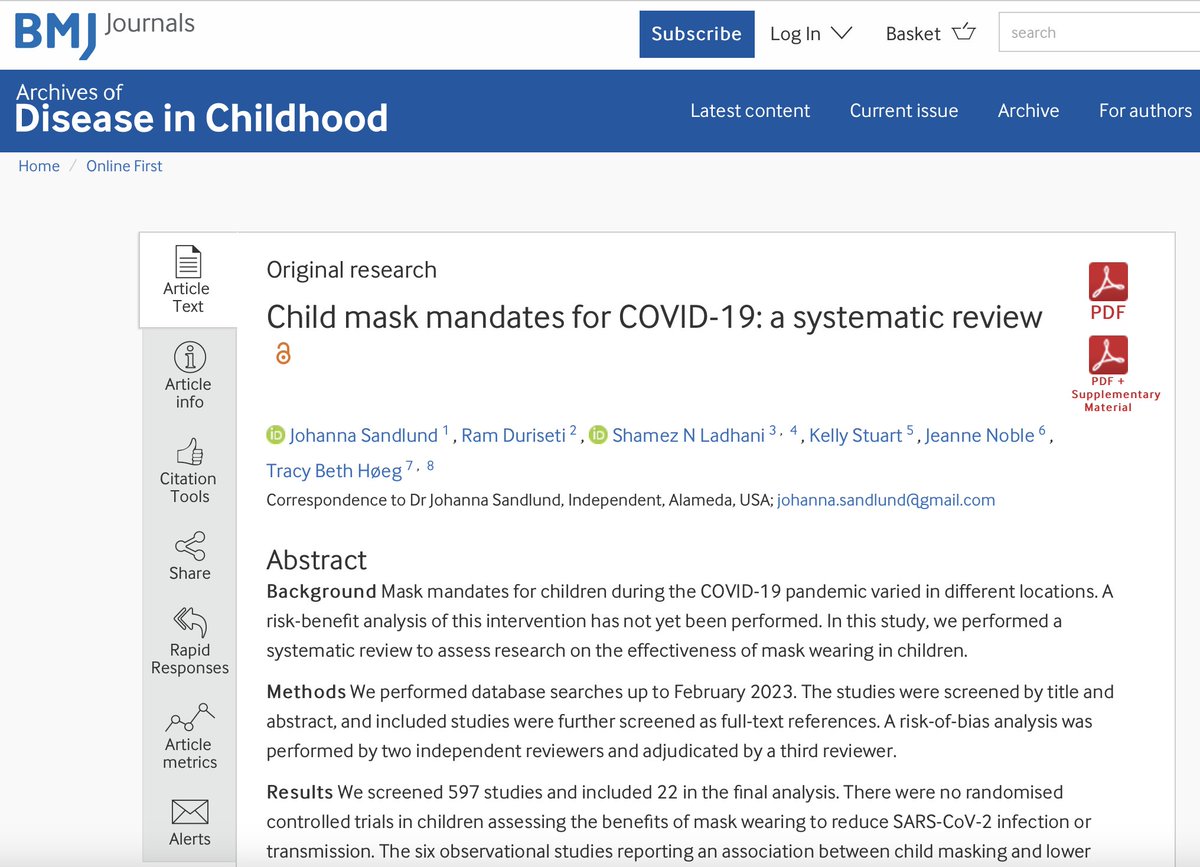
New study👇🏻
Do we have good evidence child mask mandates prevented covid spread?
TL;DR=no
Public health officials were wrong to suggest otherwise & should acknowledge this
🙏🏻:Johanna Sandlund
Ram Duriseti
@ShamezLadhani
@Kelly05484118 &
@JeanneNoble18
https://t.co/SqEyQSL5UB
Use my gift link to read this @sdutopinion editorial on the election results: "Time for anger with city’s leaders to translate into real change"
https://t.co/gpcsIgUj4t
“We are admitting a cohort that cannot read at a college level and are pretending otherwise.”
Another college professor adds to the chorus of concern about student capacity.
In @chronicle:
“Six weeks into the term, I assigned my rhetoric and writing students a 20-page article. It was the same length I had assigned for five years and the same length I had read without complaint as an undergraduate a decade ago. Not one student finished it.
When I asked why, a student answered honestly: It was too long, and she kept losing track of what the paper was about. This was not a remedial class: These were students who had cleared the admissions process and written essays good enough to get them here. Yet a routine academic reading assignment had defeated them.
Every generation of professors has complained that their students cannot read. The lament is usually overblown, but data have caught up to anecdote, and what I am seeing in my classroom is no longer a hunch. There is a measurable, generational collapse in sustained reading and writing, and the academy is responding to it with improvisation and exhaustion rather than the structural overhaul it requires.
In February 2024, Adam Kotsko, who teaches in the Shimer Great Books School at North Central College, wrote in Slate that students who once handled 30 pages of reading per class meeting now seem “intimidated by anything over 10 pages and seem to walk away from readings of as little as 20 pages with no real understanding.” Crucially, he added that this is “not a matter of laziness on the part of the students” but of underlying skills they were never given a chance to build.
The Chronicle of Higher Education’s 2024 investigation found the same pattern across institutions as different as the Stevens Institute of Technology and Wellesley College, where the average SAT exceeds 1400. Nicholaus Gutierrez, an assistant professor at Wellesley, told The Chronicle that the baseline for what students consider a reasonable amount of work has dropped so noticeably that he has cut his readings accordingly; a 750-word essay now strikes many students as long. At Stevens, the science and technology studies associate professor Theresa MacPhail described following the mantra of “meet your students where they are” for so long that she has begun to feel “like a cruise director organizing games of shuffleboard.”
Worse, the national data tell the same story in colder language. On the 2011 National Assessment of Educational Progress (NAEP) writing assessment, which is the most recent comprehensive writing benchmark, only 24 percent of 12th graders reached the Proficient level, and just 3 percent reached Advanced; another 21 percent scored below Basic. The reading side of the ledger is worse, and getting worse fast: The 2024 NAEP results released in September 2025 show 12th-grade reading scores at the lowest level recorded since the assessment began in 1992. Thirty-two percent of 12th graders now score below NAEP Basic in reading, meaning that, in the assessment’s own language, they likely “cannot draw general conclusions based on concepts presented explicitly in a text.” And yet more than half of these same seniors reported being accepted to a four-year college. That last sentence is the whole problem in one line: We are admitting a cohort that cannot read at a college level and are pretending otherwise.”
@marcjoffe Yeah probably because they do so may more hours but the breakdown would be interesting. Especially to see what they collect in reimbursement vs what speech and OT collect given we are far more highly trained professionals.
@fran_geleno@marcjoffe Definitely some. All therapies need an end point based on child’s age and long term plateau but many parents want therapy if there’s any hope of maybe just a bit more progress so then very much so less efficacy for older kids
@stephenadedalus@lymanstoneky Very much sub par service through the public schools. Too many kids, too many meetings, too few personnel to really provide adequate help. Behavioral support in a school is not ABA therapy.
Yes probably lots. I work in a field adjacent to ABA so pretty familiar. Very, very high turnover with the BT so I wonder if that full time or at any time employment stat. I see ABA going on for far too long for many kids, parents end up using it as baby sitters and figure it can’t hurt
Is this full time labor? There is A LOT of turnover at the low wage position. It’s very entry level, they get little training then dumped into a hard job with very challenging kids. Maybe it exploded because other low wage jobs were also not available this this younger group of people?
@ErikTrautman@DKThomp Too some extent parents use it as baby sitting. Do not care about outcome or time, many don’t pay anything. ABA providers assigning too many hours to kids- happens often.
@DKThomp@contrarian4data Is that considered full time? Is that just people with the title behavior interventionist or BCBA? How much turnover was there? Turn over is huge in the field. Let’s see the data
Our state and local elected representatives are collectively gross failures at the most basic element of government. Our infrastructure is failing because they all focus on reelection not governing. Without political competition, their malfeasance continues without accountability
While #SanDiego has made some progress reducing the number of middle managers on the payroll to mitigate ongoing operating budget deficits, more work needs to be done.
"'(SD Taxpayers President Mark) Kersey said while these employees are doing good work for the city, at some point tough, choices must be made. 'It’s not like they’re just sitting around on TikTok all day,' he said.
"Kersey and (MEA President Mike) Zucchet have made a big deal out of middle managers, along with former mayor of Coronado Richard Bailey.
"Bailey has made it a focal point to wrangle in the city’s personnel costs if he’s elected for the District 2 Council seat.
"If the mayor were to cut all the current middle managers in the city, that would result in approximately $49.9 million in savings to the general fund budget.
"That’s about 2.3 percent of the budget. It is about 42 percent of the city’s deficit of $118 million.
"Both Bailey and Zucchet think that while these people may do important jobs, they aren’t delivering the basic neighborhood services that frontline workers do.
“'I think it’s really a question of what we’re getting in return – are roads better paved or not, are we seeing those frontline services fulfilled,' said Bailey."
More details are available from SD Taxpayers City Hall Staffing Study.
https://t.co/Ym8Dd5Sn5W