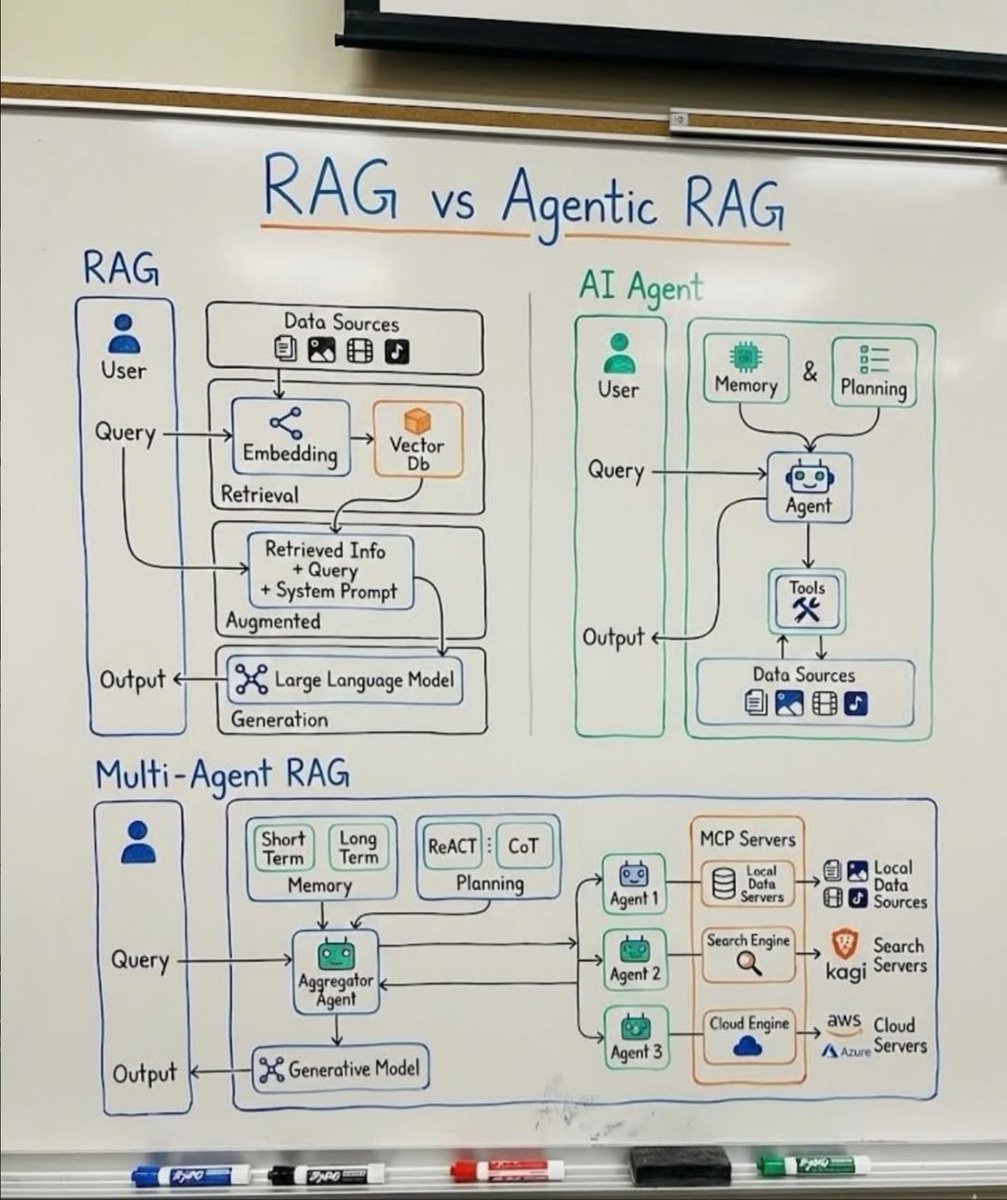
RAG was supposed to make LLMs smarter.
Ground them in facts. Give them memory.
But the truth?
Most RAG systems today are just fancy search engines—fetching chunks and hoping the model figures it out.
That’s not intelligence.
The real upgrade is Agentic RAG.
Tools like Glean, Perplexity, and Harvey don’t just retrieve… they reason.
They decide what to fetch, when to fetch, or whether they should fetch anything at all.
This changes everything:
• No blind embeddings
• No random chunk dumps
• Real, layered memory
• APIs, search, and tools inside the reasoning loop
The LLM stops guessing and starts thinking.
You've heard the term "AI agents" 100 times this month.
𝗟𝗲𝘁'𝘀 𝗯𝗿𝗲𝗮𝗸 𝗱𝗼𝘄𝗻 𝘄𝗵𝗮𝘁 𝘁𝗵𝗲𝘆 𝗮𝗰𝘁𝘂𝗮𝗹𝗹𝘆 𝗮𝗿𝗲:
The four things that make up an AI agent:
1️⃣ 𝗟𝗟𝗠: Acts as the brain, orchestrating decisions and planning
2️⃣ 𝗧𝗼𝗼𝗹𝘀: External resources like databases, APIs, or search engines the agent can access
3️⃣ 𝗠𝗲𝗺𝗼𝗿𝘆: Both short-term (conversation history) and long-term (accumulated knowledge over time)
4️⃣ 𝗥𝗲𝗮𝘀𝗼𝗻𝗶𝗻𝗴: The ability to plan steps and reflect on outcomes
Now, onto the architecture decision:
𝗦𝗶𝗻𝗴𝗹𝗲-𝗔𝗴𝗲𝗻𝘁 𝗔𝗿𝗰𝗵𝗶𝘁𝗲𝗰𝘁𝘂𝗿𝗲𝘀
One AI agent independently resolves tasks. This is ideal when your task is straightforward and well-defined.
Strengths: Low complexity, easier to develop and manage, no coordination overhead
Weaknesses: May struggle with complex tasks, can get confused with too many tool options, limited in handling tasks requiring diverse expertise
𝗠𝘂𝗹𝘁𝗶-𝗔𝗴𝗲𝗻𝘁 𝗔𝗿𝗰𝗵𝗶𝘁𝗲𝗰𝘁𝘂𝗿𝗲𝘀
Multiple AI agents collaborate to resolve tasks. Great for complex, dynamic use cases requiring specialized knowledge.
Strengths: Handles complex tasks, enables parallel processing, allows smaller specialized models
Weaknesses: Increased complexity, harder to debug, requires robust coordination mechanisms
𝗠𝘂𝗹𝘁𝗶-𝗔𝗴𝗲𝗻𝘁 𝗣𝗮𝘁𝘁𝗲𝗿𝗻𝘀
If you go multi-agent, there's tons of design patterns to choose from:
1️⃣ 𝗣𝗮𝗿𝗮𝗹𝗹𝗲𝗹: Agents work simultaneously on different parts of a task
2️⃣ 𝗦𝗲𝗾𝘂𝗲𝗻𝘁𝗶𝗮𝗹: Tasks processed in order, one agent's output becomes the next's input (e.g., multi-step approvals)
3️⃣ 𝗟𝗼𝗼𝗽: Agents operate in iterative cycles, continuously improving based on feedback (e.g., code writing + testing)
4️⃣ 𝗥𝗼𝘂𝘁𝗲𝗿: A central router determines which agent(s) to invoke based on the task
5️⃣ 𝗔𝗴𝗴𝗿𝗲𝗴𝗮𝘁𝗼𝗿: Agents contribute outputs that get synthesized into a final result
6️⃣ 𝗛𝗶𝗲𝗿𝗮𝗿𝗰𝗵𝗶𝗰𝗮𝗹: Tree-like structure with supervisor agents managing lower-level ones - clear roles but failure at top disrupts everything
7️⃣ 𝗡𝗲𝘁𝘄𝗼𝗿𝗸: Agents communicate directly in a decentralized many-to-many fashion - super resilient but can get messy with coordination
These patterns are atomic, meaning you can combine them! You might have a system with routers, loops, and parallel processing all working together.
Check out more in our ebook: https://t.co/HhPFhFR7mw