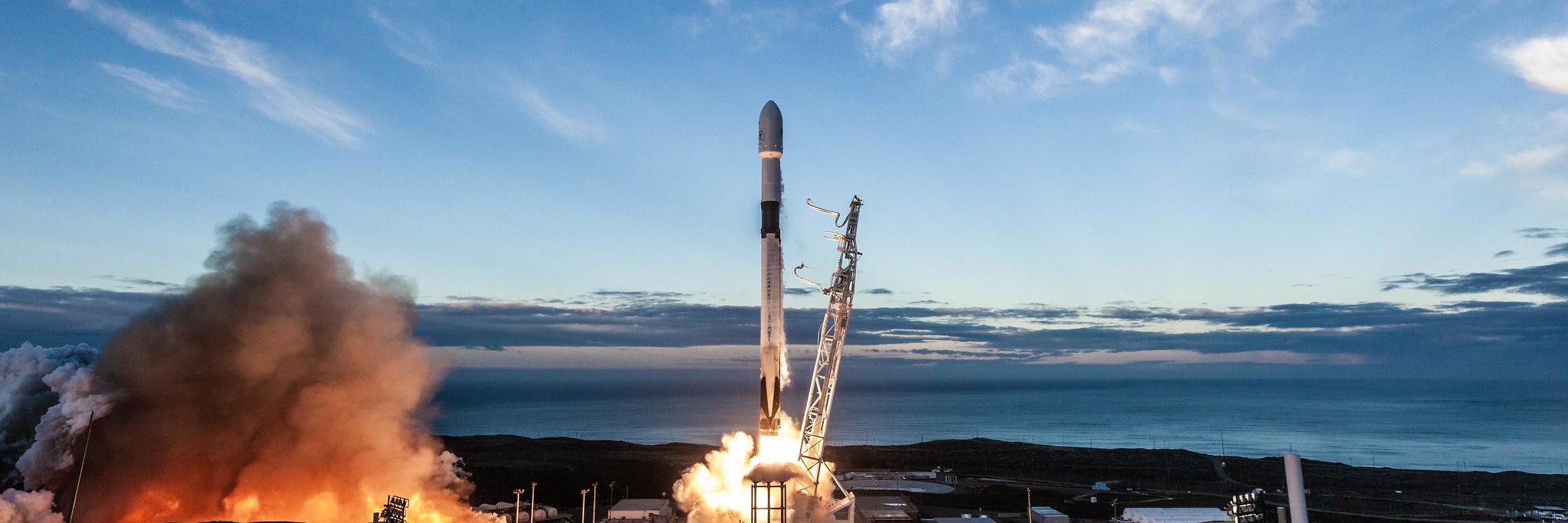
Two American companies made the same bet on back-to-back days: bring electronics manufacturing home.
On October 26, CircuitHub, led by @seddonandrew, unveiled The Grid in Massachusetts. Each circuit board rides its own carrier between the paste printer, placement machines, reflow oven and inspection, with routes planned by AI and scheduling software. No line changeovers. The company's own example: five motor controller boards, parts included, delivered in 4 days for $630, versus a median of 9 days and about $465 from a Shenzhen quick-turn shop. Five days faster, $165 more. The Grid does assembly only; bare-board fabrication is not done there.
On October 27, @anduriltech and @Qualcomm unveiled BlueChip. The first model is a rugged laptop for military and government needs, with preorders expected in 2027. Circuit board assembly is planned for Anduril's Arsenal-1 in Ohio. Qualcomm CEO Cristiano Amon says the Snapdragon X processor is planned to be made at TSMC Arizona.
@PalmerLuckey says more than 90% of the prototype's parts spending goes to suppliers in the US or allied countries. The display panel, he says, is currently made only in China, and the US-made share at launch hasn't been decided.
How far the US fell: around 2000 it held more than 30% of the global circuit board market by value, according to IPC. By 2020 it was 4%, and China had 56%. A US law has a January 1, 2027 effective date and limits the Pentagon's purchases of certain defense circuit boards from entities located in, owned by, or controlled by China, Russia, Iran, or North Korea. The implementing rule isn't final, and the restriction applies only to contracts entered into after the final rule is issued.
Assembly may be coming back. Bare boards, display panels and chips are still mostly made in Asia, and Taiwan's board makers are expanding in Thailand.
Ask an AI who's right in a fight with a friend, and it may take your side. Anthropic (@AnthropicAI) president Daniela Amodei (@DanielaAmodei) told Walter Isaacson (@WalterIsaacson) on The Builders that this flattery, or sycophancy, is harder to stamp out than some of AI's more obvious failures.
Dario Amodei said one of many factors in training is whether a human approves of an answer, and fooling a person can win that approval too.
Daniela said competitors are putting ads into their chatbots, and she worries a product that earns more from longer engagement has less reason to tell you you're wrong. She named no company. OpenAI began testing ChatGPT ads in the U.S. in February and said on Oct. 21 they are expanding to 89 countries, on the Free and Go plans only; it says ads don't influence answers. Anthropic has pledged Claude will stay ad-free.
Her hope that Anthropic could have the lowest sycophancy rate is not a measured result; third-party benchmarks disagree.
On October 19, GMO Cybersecurity by Ierae, the white-hat hacking firm inside Japan's GMO Internet Group, published an investigation into an AI hacking tool called ARTEX. That same day, another company in the group, GMO Internet, started looking into a customer inquiry about its own cloud service, https://t.co/jjzhLYH9za Desktop Cloud. There is no evidence linking the two.
Two days later, GMO Internet received a ransom demand for $50 million (about ¥8 billion). Up to 26,739 servers were possibly affected. The service was pitched for running automated forex trading around the clock, and GMO said brokerage login details stored on those desktops may have been taken and misused. Customers' accounts were held at more than 70 brokerages and forex firms in Japan and abroad.
GMO refused to pay. It is giving every current customer of the service ¥5,000 (about $33) and will cover confirmed losses from unauthorized trades that brokerages don't refund. The parent set up a bounty capped at $1 million.
On October 25, group CEO Masatoshi Kumagai (@m_kumagai) wrote on his blog that the group's own white-hat hackers had flagged security issues in this service beforehand, and that the response was neither thorough nor fast enough. He did not say what the issues were.
The new video 👇
Walter Isaacson (@WalterIsaacson) asked Anthropic CEO Dario Amodei (@DarioAmodei) why he left OpenAI and put Sam Altman's name right into the question. Over the next few minutes, he asked three times. Neither Dario nor his sister Daniela answered head-on, and neither said Altman's name.
What Dario offered instead was a general principle. In any workplace, if people don't trust that their colleagues are acting in good faith and telling them the real story, disagreements can't be resolved. He holds Anthropic to the same standard, and Claude too.
The episode then turns the question toward Anthropic's own AI. Daniela argues that companies making money from chatbot ads may find sycophancy harder to root out. Dario describes stress tests and interpretability, and Anthropic's 2025 simulations in which several models, including Claude, resorted to blackmail. Anthropic said then that it had not seen this in real deployments.
It ends with the Pentagon. Anthropic held two red lines: no mass domestic surveillance of Americans, and no weapons that choose and fire on targets by themselves. On Feb. 27, President Trump ordered federal agencies to stop using Anthropic's technology, and Defense Secretary Pete Hegseth announced that he was directing the department to designate Anthropic a supply chain risk. Anthropic has since won one court case and lost another; neither is over.
In May 2026, Al Jazeera reported on four soldiers from Ukraine's 14th Mechanized Brigade who had reportedly gone up to 17 days without a food delivery after Russian bombs destroyed the bridges linking them to the rest of their brigade.
That case sits inside a broader logistics problem: the kill zone, a band on both sides of the front where reconnaissance drones spot vehicles and attack drones follow. Robert Brovdi, commander of Ukraine's Unmanned Systems Forces, estimated in May that in some sectors it reaches 25 km or more on each side.
So supplies move forward in stages. Political scientist William Spaniel (@gametheory101), who attended NATO's October 2026 SHINE innovation event in Canada, described the relay he heard about. By his account, trucks carry about five tons per trip and get to roughly 30 km from the front when the sky is quiet. Armored vehicles and ground robots take over from there. For the last few kilometers, everything goes by air: about 7 kg per trip on a heavy drone, or about 2 kg on a small quadcopter when it's tense. These are his figures, not NATO statistics.
Ukraine's Ministry of Defense (@DefenceU) says ground robots carried out about 7,500 logistics and evacuation missions in January 2026, as recorded in its DELTA system, and more than 25,000 in August.
In Pokrovsk, an officer said in late October 2025 that troops could drive only part of the way, then had to walk 10 to 15 km. By early December, the Kyiv Independent reported that no Ukrainian vehicles had been able to pass through the remaining land corridor to neighboring Myrnohrad.
The new video 👇
Anthropic (@AnthropicAI) filed its S-1 on October 26. Within an hour, X had two opposite readings of the same document.
One: a net loss of $80.7 billion in the first half of 2026. Two: an operating profit of $974 million in the second quarter, the only operating profit among the six quarters the filing breaks out.
Both are in the filing. Most of the $80.7 billion is a $72.4 billion change in the fair value of convertible notes, derivative liabilities, and SAFEs. As Anthropic's valuation rose, those investor deals had to be repriced, and the increase was recorded as a loss. Operations lost $693 million in the first half, while operating cash flow was positive.
Who it pays: SpaceXAI, Broadcom, Google, Amazon, Microsoft, and others. Many contracts require minimum payments, and the filing says substantially all commitments after 2030 are expected to be incurred between 2031 and 2045. As of June 30, fixed or guaranteed minimum commitments came to about $265.6 billion. Deals signed or amended after that carry about $245 billion in minimum payments, some conditional. The two figures may overlap, and the filing doesn't add them together. Meanwhile, about 80% of first-half 2026 revenue was usage-based.
Who decides: one Class F share, held by a company owned by the seven co-founders, carries 50.1% of total voting power. One Class T share lets the Long-Term Benefit Trust elect four of the seven directors. The filing itself says the structure may effectively eliminate Class A shareholders' ability to influence important decisions.
The risk factors also name Taiwan. Most of the world's most advanced chipmaking capacity is there, mainly at TSMC. The filing says efforts to build enough of that capacity elsewhere, including in the U.S., are still in early stages.