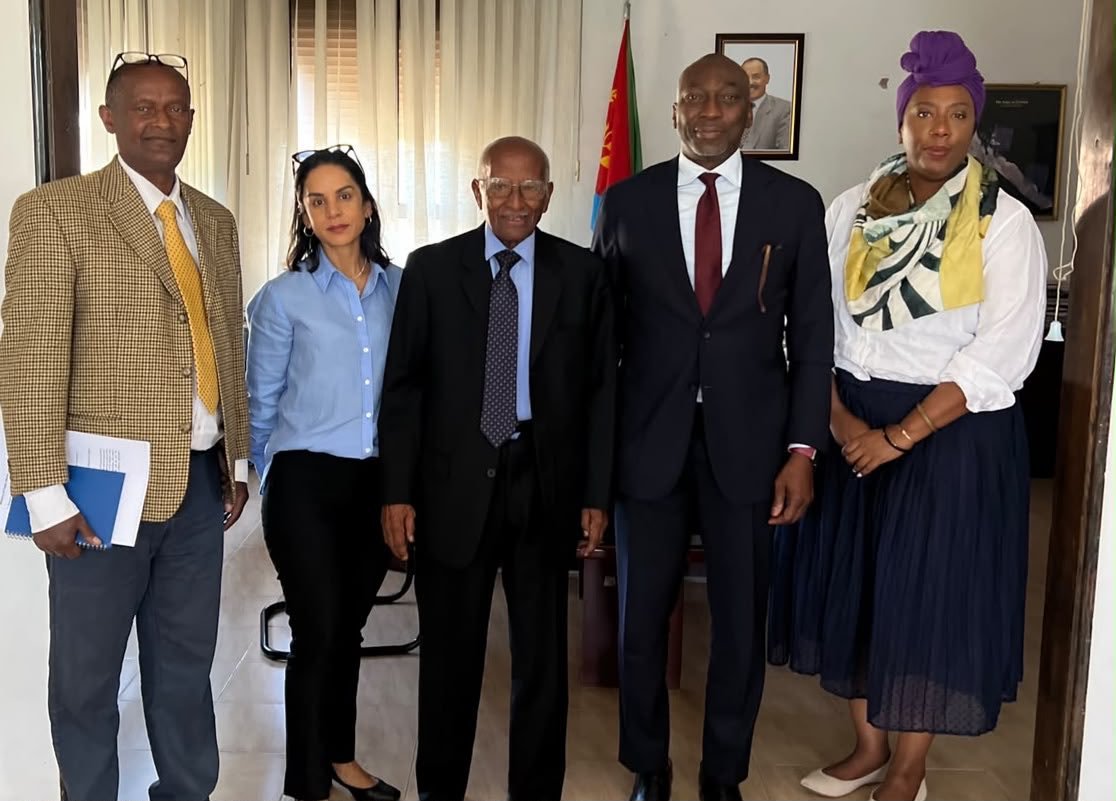
We’re proud to celebrate Ebro Ahmed, a 23-year-old Eritrean American who helped bring a moving school bus to a safe stop after the driver had a medical emergency. Saint Paul and @cheniquajohnson proclaimed Nov. 9 Ebro Ahmed Day. Thank you, Ebro, for looking out for the students and their driver.
#EastSideSaintPaul #Ward7 #EbroAhmed #EastSidePride #HonoringCommunity #Heroism
Integrating Skills for Digitalized Future to improve Healthcare Service
By: Kidane Shimendi
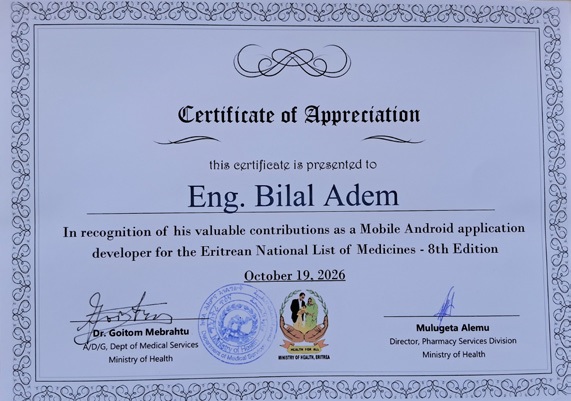
Pharmacist Nuru Abdu Ahmed and computer engineer Bilal Adem Shelogay have developed an official offline Android app for the 8th edition of the Eritrean National List of Medicines (ENLM). The app gives healthcare workers instant, searchable access to the national medicines list, VEN categories, level-of-use guidance, and alternatives—even without internet—supporting rational prescribing and better continuity of care.
Built voluntarily by local experts and now nationally distributed, the ENLM app marks a practical step in digitalizing Eritrea’s health references. Future plans include digitizing the National Formulary Manual, Standard Treatment Guidelines, plus tools like drug-interaction checkers and pediatric dose calculators to further strengthen clinical decision-making at the point of care.
https://t.co/1N888UP7nB
“THE FORCE OF LAW MUST PREVAIL OVER THE LAW OF FORCE” #UN CHIEF SENDS A STRONG MESSAGE AMID RED SEA TENSIONS
António Guterres reaffirms international law as Ethiopia’s pursuit of maritime access raises concerns over regional sovereignty and stability.
United Nations Secretary-General António Guterres has delivered a firm message on violations of international law, emphasizing that no country's ambitions can justify actions that contradict established legal principles.
Responding to a question about maritime disputes and Ethiopia's tensions with neighboring countries, Guterres made the UN's position clear: “Violations of international law are unacceptable.”
Addressing maritime issues, the Secretary-General pointed to the United Nations Convention on the Law of the Sea (UNCLOS), stressing that actions incompatible with the convention must not be accepted or respected.
His statement reinforces a fundamental principle at the heart of international relations: countries must pursue their interests within the boundaries of international law, not through coercion, threats, or the use of force.
Eritrea's sovereignty is not negotiable
The remarks carry particular significance amid rising tensions surrounding Ethiopia's pursuit of Red Sea access and concerns about the potential threat to Eritrea's territorial integrity.
Access to the sea can be pursued through peaceful commercial arrangements and agreements with neighboring states. But geographical circumstances or economic ambitions do not grant any country the right to threaten another nation's sovereignty or coastline.
The Red Sea is a shared strategic waterway not territory that can be claimed through intimidation.
Eritrea's sovereignty and territorial integrity must be respected, just as the sovereignty of every nation must be protected under international law. Any sustainable maritime arrangement must be grounded in peaceful negotiations, mutual consent, and respect for the rights of all parties.
International law must stand above military power
Guterres extended the principle beyond maritime disputes, reaffirming that violations of international law must not be tolerated wherever they occur.
His closing message captured the stakes in a powerful phrase:
“We must make sure that the force of the law prevails over the law of the force.”
For the Horn of Africa, where regional rivalries and security concerns threaten to undermine stability, this principle is essential. Military threats cannot replace diplomacy, and political ambitions cannot override international obligations.
The choice facing the region is straightforward: respect international law and pursue cooperation, or risk turning disputes into dangerous confrontations.
No nation is above the law. No ambition justifies aggression. And no country's sovereignty should become the price of another country's strategic ambitions.
The future of the Horn of Africa must be built on mutual respect, peaceful coexistence, and the rule of law not the law of the strongest.
#Eritrea #Ethiopia #AntónioGuterres #UnitedNations #RedSea #UNCLOS #InternationalLaw #HornOfAfrica #Sovereignty #PeaceAndSecurity
United Nations Day: Remarks by Ms. Nahla Valji @nahlav , United Nations Resident Coordinator in #Eritrea 23 October 2026 | Asmara
On #UNDay in Asmara, UN Resident Coordinator Nahla Valji highlighted the partnership with Eritrea under the 2022–2026 Cooperation Framework: immunization coverage held above 95%, facility-based births rose to 85%, and progress was recorded in inclusive education, climate resilience, water access, and livelihoods. She stressed that these advances belong first and foremost to Eritrea, with the UN accompanying national efforts. By the end of 2025, 992 villages—more than one-third of the country—had been recognized as free from FGM.
Looking ahead, the next Cooperation Framework will be signed before year-end, built on national ownership and Eritrea’s emphasis on self-reliance.
She noted the challenging global context of proliferating conflicts and constrained development resources, while celebrating local innovation, young people, and creative initiatives. She closed by quoting Secretary-General António Guterres: “humanity’s future depends on our capacity to advance peace, development, and human rights together,” and thanked the Government, partners, and UN team as she marked her final UN Day in the country.
https://t.co/CGwCUhEnMP
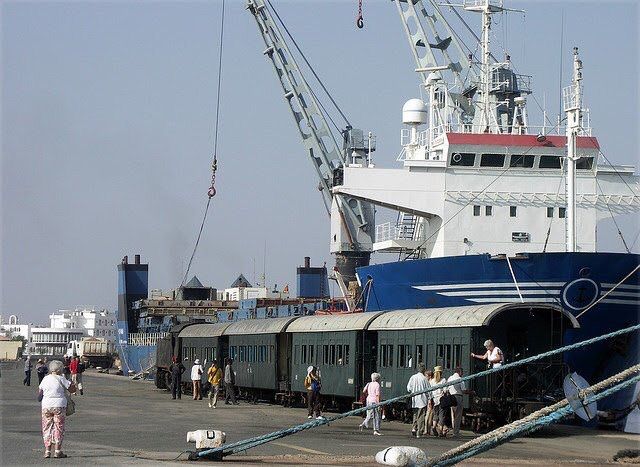
Debunking the myth: #Ethiopia did not lose access to the #RedSea simply because #Eritrea became independent in 1993. Ethiopia chose to use Djibouti ports instead.
In 1997, Ethiopia warned Assab authorities in writing that it would stop using the port over unfavorable business conditions. It then shifted trade towards Djibouti. It should be noted here that the accusation of "unfavorable business conditions" was tied to Eritrea delinking its fiscal and monetary policies from Ethiopia by issuing its own currency, the Eritrean Nakfa.
There is a fundamental difference between being landlocked, having access to maritime trade, and possessing sovereign ownership of a coastline. The history of Eritrea and Ethiopia illustrates why this distinction matters.
Access is not ownership. Choosing to stop using a port does not confer a right to own another country's coastline.
🇪🇷 Eritrean sovereignty is not negotiable.
Source: https://t.co/Rttr13hKHx
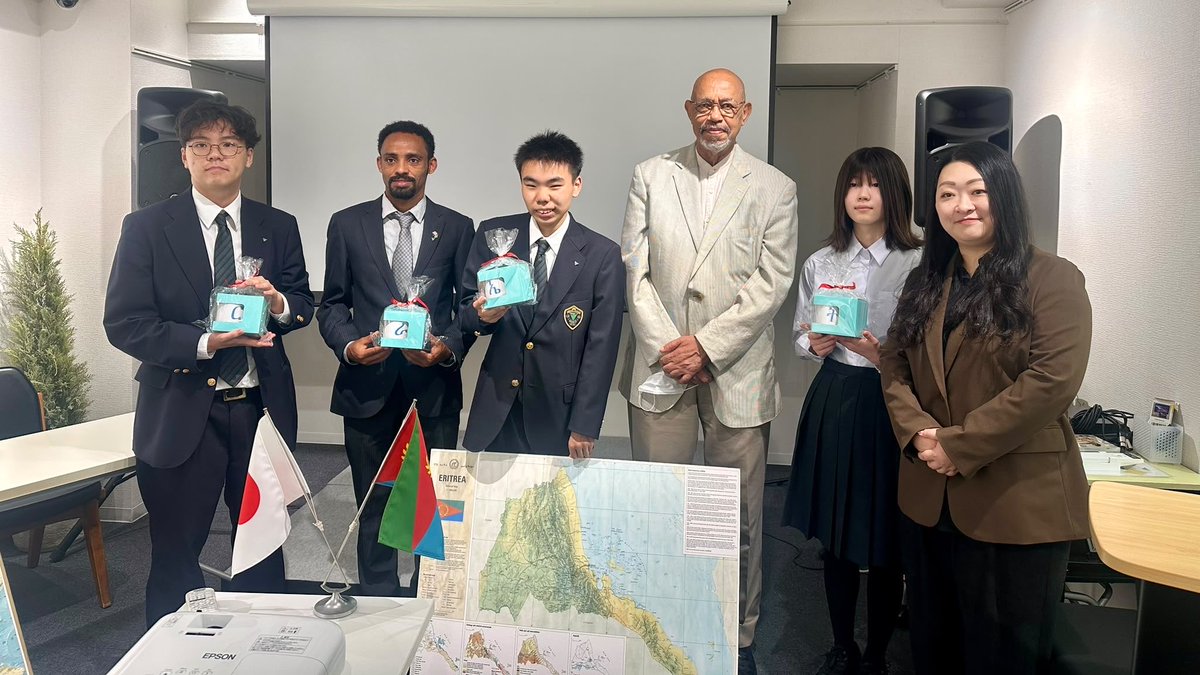
Ambassador Estifanos (@AmbassadorEstif ) shared with young Japanese students from the Africa Culture Seminar at Seisa International High School’s Tachikawa Learning Center—who visited the Eritrean Embassy—a powerful model for building people-to-people bridges: Eritrean musician and soldier Major Ghirmay Hadgu, who served in the Korean War (1951–1953).
Major Ghirmay brought the Japanese genre Enka home to Eritrea and Ethiopia—deeply sentimental ballads rooted in traditional Japanese music—and blended it with local modern music throughout his career. Through music, he built a living bridge connecting #Eritrea, #Ethiopia, and #Japan.
Ambassador Estifanos was inspired to attend and learn from the presentation by SEISA International High School students on building similar cultural bridges between Japan and Eritrea.
Mengistu believed his enormous Soviet-equipped army could preserve his rule. In 1991, that illusion collapsed.
Is Abiy Ahmed repeating the same fatal mistake?
Imported drones, tanks and foreign military support cannot substitute for political legitimacy or national unity.
History offers a warning. Will Abiy heed it?
#Ethiopia #AbiyAhmed #Mengistu #HornOfAfrica
Reading from a teleprompter on Ethiopia's TV yesterday, the Potemkin Party's Prime Minister disparages Eritrea's economic development, and particularly its manufacturing sector, as "stagnant and in decline" since its independence in 1991.
The speech/interview was also laced with his three-year old threats of war of aggression and invasion unless Eritrea succumbs to his delusional projects of "sovereign access to the sea" and "Ethiopian naval presence" in Eritrea's coastal territory; packaged this time round in different pretexts, language, and format.
To revert to his disparaging discourse on Eritrea's economic performance and potential:
1. In the past 35 years, Ethiopia was the beneficiary of a whopping 80-90 billion US dollars of international multilateral and bilateral assistance;
2. Ethiopia went through two rounds of WB sponsored debt-cancellation rounds, as well as repetitive financial bailouts from the IMF and other donors. For almost ten years in -between, Ethiopia's dire humanitarian conditions were alleviated by the international community under a customized "social safety net" and other similar "intensive care" financial antidotes.
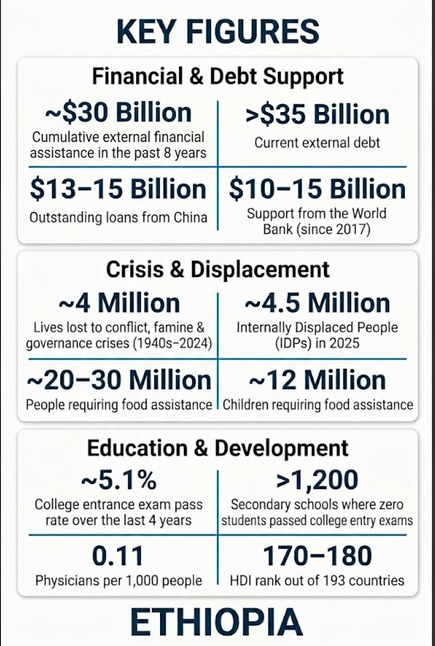
3. The current regime itself has received over 30 billion US dollars in international assistance in the last 8 years alone. In addition, its tattering economy is being resuscitated by another IMF bailout programme to the tune of 3.1 billion US dollars.
4. And yet, as the figures below illustrate, more than 68% Ethiopians are living under extreme poverty while close to 30 million people require urgent humanitarian relief assistance at this point in time.
5. In as far as the 300 manufacturing plants that the PP leader alludes to, these were old factories built during Italy's colonization of Eritrea from 1889 until 1941. The British Military Administration dismantled many of those factories - including the dock in Massawa - as "war booty" and sold them to other foreign countries. The occupationist Haile Selassie regime, in its turn, dismantled many of the remaining factories and transferred them to Ethiopia especially during the imposed "Federation" period.
6. After its hard-won independence in 1991, Eritrea registered rapid economic growth in the first seven years (WB reports). Imposed wars and unwarranted sanctions thereafter naturally affected the pace and magnitude of its economic trajectory.
7. These externalities have nothing to do with Eritrea's open investment and economic policies and visions.
8. And in any case, Eritrea has the abundant economic endowments (blue economy, extractive industry, educated and industrious human capital, and a civilized culture that celebrates religious and ethnic diversity within robust national unity) to excel and achieve its aspirations of rapid and sustainable growth in a conducive and enduring regional climate of peace and stability.
9. Finally, Ethiopia itself could do much better, extricate itself from debilitating dependency, and use its abundant resources for real development if its leaders abandon sectarian policies of division and polarization that incubate perennial cycles of internal turmoil as well as intertwined acts of regional destabilization in pursuit of delusional and expansionist projects.
The @guardian choice of language in its latest article on #Eritrea is revealing.
“Repressive”, “secretive”, “authoritarian regime”, “separatist forces”, the article constructs a political narrative before examining the actual dispute.
Describing the EPLF as “separatist forces” strips Eritrea's independence struggle of its historical context. Eritrea was an Italian colony, federated with Ethiopia under a UN arrangement, subsequently annexed, and fought a 30-year war for self-determination. Reducing that history to “separatism” is a consequential editorial choice.
The Guardian claims that up to one-third of Eritrean-born people live abroad, linking this to allegations of repression and conscription.
Where is the independently verified evidence for either claim? What methodology establishes the figure, and what evidence supports the alleged causes of migration?
Political allegations and questionable statistics do not become facts simply because they reinforce a particular narrative.
Meanwhile, the central issue receives remarkably little scrutiny: How has the UK established that the individuals it wants Eritrea to accept are actually Eritrean nationals?
Where are the independently verified identities, authenticated documents and figures distinguishing confirmed citizens from disputed nationality claims?
The article also repeats Ethiopia's accusation of an Eritrean military incursion without presenting independent evidence establishing that such an incursion occurred.
These are not minor editorial details. They concern historical context, statistical interpretation, verification of nationality and the treatment of unsubstantiated military accusations.
The Guardian is entitled to scrutinise Eritrea's government. Its readers are equally entitled to expect rigorous scrutiny of the British and Ethiopian governments' claims.
Why does an article about asylum returns devote more effort to characterising Eritrea than establishing the facts at the centre of the dispute?
On 1 October 2026, #Ethiopia expelled 10 #Eritrean diplomats, including personnel accredited to the #AfricanUnion.
This goes beyond bilateral relations. It strikes at the sovereign equality of AU member states and their right to representation.
Addis Ababa hosts the African Union. Ethiopia does not own it.
Eritrea's Ministry of Foreign Affairs has formally challenged the expulsions, citing violations of Article 4(a) of the AU Constitutive Act, Article 15 of the Headquarters Agreement, and Article V of the OAU Convention on Privileges and Immunities.
If a host state can effectively exclude another member state's diplomatic representation, is the African Union truly an organisation of sovereign equals, or merely an institution operating at the discretion of its host?
The AU's credibility, independence and commitment to its own founding principles are at stake.
#Eritrea #Ethiopia #AfricanUnion #Diplomacy #InternationalLaw #HornOfAfrica
#ASMARA: PRESERVING HER BEAUTY, BUILDING HER FUTURE 🇪🇷
Housing is more than four walls; it is dignity, stability, and sustainable development. Eritrea’s vision is to expand access to quality housing while protecting Asmara’s unique architectural heritage. With @UNHABITAT and the Ministry of Public Works exploring concrete partnerships, the goal is clear: modern development without sacrificing national identity.
#Eritrea #Asmara #SustainableDevelopment #UNHABITAT
Accessible, quality housing that respects the beauty of Asmara's built environment will further sustainable development. Thanks to @UNHABITAT for their visit and pleasure to meet jointly with the Minister of Public Works to look at concrete partnerships. #Eritrea
ETHIOPIA SEEKS A PRETEXT FOR A WAR IT HAD DECLARED LONG AGO
Over the past three years, Ethiopia’s PM has repeatedly vowed to secure “#sovereign#access” to the #Red#Sea through negotiations if possible and by force if necessary. He questioned Eritrea’s very independence and sovereignty. In doing so, he used state institutions, including , but not limited to, Parliament, state media, and official meetings; not to mention his paid digital media mercenaries. His generals have repeatedly boasted that their war would erase the boundary, leaving neither a sovereign #Eritrea nor its government.
These are not isolated remarks. They reveal a dangerous pattern of threats against a sovereign state, undermining the #UN #Charter, #international #law, and treaties that govern #territorial #integrity.
Abiy’s regime evidently keeps shifting its false accusations: one moment alleging that Eritrea crossed the border, the next claiming that Eritrea arms and supports the Alliance Forces for Survival (AFS). Yet these allegations failed to provide a shred of evidence and remain unconfirmed by independently verified bodies. Such wild accusations cannot substitute for proof and should never be allowed to serve as a pretext for a dangerous and premeditated plan of aggression.
To cover up its wild plans, this PP government is struggling to manufacture “evidence” for a #war its leaders have already threatened publicly. The world must not mistake the pretext for the aggressor’s false accusations for evidence and call this aggressor by its name.
#EritreaPrevails
#StopEthiopianAggression
#HandsOffEritrea
#StopTheWarOnEthiopians
Abiy Ahmed’s Diplomatic Illusion: What Washington Actually Said
#AbiyAhmed took a diplomatic victory lap after his call with #MarcoRubio, celebrating a “very fruitful” conversation, continued US support and a stronger strategic partnership.
Washington’s official readout painted a different picture: heightened tensions with #Eritrea, de-escalation, respect for sovereignty and territorial integrity, and warnings against further conflict.
Not a single mention of Eritrea in Abiy’s statement.
Same phone call. Two remarkably different narratives.
What Abiy chose to omit is arguably more revealing than what he chose to celebrate.
https://t.co/DEYXYSl922
#Ethiopia #USA #USForeignPolicy #Diplomacy #HornOfAfrica #RedSea #Geopolitics #EritreaEthiopia #MarcoRubio #AbiyAhmed
Abiy is wrong on every front—and he’s not the first to follow this misguided path. Unfortunately for him, he has completely discredited himself. Someone needs to remind him to be careful; his over-ambition is becoming reckless.
He imagines himself as a reincarnated Menelik II, chasing the old dream of reaching the sea, just as Haile Selassie once did. Now Abiy believes he can revive that ambition and has even declared he is willing to go to war to achieve it. #Ethiopia is once again talking in the language of irredentism and it is isolated.
But the world is not buying it. Egypt, Turkey, and the United States have all said no. Abiy has miscalculated spectacularly—he stands isolated. Even the Nobel Prize he once boasted about is now viewed with regret in Europe.
Kenya, too, must say no...... A Kenyan expert said.
It must be clearly stated that #Ethiopia - since its inception as a country has never, at any point in history, possessed sovereign access to the #RedSea. The only time it used Eritrean ports was during its illegal #occupation of Eritrea - an occupation rejected by the Eritrean people and defeated through a 30-year protracted struggle for #independence. Eritrea’s #sovereignty and territorial integrity was achieved through enormous sacrifice and is not subject for any negotiation or revision. Any attempt by Ethiopia’s current PP leadership to lay claim to Eritrean land or ports like Assab or any other place for that matter, is not only historically false but also an open violation of international law and the 1963 OAU principle that upholds colonial boundaries. Such reckless rhetoric serves only to destabilize the region and expose the aggressor nature of those who utter it. Eritrea’s sovereignty is not a topic for debate; it is a settled and irreversible reality.
#EritreaPrevails
#AU
In his address to the House of Peoples Representatives on 28 October 2025, the PP's leader proclaimed: "We did not start building our Navy five years ago (in 2020) to make it float in a small pool of water".
Inflammatory declaration of war in what they have termed as "projection of naval power with jurisdiction in Eritrea's southern coastal zone".
This wicked war agenda was conceived against the backdrop, and in the immediate aftermath, of the 2018 historic Agreement of Peace and Friendship between the two countries..
Smoking gun that illustrates, beyond any shred of doubt, that the war agenda was long planned by the Potemkin Party whose hallmark remains trite Machiavellian and backstabbing political traits.