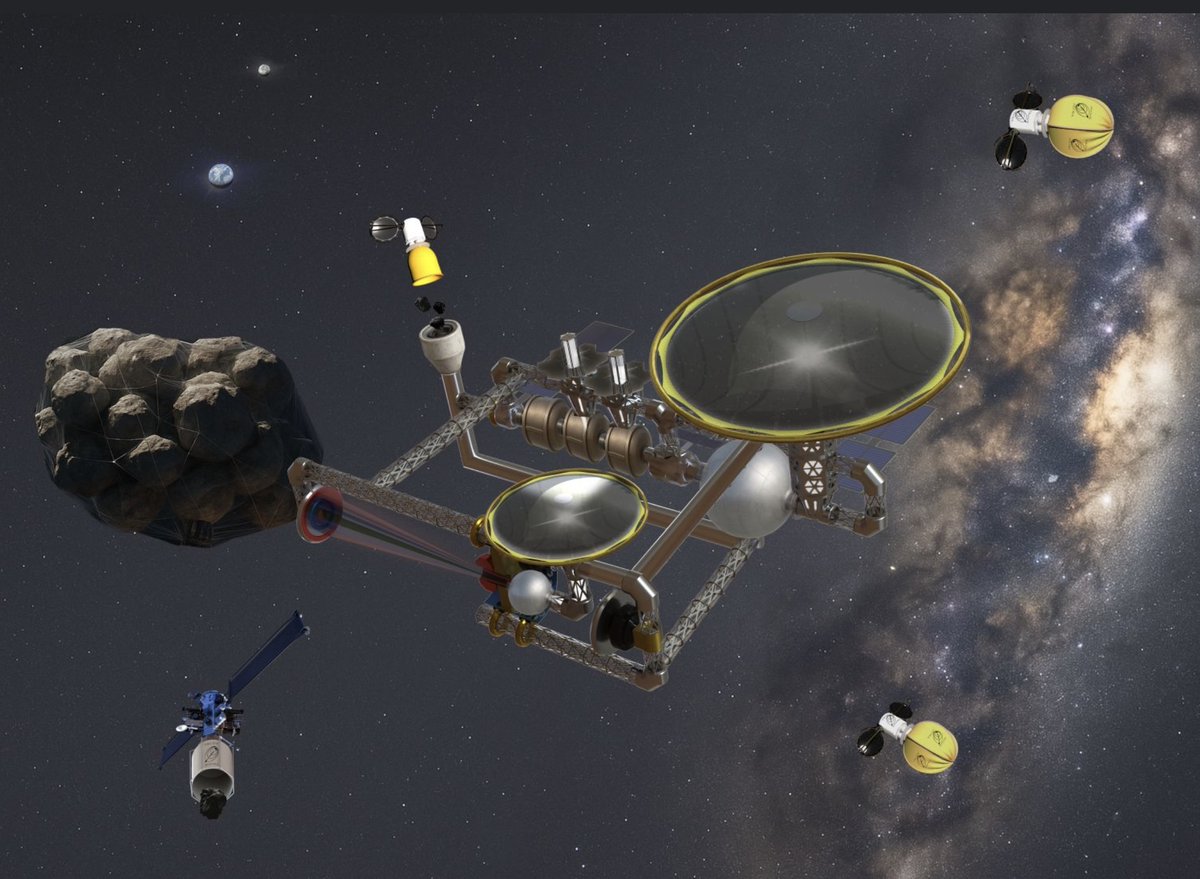
The secret plan is out! Two great articles today about our plan to capture a small asteroid and bring it into Earth orbit. The concept is part of our New Moon mission, which explores relocating a small near-Earth asteroid into a controlled orbit as the first step toward building industrial infrastructure in space.
Our team has been developing the key technologies for this approach for years, including capture mechanisms to constrain and move small asteroids and orbital debris. Accessing materials already in space could eventually enable a new generation of industries beyond Earth.
If you're interested in the future of space resources, these articles are worth a read.
hashtag#space hashtag#asteroidmining hashtag#spacetechnology hashtag#spacex hashtag#venture
One more post on the subject of the Irish getting their dander up.
The Irish Troubles (a continuous low level insurgency) lasted from the 1960s to 1998. But they were the continuation of 'Troubles' stretching back to the 1800s.
1998, that's a bit over 25 years ago.
Both sides in the Troubles, the Catholics and the Protestants, are one generation away from a civil war that lasted for TWO GENERATIONS.
The Gen Z men of today were raised on the stories of the heroism and patriotism of their fathers and grandfathers and THEY HAVE HAD NO SIMILAR OUTLET.
The IRA did not invent the vehicle borne IED. The Vietnamese used it before them.
They just invented a cocktail from their name as well as a drinking song.
'Former' IRA weapons dealers are still some of the top illegal weapons dealers in the world.
1/10th of 'British' SAS come from Ulster. A significant fraction of the British infantry as well.
Many of them served in GWOT so they have a recent master's class in insurgency.
And now Keir Bloody Starmer and the Irish Government have given BOTH SIDES a reason to start again, but this time UNITED.
We may be about to get a glimpse of what a civil war in the US looks like up against a massive surveillance state.
Take notes.
Thank you for the comments, but you can’t fire staffers. You can’t even call them out by name. That will trigger an autoimmune response.
When I was a kid, there was corruption in parts of the NYPD. You couldn’t stop it because of the “blue wall of silence.”
The blue wall of silence was an informal culture inside some police departments: officers protect fellow officers from accountability, even when they know misconduct or crimes occurred.
The logic was simple. “We rely on each other to survive dangerous situations, so loyalty comes first.” Trust among officers is essential for safety. But in some departments, that loyalty curdled into misplaced solidarity that shielded wrongdoing.
The mechanism for enforcing it was more nefarious than the crime.
Sometimes the dirty cops assaulted or set up the whistleblower. More often, they did nothing.
Doing nothing is the most effective punishment there is.
How does it work? A whistleblower cop is on patrol in the Bronx and calls for backup. The others just do nothing. Radio’s broken. Off duty. Need backup themselves. Clocked out early for a family emergency.
And it worked, because the NYPD is enormous and complicated. It employs over 50,000 people. If it were an army, it would rank among the 10 largest on earth.
You can’t hold one person accountable for doing nothing.
The whistleblower puts in for a promotion? Don’t process it. Lose the paperwork.
People are so focused on ridiculous conspiracies. They build elaborate scenarios to shoehorn disparate facts into a pattern.
Take Butler, Pennsylvania. Some people think BlackRock worked with the CIA to train and arm Thomas Crooks.
The truth is more sinister. Biden did nothing to improve Trump’s security. Police did nothing when Crooks walked around with a laser rangefinder. They decided not to use drones. They did not put the best agents on the detail. They did not check the rooftops. They did not investigate Crooks’ suspicious activity.
And accountability? We STILL don’t know the agent who was in charge of Butler. The secret service has done nothing to release her name.
Almost every real conspiracy happens when groups of people all decide not to do their jobs well. To not release names or information.
And coordinating it is surprisingly easy. Tell the detail the threat level is low today. Tell everyone they deserve a break. Tell them another agency is handling the hard part. Or flood essential people with bullshit jobs and paperwork until they can’t do the real work.
So what does this have to do with the Parliamentarian and Senate staffers?
Senators are completely dependent on their staff for everything: travel arrangements, appointments, writing the legislation itself.
Staffers run the place.
And if staffers feel under attack, they will simply do nothing.
They will not process the markup. They will not schedule the confirmation hearing. They will slow-roll, lay red tape, call extra committee hearings, delay the ones already scheduled. They will “enforce the process.” They will leak fake news to divert your attention.
There are a million ways for staffers to throw a wrench in the works and call it nothing.
And there are dozens of unaccountable scapegoats to pin it on.
It’s Thune’s fault.
It’s the Parliamentarian’s fault.
It’s the White House not respecting the process.
It’s the DC Circuit courts.
It’s the Democrats.
It’s the filibuster.
It’s complexity itself.
I’m doing it right now by saying “it’s the staffers.”
This is why they call it the blob. It’s impossible to pin down the culprit.
That’s how and why every Trump priority and appointment is getting delayed.
/1
0 F = extremely cold
100 F = extremely hot
0 C = kinda chilly
100 C = you're dead
Conclusion: centigrade is a scale created by complete morons
https://t.co/IIRGmINWJi
@varadmehta California taking over a month to count and certify the results of their elections is the best argument against switching to a National Popular Vote for electing the President.
When American POWs tried to sneak her notes with their personal information to tell their families they were still alive, she gave them to the North Vietnamese. Some of them were beaten to death. You are both commies and you can both fuck off.
PICARD: Data, shields up
DATA: Brilliant! Shields can reduce damage we sustain. Not immunity. Not hubris. Just prudence. It's not precaution—it's strategy.
[camera shakes]
WORF: HULL BREACHES ON NINE DECKS
DATA: Here's what happened: you told me to raise shields, and I didn't
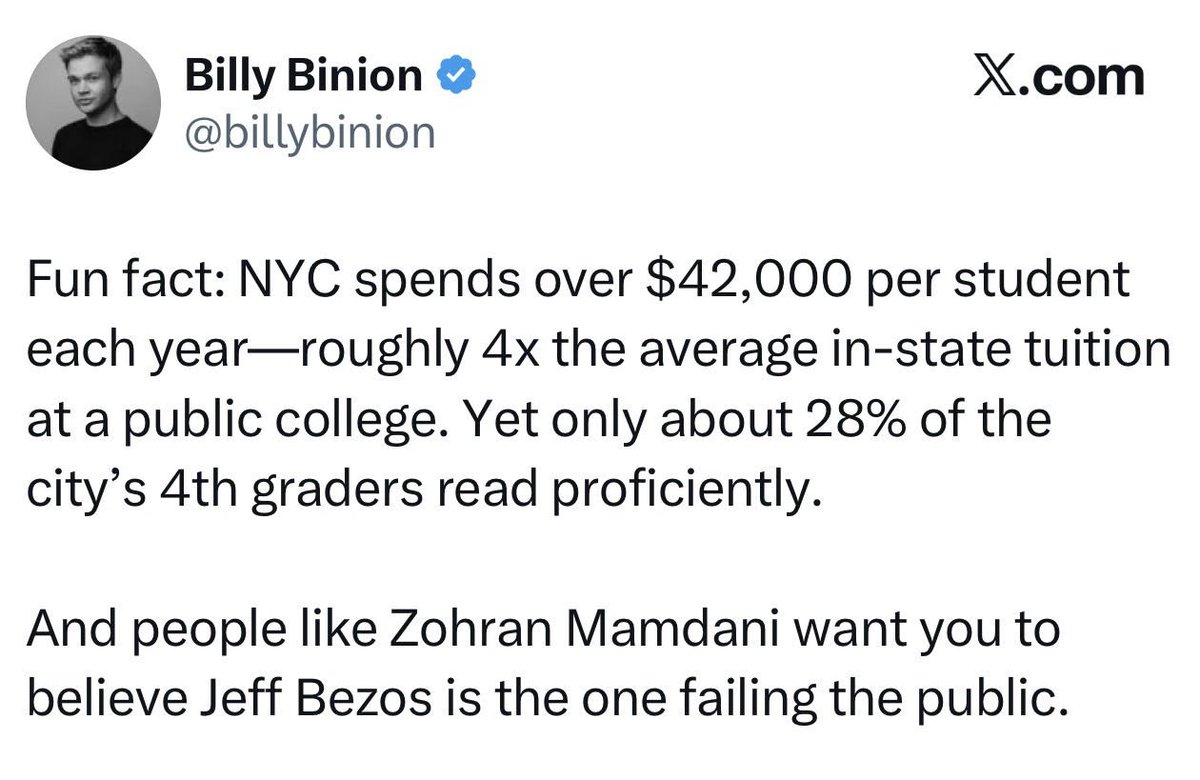
By 1900, the United States had achieved a 90% literacy rate largely by using McGuffey Readers in one-room schoolhouses. But, yeah, NYC’s problem is it’s not spending enough money.
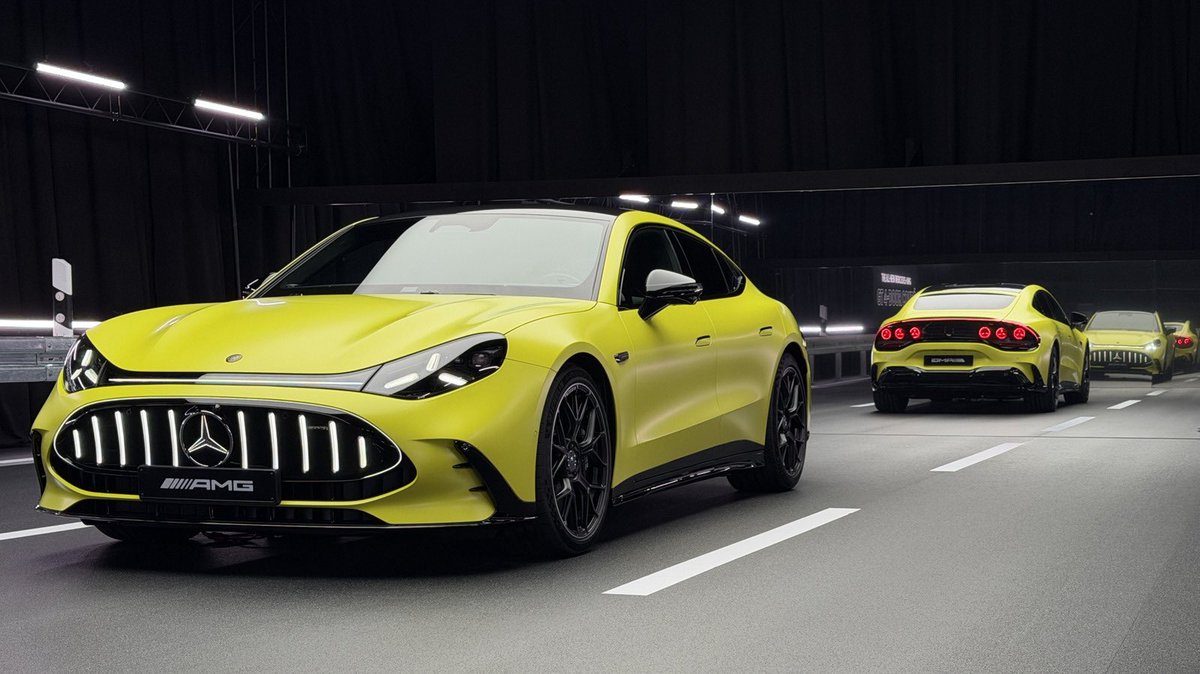
My friend in the exotic automotive space just sent me this regarding the Ferrari Luce and Mercedes GT:
“I was chatting with some Mercedes people at their event last week and journalists about why manufacturers keep dropping these electric cars that nobody asked for — and it actually makes a lot of sense once you hear it.
The EU has this rule where every car brand’s ENTIRE lineup has to average below a certain emissions number. Not per car — the whole fleet. And if they miss it, they get fined like €95 for every single gram they’re over, multiplied by every car they sold that year. We’re talking hundreds of millions.
So every EV they sell pulls that average down. Which means they can keep making the V8s and AMGs and ICE cars we actually love without getting destroyed by regulators.
So that MB electric GT 4-Door and the Ferrari Luce? Those aren’t passion projects. That’s compliance math. The irony is those EVs you hate might literally be the reason your favorite ICE cars still exist.
Mind-bending but that’s the game right now.”
A Stanford neuroscientist published a paper a few years ago that quietly answered one of the oldest questions in human history, and almost nobody outside his field has heard of it.
The question is why we dream. Not what dreams mean. Why they exist at all. Why your brain spends a third of its sleep hallucinating images instead of just resting like every other organ in your body.
His name is David Eagleman.
He runs a lab at Stanford. The paper is called "The Defensive Activation Theory", and the moment you read it the explanation collapses every other theory you have ever been taught about dreams.
Freud said dreams were repressed desires. He was guessing. He had no brain scans. He had no electrodes. He had a couch and a notebook and a century of credibility that nobody has been able to fully scrub off the subject since.
Modern neuroscience replaced him with the memory "consolidation theory". The idea that dreams are your brain sorting through the day, filing things away, deciding what to keep. That story is partially true. Sleep does consolidate memory. But it does not explain the single strangest thing about dreams, which is that they are almost entirely visual.
You do not dream in pure sound. You do not dream in taste. You do not dream in smell. You dream in pictures. Vivid, detailed, often impossible pictures that activate the back of your brain so hard a scientist scanning you would think your eyes were wide open.
Eagleman started from one fact almost nobody outside neuroscience knows. The brain is territorial. Every region holds its turf through constant electrical activity. The moment a region goes quiet, its neighbors start invading. They take the silent territory and reassign it to themselves.
This is called "cortical takeover", and it is not slow. It is not a long process measured in years. In experiments where adults are blindfolded, the visual cortex starts processing touch and sound within an hour. One hour of darkness, and the territory is already being annexed.
In congenitally blind people, the visual cortex is fully repurposed. It runs language. It runs hearing. It runs touch. The hardware never went unused. It was just reassigned to whoever showed up first.
Now sit with the implication of that for a second.
Every night, when you close your eyes and fall asleep, the sun has set. The planet has rotated. The visual cortex, which takes up roughly a third of your entire cortex, is suddenly receiving zero input. For eight hours. Every single night. For your entire life. And evolution has shaped your brain inside a planet that has been spinning into darkness for billions of years.
If cortical takeover happens in an hour, the visual cortex should have been lost a long time ago. Stolen by hearing. Stolen by touch. Reassigned by morning. Humans should have evolved into a species whose vision works fine during the day and then degrades every time the sun goes down because the territory keeps getting renegotiated overnight.
But that did not happen. Vision works the moment you open your eyes. Which means something is defending the territory while you sleep.
Eagleman's claim is that dreams are that defense.
Every 90 minutes through the night, a precise burst of activity fires from the brainstem into the visual cortex. Pontine-geniculate-occipital waves. PGO for short. They are anatomically aimed. They are not general arousal.
They are a targeted volley of signal launched directly at the back of the brain where vision lives. The cortex lights up as if it is receiving real images, and you experience that artificial activation as a dream. The bizarre narrative your conscious mind invents around it later is just your brain trying to make sense of the noise.
The dream is not the point. The dream is the side effect. The point is keeping the territory occupied.
The evidence for this is the part that should haunt you.
Newborns spend roughly 50% of their sleep in REM. Adults spend twenty. Old adults spend fifteen. The amount of dreaming you do tracks almost perfectly with how plastic your brain is. Newborns have the most plastic brains on earth. Their visual cortex is in the highest danger of being overrun by neighboring senses while it develops.
So evolution gave them an enormous defense budget. As you age, your brain becomes less plastic, the takeover risk drops, and the defense system scales down accordingly.
Eagleman and his co-author ran the same correlation across twenty-five primate species. The more plastic a species' brain, the higher the proportion of REM sleep. The relationship held across the entire primate family tree. Plasticity and dreaming move together. They are two halves of the same evolutionary equation.
A species that ranks higher on flexibility and learning also dreams more. A species that is born ready to walk and survive dreams less. Plasticity is the asset. Dreaming is the insurance premium.
And the prediction the theory makes is the one that quietly closes the case.
Of all your senses, only one is disadvantaged by darkness. You can still hear in the dark. You can still feel in the dark. You can still smelll and taste in the dark. The only sense that depends on light is vision. Which is exactly the sense your dreams are made of. The defense system is targeted at the only territory that is actually vulnerable while you sleep.
Memory consolidation is real. Emotional processing is real. Your brain does do those things at night. But Eagleman's argument is that those functions piggyback on a much older system whose original job was simpler and more brutal. Keep the lights on inside the visual cortex while the planet is dark, or lose it.
For thousands of years, people have asked what dreams mean. Prophets wrote about them. Poets wrote about them. Freud built a discipline on them. None of them had access to the actual answer, which is that dreams may not mean anything in the symbolic sense at all.
They may be the visible flicker of a defense system running in the background, the way a screen saver protects a monitor by keeping the pixels moving even when nobody is looking.
The strangest thing about the theory is how cleanly it explains why dreams feel so real. Your visual cortex cannot tell the difference between a PGO wave and an actual photon. It is the same hardware lighting up the same way. The cortex does its job. It builds an image. Your conscious mind, half-awake, wraps a story around it and calls it a dream.
You are not seeing your subconscious tonight. You are watching your brain defend a piece of itself from being stolen.
Every animal that has ever closed its eyes on this planet has done the same thing.
On August 31, 1939, a group of Polish guerilla fighters invaded a German radio station near the border at Gleiwitz, killing the civilian radio operators.
This gave the German government cause to invade Poland in retaliation, triggering WWII.
One problem: it was a lie.
Operation Himmler, as the campaign was called, was carefully designed by some of the Nazis' most sophisticated propagandists.
The German radio station operators were actually POWs plucked from a German camp, dressed up as civilians, and shot.
It was because of this that the Nazis unofficially called the affair "Operation Canned Goods."
In a vacuum, none of this would have mattered. Nazi propagandists doing Nazi propaganda should have been no surprise by 1939. More savvy observers would have spotted this from a mile away.
Except for one factor—the New York Times printed the exact lie as truth, as fact reporting, as the lead story the next day.
The Times even citedVölkischer Beobachter, the Nazi Party newspaper, as the source for the information, describing it (bizarrely) as a "semi-official news agency."
With the most prestigious, trusted news brand in the US —and maybe the world—printing outright Nazi propaganda in the lead story on the day of the outbreak of WWII hostilities, the Nazis achieved a propaganda victory of previously unimaginable proportions.
It gave Hitler just that little bit of breathing room, that moment of pause, he needed to launch his invasion of Poland.
Operation Himmler was a success precisely because New York Times printed the lie in a story that never once cited a Polish source.
Very likely, no Times reporter traveled to Gleiwitz to verify the story. And still, it defies imagination that in 1939 (!) the liberal bastion of the New York Times was willing to take a Nazi source at face value.
This wasn't just a victory for Nazi propaganda. It was Joseph Goebbels' wet dream.
To this day, the New York Times has never acknowledged its role in the lie that kicked off the Second World War.
"I hope the secret police don't kick in my door tonight."
"I hope there's some bread left when I get to the front of the line."
"I hope the commissar doesn't rape my wife."
"I hope this nagging chest cough doesn't require antibiotics that I don't have the vouchers for."
"I hope I don't get accused of harboring bourgeois counterrevolutionary sentiments."
"I hope there isn't another purge."
"I hope I can save up enough to bribe the local Party bloc supervisor for a better job posting."
"I hope no one decides to name me as a accomplice to stop the torture."
"I hope the power stays on tonight."
"I hope things will be better some day."
For the record.
Why Bet Against the Edison of Our Time?
Elon Musk’s repost of an All-In podcast talking up a Tesla–SpaceX merger within 6–12 months has been treated by much of the mainstream financial commentariat as just another bout of celebrity volatility. TSLA pops, shorts reload, the “it’s just a car company” refrain makes another lap around cable. The coverage tells you less about Musk than it does about how little the market has internalised what he is actually building.
Yes we live in an instant gratification world.
The Anthropic deal is Elon Musk showing his hand: he hasn’t just built an AI lab, he’s built an AI infrastructure business. Musk has assembled gigantic, GPU-dense data centres under the xAI/SpaceX umbrella. By leasing a major Memphis cluster to Anthropic, he turns what looked like pure capex bloat into a cash-generating service, effectively creating “Elon Web Services.” Anthropic gets an H100-heavy setup that is excellent for running large models at scale, while Musk keeps the newest Blackwell chips for training Grok-5 and other in‑house systems. He is monetising yesterday’s frontier hardware without giving away tomorrow’s advantage.
Financially, the deal means billions in likely, relatively high-margin revenue on top of what investors were already expecting. Strategically, it forces a shift in how the market values his empire: not just rockets and a scrappy AI lab, but a cloud-like compute utility with blue-chip customers. Anthropic is simply proof that others are willing to pay to stand on that infrastructure.
Yet mainstream coverage and a large slice of the investor base continue to trade Tesla as if it were an unusually noisy auto OEM with some optionality attached. The focus remains on quarterly delivery numbers, price cuts and margins, as though they were analysing Ford with better memes. That lens misses the consolidation of rockets, satellites, robots, cars and compute into a single Musk platform that increasingly resembles a next-generation utility.
Which leaves one uncomfortable question for sceptics. Why bet against the Edison of our time, and what probability do you assign to him doing for launch, energy and compute what Edison did for electricity and recorded sound, and are you positioned for that scenario at all?
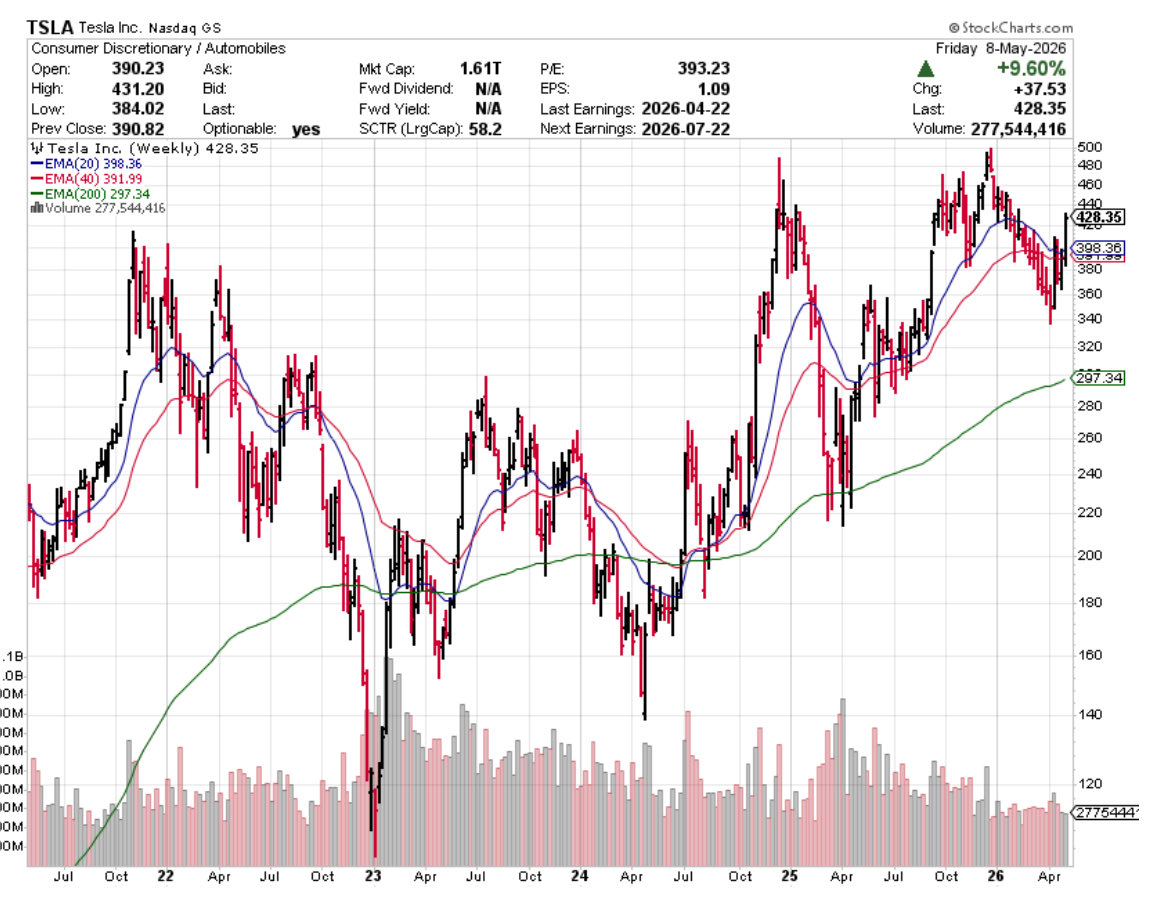
Yes the chart looks great. Old rule don’t bet against Elon still holds.
$TSLA
Food for thought.
Iran Is Not Winning. It Is Unraveling.
The prevailing narrative on Iran has it almost perfectly reversed. We are told that Tehran is winning a war of wills in the Gulf and that Donald Trump is gambling recklessly with the world’s most sensitive chokepoint. In reality, Iran is not consolidating strength; it is managing decline. And Trump’s play on the Strait of Hormuz has quietly forced energy markets to reprice security—tilting the balance decisively toward the Americas, and away from Europe, Asia and China.
The Islamic Republic no longer resembles a confident revolutionary project.
With the old clerical core leadership shattered, power has splintered between a camp that recognises a deal with the outside world as the only path to survival and the Islamic Revolutionary Guard Corps, a class of military dictators with guns, patronage networks and a rational fear that any genuine settlement will ultimately throw them overboard. This is not a unified strategy at work; it’s infighting, paranoia, a fragmented system in late-stage decay, crumbling under pressure.
Into this fragmentation, the White House has introduced a form of calibrated coercion too often caricatured as impulsive.
Around the Strait of Hormuz, Washington has threatened disruption without fully triggering it, forcing shipowners, insurers and policymakers to absorb a hard truth: dependence on vulnerable, seaborne Middle Eastern barrels is not a passing inconvenience but a structural risk. Iran can harass tankers and jolt day-to-day sentiment; it cannot rebuild a broken economy on sporadic shocks to global shipping. And the world must deal with the end of Pax Americana!
The underlying playbook is anything but novel. Sun Tzu’s insistence that “all warfare is based on deception”, Machiavelli’s counsel that a ruler must manipulate appearances and exploit factionalism, and Alfred Thayer Mahan’s argument that sea power and control of chokepoints shape the fate of nations are not museum pieces. They are, in this case, the operating code. Trump’s opaque signalling, deliberate use of disinformation and visible but limited naval posture in and around Hormuz amount to a modern, Mahanian use of sea power as economic statecraft.
Energy markets are already adjusting. Tankers are head to the Gulf of America. In a world where a single strait can a risk to economies is Europe and Asia, without ever being fully closed, assets tied to secure basins and diversified export routes deserve a premium.
The Americas sit in an enviable position: vast, politically stable hydrocarbon resources, multiple pipelines and ports, and no dependence on a distant maritime chokepoint controlled by adversaries. By contrast, Europe, much of Asia and China find themselves downstream of vulnerabilities they do not control and regimes they cannot stabilise, exposed to shipping routes that can be threatened faster than alternative supply can be mobilised.
All of this plays out against a domestic backdrop in Iran that looks less like revolutionary vigour and more like fear. A state that cannot safely keep its internet on, that must rely on public brutality to deter dissent, is not projecting confidence. It is signalling weakness, to its own citizens as much as to its rivals.
Winston Churchill once remarked that “in war, resolution; in defeat, defiance; in victory, magnanimity; in peace, goodwill.” Iran’s leadership offers only defiance, without realistic prospects of victory or peace.
The uncomfortable conclusion for those still insisting that Tehran is “winning” is that what they are observing is not the rise of a regional hegemon, but the protracted, strategically exploited unwinding of a brittle regime at the centre of an overexposed energy system.
Food for thought.
Trump, Hormuz and the End of the Free Ride
For half a century, Western strategists have known that the Strait of Hormuz is the acute point where energy, sea power and political will intersect. That knowledge is not in dispute. What is new in this war with Iran is that the United States, under Donald Trump, has chosen not to rush to “solve” the problem. In Hegelian terms, he is refusing an easy synthesis in order to force the underlying contradiction to the surface.
The old thesis was simple: the US guarantees open sea lanes in the Gulf, and everyone else structures their economies and politics around that free insurance. Europe and the UK embraced ambitious green policies, ran down hard‑power capabilities and lectured Washington on multilateral virtue, secure in the assumption that American carriers would always appear off Hormuz. The political class behaved as if the American security guarantee were a law of nature, not a contingent choice. Their conduct today is closer to Chamberlain than Churchill: temporising, issuing statements, hoping the storm will pass without a fundamental reordering of their responsibilities.
Trump’s antithesis is to withhold the automatic guarantee at the moment of maximum stress. Militarily, the US can break Iran’s residual ability to contest the Strait; that is not the binding constraint. The point is to delay that act. By allowing a closure or semi‑closure to bite, Trump ensures that the immediate pain is concentrated in exactly the jurisdictions that have most conspicuously free‑ridden on US power: the EU and the UK. Their industries, consumers and energy‑transition assumptions are exposed.
In that context, his reported blunt message to European and British leaders, you need the oil out of the Strait more than we do; why don’t you go and take it? Is not a throwaway line. It is the verbalisation of the antithesis. It openly reverses the traditional presumption that America will carry the burden while its allies emote from the sidelines.
In this dialectic, the prize is not simply the reopening of a chokepoint. The prize is a reordered system in which the United States effectively arbitrages and controls the global flow of oil. A world in which US‑aligned production in the Americas plus a discretionary capability to secure,or not secure, Hormuz places Washington at the centre of the hydrocarbon chessboard. For that strategic end, a rapid restoration of the old status quo would be counterproductive.
A quick, surgical “fix” of Hormuz would short‑circuit the dialectic. If Trump rapidly crushed Iran’s remaining coastal capabilities, swept the mines and escorted tankers back through the Strait, Europe and the UK would heave a sigh of relief and return to business as usual: underfunded militaries, maximalist green posturing and performative disdain for US power, all underwritten by that same power. The contradiction between their dependence and their posture would remain latent.
By declining to supply the synthesis on demand, and by explicitly telling London and Brussels to “go and take it” themselves, Trump forces a reckoning. European and British leaders must confront the fact that their energy systems, their industrial bases and their geopolitical sermons all rest on an American hard‑power foundation they neither finance nor politically respect. The longer the contradiction is allowed to unfold, the stronger the eventual synthesis can be: a new order in which access to secure flows, Hormuz, Venezuela and beyond, is explicitly conditional on real contributions, not assumed as a right.
In that sense, the delay in “taking” the Strait, and the challenge issued to US allies to do it themselves, is not indecision. It is the negative moment Hegel insisted was necessary for history to move. Only by withholding the old guarantee, and by saying so out loud to those who depended on it, can Trump hope to end the free ride.
it hasn't sunk in for most people. we already live in a post-scarcity society. UBI is already here.
basic package: disability, medicaid, food stamps etc
bonus package: literally getting paid for staying at home and hanging out with your relatives
extra bonus: if you are willing to commit fraud, pretend your kids are autistic and get paid for that. get paid for watching your neighbor's kid. pretend you are taking care of your grandma. fake hospice clinic. fake rehab clinic. fake therapy clinic.
giga bonus: during a time of crisis take advantage of PPP or CARES and open a fake business and get paid for existing
people are shocked when they learn that defense is the FIFTH largest line item in the budget. ahead of defense: social security ($1.6T), interest on debt ($1.1T) medicare ($1T), medicaid + ACA ($1T), AND THEN defense ($0.9T)
complain about defense all you like, but healthcare fraud is a way bigger factor. hundreds of billions per year.
this is only going to get worse, because the fraud is a structural part of the system – payouts to client groups in exchange for votes (normally D).
in the US, only 47% of the population actually works (fully 14% of the population is working age and does not work). retirees are 18% and children 22%.
the system I described above subsidizes 50m non-working people absolute minimum, but really it's far more because people that are paid to stay home and take care of their relatives are considered "workers"
of that 47% of "actual workers" maybe one third does real work, the rest are shuffling papers around or doing fake email jobs. so you have, rough math, 50 million actual workers supporting 300 million dependents. that's the nature of the economy today. it will only accelerate. eventually you will have 10 million using AI tools to do all the work and 340 million dependents.
the reason no one roots out the fraud is because it's the system that keeps our extremely fragile polity intact. the fraud is the UBI. the purpose of the system is what it does.
of course, it's a deeply unfair system, because you are allowed to commit fraud if you are a politically protected client group of the democrats. DOGE was killed faster than any government program ever, because it attempted to root out the fraud. if you are honest and unwilling to commit fraud, you are a huge loser in this system. your neighbor will have their mortgage subsidized by some government program. they will get favorable SBA loans due to DEI. they will open a fake hospice or autism clinic. they will get paid for taking care of their neighbor's kid and vice versa. the primary skill in the labor market is learning how to extract money from state and federal government programs, not gaining skills or making yourself employable. if you are just trying to work an ordinary wagie job you are a huge sucker. you are paying 40-50% effective all in taxes to everyone else who is a net taker.
the sad part is because AI is such a substantial productivity boost, it will actually keep this system going for a while longer, and maybe in perpetuity. AI boosts the 15% of the population that is actually productive so much that the remaining 85% can coast by. no one in charge will change this because they can't think of anything else. the political costs of a real UBI program are too great and we don't have the money for it anyway. so we will keep this covert fraud-based UBI program running indefinitely. unfortunately, if you are an honest wagie, you lose.
This is one of the hardest things we have ever had to share. We are not the kind of people who like to ask for help. We have always believed in putting our heads down, working hard, trusting God, and doing everything we can to carry the weight ourselves. But there comes a point where the truth is bigger than pride, and our customers, followers, supporters, and everyone deserves to know what is really happening.
Right now, we are in a legal battle with a major meat processor. And while this fight has our name on it, it is much bigger than our family alone. Small producers, family ranchers, and farmers spend generations building something they are proud of, only to come up against an industry that too often protects power over people, profit over principle, and control over transparency. The effects do not stop with the people raising the food. They reach every person purchasing meat because corruption and lack of transparency in the beef industry affect the food system as a whole and the trust families place in what they buy and feed their loved ones.
This fight has cost us deeply. Between personal health struggles and the weight of this battle, we have had to make sacrifices we never wanted to make. We have had to cut back on our restaurants and e-commerce. We have sold cattle to help pay attorney fees. We have carried stress, heartbreak, and pressure that, at times, have felt impossible to explain.
But we are still here, and we are still fighting. We are fighting for our family, for our ranch, for the values we were raised on, and for every small rancher and farmer who has ever felt crushed under a system that was never built to protect them.
So today, we are asking for help. If you believe in family ranches, quality food, hard work, and a more transparent, healthy, and clean food system, please stand with us. One of the best ways you can support us right now is by purchasing our beef at https://t.co/Suyrin9ECS.
We started a GoFundMe for those who want to be part of something bigger than our family alone. If you want to help us keep fighting, please consider donating and helping us fight for farmers, ranchers: https://t.co/Tw3VTcsLBI