[ADVISOR VIEW] Devon Card from @CrueInvest says avoiding financial planning often shifts the burden to those closest to you — your spouse, children, siblings or ageing parents.
#Moneyweb
https://t.co/aswu9btBap
→ Viewing reality from different perspectives.
The hidden patterns and structure in the veils of our lives.
I've found this animation in ~12 Reddit groups from 8 years ago. Does anyone know the original source, so we can give credit? Example source: https://t.co/i7QtL4AgI6
The most detailed 3D reconstruction of a cell ever created.
Blows my mind every time.
But what exactly are we looking at here?
The average human cell contains:
~ 15-20 total distinct organelle types, totalling between ~1-10 million working together per cell.
All these nano-machines in the cell are made up of proteins.
~ 8,000-10,000 distinct types of unique proteins, adding up to between 40 million - 10 trillion total proteins making up all those cellular systems.
~ 10,000 - 15,000 distinct types of RNA shuttling information around the cell, totalling up to ~10 million RNA molecules moving around the cell simultaneously.
~ Billions of Lipid molecules packed together into the cell membrane, which is also packed tightly with millions more protein-based nano-machines.
And let's not forget billions of lines of DNA information to build and run it all.
That's TRILLIONS of of individual molecular pieces working together to make a single cell function.
That means there is more complexity in a single cell than humanity's largest cities.
And people still believe this wasn't Divinely Designed.
This is God's Glory on Display.
But to make the point.
A cell couldn't have evolved from some nebulous simpler "protocell" because even the simplest cells still require massive complexity.
The "simplest" cell ever created was engineered by scientists knocking out pieces of a functional cell until it stopped functioning.
Here is what they found is the absolute necessary minimal requirements of a cell to function:
- Over ~531,000 lines of coded DNA information
- 473 total genes to create hundreds of unique protein products (they later added 19 genes back in because the cell was so weak)
- Hundreds of thousands of total proteins all working together
- Extensive regulatory networks guiding all these interactions
If the cell doesn't have all these systems in place, from the start...
it doesn't live.
Cell rely on an intricate network of complex systems, which are themselves built from complex interconnected pieces woven together into an incomprehensibly complex web of functionilty.
Only intelligence has ever been observed creation vast interconnected systems like this.
Life was clearly Created.
It couldn't happen any other way.
Africa is the poorest region on earth because it's where wealth creators have the least freedom to create.
I've asked hundreds of people why Africa is poor and almost nobody gives this answer.
They'll say colonialism, corruption, and low IQ.
But overregulation? Never.
And that's the whole problem.
Thomas Sowell on engineers vs intellectuals:
“The engineer is judged by the end product. If he builds a building that collapses, it doesn’t matter how brilliant his idea was—he’s ruined.”
“Conversely, if an intellectual has an idea for rearranging society and that ends in disaster, he pays no price at all.”
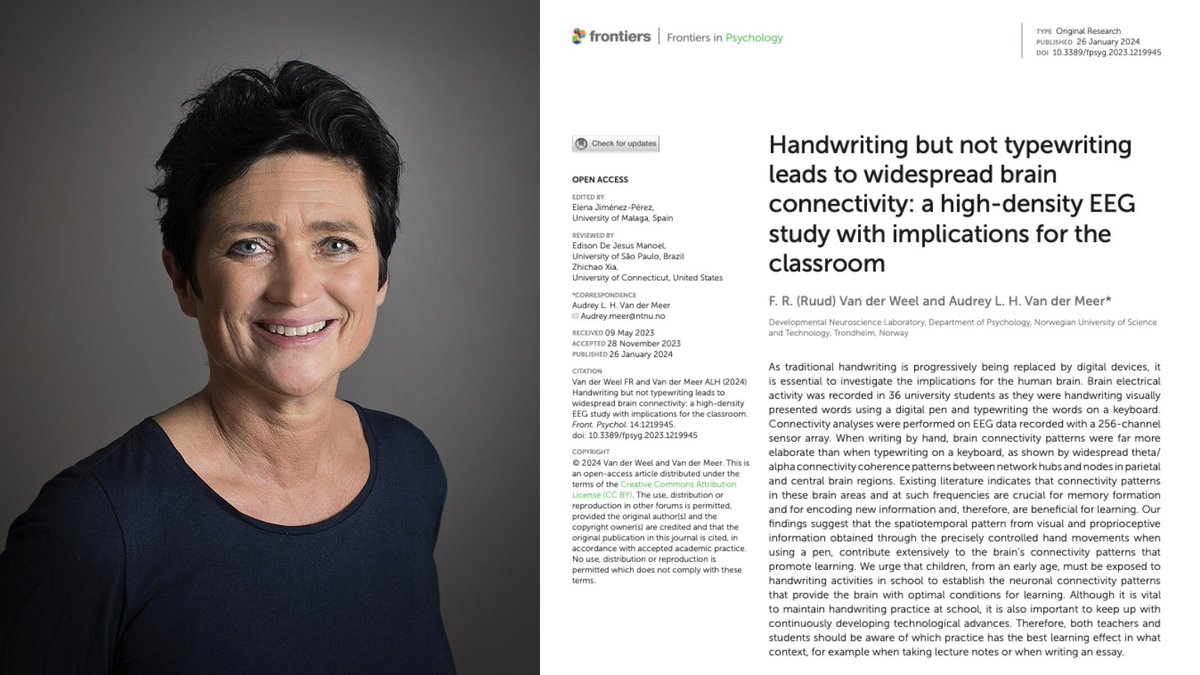
A Norwegian neuroscientist spent 20 years proving that the act of writing by hand changes the human brain in ways typing physically cannot, and almost nobody outside her field has read the paper.
Her name is Audrey van der Meer.
She runs a brain research lab in Trondheim, and the paper that closed the argument was published in 2024 in a journal called Frontiers in Psychology. The finding is brutal enough that it should have changed every classroom on Earth.
The experiment was simple. She recruited 36 university students and put each one in a cap with 256 sensors pressed against their scalp to record brain activity. Words flashed on a screen one at a time.
Sometimes the students wrote the word by hand on a touchscreen using a digital pen, and sometimes they typed the same word on a keyboard. Every neural response was recorded for the full five seconds the word stayed on screen.
Then her team looked at the part of the data most researchers had ignored for years, which is how different parts of the brain were communicating with each other during the task.
When the students wrote by hand, the brain lit up everywhere at once.
The regions responsible for memory, sensory integration, and the encoding of new information were all firing together in a coordinated pattern that spread across the entire cortex. The whole network was awake and connected.
When the same students typed the same word, that pattern collapsed almost completely.
Most of the brain went quiet, and the connections between regions that had been alive seconds earlier were nowhere to be found on the EEG.
Same word, same brain, same person, and two completely different neurological events.
The reason turned out to be something nobody had really paid attention to before her work. Writing by hand is not one motion but a sequence of thousands of tiny micro-movements coordinated with your eyes in real time, where each letter is a different shape that requires the brain to solve a slightly different spatial problem.
Your fingers, wrist, vision, and the parts of your brain that track position in space are all working together to produce one letter, then the next, then the next.
Typing throws all of that away. Every key on a keyboard requires the exact same finger motion regardless of which letter you are pressing, which means the brain has almost nothing to integrate and almost no problem to solve.
Van der Meer said it plainly in her interviews.
Pressing the same key with the same finger over and over does not stimulate the brain in any meaningful way, and she pointed out something that should scare every parent who handed their kid an iPad.
Children who learn to read and write on tablets often cannot tell letters like b and d apart, because they have never physically felt with their bodies what it takes to actually produce those letters on a page.
A decade before her, two researchers at Princeton ran the same fight using a completely different method and ended up at the same answer. Pam Mueller and Daniel Oppenheimer tested 327 students across three experiments, where half took notes on laptops with the internet disabled and half took notes by hand, before testing everyone on what they actually understood from the lectures they had watched.
The handwriting group won by a wide margin on every question that required real understanding rather than surface recall.
The reason was hiding in the transcripts of what the two groups had actually written down.
The laptop students typed almost word for word, capturing more total content but processing almost none of it as they went, while the handwriting students physically could not write fast enough to transcribe a lecture in real time, which forced them to listen carefully, decide what actually mattered, and put it in their own words on the page.
That single act of choosing what to keep was the learning itself, and the keyboard had quietly skipped the choosing and skipped the learning along with it.
Two studies. Two countries. Same answer.
Handwriting makes the brain work. Typing lets it coast.
Every note you have ever typed instead of written went into your brain through a thinner pipe. Every meeting, every book highlight, every idea you captured on your phone instead of on paper was processed at half depth.
You did not forget those things because your memory is bad. You forgot them because typing never woke the part of the brain that would have made them stick.
The fix is the thing your grandmother already knew.
Pick up a pen. Write the thing down. The slower road is the faster one.
🚨 Anthropic just showed a 24-minute workshop on how to actually do prompts for Claude.
Taught by the people who built it.
Free. No registration. No paywall.
I've seen $300 courses that don't cover what they teach in the first 8 minutes.
Watch it and bookmark it now.
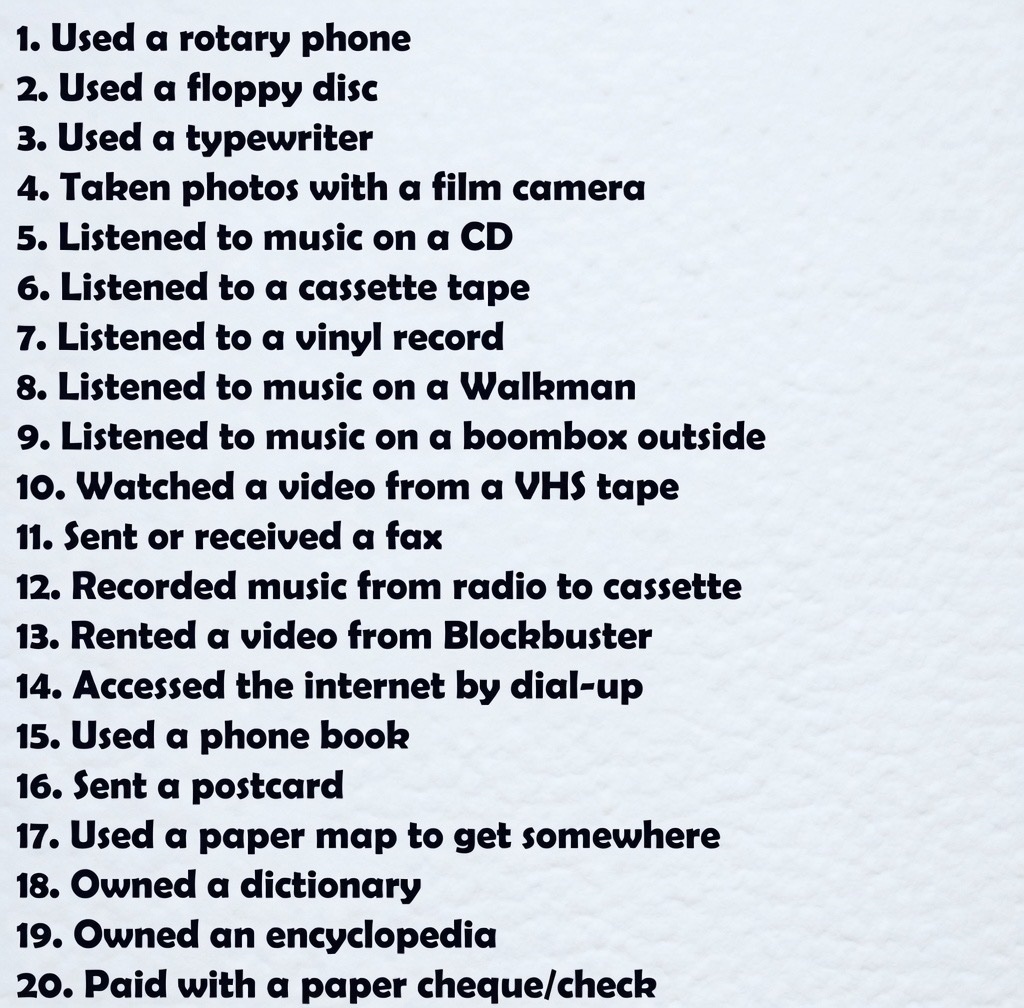
@Babywwir Yes! All 20! And rushed to the dvd/video renting store to make it in time to lend another tape to watch overnight and in the beginning even rented a VHS machine to be able to watch it on.
Voting is basically buying a house you’ve never lived in… …and then finding out it’s haunted after you move in.
Full episode with Katie Couric out now on my YouTube channel.